Michael L. Brown, Ché Ahn, and the Brownsville Revival


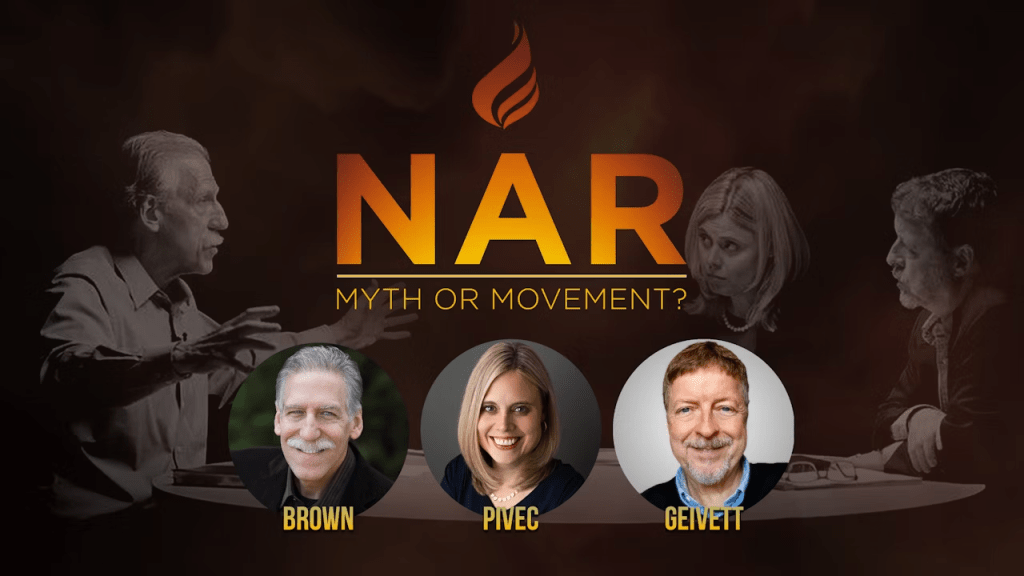
In August 2022, Holly Pivec and I met with Michael L. Brown for a Roundtable discussion that was released July 15, 2024 under the title “NAR: Myth or Movement?” The release of that discussion for public viewing was delayed for nearly two years for reasons that may eventually come to light. In the end, the three of us were invited to record final summary statements that would be attached to the end of the original production by American Gospel producer, Brandon Kimber.

In our joint summary statement concluding the Roundtable, Holly describes five errors or misrepresentations that we identify to illustrate problems with Michael Brown’s factual claims during the Roundtable. In the fifth instance, we comment on Brown’s response to the NAR apostle Ché Ahn.

In his book Modern-Day Apostles, Ahn recalls his conversation with Peter Wagner about the shortage of revivals in America, compared with other nations. “Peter said, ‘The reason why I don’t think it happened is because pastors are not the ones with the highest level of authority in the church. It’s apostles.’” Ahn then writes, “I realized that wherever revival has broken out it was because an apostle led that revival. This was true whether it was John Arnott in Toronto; John Kilpatrick in Brownsville; or me in Pasadena at Mott auditorium, where we had nightly meetings for three years; or Bill Johnson in Redding, California.”

After Holly quoted this passage from Ché Ahn’s book, Brown pushed back and disputed Ché Ahn’s point about the Brownsville Revival. Brown says,

I was part of the Brownsville Revival that was mentioned there. There was not a syllable ever about John Kilpatrick being the apostle over this. He was pastor of a local church. And God birthed the revival within this pastor of a local church. Someone else now is putting an interpretation on it and now you think, Okay, well John Kilpatrick held to that. No, no. That was someone else looking at it, whereas the people involved would say, “No, this happened through prayer and through a pastor and an evangelist working together. That’s how God poured out his Spirit in revival.” . . . . This is someone else’s opinion. . . . That’s Ché’s opinion about what happened at Brownsville. People within Brownsville differ with that. . . . I was there. I was a leader. . . . That’s his interpretation. (“NAR: Myth or Movement?”)

Brown objects to Ahn’s “interpretation,” as he calls it: that John Kilpatrick was an apostle who led the revival in Brownsville. Brown says, “There was not a syllable ever about John Kilpatrick being the apostle over this.” But of course, this misrepresents what Ahn has said. Ahn does not say that John Kilpatrick was identified at the time as the apostle who led the Brownsville Revival. In the passage Holly cited, Ahn only asserts that “wherever revival has broken out it was because an apostle led that revival.” And Ahn believes that was true of John Kilpatrick at Brownsville.

To dispute Ché Ahn’s claim regarding the Brownsville Revival, Brown must establish that no apostle played a role in the leadership of the revival period at Brownsville. Brown cannot simply assert that no one stepped forward as an apostle during the Brownsville Revival or that no one was ever dubbed an apostle of the revival during revival events. For it is at least theoretically possible that an individual functioned as an apostle leading the revival, without ever calling himself or herself an “apostle,” or without being regarded as such by anyone else, at the time. In that event, Ché Ahn would be correct, that an apostle did lead the Brownsville Revival and this apostle was John Kilpatrick. And Brown’s claim—“There was not a syllable ever about John Kilpatrick being the apostle over this”—would be completely irrelevant. Brown’s rejoinder to Ahn misrepresents what Ahn is saying in the passage we quoted.

That is Brown’s first mistake. But Brown’s comment is also factually mistaken.

As anyone can see from the video clip shown in our summary comment about this matter, a prophet, who was invited by John Kilpatrick himself to speak a word from the Lord, explicitly declares that Kilpatrick is more than a mere pastor, that he is in fact an apostle, whose leadership ministry during the Brownsville Revival is evidence of Kilpatrick’s apostolic calling. This prophet further reveals that Kilpatrick will go on to lead future revivals following the same pattern of authority, with events marked by similar phenomena as those manifested during the Brownsville Revival.

So, as a matter of fact, someone uttered a whole string of syllables expressing what Ché Ahn alleges—that John Kilpatrick, a pastor at Brownsville Church, was also an apostle who led the Brownsville Revival, as evidenced by the phenomena that occurred during the revival. And the person who said this did so from the pulpit at Brownsville Church, with John Kilpatrick present, after being introduced by John Kilpatrick as a prophet of God invited to bring a word from the Lord.

If you wonder whether “apostle John” accepted this designation, or thought that it applied to the role he played during his leadership of the Brownsville Revival, you need only consult a sermon that Kilpatrick preached at Calvary Christian Center in Ormond Beach, Florida (uploaded to YouTube Feb 13, 2022). Kilpatrick says,

I remember in the Brownsville Revival I didn’t understand the apostolic, or any of that stuff, until God poured out revival at Brownsville. And when God came and poured out His Spirit there, and the world began to come to our church, and they were drawn to that presence and that glory of God, I began to feel and understand and hear about the apostolic. . . . Somebody said, “You’re an apostle.” I said, “What do you mean by that?” . . . . So I had to begin to look into the apostolic and begin to try to get an understanding of it. [43:53]

In other words, John Kilpatrick, a noted leader of the Brownsville Revival, gradually learned during the course of the revival that he was indeed an apostle. He had exercised apostolic authority without fully realizing it. He studied the apostolic and reflected on the supernatural phenomena exhibited during the Brownsville Revival, and on that basis he concluded that people who had called him an apostle were correct.

So Ché Ahn’s so-called “interpretation” of events is shared by John Kilpatrick, of all people. And it is Michael Brown’s interpretation that is called into question.

We’re not quite sure how to account for this discrepancy between the Kilpatrick-Ahn account and Brown’s understanding. But Brown’s interpretation has all the appearance of being revisionist. It will be interesting to see if he can persuade either of these luminaries of the New Apostolic Reformation (NAR)—John Kilpatrick and Ché Ahn—that they have misdescribed the situation and that there was no apostle giving leadership to the Brownsville Revival at all.

In any case, the prophetic utterance—given in the clip we exhibit in our concluding comment for the Roundtable—establishes that Brown is indeed mistaken when he says, “There was not a syllable ever about John Kilpatrick being the apostle over this.” And he is mistaken when he says that this is merely Ahn’s interpretation that would be disputed by “people within Brownsville.”

This fuller account of how it came to be understood that an apostle was specially designated by God to lead the Brownsville Revival creates additional problems for Michael Brown. He is well-known for his vigorous defense of the Brownsville Revival (which is a head-scratcher in itself), and his claim to be a prominent participating and authoritative eyewitness of what took place at Brownsville. But due to some conflict between himself and leaders at Brownsville, Brown was relieved of his role as president of the Brownsville Revival School of Ministry and left before the Revival petered out. That Brown emerged as a leading spokesperson for the revival in the afterglow of its eventual extinction is a testament to his capacity for reinventing himself. But his interpretation of events and his denial that an apostle played a crucial role is at odds with the narrative propounded by the most significant living leader of the Brownsville Revival, apostle John Kilpatrick.

In addition, Brown, who calls NAR a “myth,” must now find himself defending a phenomenon—the Brownsville Revival —that, by official accounts, critically depended on the leadership of an apostle for its manifestation. Brown was a proud participant in a major NAR event. Fancy that!

***

Michael Brown has repeatedly sought to defend his NAR friends in response to critics of NAR. But so far, that has not gone well for Michael Brown—or for his NAR friends. In so many instances, where he has objected to our identification of individuals as NAR, Brown has invited further scrutiny of their NAR bona fides and exposed them to further trenchant criticism.

He co-authored with Joseph Mattera a statement on “NAR and Christian Nationalism” and recruited signatories whose approval of the statement is incompatible with their NAR commitments, including Joe Mattera himself. During the Roundtable, he challenged our claim that his friend Mark Chironna is NAR and pressed us to produce evidence for it. We’ve done that. (See our article “Response to Joseph Mattera and Michael Brown, Statement on ‘NAR and Christian Nationalism.'”) Brown has parted company with Ché Ahn, in no uncertain terms, when pressed about the differences between their views about apostles. And now his friend and former colleague, John Kilpatrick, is brought under the spotlight for special scrutiny by Brown’s attempted revisionist characterization of the Brownsville Revival, which is actually a paradigm instance of NAR revivalist theology and practice.

In each case, the effort to characterize NAR as a “myth” and to defend his friends against NAR allegations has only subjected Brown’s friends to the revelation of further blinding evidence in support of our claims.

***

There is one further irony to this story. When Holly quoted the passage from Ché Ahn (cited above), the purpose was to make explicit Ahn’s own view about the authority of apostles as a requirement for revival today. She was not especially interested in what Ahn had said about John Kilpatrick and the Brownsville Revival. For her specific purposes, it wasn’t the least bit relevant whether Ché Ahn had given the correct insider’s interpretation on Brownsville. The Ahn quote was one of a series of quotations Holly presented to Brown to elicit his response. Following her recitation of these several passages by different NAR individuals, Brown immediately accused the two of us of adopting a faulty methodology. And one example he offered in support of this claim was our use of the Ahn passage. Note, again, what Brown says to us: “Someone else [Ché Ahn] now is putting an interpretation on it [the Brownsville Revival] and now you think, Okay, well John Kilpatrick held to that.” But that is not what we thought and that certainly is not what we said. So it is Brown’s methodology that goes terribly awry. And thanks to Michael Brown, whose chastising comment inspired us to research John Kilpatrick’s role during the Brownsville Revival, we now do believe that Kilpatrick indeed came to consider himself to be an apostle whose leadership as such facilitated the Revival. That’s an interesting conclusion, to be sure, though it is not germane to our purposes in quoting Ché Ahn during the Roundtable.


Doug Geivett is co-author with Holly Pivec of four books on the New Apostolic ReformationReckless Christianity: The Destructive New Teachings and Practices of Bill Johnson, Bethel Church, and the Global Movement of Apostles and ProphetsCounterfeit Kingdom: The Dangers of New Revelation, New Prophets, and New Age Practices in the ChurchA New Apostolic Reformation? A Biblical Response to a Worldwide Movementand God’s Super-Apostles: Encountering the Worldwide Prophets and Apostles Movement.
As People Flee NAR, Michael Brown Defends NAR Leaders and Compromises His Status as Spokesman for Charismatics and Pentecostals


By Doug Geivett and Holly Pivec

Michael L. Brown, radio host of The Line of Fire

Over several decades, the Christian radio host Michael Brown has fashioned a narrative with himself starring as a high-profile representative of charismatics and Pentecostals. And for a long time this was his reputation with quite a number of his followers. But that narrative is unraveling.

His zealous defense of the controversial New Apostolic Reformation (NAR) movement—including his support for his friends who clearly are NAR and his attacks on the critics of NAR—has revealed that he is not the advocate for the charismatic and Pentecostal mainstream that he claims to be. He is out of sync with the mainstream, and a growing number of charismatics and Pentecostals in that stream recognize what Brown denies—that NAR is real and dangerous.

Brown’s Response to Exposure of NAR

His Support for NAR Leaders

Though Brown has long defended extremist expressions of charismatic/Pentecostal practice, and was even a leader of the controversial Brownsville Revival, he has perhaps been better known for his work as a Messianic Jewish apologist and debates with gay activists. And he does often insist that he has called out fringe leaders in the charismatic movement when they have gone too far off-center. So until recently he has perhaps been perceived as a reliable spokesman for the mainstream charismatic movement, thanks to his comparatively unnoticed extremism of the past. But that has been changing with his strenuous defense of NAR leaders.

NAR leaders Brown defends include some of the movement’s most controversial figures:

  • Bill Johnson: “Apostle” and senior leader of the globally influential Bethel Church in Redding, California—a church known for its failed resurrection attempts, failed predictive prophecies, and other bizarre practices like “grave soaking” and wrapping children in toilet paper like mummies to teach them to raise the dead.
  • Ché Ahn: “Apostle” of Harvest Rock Church in Pasadena, California, and author of the NAR manifesto Modern-Day Apostles, which details the “extraordinary authority” today’s apostles are believed to possess.
  • Mark Chironna: NAR apostle who teaches that every church should be governed by apostles and that such apostles function at an unparalleled “level of genius.”
  • Sid Roth: Host of the wacky It’s Supernatural television program, where guests frequently claim to receive appearances from Jesus, make trips to heaven, and receive messages from God to deliver to the church.
  • Brian Simmons: Author of the notorious Passion Translation of the Bible—one of the most deceptive “translations” of the Bible ever produced, subjected to criticism by numerous credible Bible scholars.
  • Mike Bickle: Founder of the International House of Prayer in Kansas City, Missouri (IHOPKC), who claims to have gone to the courtroom of heaven, where God told him that, if he were found faithful, he would be an end-time apostle with immense authority bringing divine revelation. Bickle also teaches that Christians in the last days will take vengeance on their persecutors by making prayer declarations that will “loose” the judgments of God described in the book of Revelation. And Bickle claims that God spoke to him through Bob Jones, a scandalous sexual abuser prophet, who gave him a message for the global church—a message about Jesus’ “fiery love” for believers, based on a bizarre interpretation of the Song of Solomon in the Bible.

It’s confounding that Brown would defend leaders with such extreme teachings and practices. But when asked about these and other NAR leaders, he says they could never possibly teach the things the critics say they teach. Why? Because they are his friends and he knows they would never do that. This is his resolute stance even when he has been presented with direct evidence of their teachings from their own writings and sermons. And Brown’s years-long defense of Mike Bickle and his organization is especially noteworthy in this moment, when Bickle and his organization are presently embroiled in a sexual abuse scandal involving disturbing allegations concerning multiple women and fostering grave misgivings about leadership’s management of the crisis.

Michael Brown’s routine defense of these and other prominent NAR leaders is an endorsement of individuals who lie far outside the boundaries of mainstream charismatic and Pentecostal teaching and practice.

His Attacks on the Critics of NAR

Brown responds to critics of NAR with unwarranted attacks. Many have noted his recourse to ad hominem name-calling (by denying that the NAR movement exists and asserting that critics are “conspiracy theorists”), shaming and scolding, and pleading a morally superior high ground, often quoting the Bible in his rebukes and admonitions. He adopts language of extreme censure in response to those who have noted his tendency to obfuscate, accusing them of the sin of slander.

Brown treats thoughtful critics like they are imbeciles, while they patiently present the evidence, document their claims, and stand ready to be corrected on reasonable grounds. Meanwhile, in dialogue with critics, he has admitted, on direct questioning, that he has not read their work. Nor, apparently, has he read the works of those he defends! His “knowledge” of their views is grounded in personal conversations, he says, but this is nothing more than hearsay as far as third parties are concerned, and it is trumped by a trove of published books, articles, podcasts, sermons, and the like by the NAR leaders we identify. He has dispensed with the routine work of acquiring detailed knowledge of the NAR phenomenon and loudly excoriated critics who have done their homework, never offering a detailed analysis of their specific arguments.

But people are not blind to Brown’s deflection. Following an informal debate we had with Brown on Alisa Childers’ podcast in 2018, one listener noted the many unscrupulous tactics Brown employed and wrote this:

He comes off as a skilled debater who chooses to rile and rattle his opponent rather than to come to an informed and well-discussed knowledge of the truth. He may not be a NAR apostle, but he is most certainly its foremost apologist. In conclusion, Dr. Brown can obviously deflect solid points against his position so that he is not easily pinned. However, he cannot avoid the fact that individuals who listen to or read his words are appalled by his cunning avoidance of truth and truthful conclusions.

Following a 2022 interview he did about NAR, this exchange appeared in a comment thread on YouTube:

I find it very hard to believe that Dr. Brown isn’t familiar with the craziness in the NAR movement. Che Ahn, Bill Johnson, Rick Joyner—he’s got to be familiar with these men. I mean, he’s appeared with his good friend Sid Roth on It’s Supernatural multiple times. He filibustered this entire interview.

—–

He does interview after interview having never heard of these things. The interviewer tells him, and then the very next interview he’s never heard of or seen it again.

—–

Yes! It becomes hard to see it as anything more than him being deliberately misleading and I really hate to say that. As for Kat Kerr and Sid Roth, you couldn’t slide a piece of paper between them that’s how close they are in their nuttiness.

—–

He knows full well and he’s not fooling those who think as you (and I) do.

Comments like these are frequently found in online discussions of his many appearances on behalf of NAR. (When they are posted to his own social media platforms, such comments swiftly disappear.)

Brown’s Message about NAR Rejected by Charismatics and Pentecostals

There are multiple indicators that Brown is out of step with mainstream charismatics and Pentecostals.

Brown’s Message is Repudiated by Charismatics Who Have Fled NAR

A host of people have left NAR and given testimony after testimony of the very things we and other critics have described—pertaining not only to NAR theology, but also the painful effects it’s had in people’s lives. That’s an empirical reality that Brown will not acknowledge. Some have reported experiencing the equivalent of PTSD. Many express sorrowful repentance for their former association with NAR groups. Recovery groups have formed to assist in the emotional healing of NAR refugees.

These people cannot be dismissed as cessationists (who believe the miraculous gifts, such as prophecy and speaking in tongues, have ceased). Rather, most remain within the continuationist fold, affirming the continuation of the miraculous gifts but seeking a more stable and theologically sound environment. Clearly, they aren’t listening to Brown. You can hardly expect them to track with his message about NAR, that It doesn’t exist, there’s nothing to see here. The growing exodus from NAR groups is a repudiation of that message.

Many of those people have left NAR churches and found new home churches in safe environments that are more moderate. But where is Michael Brown’s pastoral concern for the many who have been injured by prominent NAR groups and abandoned them in favor of mainstream alternatives? Why has he sided with those who have injured them?

While Brown may not know the difference between NAR and mainstream charismatic teaching, these people most certainly do. His denial that there is any substantive difference between his NAR friends and associates on the one hand and the charismatic mainstream on the other hand simply is not believable for people who have lived through the ordeal of NAR’s destructive teachings and practices.

Mainstream charismatics have not taught prayer declarations, they have not taught apostolic decrees, they have not taught prophetic activation exercises, they have not taught that it is always God’s will to heal (with no exceptions), they have not taught dominionism, they have not taught strategic-level spiritual warfare, they have not taught that apostles are officers governing the church today, and they have not taught that these offices have been reinstated in these “last days” to coordinate a miracle-working army and bring God’s kingdom to earth. Nothing Brown says to defend those who teach such things will change that fact.

The critics know better. The victims of NAR theology and practice know better. And those leading the NAR movement—including Brown’s friends who have used the label NAR of themselves in the past—know better. Is Brown the only one who does not know better? He’s positioned himself more as a spokesman for NAR than for the mainstream charismatic movement.

Brown’s Message is Contradicted by Classical Pentecostals

The largest Pentecostal denomination in the world, the Assemblies of God (AG), recognized the emergence of NAR and acted deliberately to curb its influence in their ranks with an official statement on Apostles and Prophets. Those who have read this document know that the “apostles” Bill Johnson and Randy Clark are outside the pale of acceptable teaching about apostles from the AG point of view. This is why, in March 2023, when Johnson and Clark were invited as guest speakers for one of the most influential AG churches in America, many AG pastors were disconcerted and a firestorm ensued.

Brown’s denials of NAR’s existence and his posturing in support of NAR leaders are not appreciated by these pastors. Because of their opposition to NAR, many Pentecostal pastors have expressed appreciation for our critique of NAR and recommended it to others. They have joined the resistance that we speak of in the final chapter of Counterfeit Kingdom.

Brown’s Collapsing Narrative

In short, by denying the existence of NAR and directly supporting individuals like Mike Bickle, Brian Simmons, and Bill Johnson, Brown has compromised his claim to represent the charismatic/Pentecostal mainstream, squandered the opportunity to offer a well-informed and realistic appraisal of NAR, and relinquished all moral authority to speak for most continuationists. He certainly has nothing to offer the throngs who have fled NAR in search of a more authentic experience of God.

The more Brown defends NAR leaders and portrays them as mainstream charismatics, the more he alienates mainstream charismatics who know better—and that number is growing. The same goes for Pentecostals, like those in the Assemblies of God. Brown has effectively crossed swords with them, too.

Additional Resources

For more examples of Michael Brown’s alignment with extreme NAR leaders, see our “Response to Joseph Mattera and Michael Brown, Statement on ‘NAR and Christian Nationalism.’” Our article analyzing the Mattera/Brown statement exposes several tactics that Brown and company have adopted to provide cover for NAR leaders and their extreme teachings.

To learn more about NAR and influential NAR leaders, see our three books on this topic, including especially the most recent: Counterfeit Kingdom: The Dangers of New Revelation, New Prophets, and New Age Practices in the Church. Our forthcoming book, Reckless Christianity: The Destructive New Teachings and Practices of Bill Johnson, Bethel Church, and the Global Movement of Apostles and Prophets, is soon to be released.

About Doug Geivett and Holly Pivec

Doug Geivett is Professor Emeritus of Philosophy at Biola University in Southern California. Holly Pivec is a researcher of new religious movements and has a master’s degree in Christian apologetics from Biola. Together, they have co-authored four books about the New Apostolic Reformation movement: Counterfeit Kingdom: The Dangers of New Revelation, New Prophets, and New Age Practices in the ChurchA New Apostolic Reformation? A Biblical Response to a Worldwide Movement; God’s Super-Apostles: Encountering the Worldwide Prophets and Apostles Movement; and, the forthcoming Reckless Christianity: The Destructive New Teachings and Practices of Bill Johnson, Bethel Church, and the Global Movement of Apostles and Prophets.