Michael L. Brown, Ché Ahn, and the Brownsville Revival
July 16, 2024 2 Comments
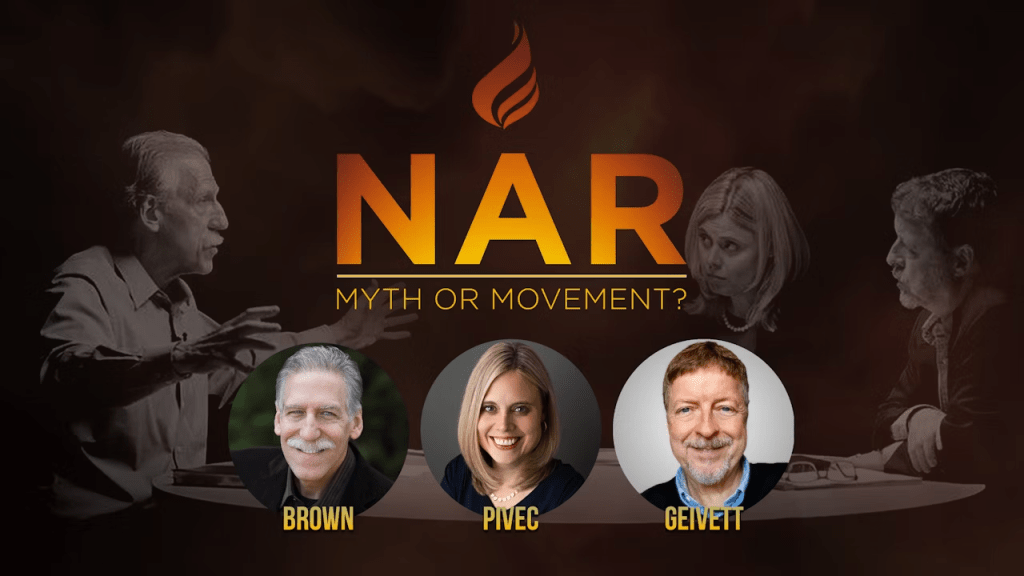
In August 2022, Holly Pivec and I met with Michael L. Brown for a Roundtable discussion that was released July 15, 2024 under the title “NAR: Myth or Movement?” The release of that discussion for public viewing was delayed for nearly two years for reasons that may eventually come to light. In the end, the three of us were invited to record final summary statements that would be attached to the end of the original production by American Gospel producer, Brandon Kimber.
In our joint summary statement concluding the Roundtable, Holly describes five errors or misrepresentations that we identify to illustrate problems with Michael Brown’s factual claims during the Roundtable. In the fifth instance, we comment on Brown’s response to the NAR apostle Ché Ahn.
In his book Modern-Day Apostles, Ahn recalls his conversation with Peter Wagner about the shortage of revivals in America, compared with other nations. “Peter said, ‘The reason why I don’t think it happened is because pastors are not the ones with the highest level of authority in the church. It’s apostles.’” Ahn then writes, “I realized that wherever revival has broken out it was because an apostle led that revival. This was true whether it was John Arnott in Toronto; John Kilpatrick in Brownsville; or me in Pasadena at Mott auditorium, where we had nightly meetings for three years; or Bill Johnson in Redding, California.”
After Holly quoted this passage from Ché Ahn’s book, Brown pushed back and disputed Ché Ahn’s point about the Brownsville Revival. Brown says,
I was part of the Brownsville Revival that was mentioned there. There was not a syllable ever about John Kilpatrick being the apostle over this. He was pastor of a local church. And God birthed the revival within this pastor of a local church. Someone else now is putting an interpretation on it and now you think, Okay, well John Kilpatrick held to that. No, no. That was someone else looking at it, whereas the people involved would say, “No, this happened through prayer and through a pastor and an evangelist working together. That’s how God poured out his Spirit in revival.” . . . . This is someone else’s opinion. . . . That’s Ché’s opinion about what happened at Brownsville. People within Brownsville differ with that. . . . I was there. I was a leader. . . . That’s his interpretation. (“NAR: Myth or Movement?”)
Brown objects to Ahn’s “interpretation,” as he calls it: that John Kilpatrick was an apostle who led the revival in Brownsville. Brown says, “There was not a syllable ever about John Kilpatrick being the apostle over this.” But of course, this misrepresents what Ahn has said. Ahn does not say that John Kilpatrick was identified at the time as the apostle who led the Brownsville Revival. In the passage Holly cited, Ahn only asserts that “wherever revival has broken out it was because an apostle led that revival.” And Ahn believes that was true of John Kilpatrick at Brownsville.
To dispute Ché Ahn’s claim regarding the Brownsville Revival, Brown must establish that no apostle played a role in the leadership of the revival period at Brownsville. Brown cannot simply assert that no one stepped forward as an apostle during the Brownsville Revival or that no one was ever dubbed an apostle of the revival during revival events. For it is at least theoretically possible that an individual functioned as an apostle leading the revival, without ever calling himself or herself an “apostle,” or without being regarded as such by anyone else, at the time. In that event, Ché Ahn would be correct, that an apostle did lead the Brownsville Revival and this apostle was John Kilpatrick. And Brown’s claim—“There was not a syllable ever about John Kilpatrick being the apostle over this”—would be completely irrelevant. Brown’s rejoinder to Ahn misrepresents what Ahn is saying in the passage we quoted.
That is Brown’s first mistake. But Brown’s comment is also factually mistaken.
As anyone can see from the video clip shown in our summary comment about this matter, a prophet, who was invited by John Kilpatrick himself to speak a word from the Lord, explicitly declares that Kilpatrick is more than a mere pastor, that he is in fact an apostle, whose leadership ministry during the Brownsville Revival is evidence of Kilpatrick’s apostolic calling. This prophet further reveals that Kilpatrick will go on to lead future revivals following the same pattern of authority, with events marked by similar phenomena as those manifested during the Brownsville Revival.
So, as a matter of fact, someone uttered a whole string of syllables expressing what Ché Ahn alleges—that John Kilpatrick, a pastor at Brownsville Church, was also an apostle who led the Brownsville Revival, as evidenced by the phenomena that occurred during the revival. And the person who said this did so from the pulpit at Brownsville Church, with John Kilpatrick present, after being introduced by John Kilpatrick as a prophet of God invited to bring a word from the Lord.
If you wonder whether “apostle John” accepted this designation, or thought that it applied to the role he played during his leadership of the Brownsville Revival, you need only consult a sermon that Kilpatrick preached at Calvary Christian Center in Ormond Beach, Florida (uploaded to YouTube Feb 13, 2022). Kilpatrick says,
I remember in the Brownsville Revival I didn’t understand the apostolic, or any of that stuff, until God poured out revival at Brownsville. And when God came and poured out His Spirit there, and the world began to come to our church, and they were drawn to that presence and that glory of God, I began to feel and understand and hear about the apostolic. . . . Somebody said, “You’re an apostle.” I said, “What do you mean by that?” . . . . So I had to begin to look into the apostolic and begin to try to get an understanding of it. [43:53]
In other words, John Kilpatrick, a noted leader of the Brownsville Revival, gradually learned during the course of the revival that he was indeed an apostle. He had exercised apostolic authority without fully realizing it. He studied the apostolic and reflected on the supernatural phenomena exhibited during the Brownsville Revival, and on that basis he concluded that people who had called him an apostle were correct.
So Ché Ahn’s so-called “interpretation” of events is shared by John Kilpatrick, of all people. And it is Michael Brown’s interpretation that is called into question.
We’re not quite sure how to account for this discrepancy between the Kilpatrick-Ahn account and Brown’s understanding. But Brown’s interpretation has all the appearance of being revisionist. It will be interesting to see if he can persuade either of these luminaries of the New Apostolic Reformation (NAR)—John Kilpatrick and Ché Ahn—that they have misdescribed the situation and that there was no apostle giving leadership to the Brownsville Revival at all.
In any case, the prophetic utterance—given in the clip we exhibit in our concluding comment for the Roundtable—establishes that Brown is indeed mistaken when he says, “There was not a syllable ever about John Kilpatrick being the apostle over this.” And he is mistaken when he says that this is merely Ahn’s interpretation that would be disputed by “people within Brownsville.”
This fuller account of how it came to be understood that an apostle was specially designated by God to lead the Brownsville Revival creates additional problems for Michael Brown. He is well-known for his vigorous defense of the Brownsville Revival (which is a head-scratcher in itself), and his claim to be a prominent participating and authoritative eyewitness of what took place at Brownsville. But due to some conflict between himself and leaders at Brownsville, Brown was relieved of his role as president of the Brownsville Revival School of Ministry and left before the Revival petered out. That Brown emerged as a leading spokesperson for the revival in the afterglow of its eventual extinction is a testament to his capacity for reinventing himself. But his interpretation of events and his denial that an apostle played a crucial role is at odds with the narrative propounded by the most significant living leader of the Brownsville Revival, apostle John Kilpatrick.
In addition, Brown, who calls NAR a “myth,” must now find himself defending a phenomenon—the Brownsville Revival —that, by official accounts, critically depended on the leadership of an apostle for its manifestation. Brown was a proud participant in a major NAR event. Fancy that!
***
Michael Brown has repeatedly sought to defend his NAR friends in response to critics of NAR. But so far, that has not gone well for Michael Brown—or for his NAR friends. In so many instances, where he has objected to our identification of individuals as NAR, Brown has invited further scrutiny of their NAR bona fides and exposed them to further trenchant criticism.
He co-authored with Joseph Mattera a statement on “NAR and Christian Nationalism” and recruited signatories whose approval of the statement is incompatible with their NAR commitments, including Joe Mattera himself. During the Roundtable, he challenged our claim that his friend Mark Chironna is NAR and pressed us to produce evidence for it. We’ve done that. (See our article “Response to Joseph Mattera and Michael Brown, Statement on ‘NAR and Christian Nationalism.'”) Brown has parted company with Ché Ahn, in no uncertain terms, when pressed about the differences between their views about apostles. And now his friend and former colleague, John Kilpatrick, is brought under the spotlight for special scrutiny by Brown’s attempted revisionist characterization of the Brownsville Revival, which is actually a paradigm instance of NAR revivalist theology and practice.
In each case, the effort to characterize NAR as a “myth” and to defend his friends against NAR allegations has only subjected Brown’s friends to the revelation of further blinding evidence in support of our claims.
***
There is one further irony to this story. When Holly quoted the passage from Ché Ahn (cited above), the purpose was to make explicit Ahn’s own view about the authority of apostles as a requirement for revival today. She was not especially interested in what Ahn had said about John Kilpatrick and the Brownsville Revival. For her specific purposes, it wasn’t the least bit relevant whether Ché Ahn had given the correct insider’s interpretation on Brownsville. The Ahn quote was one of a series of quotations Holly presented to Brown to elicit his response. Following her recitation of these several passages by different NAR individuals, Brown immediately accused the two of us of adopting a faulty methodology. And one example he offered in support of this claim was our use of the Ahn passage. Note, again, what Brown says to us: “Someone else [Ché Ahn] now is putting an interpretation on it [the Brownsville Revival] and now you think, Okay, well John Kilpatrick held to that.” But that is not what we thought and that certainly is not what we said. So it is Brown’s methodology that goes terribly awry. And thanks to Michael Brown, whose chastising comment inspired us to research John Kilpatrick’s role during the Brownsville Revival, we now do believe that Kilpatrick indeed came to consider himself to be an apostle whose leadership as such facilitated the Revival. That’s an interesting conclusion, to be sure, though it is not germane to our purposes in quoting Ché Ahn during the Roundtable.
Doug Geivett is co-author with Holly Pivec of four books on the New Apostolic Reformation: Reckless Christianity: The Destructive New Teachings and Practices of Bill Johnson, Bethel Church, and the Global Movement of Apostles and Prophets; Counterfeit Kingdom: The Dangers of New Revelation, New Prophets, and New Age Practices in the Church; A New Apostolic Reformation? A Biblical Response to a Worldwide Movement; and God’s Super-Apostles: Encountering the Worldwide Prophets and Apostles Movement.




 Doug Geivett's Blog
Recent Comments