Michael L. Brown, Ché Ahn, and the Brownsville Revival


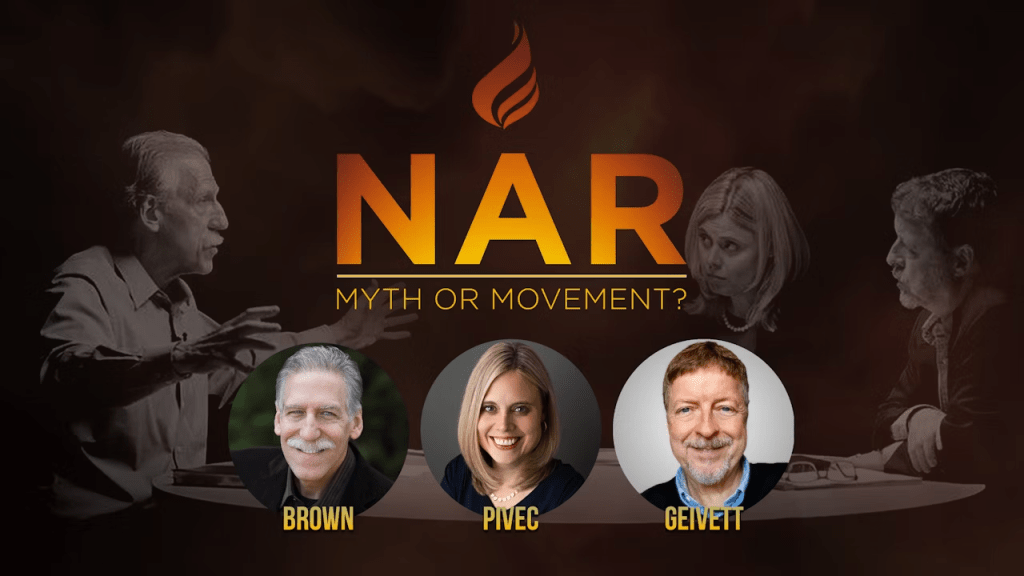
In August 2022, Holly Pivec and I met with Michael L. Brown for a Roundtable discussion that was released July 15, 2024 under the title “NAR: Myth or Movement?” The release of that discussion for public viewing was delayed for nearly two years for reasons that may eventually come to light. In the end, the three of us were invited to record final summary statements that would be attached to the end of the original production by American Gospel producer, Brandon Kimber.

In our joint summary statement concluding the Roundtable, Holly describes five errors or misrepresentations that we identify to illustrate problems with Michael Brown’s factual claims during the Roundtable. In the fifth instance, we comment on Brown’s response to the NAR apostle Ché Ahn.

In his book Modern-Day Apostles, Ahn recalls his conversation with Peter Wagner about the shortage of revivals in America, compared with other nations. “Peter said, ‘The reason why I don’t think it happened is because pastors are not the ones with the highest level of authority in the church. It’s apostles.’” Ahn then writes, “I realized that wherever revival has broken out it was because an apostle led that revival. This was true whether it was John Arnott in Toronto; John Kilpatrick in Brownsville; or me in Pasadena at Mott auditorium, where we had nightly meetings for three years; or Bill Johnson in Redding, California.”

After Holly quoted this passage from Ché Ahn’s book, Brown pushed back and disputed Ché Ahn’s point about the Brownsville Revival. Brown says,

I was part of the Brownsville Revival that was mentioned there. There was not a syllable ever about John Kilpatrick being the apostle over this. He was pastor of a local church. And God birthed the revival within this pastor of a local church. Someone else now is putting an interpretation on it and now you think, Okay, well John Kilpatrick held to that. No, no. That was someone else looking at it, whereas the people involved would say, “No, this happened through prayer and through a pastor and an evangelist working together. That’s how God poured out his Spirit in revival.” . . . . This is someone else’s opinion. . . . That’s Ché’s opinion about what happened at Brownsville. People within Brownsville differ with that. . . . I was there. I was a leader. . . . That’s his interpretation. (“NAR: Myth or Movement?”)

Brown objects to Ahn’s “interpretation,” as he calls it: that John Kilpatrick was an apostle who led the revival in Brownsville. Brown says, “There was not a syllable ever about John Kilpatrick being the apostle over this.” But of course, this misrepresents what Ahn has said. Ahn does not say that John Kilpatrick was identified at the time as the apostle who led the Brownsville Revival. In the passage Holly cited, Ahn only asserts that “wherever revival has broken out it was because an apostle led that revival.” And Ahn believes that was true of John Kilpatrick at Brownsville.

To dispute Ché Ahn’s claim regarding the Brownsville Revival, Brown must establish that no apostle played a role in the leadership of the revival period at Brownsville. Brown cannot simply assert that no one stepped forward as an apostle during the Brownsville Revival or that no one was ever dubbed an apostle of the revival during revival events. For it is at least theoretically possible that an individual functioned as an apostle leading the revival, without ever calling himself or herself an “apostle,” or without being regarded as such by anyone else, at the time. In that event, Ché Ahn would be correct, that an apostle did lead the Brownsville Revival and this apostle was John Kilpatrick. And Brown’s claim—“There was not a syllable ever about John Kilpatrick being the apostle over this”—would be completely irrelevant. Brown’s rejoinder to Ahn misrepresents what Ahn is saying in the passage we quoted.

That is Brown’s first mistake. But Brown’s comment is also factually mistaken.

As anyone can see from the video clip shown in our summary comment about this matter, a prophet, who was invited by John Kilpatrick himself to speak a word from the Lord, explicitly declares that Kilpatrick is more than a mere pastor, that he is in fact an apostle, whose leadership ministry during the Brownsville Revival is evidence of Kilpatrick’s apostolic calling. This prophet further reveals that Kilpatrick will go on to lead future revivals following the same pattern of authority, with events marked by similar phenomena as those manifested during the Brownsville Revival.

So, as a matter of fact, someone uttered a whole string of syllables expressing what Ché Ahn alleges—that John Kilpatrick, a pastor at Brownsville Church, was also an apostle who led the Brownsville Revival, as evidenced by the phenomena that occurred during the revival. And the person who said this did so from the pulpit at Brownsville Church, with John Kilpatrick present, after being introduced by John Kilpatrick as a prophet of God invited to bring a word from the Lord.

If you wonder whether “apostle John” accepted this designation, or thought that it applied to the role he played during his leadership of the Brownsville Revival, you need only consult a sermon that Kilpatrick preached at Calvary Christian Center in Ormond Beach, Florida (uploaded to YouTube Feb 13, 2022). Kilpatrick says,

I remember in the Brownsville Revival I didn’t understand the apostolic, or any of that stuff, until God poured out revival at Brownsville. And when God came and poured out His Spirit there, and the world began to come to our church, and they were drawn to that presence and that glory of God, I began to feel and understand and hear about the apostolic. . . . Somebody said, “You’re an apostle.” I said, “What do you mean by that?” . . . . So I had to begin to look into the apostolic and begin to try to get an understanding of it. [43:53]

In other words, John Kilpatrick, a noted leader of the Brownsville Revival, gradually learned during the course of the revival that he was indeed an apostle. He had exercised apostolic authority without fully realizing it. He studied the apostolic and reflected on the supernatural phenomena exhibited during the Brownsville Revival, and on that basis he concluded that people who had called him an apostle were correct.

So Ché Ahn’s so-called “interpretation” of events is shared by John Kilpatrick, of all people. And it is Michael Brown’s interpretation that is called into question.

We’re not quite sure how to account for this discrepancy between the Kilpatrick-Ahn account and Brown’s understanding. But Brown’s interpretation has all the appearance of being revisionist. It will be interesting to see if he can persuade either of these luminaries of the New Apostolic Reformation (NAR)—John Kilpatrick and Ché Ahn—that they have misdescribed the situation and that there was no apostle giving leadership to the Brownsville Revival at all.

In any case, the prophetic utterance—given in the clip we exhibit in our concluding comment for the Roundtable—establishes that Brown is indeed mistaken when he says, “There was not a syllable ever about John Kilpatrick being the apostle over this.” And he is mistaken when he says that this is merely Ahn’s interpretation that would be disputed by “people within Brownsville.”

This fuller account of how it came to be understood that an apostle was specially designated by God to lead the Brownsville Revival creates additional problems for Michael Brown. He is well-known for his vigorous defense of the Brownsville Revival (which is a head-scratcher in itself), and his claim to be a prominent participating and authoritative eyewitness of what took place at Brownsville. But due to some conflict between himself and leaders at Brownsville, Brown was relieved of his role as president of the Brownsville Revival School of Ministry and left before the Revival petered out. That Brown emerged as a leading spokesperson for the revival in the afterglow of its eventual extinction is a testament to his capacity for reinventing himself. But his interpretation of events and his denial that an apostle played a crucial role is at odds with the narrative propounded by the most significant living leader of the Brownsville Revival, apostle John Kilpatrick.

In addition, Brown, who calls NAR a “myth,” must now find himself defending a phenomenon—the Brownsville Revival —that, by official accounts, critically depended on the leadership of an apostle for its manifestation. Brown was a proud participant in a major NAR event. Fancy that!

***

Michael Brown has repeatedly sought to defend his NAR friends in response to critics of NAR. But so far, that has not gone well for Michael Brown—or for his NAR friends. In so many instances, where he has objected to our identification of individuals as NAR, Brown has invited further scrutiny of their NAR bona fides and exposed them to further trenchant criticism.

He co-authored with Joseph Mattera a statement on “NAR and Christian Nationalism” and recruited signatories whose approval of the statement is incompatible with their NAR commitments, including Joe Mattera himself. During the Roundtable, he challenged our claim that his friend Mark Chironna is NAR and pressed us to produce evidence for it. We’ve done that. (See our article “Response to Joseph Mattera and Michael Brown, Statement on ‘NAR and Christian Nationalism.'”) Brown has parted company with Ché Ahn, in no uncertain terms, when pressed about the differences between their views about apostles. And now his friend and former colleague, John Kilpatrick, is brought under the spotlight for special scrutiny by Brown’s attempted revisionist characterization of the Brownsville Revival, which is actually a paradigm instance of NAR revivalist theology and practice.

In each case, the effort to characterize NAR as a “myth” and to defend his friends against NAR allegations has only subjected Brown’s friends to the revelation of further blinding evidence in support of our claims.

***

There is one further irony to this story. When Holly quoted the passage from Ché Ahn (cited above), the purpose was to make explicit Ahn’s own view about the authority of apostles as a requirement for revival today. She was not especially interested in what Ahn had said about John Kilpatrick and the Brownsville Revival. For her specific purposes, it wasn’t the least bit relevant whether Ché Ahn had given the correct insider’s interpretation on Brownsville. The Ahn quote was one of a series of quotations Holly presented to Brown to elicit his response. Following her recitation of these several passages by different NAR individuals, Brown immediately accused the two of us of adopting a faulty methodology. And one example he offered in support of this claim was our use of the Ahn passage. Note, again, what Brown says to us: “Someone else [Ché Ahn] now is putting an interpretation on it [the Brownsville Revival] and now you think, Okay, well John Kilpatrick held to that.” But that is not what we thought and that certainly is not what we said. So it is Brown’s methodology that goes terribly awry. And thanks to Michael Brown, whose chastising comment inspired us to research John Kilpatrick’s role during the Brownsville Revival, we now do believe that Kilpatrick indeed came to consider himself to be an apostle whose leadership as such facilitated the Revival. That’s an interesting conclusion, to be sure, though it is not germane to our purposes in quoting Ché Ahn during the Roundtable.


Doug Geivett is co-author with Holly Pivec of four books on the New Apostolic ReformationReckless Christianity: The Destructive New Teachings and Practices of Bill Johnson, Bethel Church, and the Global Movement of Apostles and ProphetsCounterfeit Kingdom: The Dangers of New Revelation, New Prophets, and New Age Practices in the ChurchA New Apostolic Reformation? A Biblical Response to a Worldwide Movementand God’s Super-Apostles: Encountering the Worldwide Prophets and Apostles Movement.

W. H. Griffith Thomas (1861-1924) – How We Got Our Bible


Born in 1861, W. H. Griffith Thomas died on this date in 1924. His greatest and most sophisticated work is his book The Principles of Theology, a commentary on the Thirty-Nine Articles of the Anglican Church. But one short and reader-friendly book that should interest students of Christian apologetics is How We Got Our Bible. (Note: The full text of this book is available online here.) Here are some themes discussed in this fine little book:W. H. Griffith Thomas The Canonicity of the Bible On the question of which books are to be recognized as divinely inspired and constitutive of God’s written revelation, Thomas writes:

The answer is that it is quite easy to prove that our Bible is the same as the church has had through the centuries. We start with the printed Bibles of today and it is obviously easy to show that they correspond with the printed Bibles of the sixteenth century, or the time when printing was invented. From these we can go back through the English and Latin versions until we reach to the great manuscripts of the fourth century as represented by the three outstanding codices known as the Codex Sinaiticus (in Petrograd), the Codex Vaticanus (in Rome), and the Codex Alexandrinus (in the British Museum). Then we can go back still farther and compare the use of Scripture in the writings of the Fathers of the third century, and from these work back to the second century when versions in several languages are found. From this it is but a short step to the time of the apostles and the actual composition of the New Testament writings. There is no reasonable doubt that we possess today what has always been regarded as the Scriptures of the Christian church. (15-16)

As to the Old Testament,

The proof . . . can be shown along similar lines. Our Old Testament is identical with the Bible of the Jews at the present time. This is the translation of Hebrew manuscripts dating from several centuries past, and the fact of the Jews always having used the same Bible as they do today is a proof that all through the ages the Christian Church has not been mistaken in its inclusion of the Old Testament in its Bible. An additional evidence of great value is the fact that the Hebrew Bible was translated into Greek about two centuries before Christ, and this translation is essentially the same as the Hebrew text from which we get our Old Testament. (16)

Details of this proposal are elaborated in chapter 2, where Thomas states that “the basis of our acceptance of the New Testament is what is called in technical language ‘Apostolicity’; because the books came either from Apostolic authors, or through Apostolic sanction. Our view of the Old Testament corresponds to this” (23). The Inspiration of the Bible Thomas first approaches questions about the grounds for belief in the inspiration of Scripture in a natural but often neglected way. He reasons that the fundamental question is whether the Bible has divine authority. If there is good reason to think so, then we can ask how its authority was ensured. And the answer to that is given in the doctrine of inspiration. So his discussion begins with an argument for the need for a religious authority in the conduct of our lives and for the authority of the Bible as the answer to this need. He then expounds on the doctrine of biblical inspiration in chapters 9 and 10. But his stress is on the first point.

At the outset, two things should be said: (1) If we accept the Authority of Scripture we really need not trouble about any particular theory of Inspiration, but (2) if we seek to know as fully as we can what Inspiration means we should confine ourselves strictly to facts, since Inspiration when properly understood is not a theory, but a fact. It is something we accept, whether we can explain it or not. (86)

The facts considered in the development of a theory of inspiration are those that are presented in the Scriptures themselves, as these witness to their own nature and production. Thomas rehearses the familiar data of specific passages on this question. Judaism and the Christian Doctrine of the Trinity

In the Old Testament emphasis is rightly placed on the unity of the Godhead as against the ‘gods many’ of heathenism. But in the New Testament there is the additional revelation of the Trinity, which is not only not contradictory of the Unity, but is based on it and developed out of it. Every one knows that the Christian doctrine of the Trinity never had the slightest connection with polytheism, but grew out of Jewish monotheism. It is significant that with all the Jewish objections to Christianity in Paul’s time, no trace can be found of any opposition to his doctrine of a distinction between the Deity of the Father and the Deity of the Son, which was the germ of the fully-developed doctrine of the Trinity. (79-80)

He then adds:

The explanation of this was that the Jewish believers, having been led by experience into an acceptance of Christ as a divine Redeemer (and thereby to a distinction in the Deity) found in their Old Testament anticipatory hints of the Trinity. They realized that the unity of the Godhead was compound not simple, as the Hebrew words for ‘one’ clearly indicate (Deut. 6:4; Exod. 26:6-11; Ezek. 37:16-19). (80)

Here we see sensitivity to a problem that would later arise with contact between Christianity and Islam. Whereas the Hebrew doctrine of God propounded in the Old Testament is not explicitly revealed as a Trinity, what is said of God there is (1) compatible with the Christian doctrine, and (2) revealed in anticipation of more to come. Faith and Reason For all of his emphasis on the requirement of faith and the authority of the Bible, Thomas is no fideist.

The Bible is supreme over reason. It is the light of reason and of human thought. Revelation, because it comes from God, cannot possibly dishonor reason, which also is from God. Reason is the judge of our need of revelation. It examines the claims of revelation; but once those claims are accepted, reason takes a subordinate place, and revelation is supreme. Reason examines, tests, sifts, inquires, but the moment it has become convinced that this or that comes from God, then, like Joshua of old, it says: ‘What saith my Lord unto his servant?’ So, though revelation is supreme over reason, reason examines the credentials of revelation and then submits to them. Since Christ is our Authority, what we need is the rational conviction that the Bible is the best form in which his Word reaches us, and then we submit to it, and it becomes supreme over our reason and life. (38-39)

There is always the theme of practical concern in this book about How We Got Our Bible. is not a technical treatise. It is quite intentionally written for easy accessibility. In his conclusion to chapter 10, on the inspiration of the Bible, W. H. Griffith Thomas warns against an overly-intellectualized approach to the questions he treats.

A great number of our problems are theoretical. They come from places where people spin theories absolutely remote from human life. But if we go out into the world and tell a man of the Lord Jesus Christ, and get that man to ask, ‘What must I do to be saved?’ we shall very soon get verification of the Word of God; and when we have that, we shall not need much, if any, further testimony to its inspiration. (105)

He means that commendation of the faith, when it issues in persuasion on the basis of good evidence, produces confidence in the Bible’s claim to be the Word of God.

◊ ◊ ◊

Other posts in this series . . .

Bible.Is App for iPhone and iPad


Nothing can replace reading the Bible from the page, and this iPhone and iPad app—called Bible.Is—is no substitute for that. But audio is an excellent supplement to a Bible reading and study program. This app is convenient to use and makes the Bible available in surprisingly many languages.

  • Use it to “read” whole books of the Bible one at a time.
  • Learn unfamiliar dimensions of Scripture truth from the cadences of the spoken Word (e.g., the Book of Leviticus).
  • Learn and improve your knowledge of a foreign language through audio exposure to biblical truth.
  • Memorize extended passages through repetition.
  • Listen with your Bible open and read along with the audio.

I doubt if any app does as well what this app so effectively does what it’s designed to do. It rivals every audio version of the Bible I know of. I would like to see the New American Standard Version (NASV) in its repertoire, since this is my preference for Scripture memory. But publishers of the NASV have enforced strict proprietary controls on the publication of this valuable translation, and so have, regrettably, limited its dissemination—not the fault of this app designer (though they might be able to obtain permission at a price). The English Standard Version (ESV), available on Bible.Is is an excellent alternative to the NASV.

You can also use Bible.Is from any computer with a browser. Just visit their home page here.
By the way, the Bible.Is app can be downloaded to your iOS device for free. And yes, it is available for Android, as well.


Scripture Memory Made Easy


Scripture Memory Made Easy is the title of a little book by Mark Waters. The method resembles the approach I was taught by Garry Friesen as a college student in the late 1970s. The 64-page booklet, dubbed an “easy-to-understand pocket reference guide,” is both a guide to Scripture memorization and “a plan for learning one hundred Bible verses in fifty-two weeks.”

The author stresses the importance of review and has built this crucial element into the method. He also advises the excellent practice of memorizing verses topically. Both of these components of a sound Scripture memory plan were part of the Navigator’s “Topical Memory System” that I used when I was a teenager.

I have always believed in the value of Scripture memorization. It’s never too early to begin. Nor is it ever too late. For all the enthusiasm we see today for new techniques of “spiritual formation,” there is almost no emphasis on the memorization of carefully selected passages from the Bible.

Scripture Memory Made Easy, by Mark Waters, is a useful remedy.

Order at Amazon

Happily, the Topical Memory System, by the Navigators, continues to be published. Today’s kit includes 60 verses cards with passages from several familiar English translations, a workbook, and a verse card holder.

If Scripture memorization is new to you, I urge you to begin now. God will reward your efforts with the supply of wisdom for life’s small and major moments.

Note: I welcome your response to this post. Other readers may be encouraged to know of how your own experience with Scripture memory has increased your faith, enabled you to follow God’s will, and fostered greater boldness as a believer living in a secular society.

This website is read by people of differing beliefs. This particular post is primarily for those who believe the Bible is the greatest source for wise living. Anyone who believes this should be especially open to the value of Scripture memorization.

Again, I look forward to hearing from you!

Get a Grip on Greek


In the 1970s and 1980s I took several courses on New Testament Greek, at both grad and undergrad levels. I don’t need reminding how long ago that was! Like so many others, I “let my Greek go.” So my proficiency dropped dramatically. Call it my own personal “Greek tragedy.”

After investing the effort in studying Greek, I hated to see it go to waste. I’ve made good use of my knowledge at times, but I haven’t been very deliberate about sustaining and improving my grip on Greek. Now I’ve come across a little book that addresses this very typical reality—Keep Your Greek: Strategies for Busy People, by Constantine R. Campbell.

Campbell’s book of 90 pages is organized into ten mini-chapters.

  1. Read Every Day
  2. Burn Your Interlinear
  3. Use Software Tools Wisely
  4. Make Vocabulary Your Friend
  5. Practice Your Parsing
  6. Read Fast
  7. Read Slow
  8. Use Your Senses
  9. Get Your Greek Back
  10. Putting It All Together

There’s advice in an appendix on getting it right the first time, for those who are just now beginning to learn NT Greek. The book ends with a list of resources truly useful to the person who would follow the practical advice that Campbell gives.

There are no stunning new revelations here about how to stay on top of a language you’ve learned. It’s mostly common sense—but it’s wise and inspiring common sense.

The author maintains a blog—Read Better, Preach Better—where he offers practical advice on biblical study and Bible-based preaching. The chapters of his book are adapted from a series of blog posts about keeping your Greek skills intact. Each chapter concludes with a few comments or “blog responses” from his readers. It’s a clever idea whose potential, I think, is never fully exploited. The value of including these responses depends, of course, on the value of the responses themselves.

Campbell uses Accordance software in his own regimen of Greek review and New Testament study. I’ve used this tool myself. It is powerful and convenient.

Two resources especially recommended by Campbell are:

I concur with these recommendations.

If you need brushing up, or you have the inclination to teach yourself New Testament Greek, I strongly recommend the published work of my friend Bill Mounce:

Mounce provides a wealth of additional tools, including his FlashWorks vocabulary drilling program, at his Teknia website.

For audio assistance with Greek study and review, these tools will prove useful:

Cover of "Sing and Learn New Testament Gr...

Cover via Amazon

Finally, you must poke around at the Institute of Biblical Greek website.

At least twice monthly, I teach an adult Bible study. Lately I’ve been introducing group members to the benefits of Greek study. We are currently studying 1 John, with an emphasis on Bible study technique. If you happen to live in North Orange County, California, you’re welcome to join us!

Watch for this TV Ad about Barack Obama after the DNC Convention


pH for America will soon be running a TV ad featuring comments by Barack Obama about the proper use of the Bible in American politics. The ad is slated for release shortly after the Democratic National Convention is over. But you can see the complete video of the forthcoming ad now.

If you want to see the video, click here:

Here are a few discussion questions:

  1. What is the primary thesis of this ad?
  2. How is this thesis supported?
  3. What seems to be Obama’s approach to interpreting the Bible?
  4. Do you agree with this approach?
  5. What are the strengths and weaknesses of this particular ad?
  6. Will this ad influence voters? Do you think it should?

What say you?

Reviewer Sought at “Obscure Classics”


Here’s an opportunity to review classic films at a site dedicated to Obscure Classics.

“Have you dreamed of having your reviews and essays featured on our site? Have you fantasized about the enormous fame you’d have if only you could be a member of the Obscure Classics team?

“Well, lucky for you, we’re recruiting! I’m currently looking for one or two people to add to the awesomely awesome team here.”

Go here for details: