Writing with Hedges


Good authors hedge their bets. That’s what English professors Booth, Colomb, and Williams claim. But is this always the case? See if you can identify any hedges in this selection from their book The Craft of Research.

“Some researchers think their claims are most credible when they are stated most forcefully. But nothing damages your ethos more than arrogant certainty. As paradoxical as it seems, you make your argument stronger and more credible by modestly acknowledging its limits. You gain readers’ trust when you acknowledge and respond to their views, showing that you have not only understood but considered their position. But you can lose that trust if you then make claims that overreach their support. Limit your claims to what your argument can actually support by qualifying their scope and certainty. . . .

“Consider mentioning important limiting conditions even if you feel readers would not think of them. . . .

“Only rarely can we state in good conscience that we are 100 percent certain that our claims are unqualifiedly true. Careful writers qualify their certainty with words and phrases called hedges. For example, if anyone was entitled to be assertive, it was Crick and Watson, the discoverers of the helical structure of DNA. But when they announced their discovery, they hedged the certainty of their claims (hedges are boldfaced; the introduction is condensed):

‘We wish to suggest a [note: not state the] structure for the salt of deoxyribose nucleic acid (D.N.A.). . . . A structure for nucleic acid has already been proposed by Pauling and Corey. . . . In our opinion, this structure is unsatisfactory for two reasons: (1) We believe that the material which gives the X-ray diagrams is the salt, not the free acid. . . . (2) Some of the van der Waals distances appear to be too small. (J. D. Watson and F. H. C. Crick, “Molecular Structure of Nucleic Acids.”)

“Without hedges, Crick and Watson would be more concise but more aggressive. . . .

“Of course, if you hedge too much, you will seem timid or uncertain. But in most fields, readers distrust flatfooted certainty expressed in words like all, no one, every, always, never, and so on. Some teachers say they object to all hedging, but what most of them really reject are hedges that qualify every trivial claim. And some fields do tend to use fewer hedges than others. It takes a deft touch. Hedge too much and you seem mealy-mouthed; too little and you seem smug. Unfortunately, the line between them is thin. So watch how those in your field manage uncertainty, then do likewise.”

The Craft of Research, 3rd ed.
Authors: Wayne C. Booth, Gregory G. Colomb, and Joseph M. Williams
Publisher: Chicago University Press
Copyright 2008
Pages: 127-129

Questions to Consider:

1. What do the authors mean by a “hedge”?

2. Why must authors hedge when making arguments, even when they are experts in their field?

3. Do the authors do any hedging of their own in this selection?

4. Can you give an example of something you’ve read that came across too smug? How about too timid?

5. It can be tough to tell whether a blog post is trustworthy, knowledgeable, or well-argued. Often, a blogger neglects to hedge responsibly. How would you apply the “hedge test” to the blogs you read?

The Unexamined Life and the Fate of Serious Reading


A serious book about serious reading. By “serious” I mean a book that takes comparatively serious effort. But Bound to Please is also a pleasing book, for those who make the effort. You’ll know what I mean by “serious” and “pleasing” when you read the following selection. Author Michael Dirda comments on a report issued by the National Endowment for the Humanities (NEH)—called “Reading at Risk: A Survey of Literary Reading in America.” The preface to that report is by Dana Gioia, a distinguished poet and critic.

“’Reading at Risk’ is right to lament the decline of what I will forthrightly call bookishness. As the report implies, the Internet seems to have delivered a possibly knockout punch. Our children now can scarcely use a library and instead look to the Web when they need to learn just about anything. We all just click away with the mouse and remote control, speeding through a blur of links, messages, images, data of all sorts. Is this reading? As Gioia reminds us, ‘print culture affords irreplaceable forms of focused attention and contemplation that make complex communications and insights possible. To lose such intellectual capability—and the many sorts of human continuity it allows—would constitute a vast cultural impoverishment.’


“Yes, the Internet has allowed fans of Finnegans Wake and Dorothy Sayers and the English ghost story to gather and share their knowledge. Web sites and chat rooms do encourage people from around the world to form digital communities. But the computer must seem a far more ambiguous gift to anyone who has ever faced screenfuls of spam, or discovered that hours are eaten up just answering email, or found their colleagues drooling over pixellated lovelies, or noticed that their children had stopped going outside because they were unable to tear themselves away from bloody, digitized battles, or simply realized that they themselves felt incomplete when not online every minute of the day—and half the night. In other words, virtually all of us recognize that that flat-screen monitor before our eyes casts an insidious spell, and all too often it seems that the best minds of the next generation—and more than a few of our own—are being lost to its insidious, relentless ensorcellments. Who now among the young aspires to be cultivated and learned, which takes discipline, rather than breezily provocative, wise-crackingly edgy’?


“Americans can still be smart and creative, but the pressure of the times is oriented toward quickness—we want instant messaging, live news breaks, fast food, mobile phoning, and snap judgments. As a result, we are growing into a shallow people, happy enough with the easy gratifications of mere speed and spectacle in all aspects of life. Real books are simply too serious for us. Too slow. Too hard. Too long. Now and again, we may feel that just maybe we’ve shortchanged our better selves, that we might have listened to great music, contemplated profoundly moving works of art, read books that mattered, but instead we turned away from them because it was time to tune into Law and Order reruns, or jack into a WarCraft game on our home computer, or get back to the latest made-for-TV best seller. Sometimes nonetheless, late at night or when faced with one of life’s true crises, we will surprise in ourselves what poet Philip Larkin called the hunger to be more serious.”

MDirda-Book Cover-Bound to Please

Bound to Please: An Extraordinary One-Volume Literary Education—Essays on Great Writers and Their Books
Author: Michael Dirda
Publisher: W. W. Norton
Copyright 2005 by Michael Dirda
Pages xxv-xxvi

Questions to Consider:
1. Dirda compares serious reading with the Internet, to draw attention to the special value of reading real books. What values are compromised when the print-culture gives way to the Web-culture?
2. What is Dirda’s basic thesis? What do you find most convincing about his thesis?
3. How do these few paragraphs make you feel about your own reading practices?
4. What does the word ensorcellment mean? Why would Dirda use an unfamiliar word like this here?

Secularist Faith and College Football


There’s an interesting story in the Chronicle of Higher Education this week. It reports on the football program at Clemson University, where the coaching staff is openly Christian. They have prayer meetings for students and baptize those who come to faith.

Apparently, this is controversial.

Anne Laurie Gaylor is co-president of the Freedom from Religion Foundation. She asserts that “a culture of evangelizing on a football team has got to stop.” She adds that a state-funded institution is an inappropriate place for repeated religious messages.

This is ironic and hypocritical. It is ironic because the university exists for the purpose of influencing impressionable young men and women. Ms. Gaylor knows this. It’s what she does when she advocates for “freedom from religion,” and trains her powers of influence on young adults to persuade them to adopt a liberal, religiously pluralistic, and secular, perhaps even atheist, perspective. Her agenda is threatened by the presence of equally vocal religious believers on turf where she and other secularists have staked a claim and are used to getting their way.

Advocacy of a religious point of view or another is not equivalent to “pushing religion” on others, any more than Ms. Gaylor’s secularist advocacy amounts, in principle, to pushing her religion on others. I say “in principle” because her tactics are exclusivist. She has no tolerance for ideological competition. Her basic outlook on life is her own take on religious questions. It defines her religion. And her religious outlook is reflected in her advocacy. Her organization exists principally for advocacy for this religion.

A football program differs from a religious advocacy group like the Freedom from Religion Foundation. A football program prepares young men for leadership through discipline and sport. At Clemson, the leaders of this program happen to be Christians who, exercising their own freedom of conscience, are openly Christian and interested in the souls of their players. The Freedom from Religion Foundation is all about pushing a set of ideas on impressionable students. Their ideas are overtly secularist and anti-Christian. Apart from that, they have nothing to contribute. They do not even advocate for vigorous public discussion and comparison of Christian and non-Christian perspectives, including their own. They do not invite scrutiny of their agenda, nor do they submit their own worldview commitments to examination suited to university life. They are preachers and missionaries. They expect to exercise the freedom that they insist should not be allowed to others in the university world.

Ms. Gaylor herself probably was an impressionable young student at one time; she, too, probably was influenced by people she wished to please. It is likely that she fell under the spell of an ideology that she now seeks to promote, because she thinks that what she believes is true and that others should believe as she does. She has beliefs about what counts as religion, what it means to be free from religion, what it takes to be free from religion, and how freedom from religion can be fostered through her organization. And she expects others to believe this, too. It is peculiar that she expects religious believers like those on the coaching staff at Clemson to agree with her. She claims that what they believe is their own business. But they should not “evangelize.” They should, in other words, keep their faith to themselves, while she and her kin promote a secular agenda in the resulting vacuum. How convenient for her.

Secularists seek enforcement of the privatization of Christian belief. They do this publicly and generally without censure. But Christian belief is compromised when it is privatized. So the effect of Ms. Gaylor’s missionary enterprise would be the privatization of a faith that is essentially interpersonal and the social advancement of a cult of irreligion that she would not keep to herself.

For the article in the Chronicle of Higher Education, click http://chronicle.com/article/With-God-on-Our-Side/143231/?cid=wb&utm_source=wb&utm_medium=en.


Missing Pages of the Bible


So today I was reading on the subject of Christianity’s Hebrew heritage and I wanted to consult a Scripture reference made in the book. I grabbed the most convenient copy of the Bible where I was in my office, the New Living Translation. I don’t remember the circumstances, but I obtained this Bible in May of 1997. In all the intervening years, I never opened this book. I literally had to blow the dust off it! So I turned to Luke 1:73.

It wasn’t there. Neither were any of the other verses between Mark 7:31 and Luke 9:7. Thirty-three pages are missing. The missing pages recount the most compressed version of the Passion of Jesus and the most extensive account of the birth of Jesus. These things matter.

I’m not worried about the orthodoxy of Tyndale House Publishers, who inscribed the front cover of this edition with the words “Easy to Understand, Relevant for Today.”

It made me mindful of the contemporary relevance of ALL of Scripture. And of the compelling evidence we have that extant manuscripts of the Old and New Testaments are reliable copies of the original autographs.

But it struck me as odd, as such things always do, that on the one occasion when I turn to this edition of the Bible, the passage I seek simply cannot be found. Time, now, to look up Matthew 7:7.

Happy 11.12.13


Today is: 11-12-13. Savor it. It won’t last long. And it won’t happen again!

A Thing of Beauty—for You, Me, and Roger Shattuck


In a book called Candor and Perversion, Roger Shattuck writes, “Forty years ago in a Paris bookstore near the Odéon, I happened upon a large, slim volume of intermingled writing and drawing. That book was the first object I acquired for purely aesthetic reasons.”

Shattuck goes on to lament the altogether passive response others had when, in his enthusiasm, he showed them his prized possession.

Often we find the beautiful in places where others see only a peculiar drabness. If they see anything at all. (Appreciation of the beautiful depends on close observation, an intentional noticing.) So it’s no surprise that Shattuck’s aesthetic tastes were not especially contagious.

When I came across this passage about ten years ago, and then again today in the commonplace surroundings of my living room, what struck me was Shattuck’s ability to recall “the first object [he] acquired for purely aesthetic reasons.” I thought to myself: What was the first object I acquired for purely aesthetic reasons? Is there a “first object”? That is, have I ever acquired anything for purely aesthetic reasons?

And then I wondered: Is it possible to appreciate something for purely aesthetic reasons, untainted by other reasons I might have? It must be, if Shattuck acquired just such a thing. So, If it is possible, how is it possible? And, Is it possible to appreciate an object for aesthetic reasons if it is also appreciated for other reasons?

It’s so easy to ask questions that are not so easy to answer. No wonder we ask but do not stick around for the answer. (Perhaps we inoculate ourselves against guilt about this with the relativist bromide that “there is no answer.” How can one be so confident of this if one hasn’t looked for an answer? Skepticism is such a convenient disguise for intellectual laziness and indifference.)

But I digress.

What I’d like to know is whether you can recall what object you first acquired for purely aesthetic reasons. If so, what was that object?

Building a Case for Architecture—Part 2 in a Series


My first entry in this series was about my experiences reading science fiction. Readers would naturally have expected a continuation of the series with more on SF. So what’s up with architecture?

Here’s what’s up. I got the idea to reflect on my past and present experiences, with thoughts tossed in about what I’d still like to read (or read again) and why. But I want to zero in on the best of my experiences in categories. These categories may be broad, or they may be very focused.
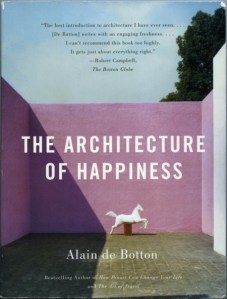
Image.Book Cover.Alain de Botton.Architecture of HappinessWith this in mind, feel free to read the following interview with myself:

Alias: How did you come by this lame idea?

Doug: To begin, I read a lot. Too much for other people’s good. Most of the books I’ve read I own, and the best ones are a valuable part of my library. Among my treasured books are books about books. One of these is a book called The Reader’s Companion: A Book Lover’s Guide to the Most Important Books in Every Field of Knowledge, as Chosen by the Experts. Now, I’m not expert about very many things, but books have been great companions for me for as long as I can remember.

Alias: What are some books you remember from your youth?

Doug: I may get to that in a separate contribution to this series. But the other day I was reminded of a whole series of books that I read cover-to-cover. I was riding on the Coaster—a train that runs from Oceanside to San Diego—with my extended family. There were about 25 of us. I got to chatting with one of my young nephews and I asked him what books he liked. He said he likes the Sugar Creek books. So bam! out of the blue comes this memory of all The Sugar Creek Gang books. I was reading those about 35 years ago! So my nephew and I have a lot in common. See what happens when you talk about books?

Alias: So this series is about books that have been important to you?

Doug: Important to me in a way that might be of interest to others who care about the things I care about. I’ve spent a lifetime asking people for book suggestions. I want to write about the choices I’ve made along the way, why they mattered then and whether they matter now, and reasons I might recommend them to others. It would be tough to list the most important books in my own field, and impossible for any other field. But I can list books of value, and that’s what matters. If I’m interested in a genre of literature new to me, like science fiction or epic poetry, I want to select from choice offerings. I poke around and ask people for suggestions. Then I jump in. I get a feel for things, and then I move on. Maybe I come back.

Alias: Why don’t you have a classy name for this series?

Doug: Good question. What would you suggest?

Alias: How about “Books of Value”?

Doug: I like it. Maybe my readers will have some great ideas, too. I can go back and change titles to earlier entries in the series to reflect the name of the series. But a series name should be catchy, and it should reveal something about what to expect.

Alias: This entry is called “Building a Case for Architecture”? Why is that if all we’re doing here is conducting an interview?

Doug: Well, we got a little off track. But architecture is an interest of mine. I mean, I’m interested in certain things about architecture—what buildings mean, why one building is beautiful and another isn’t, whether a particular building fits its surroundings or whether it’s poorly located. How long a building has been where it stands, and what the surrounding area was like when construction was completed. There’s no way that Christopher Wren could have imagine how the city of London would eventually gobble up the ornate churches he designed for the city. There are so many angles on architecture. I guess there was a pun in that.

Alias: What are some other interesting issues?

Doug: Whether the purpose of a building has changed over time. For example, this seems to be the case with so many churches in New England, all painted white and adorned with a simple steeple. What are they there for now? What happened there? That question, “What are they there for now?” sort of grabs me. These buildings have been “re-purposed,” as if that purpose they now serve is the purpose they were designed to serve. “They’re so cute. Perfect for a boutique shop, or a tea room.”

I’m interested in changes in architecture over time, and why some forms of ancient architecture have been borrowed many times since their invention. For example, do you know the architectural basis for this nation’s capitol building? Why was this chosen? Who made the decisions? What was this new adoption of classical architecture supposed to mean to a young nation?

Ot this . . . how does a building make you feel when you stand next to it, or when you’re inside? Is it better to view it from a distance? Is it even possible to view it from a distance, or is it too crowded by other buildings? When I see a photo of aerial view of New York City, what do I see? Buildings. I don’t see one building; I see many buildings. But I may not focus on any one of them. My attention may be on the whole that somehow is NYC. How is that possible? What does it say about NY? What does it say about me? Am I different than most people in the ways my attention is attracted when I see a skyline?

What’s more impressive, the Golden Gate Bridge as such or the terrific human accomplishment it represents? Does it really “represent” human achievement? Is it supposed to? Or try this one. How is the Golden Gate Bridge different in kind than the “carvings” of Mount Rushmore? What does Mount Rushmore “mean”? Are there any buildings that mean the same thing? Could there be? What is the limit to what a building can mean? And what may be a related question, what were the great monarchs or the papacy thinking when they commissioned the design and erection of certain buildings?

Many old buildings get bull-dozed, but others are preserved at great expense? What makes the difference? Who decides? Have there been any major regrets about decisions past? And how, exactly, is a building preserved? You can’t tuck them away in an art museum somewhere.

Alias: And there are books that explore such things?

Doug: Yes! My first suggestion is the book The Architecture of Happiness, by Alain de Botton. Start here. If you aren’t turned on about buildings after that, then move on. Read about crocodiles instead. If you’re hooked, then learn a little about types of architecture. For this I suggest the morsel Architecture: A Very Short Introduction, by Andrew Ballantyne. It’s not beautifully crafted, like de Botton’s, but it’s short and it’s educational. There are guidebooks for specific buildings or neighborhoods. There are books with sketches of buildings old and new. And don’t forget about biographies of great or celebrated architects: Frank Lloyd Wright and Le Corbusier. And then are biographies, as it were, of buildings themselves, accounts of how they were designed and built, the purposes they served or serve, and so on. Think of the Chrysler Building, the Empire State Building, the Taj Mahal.

Alias: Are there books on architecture that you hope to get to eventually?

Doug: Yes. Heavenly Mansions and Other Essays on Architecture, by John Summerson; Lewis Mumford’s From the Ground Up, another book of essays. These authors are good at their craft. They are wordsmiths, which makes reading about architecture (or anything, for that matter) more enjoyable. I like the essay style because you can dip into a work at your leisure and take something away in short order. Gaston Bachelard, The Poetics of Space looks interesting to me from this distance. But the style of French philosophy may not be to my liking. We’ll see.

Other Sources for Reading about Architecture (for non-architects):

Readers, do you have suggestions for non-architects reading to understand and appreciate architecture? Leave your suggestions for the rest of us in the comments box.
Robert Heinlein and the Novelty of Science Fiction—Part 1 in a Series


I have no special expertise in science fiction. I’ve read little of it. But what I’ve read I’ve selected carefully and most of it has been a joy to read. The league of SF enthusiasts is intense if not immense. Though the SF genre has attracted a hefty percentage of readers, this result has been hard-won. This is my impression from the sidelines, as it were.

My limited direct experiences with science fiction may be of interest to those fiction readers who have long wondered what all the fuss is about, and to those enthusiasts who care to know what a neophyte like myself might say about what he’s found worthwhile.

So here is the first installment in my recounting of those experiences . . .

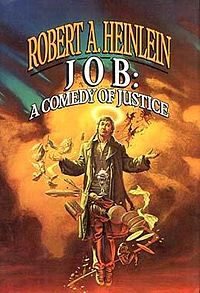
Image.Book Cover.Job Comedy of Justice.Robert HeinleinI think the first author I read was Robert A. Heinlein. An excellent choice, I’m sure the experts would agree. (You may know him through some of the films inspired by his work.) The trouble is remembering which book came first—and whether there were others. I’m pretty sure it was Job: A Comedy of Justice. I like sustained, serious comedy, and I’ve always been drawn to the Old Testament book of Job. Putting the two together would be quite a feat. Those who subscribe to my webpages will likely find this novel a tempting entry point for reasons that resemble my own. (Others, who do judge a book by its cover, may be drawn first to his book Friday.)

As a philosopher, I can appreciate Heinlein’s talent as an observer of the human condition and what a future society might look like, if we continue on our present course, or if dramatic changes happen to us (notably through the development of technology). Heinlein had metaphysical and epistemological interests, as well, but his sensibilities were quite different than my own. This is no reason to pass over his ouvre. I’m an advocate for reading outside your comfort zone and conversing with diverse perspectives. It’s an aid to understanding your own worldview, and accepting it more responsibly. And fiction is among the best ways to access alternative perspectives on reality and human experience. Literate science fiction can do that for you. (I think, also, of Robert Pirsig’s book Zen and the Art of Motorcycle Maintenance. Not SF, but imaginative and contemplative, a far distance from where I stand intellectually, but by a clever fellow-traveler—on a motorcycle, to boot!)

Heinlein lived to be 80 years old, but his output was comparatively meagre for one with so great a reputation and influence. It shows that quantity is no match for quality. His total cast of significant characters, on the other hand, is almost ridiculously extensive. And you know an author’s influence is substantial when there’s a thriving online society dedicated to his legacy.

So that’s how it all started for me, and for that, I suppose, I’m in debt to Heinlein. But deep as my appreciation goes, I will never be considered a “Heinleiner.”

Note: For an exposition of worldview analysis within literature, I recommend James Sire, the book among his many that had the greatest influence on me. When I read it in the late 1970s, the book was called How to Read Slowly: A Christian Guide to Reading with the Mind. It’s now been adjusted to How to Read Slowly: Reading for Comprehension, which doesn’t quite get at the essence of the book, I feel. It’s a book I wish I had written. But I couldn’t have done so when I was 18. Probably still couldn’t.

Judging Mystery Novels by Their Opening Lines


1st edition (Alfred A. Knopf)

1st edition (Alfred A. Knopf) (Photo credit: Wikipedia)

Two days ago I invited readers to choose one of four mystery novels based on its first line alone. I also challenged readers to identify author and title for each of the opening sentences of the four books. Click here for details.

Here are the opening lines, with title, author and year of publication:

#1: “A blizzard raged on the glacier.” From Operation Napolean, by Arnaldur Indridason (St. Martin’s, 1999).

#2: “Three days before her death, my mother told me—these weren’t her last words, but they were pretty close—that my brother was still alive.” From God for Good, by Harlan Coben (2002).

#3: “God, I hate air travel.” Call No Man Father, by William X. Kienzle (1995).

#4: “When they ask me to become President of the United States I’m going to say, ‘Except for Washington DC.'” Spy Hook, by Len Deighton (1989).

I read these books in the following order:

  • Spy Hook
  • Gone for Good
  • Operation Napolean
  • Call No Man Father

Each has its virtues, but ranking them is easy for me. In descending order of preference, this is my ranking:

  1. Call No Man Father
  2. Operation Napolean
  3. Gone for Good
  4. Spy Hook

Next challenge: match book titles with the main characters in each.

  1. Will Klein
  2. Father Koesler
  3. Kristin
  4. Bernard Samson

Can You Judge a Book by Its First Line?


You can’t judge a book by its cover, right? How about judging a book by its first line?

In recent weeks I’ve read four novels by different authors, all of them mysteries. In chronological order these books were first published in 1989, 1995, 1999, and 2002.

The Mystery BookshelfIf you were to decide to read just one of these books this year, based on the first line only, which would you pick? Here are the first lines for each, in random order.

#1: “A blizzard raged on the glacier.”

#2: “Three days before her death, my mother told me—these weren’t her last words, but they were pretty close—that my brother was still alive.”

#3: “God, I hate air travel.”

#4: “When they ask me to become President of the United States I’m going to say, ‘Except for Washington DC.'”

If you can identify the author and title for all four of these quotations, you deserve a free copy of each. Of course, we don’t always get what we deserve.

Maybe you can match quotations with year of publication?

Or maybe you can guess which of these books I liked most . . .

The irresistible image used here is from a Twitter site called “Mystery Bookshelf,” username @themysteryblog. Check it out.

[In two days, I’ll connect the dots.]

Email Overload: How Soon Can I Get Back to You?


You’ve Got Mail!

Anyone with an email account gets flooded with stuff that you simply don’t care to see, don’t need to read, and can’t bear to respond to. That’s a general problem. This problem works out in different ways for different people. Whatever the scenario, it creates a challenge to efficient email management, which is crucial to general time management, which is crucial to personal sanity.

youve_got_mail_ver3What about unsolicited email from unknown parties with legitimate questions you may be able to help with?

This I encounter on a regular basis. There are two basic reasons for this.

First, people learn of my interests and expertise from the books I write and the public speaking I do. I also blog and have a Facebook and Twitter presence. I write and speak about film, books, events, the existence of God, faith and reason, science and religion, kayaking, miracles, epistemology, faith and reason, motorcycling, cultural engagement, politics, and other things that I can think of right now. As you might imagine, there others in the world who have similar interests.

Second, after speaking on a topic and meeting with people to discuss their questions, I will frequently encourage them to contact me for more about a topic, for individual discussion, for reading recommendations, etc. I actually give them my email address. But I always ask them to remind me when and where we met.

My colleagues are good about checking with me before giving out my contact information, so I’m pretty much in the driver’s seat on that one. Still, my email address is pretty easily discoverable. Maybe the FBI can’t figure it out, but I’m sure you can.

Let me shoot straight about a couple of things:

  • I like hearing from people with legitimate questions, perspectives, requests, and invitations to speak.
  • I have to control the flow of input/output so that I can reply to worthy inquiries.

Much of this is up to me. But I have a few suggestions that may help two groups of people: (1) those who face the same challenge, and (2) those trying to get through with legitimate email messages.

Speaking for myself, it’s more likely that I’ll respond, and respond quickly, if:

  1. You write a very specific, descriptive subject heading.
  2. You keep your message brief.
  3. You’re very specific and clear about why I’m the guy you thought you should write.
  4. I remember you from a pervious meeting.
  5. I know in advance that you’ve been referred to me by someone I respect.
  6. You demonstrate that you’ve spent your own valuable time looking elsewhere for help on your topic.
  7. You acknowledge that I may not be able to respond immediately, or even later on.
  8. You’re offering me $10,000, and all expenses paid, to speak for 30 minutes someplace on this planet.

Note: If you’re a past student of mine, you get priority over all other cold messages that come my way. If I know it’s you, you will hear from me!

Here are some question types that dissuade me from responding:

  1. Can you answer a few short questions for me?
  2. Can you recommend a book about . . . ?
  3. I read your book about . . . and I disagree with it. What is your response?
  4. Will you please send me a complimentary copy of your book on . . .?
  5. Will you please help me build my library with books you don’t need anymore?
  6. I’d like to have an email discussion with you about . . . . (Not technically a question.)
  7. Can I drop by your office sometime to chat?
  8. A friend of a friend of a friend of mine suggested that I contact you about . . . . (Especially don’t do this if all of the above “friends” are Facebook friends you’ve never met.)

[I did once get an email message and a phone call from a guy in New Zealand who said he was leaving on a world tour and would like to meet with me when he was in Los Angeles. I said yes. But that guy happened to be Michael Denton, whose book Evolution: A Theory in Crisis I had read. He’d read my book on God and evil and wanted to talk about the problem of evil. We did and we became friends.]

None of this is intended to scare people off from writing me. I really do welcome email that deserves the attention and time a responsible answer would take. And if you’re reading this—and we both know you are—you’re probably one of those people who should feel free to contact me. The guidelines I suggested here will help single you out from the rest of the pack and elicit a timely response.

One More Thing . . . .

I read every comment I get at this website and I respond to virtually every comment. So keep those comments rolling in! If you have other suggestions for quality email communication, how about sharing them here?

Other Sources on This Topic

These guys helped me with ideas for this post:

Adam Grant, “6 Ways to Get Me to Email You Back”

Tim Ferriss, “5 Tips for Emailing Busy People”

Silence Your Cell Phones—World War Z Is about to Begin


Cover of "World War Z: An Oral History of...

Cover via Amazon

What is it about zombies that makes them so worth watching? I can’t prove this, but I have a hunch . . . nothing does.

With nothing to do but watch the world come to an end, and no one to do it with, I went to see World War Z. How could I have forgotten what the ‘Z’ stands for? I had just come from a hamburger and an excess of fries at the local 5 Guys when I got to the theater. It looked like I was at least ten minutes late. I told the ticket agent (isn’t that a fancy title?) that I was there to see World War Z, if, but only if, it hadn’t started yet. I wasn’t sure he could sort out the bi-conditional “if and only if,” but this kid must have a keen mind for logic. He told me I had nine minutes; they were still showing previews. I asked if the theater was full. “There are eleven people,” he said. I wondered, Is that good or bad? I guess for a Tuesday night, that’s pretty good.

I paid for my ticket and met my old friend Ken, the guy who takes my ticket when I walk in. I always ask Ken what he thinks of the movie I’m about to see. I’ve learned to trust Ken’s judgment. This time Ken said, “I’m not much into zombie movies, but in this one they look pretty good.” That’s when I realized what I had gotten myself into. That’s when it hit me that World War Z is about zombies . . . and the world, of course. I felt stupid. What else could the ‘Z’ stand for? But I might be forgiven. Check out the movie poster. Doesn’t it bring to mind the Zorro series, this time with a faint hint of apocalyptic doom?

Usually, I don’t wait in line to see a zombie movie. In fact, if you’ll pardon the allusion, I generally avoid them like the plague. But I had paid for a ticket. And Ken had said about this movie that the zombies “look pretty good.” I had to satisfy my curiosity. What do good-looking zombies look like? Is this a movie my wife would approve of?

For those who haven’t seen the movie, here’s a spoiler alert: Ken must have meant something else by zombies that “look pretty good.”

For the record, the zombies I know (remember, I’m a university professor) don’t look or act anything like the ones in this movie. My zombies are rather subdued, almost motionless. If you tripped over them in a dark alley, you still might not know they were there. By comparison, I must say, the zombies in this movie are pretty amped up. And you certainly would never want to meet them in a dark alley. (I wonder what it would be like if these zombies and my zombies were to meet?)

I did learn something from this movie, apart from the intended message narrated at the end. If an encounter with a zombie doesn’t make your teeth chatter, hearing his teeth chatter will make you laugh. That’s how it affected 9 out of 11 people in the theater. (Silly me, there were other times when I could not restrain a mild chuckle, even when no one else appeared to be in such good humor.)

I have an obligation to tell you there are things about this movie that simply aren’t believable.

  • Israel’s Mossad figures out before anyone else in the world how to protect themselves from zombies, but they don’t know the effect that loud, screechy microphones would have on them? Come on, people! The Mossad are better than that.
  • Can you really hear the teeth of a zombie chatter through plexiglass that is so substantial that even the zombie can’t break through it? Give me a break!
  • Are we supposed to believe that an envoy from the United Nations is the best candidate for staving off the complete annihilation of humanity? I’d trust any neighbor in my cup-de-sac over the U.N. boys and girls. (Remember Benghazi and Susan Rice?)

These things just don’t add up. Fortunately, the movie’s realism is salvaged by the general plot: Savage zombies ravage the world, quickly turning the un-undead into the undead, and there’s a bona fide solution to the problem that is discovered by Brad Pitt—and just in time.

That’s the reassuring message of the film.

Or not.

But I can’t spoil the movie for you by revealing what the narrator says at the end.

If that doesn’t get you to go see this movie, then I guess nothing will.

My First Published Dialogue—”Can and Would God Speak to Us?”


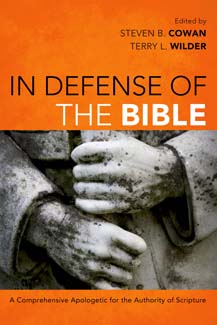
My most recent publication is the opening chapter in the new book In Defense of the Bible: A Comprehensive Apologetic for the Authority of the Bible, edited by Steven B. Cowan and Terry L. Wilder (B&H Academic, 2013).

The full title of my chapter is “Can and Would God Speak to Us? A Dialogue on Divine Speaking.” Writing in dialogue format was a new venture for me. I enjoyed listening in on what “Chad” and “Danielle” had to say in conversation with each other. (What they say about learning something new during the process of writing is true!) I was challenged by the format, but I hope to try my hand at it again sometime.

Image

I encourage readers interested in sophisticated responses to contemporary challenges to biblical authority to read this book. Each chapter stands on its own as an important contribution on a specific topic. There’s something here for everyone, with topics ranging from canonicity to supposed contradictions in the Bible, from biblical archaeology to biblical criticism, from issues of slavery and sexism in the Bible to issues of genocide in the Bible. There are discussions of the Bible and ancient pagan myths, the historical reliability of the two testaments, the quality of biblical manuscripts, the interpretation of Scripture and its role as a source for theology, and science and the Bible.

Book Prize for Being Good


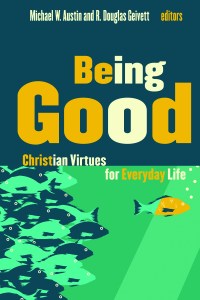
Austin and Geivett.Being Good.Book CoverIn June 2013, our book Being Good: Christian Virtues for Everyday Life (Eerdmans, 2012) received the “Character Essay and Book Prize,” awarded by the Character Project at Wake Forest University. Here’s the Character Project’s description of criteria for awarding prizes:

Several Character Essay and Book Prizes were awarded to essays or books on character which are accessible to non-academic audiences in venues with a wide readership. We received many outstanding entries, and awards were made in three areas: the psychology of character, the philosophy of character, and the theology of character.

We wish to thank Christian Miller, Director of the Character Project, for his generosity and warm hospitality. Rebecca Konyndyk-DeYoung’s chapter on “Courage” received an independent award in the essay category. Congratulations, Rebecca!

Mike Austin and I continue to be grateful to Eerdmans for their enthusiastic support in publishing this book.

Novel Quotation—What University Professors Do


This quotation comes from the novel A Novel Bookstore, by Laurence Cossé. It speaks knowingly of the professor’s vocation.

‘That’s the way they are, those university professors,’ said Madame Huon, ‘they work one day a week.’ ‘One day!’ echoed Madame Antonioz. ‘You need at least two hours to get to Chambéry. If you take off an hour for lunch, that leaves half a day.’

We have been found out, I’m afraid!