An Enigma
March 10, 2015 Leave a comment
Atheism. Narcissism. Genius. Machine. Consciousness. Deception. Homosexuality. Hormonal therapy. Heroism. Suicide.
Are you good at believing the things you believe? Does it show in the way you live?
March 10, 2015 Leave a comment
Atheism. Narcissism. Genius. Machine. Consciousness. Deception. Homosexuality. Hormonal therapy. Heroism. Suicide.
March 9, 2015 Leave a comment
Due to popular demand, the contest described below ended within a few hours. A new contest that should last longer is now in effect. For details click on this link.
***
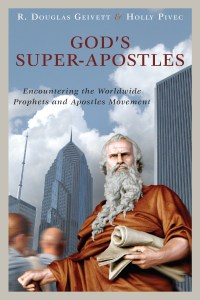
I’m pleased to announce that our book God’s Super-Apostles is doing well and is addressing readers’ needs. Our two books, including A New Apostolic Reformation?, are in their second printing, and a third will be happening soon.
Today is the first day of an Amazon Giveaway contest for God’s Super-Apostles that ends March 16. You can enter the contest by clicking here for details at Amazon. If you’ve already purchased your copy, this will make a great gift for a concerned friend.
February 24, 2015 Leave a comment
Today I’m doing a radio interview with Greg Koukl on his show Stand to Reason. We’ll be discussing the topic of my two new books about the New Apostolic Reformation. The show airs live at 4 pm Pacific Standard Time on KKLA 99.5. It’s also streamed live at the show website: str.org. After today, the interview will continue to be available online.
Our books, God’s Super-Apostles: Encountering the Worldwide Prophets and Apostles Movement and A New Apostolic Reformation? A Biblical Response to a Worldwide Movement, were first released in December and are now in their second printing. A third printing is planned in the next few weeks. Both books can be purchased in paperback or in Kindle format at Amazon.
February 16, 2015 1 Comment
Tim Challies’s review of our book God’s Super-Apostles: Encountering the Worldwide Prophets and Apostles Movement has been translated into Thai for those who follow the work of Karl and Sun Dahlfred in Bankok. It can be found here.
Here is a portion of the review in Thai:
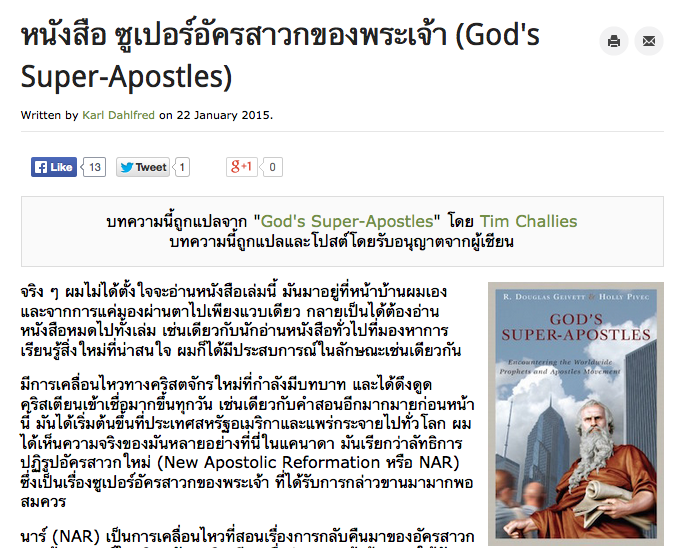
The original review by Tim Challies can be read here.
February 2, 2015 5 Comments
I’ve recently returned from Saint Louis University where I was Visiting Faculty of Philosophy for the fall 2014 semester. I was there on a generous grant from the Templeton Foundation doing research on The Philosophy and Theology of Intellectual Humility. I’ve received an additional grant for the current spring 2015 semester as Research Fellow in the Center for Christian Thought at Biola University. The theme is Intellectual Virtue and Civil Discourse. With this grant I’m able to continue my research on the general topic of intellectual humility. There are many good online materials and in-residence opportunities at CCT. Click here for details.
February 1, 2015 Leave a comment
Those following the New Apostolic Reformation may want to tune into my interview with the Pilgrim Radio Network (pilgrimradio.com) in a two-part discussion of the subject of the New Apostolic Reformation. Part 1 airs Monday, February 1 at 2:30 am, 12:30 pm, and 9:30 pm. The second portion airs Tuesday, February 2, on the same schedule.
We’ll be talking about two books I’ve co-authored with Holly Pivec: A New Apostolic Reformation? and God’s Super-Apostles.
 Both books are available
• in paperback
• on Kindle
If you wish to schedule an interview with one of us about the New Apostolic Reformation, or review a copy of one of our books, please contact our agent Emily Varner at AcademicPS.
February 1, 2015 Leave a comment
Imagine my surprise when I received in the mail yesterday a book published in Chinese. Often I do get complementary copies of new books. But in Chinese? This does not happen every day. On close inspection it turned out to be a Chinese translation of the book Four Views on Salvation in a Pluralistic World, a Zondervan publication. Years ago I co-authored one of the four views for the original English edition of this book, never expecting that it would one day reach a nation with over 1 billion people! How strange to see my name written in Chinese characters. I didn’t know that was possible.

Chinese Edition of Four Views on Salvation in a Pluralistic World—Published by CCLM
If you’re more proficient in Chinese than in English, I commend this edition book to you!

A useful summary and review of the book by Michael J. Vlach can be found here.
January 22, 2015 Leave a comment
For more information about our books on the New Apostolic Reformation, you may want to read these reviews:
• “Young, Restless, and Reformed, here and here
If you learn of reviews that should be included in this list, please say so in the comments box below.
—————
Both books, God’s Super-Apostles and A New Apostolic Reformation? can be ordered at Amazon here and here, or direct from the publisher here.
January 21, 2015 Leave a comment
The western world is still trying to make sense of the Charlie Hebdo murders in Paris on January 7, 2015. Four days later, in his Forbes column, Doug Bandow offered a unique analysis. He makes an interesting and persuasive argument that there is much more at stake than free speech. What lies at the root of this incident, reflected time and again in one atrocity after another, is religious persecution meted out against dissenters.
Here is one especially thought-worthy paragraph:
The thugs who cut down a dozen [people at] Charlie Hebdo are the international cousins of those who murder alleged blasphemers and apostates in Muslim nations. Laws against blasphemy once were common in the West, and persist in a few nations—some, ironically, represented by government leaders who marched in Paris—and even a couple of American states, but are rarely used. However, blasphemy laws are actively enforced throughout the Muslim world. The irony is that where Islam is strongest, with belief by overwhelming popular majorities and support from authoritarian state authorities, the slightest perceived criticism of the dominant faith can result in prison or death. That suggests lack of confidence in the truth of Islam and fear of free inquiry by free minds.
The last two sentences draw attention to a neglected point. Would a religious group that is secure in its beliefs be as hypersensitive as those who murder alleged blasphemers?
I would add that such horrific actions—which are a daily occurrence somewhere in the world—are rooted in a worldview, a set of controlling beliefs that are either true or false. Our public discussion needs to acknowledge this point. There has been plenty of talk about whether Islam is a “peaceful religion” that has been hijacked by militant apostates (notice, they aren’t generally called “apostates” even by moderate Muslim leaders). But this distracts from three more fundamental questions:
The atrocities we’re witnessing should prompt us to give more attention to this question.
January 21, 2015 Leave a comment
In the January 2015 issue of the Assemblies of God Ministers Newsletter, George Paul Wood urges his Pentecostal friends and co-workers to read our books God’s Super-Apostles and A New Apostolic Reformation? A Biblical Response to a Worldwide Movement. His
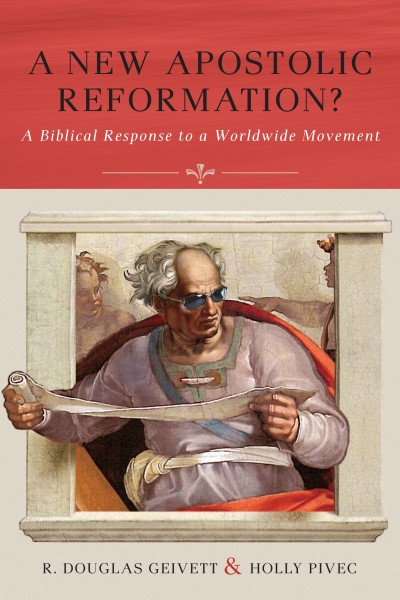 review begins on page 6. In addition to summarizing the message of the books and explaining his view of their importance for Pentecostalism worldwide, Wood presents his own summary of the central tenets of the New Apostolic Reformation.
What, then, is the New Apostolic Reformation? Its most distinctive teaching is that the end-times church must be led by apostles and prophets. In addition . . ., NAR promotes strategic-level spiritual warfare, apostolic unity, and the ability of all Christians to work miracles.
Wood notes that the Assemblies of God position paper “Apostles and Prophets” expresses concern about NAR emphases. To be sure, leaders of the New Apostolic Reformation very clearly have moved beyond classic Pentecostalism. Wood aptly refers to NAR leaders as “hypercharismatics.” As a Pentecostal leader himself, he implores fellow Pentecostals to resist the excesses of the NAR movement, and to recognize how distant this movement is from the core commitments of classic Pentecostalism.
————
*The Assemblies of God Ministers Newsletter is circulated to some 36,000 credentialed ministers of the AG church.
January 20, 2015 Leave a comment
Tim Challies, pastor of Grace Fellowship Church in Toronto, Ontario, reviews God’s Super-Apostles, our recent book assessing the New Apostolic Reformation.
His review article begins . . .
I didn’t actually intend to review this book. It showed up at my door and a brief glance turned into a quick skim turned into a full read turned into a review. As a committed reader always looking for something new and interesting, I just love it when that happens.
Tim, we just love when that happens!
Thank you for helping to expose the excesses of the New Apostolic Reformation. It’s clear from the comments your review has already gleaned that many of your readers have encountered the NAR movement and its extraordinary claims.
Update:
The Tim Challies review has been translated into Thai. Read here.
—————
Both books, God’s Super-Apostles and A New Apostolic Reformation? can be ordered at Amazon here and here, or direct from the publisher here.
January 6, 2015 4 Comments
Today I’ll be on the Janet Mefferd Show to be interviewed about my new book, co-authored with Holly Pivec, A New Apostolic Reformation? A Biblical Response to a Worldwide Movement. The Show airs live at 3 pm Central. Go to janetmefferd.com for the live broadcast, or listen to the interview at your leisure in the audio archives.
July 9, 2014 1 Comment
This afternoon I heard a radio announcement that the season premiere of Fx’s “The Bridge” airs tonight. I thought I might tune in. So I settled into my easy chair and flipped on the TV. Bill O’Reilly was waxing eloquent and I was reaching for my TimeWarner Cable guide to find the Fx channel. I paused, however, to listen to O-Reilly’s customary interview with Dennis Miller, often the only worthwhile segment on “The Factor.”
Dennis signed off and I recalled my task—to find where I can get Fx on my TV. I scanned the column of station numbers. And just as my eye landed on “Fx,” I heard Bill O’Reilly actually say “Fx.” I’m not making this up. O’Reilly then went on to remind his audience—that would be me (in a manner of speaking)—that “The Bridge” airs tonight.
Bill O’Reilly is a talented man. But his ability to read my mind, and his inclination to say something about it on national TV, is uncanny.
***
Footnote: Speaking of coincidences, the timing of tonight’s premiere of “The Bridge” could not be better. This is a series about border crossings between Mexico and the U.S. Today there’s as much coverage of our urgent border dilemma as there is of the imminent threat of an Israeli ground invasion into Gaza. Border crossings are making news in more ways than one. And that’s a memo.
July 9, 2014 13 Comments
Maybe you’ve heard of it—the New Apostolic Reformation. Or maybe you haven’t. Either way, you probably know someone involved in the movement. It’s even possible that you attend a church that is part of a vast network of churches and ministries promoting the cause of modern-day apostles and prophets. You may be supporting missionaries and Christian organizations that have joined this cause.
Whether you’re sympathetic, concerned, or just curious, I urge you to take a close look and consider how you will respond. This movement is worldwide. Its mission is ambitious. It seeks to control the key sectors of society, including government, education, and the media. And it claims to act with unique authority from God, who has re-instated the New Testament offices of apostle and prophet to usher in the kingdom of God.
Scores of people are drawn to NAR claims that God is now revealing himself through an army of prophets and that they are producing miracles on a scale never seen before in Church history. The signs and wonders performed by the new apostles and prophets, they say, are greater even than the miracles wrought by Jesus.
Scores of people have been injured by this movement. It has divided families. It has left people in financial difficulties they never imagined. It has fostered disappointment with God, who failed to deliver on his alleged promises. It has even left some with a bitter taste about Christianity of any kind.
The major media have been talking about it. But there hasn’t been a serious and detailed investigation of NAR claims until now.
I’ve just completed two books, co-authored with Holly Pivec, about the New Apostolic Reformation, a movement ignited by C. Peter Wagner and now spreading like wildfire beyond the limits of his own influence. We offer a full exposition of the major teachings of movement leaders, and we examine them in detail, testing them against the teaching of the Bible. We conclude that their claims are false and misleading. Some are dangerous.
If you’re looking for an overview of the movement and you want a concise biblical evaluation of the movement, then you might begin with our book God’s Super-Apostles—Encountering the Worldwide Prophets and Apostles Movement.
If you want a fuller exposition of NAR teachings and a more complete examination of the movement, then you’ll want to read A New Apostolic Reformation? A Biblical Response to a Worldwide Movement. In this second book we offer detailed documentation for our description of the New Apostolic Reformation. And we carry our examination further, with fuller arguments to support our assessment.
I want to thank Holly for enjoining me to research this movement with her and for collaborating on two books that we believe will be of real service to others, including Christians and non-Christians. Both books are in production now and will be out in October or November. Already people have been placing advance orders with the publisher, Weaver Books.
In the days ahead I’ll be sharing more about the NAR. Meanwhile, you may want to visit Holly’s blog spiritoferror.org.



 Doug Geivett's Blog
Recent Comments