Arnold Lunn (1888-1974) – Skiing Expert, Agnostic, and Christian Apologist


Arnold Lunn was born to a Methodist minister, but he was himself agnostic and a critic of Christianity—until he was 45 years old, when he converted to the faith. Today is the anniversary of his death in 1974.

Lunn was a professional skier and full-time enthusiast. He founded the Alpine Ski Club and the Kandahar Ski Club. He brought slalom skiing to the racing world, and he’s the namesake for a double black diamond ski trail at Taos Ski Valley.

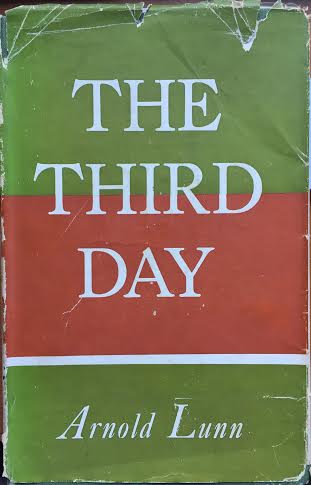
Lunn credited his agnosticism to the wholly unconvincing cause of Anglicanism. He looked in vain for persuasive arguments for the existence of God and the truth of Christianity. Later he Book Cover-Arnold Lunn-The Third Daywould say that “an odd hour or two at the end of a boy’s school life might not be unprofitably spent in armouring him against the half-baked dupes of ill informed secularists” (The Third Day, xvii). He wrote in criticism of the faith and debated Christianity’s prominent defenders.
Despite his religiously agnostic stance, Lunn found that problems for scientific naturalism proved equally recalcitrant. This created a dilemma for him. But his vigorous opposition to Christianity was guided by an intellectual honesty that was helpless before the evidence he exhumed. In due course he gave up and converted to Christianity. All the energy he had devoted in the cause against Christianity he now mustered on behalf of Christianity. He published several books in support of Christian belief.

He famously debated two major critics, C. E. M. Joad and J. B. S. Haldane. The inside flap of his book The Third Day observes that Lunn was an effective apologist “because he has learnt apologetics in the controversial arena.” But Lunn is unusual for having taken alternate sides in this arena. As he wrote in a pamphlet, “I can imagine no better training for the Church than to spend, as I did, a year arguing the case against Catholicism with a Catholic, and a second year in defending the Catholic position against an agnostic.”

Lunn was prolific. He wrote manuals in skiing and mountaineering, fiction, memoirs, and popular books of Christian evidences. Personal letters between himself and both Joad (Is Christianity True?, 1933) and Haldane (Science and the Supernatural, 1935) were published, as well.

Here are a few excerpts from his book in defense of the resurrection of Jesus:

Substantial Truth Under Circumstantial Variety

William Paley pointed out that human testimony is generally to be accepted when the “substantial truth” of witnesses survives despite “circumstantial variety.” This principle is practiced in courts of law when evaluating testimonial evidence presented during trial. The rule applies also in weighing the testimony of eyewitnesses to Jesus following his resurrection from the dead. Arnold Lunn puts the point this way:

If it could be proved that the various accounts which we possess of the events of the first Easter Sunday and of the subsequent appearances of Jesus to the disciples were not wholly consistent so far as details are concerned, this fact might be difficult to reconcile with any theory of direct inspiration or Biblical inerrancy but would not invalidate the evidence so far as the central fact of the Resurrection is concerned. (70-71)

Lunn is not conceding anything. He is not supposing that there are real contradictions in the eyewitness testimony. His point is that even if there were discrepancies, this would not disqualify their common testimony that Jesus did rise from the dead.

The “Collective Hallucination” Hypothesis

Lunn writes with good humor when he responds to a longstanding objection to the resurrection claim.

The anti-miraculist does not deny that the disciples believed that they had seen the risen Lord, but he asserts that they were victims of ‘collective hallucinations’. Anti-miraculists suffer from the collective illusion that a polysyllabic phrase is a satisfactory substitute, both for proof and for explanation (74, with italics added here).

So, was it the risen Lord whom the disciples saw in the flesh, or did they merely imagine that they did?

To begin, circumstances must be abnormal for any normal person to hallucinate, and more so for groups of people. Next, eyewitnesses were slow to acknowledge that it was Jesus whom they had encountered during his post-resurrection appearances. It is a curious thing that Mary Magdalen, for example “saw our Lord and mistook him for the gardener” (75). This happened, as well, when a group of disciples encountered Jesus on their way to Emmaus. The disciples in the Upper Room thought they saw a ghost. In each case, those who were present had to be persuaded that it was, in fact, Jesus who appeared to them. Whatever it was that did the trick for them, it wasn’t some hallucinatory experience. Their initial experiences did not immediately issue in recognition or faint apprehension. For they had no genuine expectation that Jesus would be raised from the dead. “They didn’t run away with their first impressions, and tell unauthenticated stories of a miracle. They examined their first impressions and only by examination learned of their miraculous truth” (75). The disciple Thomas (the “doubter”) sought to preserve the utmost sobriety in consideration of evidence and would not even accept the testimony of his closest peers without firsthand experience.

It is indeed ironical that those who cannot accept the Resurrection of Jesus because it is unique are driven to postulate something no less unique, a ‘collective hallucination’ of a type not paralleled in all the records of human illusion, an illusion which has had an infinitely greater effect on the course of history than any admitted fact. (77)

The Origin of Primitive Belief in the Resurrection of Jesus

The real difficulty for any critic is to make sense of “the origin of a belief so contrary . . . to human experience” and to the expectations of Jesus’ disciples. They would have to have been desperate fanatics to proclaim the resurrection of Jesus before the gaze of those who had crucified their Lord, and to endure physical persecution and martyrdom. Somehow they managed to rock their world with their message, as countless numbers came to believe on the basis of their testimony.

The Empty Tomb

It has always impressed me that, though the tomb of Jesus was well-known to his disciples, there is no evidence of veneration, such as you would expect from family and friends with deep affection for a charismatic leader. As Lunn says, “From the moment that the women return from the Garden the tomb of Jesus passes, historically, into complete oblivion” (The Third Day, 83). If the disciples had not been convinced of the resurrection, they might well have regarded it as a shrine; they would have remained in Jerusalem rather than devote themselves to worldwide proclamation of a gospel they knew to be false.

Lunn examines several anti-miraculist hypotheses meant to explain the empty tomb. He calls these “anti-miraculist” because they are, without exception, motivated by a positive denial of the supernatural:

  1. Jesus did not die on the cross, but recovered in the tomb from which he subsequently escaped.
  2. The women made a mistake and went to the wrong tomb.
  3. The sepulchre in which Jesus was first buried was never intended to be a permanent tomb. Joseph of Arithmathea removed the body and transferred it to another sepulchre.
  4. Strauss’s proposal: It is quite possible that it [the body] was thrown into some dishonourable place with those of other executed criminals, and in this case his disciples may have, at first, had no opportunity of seeing the body. Later, when they preached the Resurrection, even their opponents would have found it difficult to recognise his body and to provide proofs of its identity.
  5. The disciples stole the body from the tomb.

Lunn demonstrates that “a reconstruction of the situation” answers each of these objections and reveals them to be due to an anti-miraculist bias.

Secularism and the Decline of Morality

Lunn had a way with the pen. “If a man be nothing more than first cousin to the chimpanzee, he has no logical ground of complaint if he is put behind bars” (The Third Day, xi; italics are mine). As religion declines, so too does morality decline. Atheism dooms humanity to a denial of what makes human persons human and worthy of moral respect. Even if true, the effect is most unpleasant. I would add that if we are little more than a bundle of nerves and their impulses, operating mechanically in a purely physical and deterministic world, it should come as a a real surprise that we are capable of noticing this “fact” and finding it disturbing.

The “Aesthetics of Argument”

Lunn lamented the Revolt Against Reason (the title of a book published in 1950), manifest not only among notional Christians but also by scientific materialists. He happily owned the accusation that he was a Christian rationalist. Evidence was, for him, the only sure path to responsible belief. Emotionalism and the general neglect of reason exact a costly loss of confidence and a failure of witness.

To counter this trend, Lunn called for what he termed an “aesthetic of argument.” He says, in the introduction to his book that details the case for the resurrection, that his aim is to convert the unconverted. He was converted under the pressure of evidence, and ever after it was his lifelong ambition to assist others along that path. He was convinced that public debate, especially at universities, was a valuable investment in this cause. For it ensured that more would attend to the arguments out of curiosity about the outcome of a debate than they would at a church-sponsored meeting.

This has been my experience, too.

* * *

For any young person who aspires to the work of an apologist, I cannot recommend enough a close study of the life and work of Arnold Lunn. One could do with more admirable leaders in this field of Christian theology and practice.

Notes:

  1. There is a brief interesting review of the Lunn-Joad correspondence in here.
  2. C. E. M. Joad, a vociferous critic of Christianity, later converted to Christianity, and subsequently was, in his own way, a defender of the faith. See The Recovery of Belief (1952).
  3. There is an inspiring brief biography, written by Bernard O’Connor, Archibishop of Melbourne. Here’s the link to my own marked copy.
  4. A review of Lunn’s book The Third Day is to be found in Studies: An Irish Quarterly Review 35.137 (March 1946): 118-21.
  5. Science and the Supernatural, a compilation of the letters between Lunn and Haldane, is available online here.

◊ ◊ ◊

Other posts in this series . . .

Justin Martyr—Apologist for Today


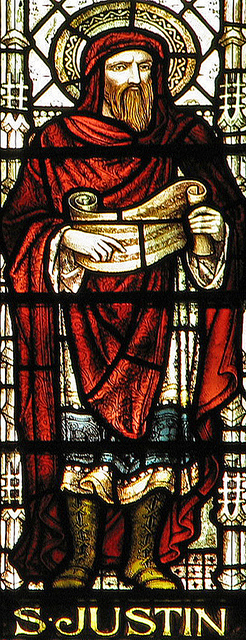
Justin Martyr Stained GlassToday is the Feast Day for Justin Martyr (ca. 100-165 AD), considered by many to be the first great apologist of the Christian church. The apostle Paul is surely a better candidate for that distinction. But Paul was an inspired author of Scripture. This is not true of any of the other great Christian apologists. And Justin apparently was the first of these. Certainly, he is the first whose writings have survived and are available in English translation.

Justin is mentioned with admiration by many of the ancients. Tatian, his pupil (according to Irenaeus), was fond of Justin. We learn from Tertullian that he was martyred for his advocacy for Christianity. Eusebius of Caesarea, the first church historian, who was himself an apologist, has much to say about Justin.

We have an account of Justin’s conversion in chapters 7 and 8 of his Dialogue with Trypho the Jew. What he recounts sounds like the story of a stranger’s witness to the truth of Christianity by various evidences and the stranger’s persuasion of an open-minded philosopher—namely, Justin—by these evidences. With the word of the stranger’s testimony, says Justin, “my spirit was immediately set on fire.”

Justin’s meditations, in addition to further study, led him to conclude that Christ had revealed “the only sure and useful philosophy.” Though the authenticity of this account is uncertain, Justin’s zeal for Christ and perseverance in defense of the faith are incontestable. Chapter 2 in the Second Apology reflects a debt to the faithful testimony of other Christians in his movement from Platonism to Christian belief (see also Second Apology, chapter 12).

His chief works in Christian apologetics include Dialogue with Trypho the Jew; First Apology; and, Second Apology. There is much that is admirable and worthy of fresh consideration in all of his writings. As to the first, the following understatement, from The Oxford Classical Dictionary, very nearly says it all: “He seems never to have been attracted to Judaism.”

Here are a few nuggets from Justin’s First Apology:

Criteria for Rational Belief

Early in his First Apology, Justin set forth a controlling principle, which we today might call a basic intellectual virtue.

Reason dictates that those who are truly pious and philosophical should honor and love only the truth, declining to follow  opinions of the ancients, if they are worthless” (chapter 2).

He invited scrutiny of the evidence and did not expect an irrationalist response to Christian preaching. And he urged his audience to weigh the evidence and resist any temptation to accept what is less reasonable because it is more palatable.

The Possibility of Resurrection

David L. Edwards relates that “as a young man he [Justin] had been a Platonist, until he had ceased to believe that souls could, if they tried hard enough, remember their pure life before birth.” This belief gave way to Christian hope in a future resurrection. For anyone who thinks it laughable that a dead body, dissolved into its constituents and diffused into the earth, might be raised physically from the dead, Justin makes an interesting observation. He asks them to imagine that they had no knowledge of the means of procreation, and to consider how they would react if they were shown both human seed and a picture of a mature human person, and then were told that from such a seed the man was produced. This would exceed anyone’s capacity to believe. And yet it would be true. As it is by the power of God that this thing comes to pass, so it is no less possible that God clothes the soul again in the future with the same body of the person who has died. He then recites Matthew 19:26 and Matthew 10:28. (See chapter 19.)

Common Ground in Reasoning with Nonbelievers

Justin also took pains to seek common ground with nonbelievers in his proclamation of Christian doctrine. The details of his method cannot be developed here. But students of Justin have examined his appeal to ancient philosophers (e.g., Socrates and Plato) in drawing out the truth of Christian belief. He held that many vital elements of God’s truth—shown forth more fully and in greater glory through the Old Testament prophets, Jesus Christ, and the New Testament writers—are latent in ancient pagan philosophers.

This point served at least two purposes. First, it pointed to the incompleteness of secular philosophies; second, it suggested such a connection with the complete truth realized in Christ that this would count in support of the Christian philosophy. (See chapters 20-23). Still, whereas “we say things similar to what the Greeks say, we only are hated on account of the name of Christ” (chapter 24). Christ’s philosophy goes beyond the classic creeds of the pagans, and this is a point of resistance for many.

Divine Sovereignty and Human Responsibility

I find especially interesting a passage in chapter 28. Speaking of God’s delay in bringing final judgment on on Satan and his minions, Justin writes:

For the reason why God has delayed to do this is His regard for the human race; for He foreknows that some are to be saved by repentance, and perhaps some not yet born. In the beginning He made the human race with the power of thought and of choosing the truth and of acting rightly, so that all people are without excuse before God; for they have been born capable of exercising reason and intelligence.

Observe, first, Justin’s doctrine of divine foreknowledge and human freedom. He is not altogether explicit here, but he intimates that God knows in advance what men and women, including perhaps those who do not yet exist, will freely do when presented with the opportunity to repent. His mention of those who have not yet been born invites curiosity about how he might regard the Molinist doctrine of divine middle knowledge. Second, he stresses the accountability of men and women for believing what is true, on the grounds that they are created with the capacity for “exercising reason and intelligence.”

Fulfilled Prophecy

Justin put much stock in the evidence of fulfilled prophecy to support the Christian verdict about Jesus Christ. He lists many prophecies of the Hebrew prophets and reasons that they are fulfilled in Jesus. He notes that the work of Christ was predicted even by Moses (see Gen. 49:11). He appeals to Isaiah 7:14 as a foretelling of the virgin birth of Christ (see Luke 1:32 and Matt. 1:21), and to Micah 5:2 regarding the place where Christ, as Messiah, would be born. He sees in Jesus fulfillment of such  prophecies as we find in Isaiah 52:2, 58:2, Psalm 22:16, and Zechariah 9:9-10. (See chapters 30-53.)

This method in Christian apologetics is nothing new. Justin even addresses the objection that the alleged fulfillment of prophecy is evidence for fatalism (see chapters 43 and 44; see also Second Apology, chapter 7). And he mounts an inductive argument, from the fulfillment of past prophecies to the reasonable expectation that those that remain will also be fulfilled. This claim serves both as a confirmation of Christianity and as a warning not to neglect the philosophy of Christ. (See chapter 52.) Justin even rebuts the objection that the Christian doctrine of salvation is compromised, since those who, living before Christ, could not have obeyed Christ for salvation (see chapter 47).

The Second Apology

If the First Apology is a more general treatise in apologetics, the much shorter Second Apology addresses more practical concerns due to the experience of Christians under pagan persecution. He touches on the problem of divine wisdom in the permission of suffering. He includes a note about why persecuted Christians do not commit suicide (chapter 4).

Extensive Source List for the Study of Justin Martyr

  • L. W. Barnard, Justin Martyr: His Life and Thought (1967)
  • L. W. Barnard, “Justin Martyr in Recent Study,” Scottish Journal of Theology 22 (1969): 152-64
  • L. W. Barnard, Justin Martyr: The First and Second Apologies (Engl. trans.) (1997)
  • L. W. Barnard, “The Logis Theology of Justin Martyr,” Downside Review 89 (1971): 132-41
  • A. Bellinzoni, The Sayings of Jesus in the Writings of St. Justin Martyr (1967)
  • R. M. Berchman, From Philo to Origen: Middle Platonism in Transition (1984)
  • A. Bery, Saint Justin: Sa vie et sa doctrine (1911)
  • A. W. F. Blunt, The Apologies of Justin Martyr (1911)
  • L. R. Bush, Classical Readings in Christian Apologetics: A.D. 100-1800 (1983), 1-29
  • H. Chadwick, Early Christian Thought and Classical Tradition (1966)
  • H. Chadwick, “Justin Martyr’s Defense of Christianity,” Bulletin of the John Rylands Library 47 (1965): 275-97
  • F. H. Colson, “Notes on Justin Martyr, Apology,” Journal of Theological Studies 23 (1922): 161-71
  • F. L. Cross, The Oxford Dictionary of the Christian Church
  • J. Daniélou, Message évangelique et culture héllénstique (Eng. trans. 1973)
  • I. J. Davidson, The Birth of the Church: From Jesus to Constantine (2004)
  • A. J. Droge, “Justin Martyr and the Restoration of Philosophy,” Church History 56 (1987): 303-319
  • D. L. Edwards, Christianity: The First Two Thousand Years (1997)
  • M. J. Edwards, “On the Platonic Schooling of Justin Martyr,” Journal of Theological Studies 42 (1991): 17-34
  • A. A. T. Ehrhardt, “Justin Martyr’s Two Apologies,” Journal of Ecclesiastical History 4 (1953): 1-16
  • M. S. Enslin, “Justin Martyr: An Appreciation,” Jewish Quarterly Review 34 (1944): 179-205
  • S. Hornblower and A. Spawforth, eds., The Oxford Classical Dictionary (2003)
  • N. L. Geisler, “Justin Martyr,” in Baker Encyclopedia of Christian Apologetics (2006), 395-97
  • B. L. Gildersleeve, The Apologies of Justin Martyr (1877)
  • E. R. Goodenough, The Theology of Justin Martyr (1923, 1968)
  • R. M. Grant, “Aristotle and the Conversion of Justin,” Journal of Theological Studies 7 (1956): 246-48
  • R. M. Grant, Greek Apologists of the Second Century (1988)
  • R. M. Grant, “A Woman from Rome: Justin Apol. 2.2,” Church History (1985): 461-72
  • A. Harnack, Judentum und Judenchristentum in Justinus’ Dialog mit Trypho, Texte und Untersuchungen 39 (1913)
  • H. S. Holland, “Justinus Martyr, St.,” in Dictionary of Christian Biography 3:560-87 (1882)
  • R. Holte, “Logos spermatikos: Christianity and Ancient Philosophy According to St. Justin’s Apologies,” Studia Theologica 12 (1958): 109-168
  • Justin Martyr, “Apologia,” in The Anti-Nicene Fathers, edited by A. Roberts and J. Donaldson, volume 1
  • Justin Martyr, Dialogue with Trypho the Jew (various editions)
  • Justin Martyr, First Apology (various editions)
  • Justin Martyr, Second Apology (various editions)
  • Justin Martyr, “Fragments of the Lost Work of Justin on the Resurrection,” in The Anti-Nicene Fathers, edited by A. Roberts and J. Donaldson, volume 1
  • P. Keresztes, “The Emperor Antoninus Pius and the Christians, Journal of Ecclesiastical History (1971): 1-18
  • P. Keresztes,”The Literary Genre of Justin’s First Apology,” Vigilae Christianae 19 (1965): 99-110
  • P. Keresztes,”The ‘so-called’ Second Apology of Justin,” Latomus 24 (1965): 858-69
  • M. J. Langrange, Saint Justin, Martyr (1914)
  • C. C. Martindale, Justin Martyr (1921)
  • H. Musurilla, The Acts of the Christian Martyrs (1972)
  • E. F. Osborn, Justin Martyr (1973)
  • G. T. Purves, The Testimony of Justin Martyr to Early Christianity (1988)
  • J. S. Romanides, “Justin Martyr and the Fourth Gospel,” Greek Orthodox Theological Review 4 (1958-1959)
  • W. A. Shotwell, The Biblical Exegesis of Justin Martyr (1965)
  • O. Sarksaune, “The Conversion of Justin Martyr,” Studia Theologica 30 (1976): 53-73)
  • O. Sarksaune,The Proof from Prophecy: A Study in Justin Martyr’s Proof-Text Tradition (1987)
  • C. I. K. Story, The Nature of Truth in the Gospel of Truth in the Writings of Justin Martyr (1971)
  • D. Trakatellis, The Pre-Existence of Christ in the Writings of Justin Martyr (1976)
  • C. J. de Vogel, “Problems Concerning Justin Martyr,” Menemosyne 31 (1978): 360-88
  • J. C. van Windon, An Early Christian Philosophy: Trypho 1-9 (1971)
  • C. M. Watts, “The Humanity of Jesus in Justin Martyr’s Soteriology,” Evangelical Quarterly 56 (1984): 21-33
  • P. R. Weis, “Some Samaritanisms of Justin Martyr,” Journal of Theological Studies 45 (1944): 199-205
  • D. F. Wright, “Christian Faith in the Greek World: Justin Martyr’s Testimony,” Evangelical Quarterly 54 (1982): 77-87
  • J. E. Wynne-Morgan, “The Holy Spirit and Christian Experience in Justin Martyr,” Vigilae Christianae 38 (1984): 172-77

◊ ◊ ◊

Other posts in this series . . .

Thingamajig #2


What’s the causal relation between these two objects, and what third object is missing from this picture?

unnamed

Crossing the Heath with William Paley (1743-1805)


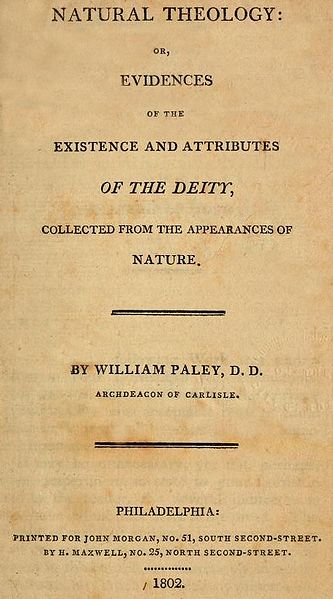
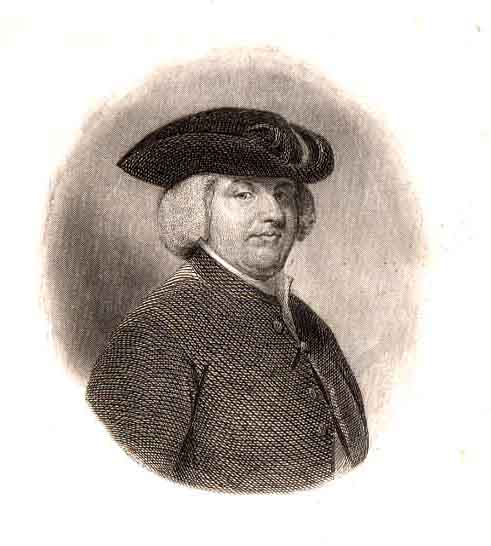
On this date in 1805, the Christian church lost one of its ablest and most-remembered defenders. William Paley—Anglican minister, professor, and author—is permanently associated with the analogy of a watchmaker and the God of personal theism. He wrote that “the contrivances of nature . . . are not less evidently mechanical, not less evidently contrivances, not less accommodated to their end or suited to their office, than are the most perfect productions of human ingenuity” (Natural Theology, 1802). Paley mined the riches of biology for samples of such contrivance. In his day, the state of scientific knowledge in the field of biology permitted comparatively easy inference to the appearance of teleology in the natural world. Critics today forget this. The

William Paley, Natural Theology

William Paley, Natural Theology

“demise” of Paley’s design argument for the existence of God is credited especially to a development that was to happen some 60 years later—the emergence of the new theory of evolution, beginning with the publication of Charles Darwin’s On the Origin of Species by Means of Natural Selection, or the Preservation of Favoured Races in the Struggle for Life (1859). Paley’s major work—Natural Theology; or, Evidence of the Existence and Attributes of the Deity. Collected from the Appearances of Nature—enjoyed a pretty good “survival” record itself. His work was considered essential reading at universities for a hundred or more years. Also, some critics maintain that David Hume dealt a decisive blow to Paley’s argument. Never mind that Hume’s Dialogues concerning Natural Religion appeared posthumously in 1779, that Paley was thoroughly familiar with the Dialogues, that Paley developed his argument in express response to Hume’s critique, and that Paley was thought to have bested Hume by many of Paley’s contemporaries. He was not entirely unsuccessful in this endeavor, though some, like John Stuart Mill, believed that they had detected formal weaknesses in his argument. Here is the famous passage from Paley’s Natural Theology:

In crossing a heath, suppose I pitched my foot against a stone, and were asked how the stone came to be there; I might possibly answer, that, for anything I knew to the contrary it had lain there forever: nor would it perhaps be very easy to show the absurdity of this answer. But suppose I found a watch upon the ground, and it should be inquired how the watch happened to be in that place; I should hardly think of the answer which I had before given, that, for anything I knew, the watch might have always been there.Yet why should not this answer serve for the watch as well as for the stone? Why is it not admissible in the second case, as in the first? For this reason, and for no other, viz. that, when we come to inspect the watch, we perceive (what we could not discover in the stone) that its several parts are framed and put together for a purpose, e.g. that they are so formed and adjusted as to produce motion, and that motion so regulated as to point out the hour of the day; that if the different parts had been differently shaped from what they are, of a different size from what they are, or placed after any other manner, or in any other order, than that in which they are placed, either no motion at all would have been carried on in the machine, or none which would have answered the use that is now served by it.

Paley then produces examples of these components in a watch:

To reckon up a few of the plainest of these parts, and of their offices, all tending to one result: We see a cylindrical box containing a coiled elastic spring, which, by its endeavour to relax itself, turns round the box. We next observe a flexible chain (artificially wrought for the sake of flexure) communicating the action of the spring from the box to the fusee. We then find a series of wheels, the teeth of which catch in, and apply to each other, conducting the motion from the fusee to the balance, and from the balance to the pointer; and at the same time, by the size and shape of those wheels, so regulating that motion, as to terminate in causing an index, by an equable and measured progression, to pass over a given space in a given time. We take notice that the wheels are made of brass in order to keep them from rust; the springs of steel, no other metal being so elastic; that over the face of the watch there is placed a glass, a material employed in no other part of the work; but in the room of which, if there had been any other than a transparent substance, the hour could not be seen without opening the case. This mechanism being observed (it requires indeed an examination of the instrument, and perhaps some previous knowledge of the subject, to perceive and understand it; but being once, as we have said, observed and understood), the inference, we think, is inevitable; that the watch must have had a maker; that there must have existed, at some time, and at some place or other, an artificer or artificers, who formed it for the purpose which we find it actually to answer; who comprehended its construction, and designed its use.

This truly economical and accurate description of a watch and its function is impressive. It is described in meticulous detail for a reason, to bring it into comparison with “contrivances of nature”:

For every indication of contrivance, every manifestation of design, which existed in the watch, exists in the world of nature, of being greater and more, and that in a degree which exceeds all computation. I mean, that the contrivances of nature surpass the contrivances of art, in the complexity, subtilty, and curiosity of the mechanism; and still more, if possible, do they go beyond them in number and variety: yet, in a multitude of cases, are not less evidently contrivances, not less evidently accommodated to their end, or suited to their office, than are the most perfect products of human ingenuity.

An astonishing array of natural objects are observed and described next. The inference, of course, is that, there being an analogy between (a) an artifact of the sort that a watch is and (b) objects in the natural world such as the ones he has cataloged, there is an “artificer,” or designer, of the natural world. Darwin was not impressed. He was convinced that the natural phenomena in Paley’s inventory could be accounted for by a process of purely natural selection. But it was not clear when Darwin introduced his thesis, and it is not clear even now, that the full range of natural phenomena are best explained in terms of natural selection. There isn’t space here to defend Paley in detail. But it is key to his argument that close observation and deep understanding of an object may be needed to pick out what is best explained by the design hypothesis. Darwin’s theory entails that fully formed organisms that function in complex ways are the by-products of a long, slow, unguided process. And yet, for many organisms under observation today, at various stages in their developmental history, they lack functional utility. On the Darwinian hypothesis, nothing draws them toward functionality. And for some such organisms, nothing is extraneous to their function once they reach a capacity for function. This is Paley’s basic insight. It has been exploited more recently by Michael Behe, author of Darwin’s Black Box, where the human “contrivance” he uses to make the same basic point is even simpler than a watch; it is the common mousetrap.

William Paley

William Paley

While Paley is best known, and most commonly chastised, for his teleological argument, he made other important contributions to the cause of Christian apologetics. His earlier work A View of the Evidences of Christianity, investigates the special evidence that supports apostolic testimony concerning the resurrection of Jesus Christ and defends the historicity of their accounts of Jesus in the Gospels. Those who follow the work of today’s apologists in defense of these claims will recognize the influence of William Paley. (See, for example, William Lane Craig, Reasonable Faith, chapter 8.) Paley’s critics have been altogether too dismissive of his extraordinary achievement. I feel sure that most have never examined his two major works for themselves. These skeptics are as likely as not to have rendered a negative verdict on the basis of brief snippets of Paley’s teleological argument, lifted from context and reprinted in some classroom anthology, or on the basis of hearsay, which is guilty of the same. And many Christian apologists today have neglected the riches of William Paley’s methodical and systematic work. I commend fresh consideration of his writings. Who knows what a ramble in the heath with this great thinker might turn up?

***

Notes:

  • Paley’s Natural Theology (Oxford World’s Classics series) is avaliable at Amazon here.
  • A free Kindle edition of Paley’s A View of the Evidences of Christianity can be obtained here.

◊ ◊ ◊

Other posts in this series . . .

Death Is a Big Deal—Mortal Motivation Theory in Psychology


Death is a big deal. Most of us know it, or acknowledge it. Those of us who don’t are in denial—a fairly typical way of coping with unpleasant or unwelcome realities.

A handful of psychologists have developed a theory about how the fear or anticipation of our personal demise influences the way we make sense of our world.

On their view, our notions about death drive much of our behavior, and in ways we little suspect. This may seem obvious for some people, organizations, religious groups, and such. But these psychologists propose a completely general thesis with universal application. What is most controversial is their claim about each of us as individuals:

At a more personal level, recognition of our mortality leads us to love fancy cars, tan ourselves to an unhealthy crisp, max out our credit cards, drive like lunatics, itch for a fight with a perceived enemy, and crave fame, however ephemeral, even if we have to drink yak urine on Survivor to get it.

This movement within the field of psychology has come to be called “terror-management theory.”

Some who demand an evolutionary explanation for our psychological constitution, in all of its rich complexity, apparently feel some uneasiness about the proposal. But Sheldon Solomon, one of the theory’s chief architects, doesn’t seem to be fazed by this. He has no trouble referring to a human person as a “breathing piece of defecating meat.” I would imagine we have evolution to thank for that.

His book, a co-authored treatise, is called The Worm at the Core: On the Role of Death in Life. William James (1842-1910), the philosopher and psychologist, provided the authors with their title in his own reference to death as “the worm at the core” of the human condition. I suspect, though, that similarities between their conception of human persons and William James’s don’t extend much further than this borrowing.

Also, I wonder if they’ve thought very deeply about how the Christian religion locates the problem of our mortality within the total picture of human meaning and purpose. More likely than not, they would explain the hold of a Christian worldview on the minds and psyches of so many people as a fear-of-death management-system. That would make for an ironic parallel and discontinuity between their perspective and that of the Christian Bible.

That the anticipation of death reverberates throughout our sensibilities and actions has been thought before. The authors themselves credit Ernest Becker (1924-1974), author of The Denial of Death, for setting them on this particular research path. But the notion may have special appeal in a social context dominated by scientific naturalism. In such a context, one advantage of their theory is that it lends support to convenient debunking of claims about life after death. Doctrines of immortality are reduced to coping mechanisms. And that’s about all there is to it.

If belief in immortality provides a person with psychic support in the face of death, it may be supposed, then we have a psychological explanation for his belief in immortality.

Or not. The trouble is, the move made in this explanation for belief is a non sequitur. For a doctrine might actually be true and a believer in immortality might actually be justified, on reasonable grounds, for affirming that doctrine, even if immortality does provide believers with psychic support. In fact, belief in immortality would be a triple advantage if (1) the doctrine of immortality is true, (2) there’s good reason to affirm the doctrine, and (3) the doctrine provides powerful psychological support (in the form of hope, for example) in a world of mixed blessings.

Of course, the believer must reckon with the specter of a modus tollens reversal:

  1. If the doctrine of immortality is true, then the doctrine of scientific naturalism is false.
  2. The doctrine of scientific naturalism is true.
  3. Therefore, the doctrine of immortality is false.

This isn’t a serious obstacle, if the doctrine of scientific naturalism is false. It isn’t an obstacle if there is little evidence or argument that scientific naturalism is true. And since the evidence for scientific naturalism is ambiguous at best, the doctrinaire naturalist still has reason to consider the significance of his life within the framework of the possibility that some doctrine of immortality is true. And this may induce fear for anyone clinging to scientific naturalism.

No naturalistic explanation for the psychic power that derives from hope for an afterlife can dispense with this challenge to naturalism.

So what if belief in immortality aids in managing the fear of our eventual earthly demise? I suppose it’s as likely that the denial of immortality could also be a terror-management strategy. How convenient to think that death is not a threshold of crossing between the known and the unknown, but just the end of it all?

The Stoics advised composure in the face of death on the grounds that when it comes there will be no regret because no one left to regret it. Or at least no basis for fearing it. Why fear now what you won’t fear when it actually happens? But that isn’t the problem, is it, this side of the fatal divide? The real problem is knowing whether there is something in it for us beyond the threshold of death, and knowing, if there is, what it might be, and whether there are different possibilities, depending on your existential and doxastic commitments here and now.

There is room, I think, for more than one version of “mortal motivation theory” in psychology. There is the secularist-naturalist version promoted by the authors of The Worm at the Core. And there is the religiously serious version according to which death is a fitting device for contemplating our place in a super-naturalistically haunted universe and reflecting on where it might all be leading.

***

For a detailed review of the book in The Chronicle of Higher Education, click here: Mortal Motivation – The Chronicle Review – The Chronicle of Higher Education. Direct quotations in this post are from the Chronicle review by Marc Parry.

How One Psychologist Is Tackling Human Biases in Science


How One Psychologist Is Tackling Human Biases in Science.

What is no doubt bad news for many scientists should be good news for the progress of science and the enterprise of knowing.

It’s good to see greater effort being made to explore the place of intellectual virtue in the practice of science. And there is some irony in the fact that problems of bias in research and intellectual activity in general is confirmed by the methods of scientists.

It would be good to have more examples of the problem described by these researchers on bias. And it would be useful to study the effects of such pervasive scientific shortcomings on belief in matters beyond scientific judgment—in religion, for example.

‘Born Bad’: How the idea that we’re all sinners has shaped Western culture – The Washington Post


‘Born Bad’: How the idea that we’re all sinners has shaped Western culture – The Washington Post.

Read this book review by Michael Dirda and consider where the argument about original sin and the history of Christian doctrine errs.

Your observations are welcome. Feel free to share using the comments box below.

What Do William Gladstone and Little Big Man Have in Common?


I don’t get it, these coincidences with no significance always happening to me.

Allow me to illustrate from today’s events.

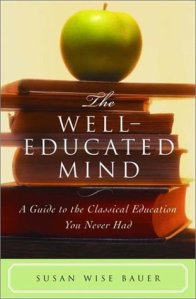
Around noon, I hefted my copy of Roy Jenkins’s biography of William Gladstone from the shelf, with the vague intention of reading some portion of its 698 pages. As if this would not be enough to occupy the few moments I could spare, it occurred to me that I might also refresh my memory of what Susan Wise Bauer says about reading biography, in her book The Well-Educated Mind.

Book Cover-Roy Jenkins-William GladstoneBook Cover-Susan Wise Bauer-Well-Educated MindBook Cover-Thomas Berger-Little Big Man

Not only had I forgotten what Bauer says about biography, I had forgotten that she doesn’t say anything about biography as such. Rather, she has a chapter on reading autobiography. And her guidelines are fairly specific to this sub-genre, with only limited application to biography in general. Still, my wandering eye surveyed the pages on autobiography. In there, she recommends several worthy examples. Among them is Mary Rowlandson’s The Narrative of the Captivity and Restoration (1682). This autobiography Bauer calls a “captivity narrative,” as if this is a recognized sub-species of the genre. This was news to me, but it was plausible.

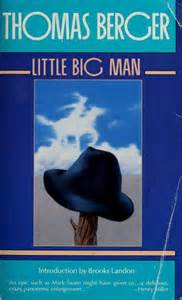
This evening—mind you, this was several hours later the same day—I was relaxing with a different book. I had ordered Thomas Berger’s novel Little Big Man and it arrived with today’s junk mail. Naturally, I began with the Introduction by Brooks Landon. It is mercifully short, so getting to the first page of the novel itself was relatively pain-free.

But now I come to the coincidence that occasions this post.

It was entirely coincidental when I read Brooks Landon’s opinion that this novel is “a literal model of the traditional ‘captivity narrative'” (page xvi).

There it was again—”captivity narrative”—twice in one day, with no recollection of prior encounters with the term. Certainly, the term is not (or was not) a part of my active vocabulary. So why, with no real familiarity of the term, did I encounter two uses of it in such a disconnected sequence of events, in two books, one a work of non-fiction and the other a novel—all within the space of a few hours?

What difference does it make? you ask. But that’s the point, you see. It makes no difference. It just happened. It was a coincidence of no consequence!

But coincidences often are thought to be consequential just in the nature of the case. And so it is doubly puzzling that inconsequential coincidences should happen so often.

Sigmund Freud and the Illusion of Peace


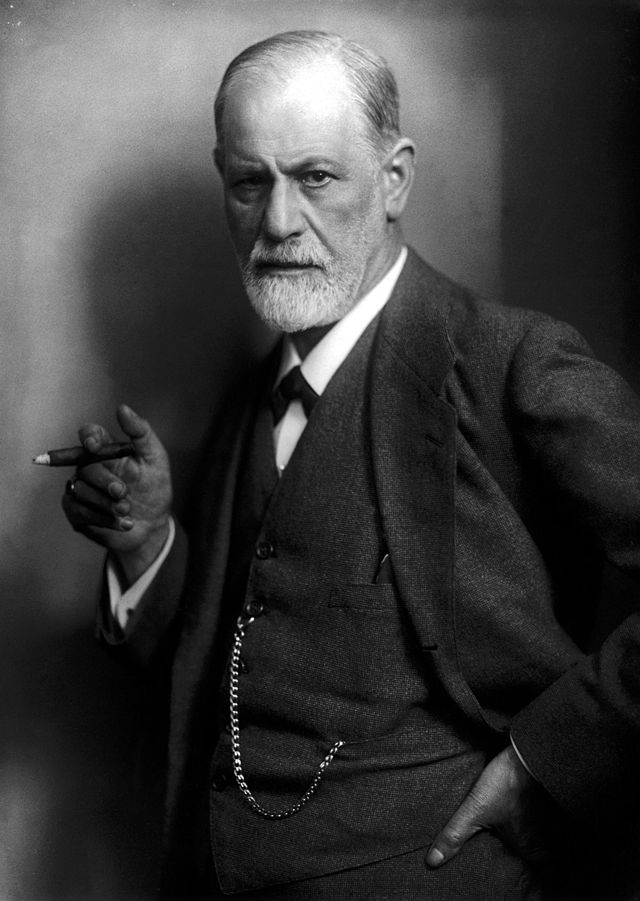
Yesterday’s post was about Karl Marx. Today it’s about Sigmund Freud, who was born on this date in 1856. They have this in common—that religion is a subjective response of one sort or another, to be explained away psychologically or sociologically. Feuerbach contended that God is part of the furniture of a dream world. Marx called religion “the opiate of the people,” a drug that postpones the realization of social utopianism. Freud, when writing about religion, spoke of “the future of an illusion.”

Sigmund Freud (1856-1939)

Sigmund Freud (1856-1939)

All were atheists. All traded the idea of God for a vision of reality that gained traction for awhile, then lost steam. Almost no one knows about Feuerbach, and those who do seldom think of him with affection. Marx’s communism, where it exists, is anything but utopian. And Freudian psychoanalysis is now repudiated by most practitioners and theorists in psychology.

The doctrines that God is a projection of the human imagination (Feuerbach), that religion is a drug that holds humanity back from realization of its highest aspirations and greatest potential (Marx), that the idea of God meets some need for a grand Father figure (Freud), are all affectations. They each acknowledge the pervasiveness of religion in the experience of humanity. Each explains away what it does not argue is false. Each imagines a world improved by the deconstruction of religion. And each has failed in its diagnosis of the human predicament and in its prognosis for a religionless world.

Notice, each of these visions for humanity attempts a solution for the human predicament, which they each in their own way attribute to religion. But the attempt to shift responsibility for the human predicament onto God is itself responsible for the human predicament. The strategy has its origin in the Garden, where the serpent alleged that God’s warning and God’s promise would hold the first couple back from realizing the full potential of humanity.

The impulse is the same for every generation. There is nothing new under the sun (Ecclesiastes 1:4-11). Today, the false starts toward utopian society are rooted in scientific naturalism, mysticism, political meliorism, and religious fanaticism. In every case, true religion is either denied or obscured. The effect is the same: to steer men and women away from the only sure source of salvation, individually and collectively.

We frantically grasp for some semblance of peace—peace of mind, peace among nations. But our frenzy only makes things worse. It displaces peace. And it ensures that the true source of peace is passed by, unnoticed. That source is too good to be true, too easy for it to really count: “Come to me all you who labor and are heavy laden, and I will give you rest. Take my yoke upon you, and learn from me, for I am gentle and lowly in heart, and you will find rest for your souls. For my yoke is easy, and my burden is light” (Matthew 11:29-30).

But isn’t that how the achievement of peace should come? Not as an achievement, but as a gift?

Some dates:

  • 1841—Publication of Ludwig Feuerbach’s, Das Wesen des Christentums (English: The Essence of Christianity)
  • 1848—Publication of The Communist Manifesto, by Karl Marx and Friedrich Engels
  • 1922—Formation of the Communist Party in Russia and establishment of the Soviet Union (USSR)
  • 1927—Seizure of control of China by the Communist Party
  • 1927—Publication of The Future of an Illusion, by Sigmund Freud

Confusion in the Public Square—The Case of Pam Geller and Islamic Jihad


Pam Geller, president of the American Freedom Defense Initiative, is an activist. She clearly is on a mission to raise awareness of the threat from radical Islam. Most recently, she hosted an event in Garland, Texas. The idea was to award $12,500 to the winner of a cartoon contest for depicting the prophet Muhammad. This is just the sort of thing that riles Muslims worldwide. It is provocative and incendiary. It appears that it was deliberately so. Ms. Geller doesn’t like jihadists, and this is her way of drawing—quite literally—attention to the seriousness of their threat.

The event in Garland turned bloody when two gunman rolled up to the venue, brandished high-powered weapons, and were shot dead by the police. A media frenzy has developed over the event, but it has been focused through a peculiar lens: the misdeeds of Ms. Geller.

Apparently, Geller wishes to test the first amendment protecting freedom of speech in the United States. And she seems to have concluded that this precious right has been trampled in the aftermath of the event. In her media appearances, she has sought to direct attention to the truth of her message, so dramatically demonstrated by what happened at the Curtis Culwell Center: Muslim radicals are a danger and a threat to Americans right here at home.

There are at least three possible motivations for the media outcry against Ms. Geller:

  1. The Chris Matthews of this world probably are motivated by a socially and politically liberal ideology. These ideologues are always at pains to distinguish peace-loving Muslims from those radicals who have highjacked the peaceful religion of Islam, almost as if the “extremists” aren’t real Muslims. They smugly pronounce Islam to be inherently peace-loving, without any obvious awareness of what the Qu’ran teaches or Muslim history. They haven’t discerned that the “true” Muslims that they link together are the reformist progressives who feel no compunction to take the Qu’ran literally. Because they’ve bought the line that Islam itself is harmless, these ideologues are intent on calming emotions about the dangers of Islam. Pamela Geller should be ashamed of herself.
  2. Some of Geller’s critics may be genuinely fearful for American security. They’ve accused her of being dangerous. They’ve suggested that she is a threat to our security. After all, her actions were provocative. She sponsored an event that is offensive to Muslims. And radical Islamists can be counted on to step out of the shadows to shed blood to “voice” their disapproval. If she and her cohorts keep this up, we’re bound to face more immediate and alarming threats in our own backyard. She owes it to her fellow Americans to keep a lid on it and let saner measures deal with the threat she abhors.
  3. Some pundits may simply think Geller is acting stupidly. She’s asking for trouble, foolishly thinking that her campaign will stem the tide of jihadism in the world. There are better ways of answering the threat, and it’s nuts to think that progress can be made on this front through the antics of an extremist counter-Islamist. (Of course it won’t. But it may also be stupid to think that she thinks it will.)

I should mention a fourth potential motive for the media’s present obsession: Their need for another news story. “After all, Baltimore has calmed down, and they need some news to report.” This vague allusion to media cynicism neglects the significance of similarities and differences in media treatment of Ms. Geller’s escapades. They share a distaste for her actions; they differ in their specific criticisms of them.

The Common Sense Objection

The media critique of Geller has generally fallen short of accusations that she crossed the line protecting her freedom of speech. Her freedom of speech is protected. And note, Geller is doubly protected. First, the first amendment protects her from prosecution for her actions. Second, when threatened by violence, she and her cohorts are rightly protected by law enforcement. The gunmen who were killed violated the law. Geller did not. They had murder on their minds. Geller did not.

Here’s a difficult question for the media to wrestle with: If the gunmen were shot and killed for their own violent, law-breaking actions, while Pamela Geller was exercising her first amendment rights and did nothing legally wrong, should we focus on what the jihadists are doing to threaten American civil liberties, or should we focus on the wisdom of Pamela Geller’s actions? Wow, that’s a tough one.

Many media personalities have focused exclusively on the provocations of Ms. Geller and not at all on the nefarious action of the gunmen who represent world jihadism. They’ve blamed her for what occurred on May 3. This is a diversion from the truth that the gunmen were responsible for the outcome and that their acts were motivated by commitment to extremist Islam. And it ignores the report that ISIS has taken responsibility for the murderous decision to attack the Muhammad Art Exhibit.

There is a place for considering whether Pamela Geller is going about things in the right way. I think it’s a mistake. For several reasons. Not the least of which is that it isn’t exactly the Christian thing to do. I hope there aren’t a lot of Christians commending her for the strategy she’s adopted. Rank and file Christians—who have little influence on the international stage and can do little to effect geopolitical change—are called to winsome engagement with those who do not accept their Gospel. On the other hand, I believe there is the possibility of crafting a Christian strategy for dealing with ISIS and others. I even think that a Christian strategy is what is most needed today. Urgently needed.

But the media have a responsibility to get their priorities straight in the encouragement of civil discourse about what matters most. And right now that includes assessment of the potential for future attacks, some of which will likely succeed if we’re not vigilant. It’s not as if it takes a Pamela Geller to stimulate jihadist outrage.

And all Americans should be wondering whether fellow Americans whose tactics they disapprove should be cowed into silence into order to make peace with those who plot the disruption of our civil liberties. Reportedly, the winner of the cartoon contest has gone into seclusion after receiving death threats. Does Chris Matthews think he’s getting what he deserves?

Karl Marx Is Dead—And So Is Dialectical Materialism (for the most part)


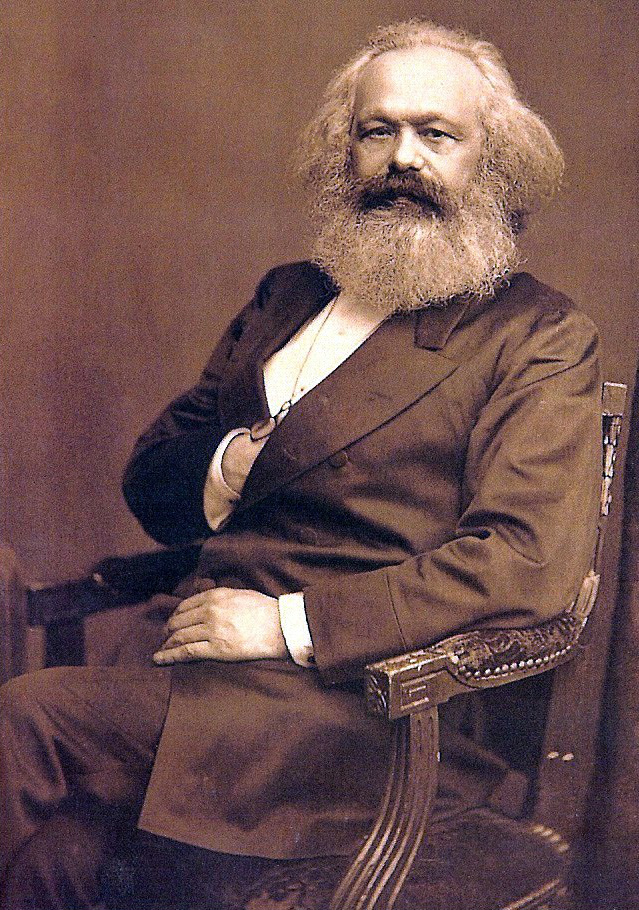
Nietzsche famously said, “God is dead.” His great intellectual forebear, Karl Marx, was born on this date in 1818, just five years after Søren Kierkegaard, who has the same birthday. Marx is perhaps the best-known atheist of the 19th century. He grew up in a German-Jewish home. But it is said that he converted to Lutheranism when he was only six years old. Either it didn’t take, or it didn’t last.

Karl Marx (1818-1883)

Karl Marx (1818-1883)

He was a militant atheist during his college years at Bonn and Berlin. He was drawn to a group called “the Young Hegelians.” A major figure of this group was Ludwig Feuerbach, who influenced Marx and probably inspired much of the atheist element in Marx’s “dialectical materialism.” For Feuerbach, God is nothing more than a projection of the human imagination. Religion is but a dream. And it is a dream with a mixed reputation. It expresses the guilt and remorse characteristic of the human condition, and then pretends to offer a solution. Humans find it pretty hard to escape this fantasy, since it serves a useful purpose.

Marx extended the motif, calling religion “the opiate of the people.” More drug than dream. The corrective he envisioned would replace the need for a beneficent transcendent being with a social arrangement that would ensure tranquility and economic stability. His dialectical materialism provided the metaphysical framework for his communist utopianism. As materialist, he asserted that all is matter, including the human person. But his materialism affirms an evolutionary history that leads dialectically to utopian finality, where society progresses from “each according to his ability, to each according to his need.” The path to this ideal condition would be painful but necessary. It would be mediated by revolution.

Sadly, this much of the Marxist vision has been realized; but its glorious outcome has been more nightmare than dream. Neither Marx nor Feuerbach offered any real arguments against the existence of God. Instead, they embrace the nonexistence of God as a kind of article of faith. They imagined that all who believe in God do so without objective warrant. But pervasive belief in God must be explained—and got rid of—somehow. Thus they offered psychological and sociological explanations for religious belief. This created space for Marx’s theoretical speculations, which gained surprising traction in his day. His dialectical materialism is mostly a thing of the past. Communism has been exposed as a vicious means for dictatorship rather than equality. But the attitude persists that religion is a private matter that tends rather to debase humanity than to realize humanity’s highest aspirations.

This is a powerful catalyst for secularism. If religion is ungrounded, the most it can offer is private solace. But the heart grows restless with solace that has no objective ground. And so humanity turns to substitutes, seeking always to make a better life without God. It matters not whether God is dead—as Nietzsche proclaimed. What matters is whether the heart appropriates what reason supports. Our need for spiritual solutions to pervasive problems is some evidence that spiritual solutions do exist. But that possibility can only be taken seriously if evidence for religious truth is considered fairly and objectively. No path to a better world is worth trying if it doesn’t start there.

As I noted in a previous post for today, Søren Kiekegaard sought to awaken recognition of these facts about humanity and spiritual values. Too bad Marx didn’t listen to Kiekegaard.

The Great Dane—Remembering Kierkegaard


Søren Kierkegaard (1813-1855)

Søren Kierkegaard (1813-1855)

Today is Søren Kierkegaard’s birthday. He was born May 5, 1813, in Copenhagen, Denmark. He’s been called a Christian existentialist, a fideist, a satirist, and “the melancholy Dane.” He was concerned about the disconnect between Christian profession and the lived reality of true Christianity. He called his contemporaries to a deeper personal encounter with God. And he wrote with penetrating insight about the failure of the purely aesthetic life—what we today might call secularism—which seeks pleasure without discerning its natural and ultimate end, namely, despair. Kiekegaard’s contribution is considerable, even for the evidentialist. In fact, his sermonic style may be of value to the apologist who insists on the value of evidence. E. J. Carnell, mid-twentieth century, did the most to bring Kierkegaard’s insight into an overall “combinationalist” approach to apologetics. Carnell wrote:

There can be no question that Søren Kierkegaard gave a profoundly convincing defense of the third locus of truth.

Carnell was speaking of a “third way of knowing,” which respects the tendencies of the human heart, properly submitted to God, to discern religious truth. In this, Kierkegaard (and Carnell) were like Blaise Pascal, who spoke of “reasons of the heart which reason cannot know.” Carnell’s commentary on Kierkegaard continues:

What Christianity has always assumed, Kierkegaard made explicit. . . . Saving faith is not simply an intellectual assent to objective facts. Faith is cordial trust; it is a concerned, inward response to the person and work of Jesus Christ. Until the end of time, therefore, men who remember what it means to be a person will defend the supremacy of truth as inwardness. God sent His Son to make us good, not simply to make it possible for us to recite the creeds of the church.

Carnell is saying that few apologists have noted this vital aspect of Christian belief and conduct. But he issues a caveat:

But what must be questioned is the prudence of Kiekegaard’s attempt to secure inward truth by opposing it to objective evidences. It is from his lips, not those of the biblical writers, one learns that faith must believe what understanding finds contradictory—and for that very reason. Scripture’s healthy balance of the loci of truth has been upset by Kierkegaard. Rationality was bequethed by Jesus Christ as a light by which men may penetrate the darkness of error. ‘The true light that enlightens [gives a spiritually rational nature to] every man was coming into this world’ (John 1:9). Being a rational creature, thus, man must proportion his spiritual commitments to what the mind can conscientiously clear. Apart from this distribution of authority edification is impossible. . . . Saving faith germinates only after the mind is first convinced of the sufficiency of the evidences. If Christ taught plain logical nonsense . . . a balanced man would turn aside from Him as one to be pitied, not trusted. The reason why we are able to trust Christ is that He spoke and lived in a way which is congenial with our axiological expectations.

For Carnell, our “axiological expectations” include both what is existentially compelling and what is rationally convincing. “Faith” without the soul’s commitment may not be faith at all. But what is faith if it is not grounded in good reason? For anyone can have faith in anything.

◊ ◊ ◊

Other posts in this series . . .

Assessing My Need for an Apple Watch


I didn’t think I’d find the Apple Watch very interesting. The #1 reason is that I was sure it would be priced beyond my reach, for a timepiece. The #2 reason was that I thought it would be more timepiece than anything Apple should be willing to brag about.

Then I watched the various short tutorials at the Apple website. It does seem to have some nice features. Certainly, if you want to, you can pay $10k for a special edition. But for a few hundred you can get the same technology with less but completely satisfactory luster.

Still, a few hundred dollars? I wear a watch I paid less than a hundred for and everybody thinks it’s a Rolex. And I have a smart smart phone, the iPhone 6. I could strap it to my wrist.

If Apple and its loyal customers have watch envy, they have some catching up to do. They may want to drool over “The World’s Most Expensive Watches.” For my money, I’d go with the Roger Dubuis Excalibur Quatnour. Unfortunately, it’s priced at 1 million Swiss francs, and I have only a few dozen francs left over from my last trip to Zürich.

I think I’ll stick to my policy of waiting for the second or third generation Apple Watch before I buy the first—at a discount.

Here’s a New Yorker cartoon that captures the tech zeitgeist, and my own mood, in good humor:

Daily Cartoon: Friday, April 24th – The New Yorker.

My Interview with the Good Book Blog about the New Apostolic Reformation


Last week I was interviewed by the Good Book Blog about the New Apostolic Reformation. This blog publishes articles written by faculty of Talbot School of Theology at Biola University.

To read the interview, follow this link.

Talbot Good Book Blog

Note: This is post #500

A New Apostolic Reformation? Bellevue Slide Presentation


I spoke recently at the annual Worldview Apologetics Conference in Bellevue, Washington (April 17-18, 2015). Other speakers included Ravi Zacharias, Norman Geisler, and E. Calvin Beisner.

Two of my four presentations focused on the New Apostolic Reformation, the subject of two books I’ve co-authored with Holly Pivec.

One book is brief and introductory. It’s called God’s Super-Apostles. The other is an expanded treatment with more detailed discussion and extensive documentation. It’s called A New Apostolic Reformation? A Biblical Response to a Worldwide Movement.

You can access my presentation slides by clicking on the following link:

A New Apostolic Reformation?

RDG-NAR Presentation Slides-Title Page

This is the first presentation link I’ve posted to my website. Your feedback is welcome!