Legends of the Fall: A Discussion Guide


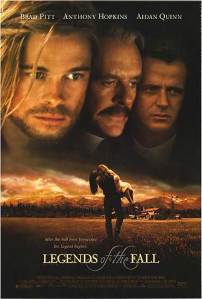
Legends of the Fall (USA, 1994); directed by Edward Zwick

Chapter 4 of my book, Faith, Film and Philosophy, is titled “Defining Love through the Eye of the Lens: Romance, Sex, and the Human Condition in Pretty Woman, Legends of the Fall, and The Bridges of Madison County.” The author is Greg Jesson. Here are discussion questions for the film Legends of the Fall that I’ve used in conjunction with his chapter.

  1. A native American named Stab, an elder of the Cree Nation, narrates the beginning of the film. How would you explain the director’s choice in beginning the film this way?
  2. In a letter to his mother, Alfred writes, “I pray every night for the grace to forgive Tristan.” Do you agree that Tristan has sinned against his brother, Alfred? Explain your answer. Does Alfred ever forgive Tristan? Why or why not? If you believe he doesn’t, what would it have taken for him to forgive Tristan?
  3. When visited by a committee of citizens who want Alfred to be elected to Congress, he shouts at them, “What do you want for yourselves if you get my son elected?” What does this say about his view of politics? What does it say about his view of people, in general?
  4. Alfred says, in response to his father’s accusation that the U.S. government has yet to regain its wisdom, common sense, and humanity: “I will consider it my absolute duty to bring both wisdom and humanity to the United States Congress.” This may ring a bell. Compare Alfred’s vow with the similar promise made by Charles Foster Kane in Citizen Kane. How are they alike? Different?
  5. Following his argument with the Colonel, Alfred says, tenderly, “Susanna, you deserve to be happy.” Is this true? What is Alfred’s conception of happiness? How does this compare with your conception of happiness?
  6. Does the Colonel have a favorite son? If so, who is it? What accounts for this? How are the others affected?
  7. What happens when Susanna’s name comes up, after Tristan returns home? Is Susanna over Tristan? Is Tristan over Susanna? What is your evidence?
  8. What do you think of Anthony Hopkins’s performance as a stroke victim? Is his stroke supposed to mean anything that ties into the story line of the film? (Is it symbolic?)
  9. One Stab repeatedly speaks of “the bear inside” of Tristan. What is the point of this metaphor? What does it say about Tristan and One Stab’s evaluation of him as a person?
  10. At a public meeting, Alfred and Tristan meet. Alfred asks, “How’s father? Is he well?” Tristan answers, “As well as can be expected.” What does this mean? What can be expected? Why?
  11. In explanation of the accidental death of Isabel, Alfred says to Tristan, “It was a terrible, tragic, accident.” What does this say about Alfred? Has he changed as a person?
  12. Whose faults are greater? Tristan’s, or Susanna’s? Support your answer.
  13. At Susanna’s grave, Alfred says to Tristan, “I followed all the rules . . . . And you, you followed none of them. And they all loved you more.” What does this say about Alfred’s view of love? What does it say about his view of doing the right thing? Is there a sense in which he isn’t any different than Tristan?
  14. Tristan’s father says to him, “You are not damned, Tristan. I won’t allow that.” Any comments?
  15. How are things resolved in the end? Does this change anything?
Hacking the ABD Life: Part 2 — The Intellectual Virtues


The academic life has an intellectual component. Duh. But what does that mean?

It means, in part, that an exemplar of the academic life manages his or her life with intellectual virtue. An intellectual virtue is a character trait that improves the chances of believing well—of conducting inquiry in a responsible way and living responsibly on the basis of what is learned through inquiry.

I believe that all members of the human community are called to intellectual virtue, insofar as they are able. Intellectuals should be models of acting from intellectual virtue. I question whether a perceived intellectual is a genuine instance of such a person if he or she is severely lacking in intellectual virtue. The true intellectual must have a suitable measure of intellectual virtue. Diplomas are no assurance of that.

The Ph.D. candidate has already been initiated into academic life—the life of the guild, as it were. One can only hope that this also has included initiation into the intellectual life. The ABD life is a test of intellectual virtue, and an opportunity to grow in intellectual virtue. Certain particular virtues are especially salient to commendable intellectual practice at the ABD stage in one’s career. Here are three of them:

  • Curiosity
  • Courage
  • Moderation

Intellectual curiosity is a natural goad to dissertation research. Intellectual courage is needed to sustain research and overcome obstacles. The virtue of moderation curbs excesses of various kinds. Dissertation research tests the expression of these virtues.

Curiosity stimulates creativity and supplies the initial energy to launch a dissertation project. It’s often difficult to sustain that level of curiosity throughout the research and writing process. The Ph.D. candidate needs to have ways of staying engaged with the chosen topic. As long as new questions emerge with the progress of research, there is evidence of curiosity.

Courage helps the researcher stay at it. The intellectually courageous person believes in the good to be achieved by the research that has been undertaken. Courage fills the void when curiosity dries up, and finds fresh sources of curiosity in the act of persevering. This virtue is threatened in numerous ways. Among the most sinister are the negative judgments of others.

Moderation is probably the least appreciated of the three. Moderation protects the researcher from excesses that would lure him or her away from efficient realization of the primary objective. One can research to excess. The sociology of the ABD experience reinforces the sense that it isn’t possible to “over-research” a topic. Turning over every rock, however promising it may seem in advance, feels responsible; but it is really counter-productive, and hence irresponsible.

Future installments on “Hacking the ABD Life” will focus on specific intellectual virtues. Please chime in with thoughts you have about the connection between the intellectual life and doing scholarship from virtue. Let me know what virtues you think are most salient to realizing that dream of passing from ABD to Ph.D.

Hacking the ABD Life: Part 1 — “Good” Means “Good Enough”


ABD—”All But Dissertation.” This label has a distinctly demoralizing drum to it, especially as a designation for someone—the Ph.D. candidate—who has accomplished so much, usually comparatively early in life.

Of course, writing a doctoral dissertation is a huge undertaking in its own right. And it can make or break a Ph.D. candidate’s academic career. There are two main challenges. The first is as much psychological as it is anything else. You have to have “internal fortitude,” the ability to take small steps toward the completion of a big project, to manage hurdles and set-backs, and to survive the comparative loneliness of the process.

Second, you have to impress your dissertation committee with the quality of the finished product and with your prospects as a scholar. So the work has to be good. This, obviously, relates closely to the first main challenge.

Let me repeat the best advice I received while writing my Ph.D. dissertation: “Think of your dissertation as the last paper you write during your formal education, and keep in mind that it really doesn’t have to be longer than a hundred pages.” It didn’t hurt that this counsel came from a member of my dissertation committee.

The suggestion about length is probably situation-specific. It would be wise to consult with your committee about appropriate length. And “consultation” is the key word here. You should be able to share your own ideas about appropriate length, given your topic and the way you plan to organize your material. It is generally believed that the best dissertation topic is a narrowly focused topic. It would stand to reason that in many cases narrower focus translates into fewer total pages. There’s a saying, “Don’t beat a dead horse.” There’s another saying, “If the horse is dead, dismount.” The goal shouldn’t be to come up with a topic that will require X number of pages, but to come up with a topic that makes a worthy contribution to the field and establishes the author as a capable scholar, regardless of word count.

The more general principle in my advisor’s comment is that the dissertation isn’t a book. It’s not even a published paper. I caution against approaching your dissertation as if you were writing a book manuscript that will be ready to submit to one of the top academic presses. Your dissertation committee is large enough with the three to five people that play that official role. No point trying to write for the vague target audience for a book on the same topic. Save that for later.

Let me put it this way. You’ve got three people on your committee. Maybe one of them knows quite a lot about your topic. The other two are conversant. Are there others in the discipline who have go-to expertise on your topic? Probably so. Will they be in the room during your dissertation defense? Probably not. So you can forget about them.

Your work has to be good. I said that before. But how good does it have to be? Answer: good enough (lower-case “g”). So estimate how good that is and make that your goal. And I do mean estimate. Don’t calculate. Members of your committee have responsibilities. They should be able to advise you about what their expectations are. No one else’s opinion really counts, especially if they don’t see the work before the defense. (That includes the expert on another continent, and it includes your doting grandmother and admiring spouse—if you happen to be married.)

If you’re ABD, let me know your thoughts. If you’re on a dissertation committee for someone who is ABD, your comments would be especially valuable.

LibriVox: Never Pay for an Audiobook Again


Audiobooks are great for life hackers who want their time to be productive while driving, jogging, or weeding the garden. It used to be you had to buy or rent CDs to listen to audiobooks. Now you can download them to your laptop or MP3 player from iTunes. Audible.com currently has over 40,000 titles. If you subscribe to their email updates, you’ll get notices of special pricing on items that may interest you.

Audio.com is the place to turn for books that are still protected by copyright. But now you can listen to works that are in the public domain . . . for free. LibriVox has an ambitious goal—”to make all public domain books available as free audio books.”

Copyrights last for a limited period of time. Original copyrights for books published in the U.S. prior to 1923 have all expired. Unless those copyrights are renewed, the titles are in “the public domain.” That means they can be copied by any means, without permission, and pretty much for any purpose. Project Gutenberg makes titles that are in the public domain available as e-books. Now we can get many of the same titles in audio format from LibriVox.

Volume IV of Edward Gibbon’s History of the Decline and Fall of the Roman Empire went online today. G. K. Chesterton’s book of detective stories, The Club of Queer Trades, has been available since Sunday. If you’re into Chesterton, you’ll be glad to know that his justly famous book Orthodoxy is there waiting for you.

The LibriVox website is neatly organized and user-friendly. Searching the catalog is a snap. Pages for specific audiobooks feature a number of useful resources: including written summaries of the book, links to pertinent pages in Wikipedia (for background) and Gutenberg.org (for the e-book version, if available), RSS feeds, and iTunes subscriptions. The total running time and reader’s name are indicated. Books can be downloaded as a whole or in sections.

Voice actors who aspire to voice-over or audiobook narration may want to get some practice and work on their portfolios. You can volunteer to be a reader for this service.

If You Can’t Hack It, Try This . . .


How are you hacking it? Is some aspect of life too much for you?

A new section of my blog will be devoted to life-hacking skills. It’s called “If You Can’t Hack It, Try This.” I made the first entry yesterday, on why it’s a good idea to leave your email alone first thing in the morning. More posts are on their way. There will be items on information management (now called “information farming” by some), efficient use of the internet for personal productivity, planning and completing projects, productivity tools, recommended websites, book reviews, writing strategies, study tips, and more.

As a university teacher, author, and speaker, my challenges may be different than yours. Let me know through the comments link below if there are topics you’d like to see considered. And if you have suggestions for things to try in some area where it’s hard to hack it, why not post them using the comments link?

Never Check Your Email First Thing in the Morning (Regardless of Your Time Zone)


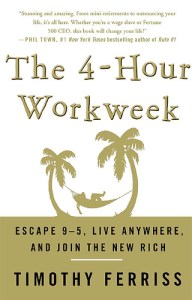
This advice comes from Timothy Ferriss, author of The 4-Hour Workweek. The bit about the time zone is my little contribution.

This is great advice, but Ferriss doesn’t explain why. You can figure it out in context, but you might not have the book. And some things aren’t there. So here’s my explanation.

1. For many of us, email is a black hole. Once you get in, it’s hard to get out. We know this happens. So we might be starting our day with email just to avoid the really important and productive stuff. Don’t let this happen.

2. If you check your email first thing in the morning, you’re liable to spend more time messaging than you would later in the day, since it may feel like you have more time for email before the day really gets cranking.

3. The impulse to check email first thing every morning is a good indicator of an unhealthy addiction. If you feel like you simply must check your mail, then you have less discipline in your life than you need if you want to be productive.

4. Checking your email early clutters your mind with other people’s business when you want to devote your best hours to your own business. Before you open your mail, you don’t know what’s in there waiting for you. Why take the chance that it will bear tidings of new responsibilities?

5. By deliberately waiting to check your email, you train yourself to estimate more accurately the importance and urgency of email in your life. The bane of email is that it is too convenient and it creates an artificial sense of urgency. Postponing your email fix helps you experience the freedom from email that comes when you realize that very little of it is urgent. If you think it’s urgent, you may feel its bidding during all hours of the day, regardless of how often you check. And checking first thing in the morning feeds that sense of urgency.

6. Checking email first thing may encourage poor email management. Suppose you adopt the policy that you will never leave a message you’ve read in your inbox. Great idea. But to follow through on that policy, you have to have a message management system. The simplest of systems has three bins or folders, one for the archives, one for follow-up tasks, and one for holding items while you wait on someone else to complete a task. The rest can be deleted. So every message that’s opened is immediately handled in one of five ways: (1) it’s trashed, (2) it’s answered, (3) it’s archived, (4) it’s tucked into a follow-up folder, or (5) it’s moved to a folder awaiting someone else’s action. The FOLLOW-UP and WAIT bins will have to be monitored. So you’ll probably want to keep track of them in your task management system. Staying organized this way takes a little extra effort. If you don’t want to tie up your morning with these kinds of activities, and you just want to open your mail to see what’s in there, you will end up doing one of two things, practicing your management protocol when you should be doing something more productive, or leaving read messages in the inbox to be tended to later.

7. It may turn out that simply waiting a few hours to check mail allows just enough time for many messages to become stale. If a message has gone stale, because the urgency of the moment when it was sent has evaporated, then you have one less message to deal with.

And now a word about time zones. I live in California, where it’s three hours later than in the east. So by the time my day starts, other people in my communication loop have already had three hours to post messages. So I might think I owe it to them to jump into my mailbox right away to see if that’s the case. But I owe it to myself not to do this.

I’d like to know about your email headaches, and strategies for getting relief. So please post your comments. Just don’t expect me to reply first thing in the morning.

Acronym Crazy


There’s an acronym for everything. Well, almost everything. Acronym Finder has a database of over 200,000 acronyms, many of which serve multiple purposes. And the list is growing—TLIG. (Yes, I made that up . . . IMTU.)

The funny thing about acronyms is that they attract logophobes (people who dread words) and logophiles (people who love words). GF. (That’s “go figure.”) And since logophobes and logophiles are very different creatures, it would be unwise to adopt the acronym “LP” for both. Besides, LP is already taken.

Acronyms do come in handy. Often they are easier to say or remember than the phrases they abbreviate. Those that have a standard use are considered words in their own right, with their own entries in the main catalog of any good dictionary. The ideal acronym is pronounceable: NATO, AIDS, UNESCO. But a host of second-class acronyms aren’t pronounceable, even though we forget that they aren’t—for example, BBC, KGB, and DVD. An unpronounceable acronym achieves a kind of elite status when its written form is no longer accompanied by periods after each letter. So U.S.A. has by now been elevated to USA. Acronyms that are both pronounceable and normally written in lower case letters are truly special; they look like they’ve always been words: laser, radar, and snafu come readily to mind (if you happen to be consulting the New Fowler’s Modern English Usage, 3rd ed., for its entry on “acronym”).

Some of the most familiar acronyms stand for phrases that many people can’t recollect, or never even knew, as suggested by the following hypothetical, but easily imagined, conversation.

Ed: I work for the National Aeronautics and Space Administration.

Fred: Never heard of it.

Ed: Have you heard of NASA?

Fred: Of course. Why do you ask?

By now you’re probably wondering, “Is the word ‘acronym’ an acronym for anything?” The answer is yes, sort of. There are two reasons for the qualification. First, “acronym” is a word in its own right, and was before it was “acronymized” (which, I stipulate, is pronounced with emphasis on the second syllable). This is a case of reverse acronymization, you might say. Second, there isn’t much demand for the acronym “acronym.” But there are some smarty-pants uses of “acronym” as an acronym. For these, check out Acronym Finder.

Acronym Finder isn’t just fun and games. If you ever forget what “ATM” stands for, and you have an urge to close that memory loop, AF is the tool to turn to. Be careful what you ask for, though. I blithely entered my name: D-O-U-G. Turns out this is an acronym with a single definition: “Dumb Old Utility Guy.” Maybe this blog post proves the point.

[Footnote: “Acronym” is not to be confused with “anacronym.” “Anacronym” isn’t a word, but it should be. In my own private lexicon it means “a word or phrase that has become obsolete.” Some acronyms are so popular that the words or phrases they represent are, in precisely this sense, anacronyms.]

Disillusioned Professor Comes to Grips with ‘The Visitor’


He has the perfect name and the ideal job for portraying upper-middle-class disillusionment. Walter Vale is a literature professor at a reputable university in the Northeast. He’s no longer capable of enduring day-to-day encounters with students, and he’s embarked on a sabbatical during which he only pretends to be writing his next book. Will those who see the film The Visitor be able to relate to Walter’s dysphoric existence? Yes, because the role is performed by Richard Jenkins.

“Richard who?” The folks at Back Stage West must have been thinking the same thing. In this week’s issue, Jenelle Riley describes how a “blue-collar actor” like Jenkins (who’s never played a lead role in television or film) can lead in every scene of a low-budget indie film and launch it to nationwide screening. When BSW arrived in today’s mail, I was pleased to see a cover story about this actor, and about this film.

I saw The Visitor when it was screened at the Sundance Film Festival in January. I recognized Jenkins, but couldn’t place him. The Riley essay explains why. But I liked him, and I liked this film because of him. He was funny, in that way that only the wearing malaise of life experience can make a thoughtful person funny. When the film ended, writer-director Tom McCarthy fielded questions from the audience. He was good. But Richard Jenkins stole the show.

This film is supposed to be about how injustices can accrue in the treatment of illegal immigrants. It could even be said that The Visitor is making an argument that at least some illegal immigrants should be granted amnesty. Many viewers will find themselves reflecting on this possibility. But the movie is just as much about how a man like Walter can get a new lease of life through his encounter with the unexpected, even if things still don’t turn out the way he would like.

The film begins and ends brilliantly. Walter is a serious man in a serious funk, who teaches us to lighten up a little. The Visitor opens April 11 in a platform release (that is, in a handful of theaters to generate buzz). This is one I’ll be seeing again.

Footnote: You’ll enjoy this film more if you don’t see the trailer first.

Music Mania and Doing Good: Big Things Come in Small Packages


The iPod. The iPhone. Nifty little devices for packing huge inventories of favorite music. In the world of technology, small is BIG—at least some of the time. But today we find out just how BIG small can be. Apple, the people who invented the iPod and the iPhone, announced today that they are #1 in music retail in America. Wal-Mart has left the building; Apple is the new elephant in the room.

How big an elephant are we talking about? Apple has sold 4 billion songs (give or take) to more than 50 million people in this country over the past five years. Let’s do some math. Four billion divided by fifty million equals eighty. So, on average, American customers have purchased 80 songs from Apple. Since tunes go for 99 cents in most cases, that’s roughly $80 per customer, over five years. So $16 per year. Doesn’t sound like much, right? But fifty million customers cranks that figure up to nearly four billion dollars since Apple opened the iTunes music store. A nominal expenditure of financial energy on the part of a sufficient number of people yields an enviable cache of, well . . . cash.

Only 16% of all Americans achieved this result. Sixteen people for every 100 hundred Americans spent $16 on tunes each year for five years, and Apple garnished $4 billion.

Big things come in small packages, if you have enough small packages. But “enough” small packages can be a relatively small percentage of the total pool of possible contributors. In this case, Apple can generate an influx of $4 billion dollars from a relatively small percentage of Americans who love their music to the tune of about $80 each.

One lesson in this is that when enough people care just a little bit about something, and they show that they care with a modicum of energy, big things can happen. Apple has literally been banking on that.

I’ll go out on a limb here and say that most Americans, when they click for a new iTunes purchase, are not thinking, “I sure hope there are a bunch of other Americans out there doing the same thing; otherwise, this just wouldn’t be worth my trouble.” They act for a limited good over which they have considerable control. But because lots of other people do the same thing, Apple is a big winner.

How often do we consider performing some action that would produce only a limited good (something we value), but we refrain simply because the good we can produce by ourselves seems too puny to bother? What if we interpreted our action differently? What if we decided to act for the limited good over which we have some significant control? What if we forgot about whether anyone else cares as much as we do about realizing that good? If we all did that, maybe big things—good big things—would happen.

Having a new three-minute tune to tickle my tympanic membrane is a limited good. I’ll shell out 99 cents for that, now and then. Budgeting $16 a year for this is within reason for most Americans. We manage our music mania pretty well. But it’s only music, after all, piped in through our iBooks, iPods, or iPhones. Surely there are greater goods we could each achieve with the same modicum of expenditure. So what are we waiting for? What good thing would you do, if only enough other people would do it, too?

Tell you what. I won’t wait for you, if you won’t wait for me.

Parenting with Purpose


What is a parent supposed to be doing . . . as a parent? My friend Mike Austin is author of a book called Conceptions of Parenthood (Ashgate, 2007). In an excerpt on his “Morality and the Good Life” blog, Mike suggests that parents should endeavor to train their children in skills that will result in their well-being over the long haul. This, he says, encompasses the goal of preparing them to live autonomously. Mike interacts briefly with William Irvine (author of Doing Right By Our Children), who stresses the value of freedom.

I concur with Mike, and would argue that the best kind of freedom depends on being rational, and is experienced as a result of making consistently wise choices. So educating children for freedom is educating them in a tradition of wisdom. And that involves guidance through experiences of choosing wisely in comparatively safe situations when they’re young, and in increasingly challenging circumstances as they get older. This would surely empower them to be even more effective in using their freedom to achieve the best and highest goals as they enjoy greater autonomy.

If we who are parents succeed in this endeavor, our children may be our own wise counselors some day.

Two Film Noir Icons Die Within a Week of Each Other


Director Jules Dassin has died at age 96 today. Actor Richard Widmark died Monday, March 24. He was 93. Dassin and Widmark were major contributors to the film noir era. Their careers are recapitulated in The New York Times.

http://www.nytimes.com/2008/04/01/movies/01dassin.html

http://www.nytimes.com/2008/03/27/arts/27widmark.html

http://movies.nytimes.com/person/76135/Richard-Widmark?inline=nyt-per

Richard Severo writes, “In 1962, with his best films largely behind him, Mr. Dassin told Cue magazine: ‘Of my own films, there’s only one I’ve really liked — ‘He Who Must Die.’ That is, I like what it had to say.” The film, released in 1957, is set on the island of Crete as locals prepare for their annual Passion Play performance. Things go wrong between two priests.

Widmark worked in over 60 movies and was one of my favorites. Two of his credits include Kiss of Death (1947) and Murder on the Orient Express (1974). Under the direction of Jules Dassin, he played in Night and the City (1950).

Aljean Harmetz recounts Widmark’s explanation, in a 1995 interview with The Guardian, for forming his own production company in the 1950s. Widmark said, “The businessmen who run Hollywood today have no self-respect. . . . What interests them is not movies but the bottom line. Look at ‘Dumb and Dumber,’ which turns idiocy into something positive, or ‘Forrest Gump,’ a hymn to stupidity. ‘Intellectual’ has become a dirty word.”

Harmetz adds that Widmark “vowed that he would never appear on a television talk show, saying, ‘When I see people destroying their privacy — what they think, what they feel — by beaming it out to millions of viewers, I think it cheapens them as individuals.’”

Trawling for Language Tips


So far, I haven’t gotten much free advice about fast-fluency language learning. One guy suggested prayer. But I’m not banking on that alone. Another reminded me that a mutual friend used to teach in Kiev and recommended I hit him up for a crash course. As it happens, our mutual friend is the one who arranged for me to lecture in Kiev in the first place. So why didn’t I think of that?

Something tells me that my reader-pool is too small for my blog request to bring lots of experienced fish to the surface. After all, this blog is, like, ten days old. (OK, eleven.) Readers may not share my ambition to learn other languages in preparation for short-term travel. And those who dream about it may think it’s totally irrational to make the effort.

But trawling for language tips on the web brings hope. I found my way back to a site that I’ve enjoyed reading before—Tim Ferris’s blog on The Four-Hour Workweek. Check it out at www.fourhourworkweek.com. He has a page on “How to Learn (But Not Master) Any Language in One Hour.” I figured if it didn’t take me an hour to see what he has to say, it could be productive. It was.

We seem to think alike, on this point, at least. His strategy is to size up a language for fluency potential by testing it in specific ways. This takes about an hour. When you’re done, you’ll know enough of the language to know what you’re up against. And that’s a huge first step.

At the top of his article are two screenshots, one titled “Deconstructing Arabic in 45 Minutes,” the other, “Conversational Russian in 60 minutes?” Bingo. Russian. But what’s that question mark about? Ferris has something to say about that later. You know how German is laden with noun cases and variations on the definite article, depending on the role a noun plays in a sentence? Well, he says, “Russian is even worse.” That’s what I needed to hear.

But wait. I like German and I enjoyed studying German in school. So I read on. There isn’t anything more specific about Russian in the article. But his advice is concise and sound (no pun intended). His chief admonition is to treat learning a new language like learning a new sport.

One of the scary things about Russian—encountered right away—is the alphabet. It even has its own name—”Cyrillic.” It’s called that because a 10th century Christian missionary to the Slavic peoples, a fellow named Cyril, had something to do with its invention. The Russian alphabet has a few totally unfamiliar characters. It also has some familiar looking characters, like ‘B’, that don’t sound at all like they do in English (even though there may well be a Russian equivalent for the English pronunciation of a particular character . . . if you follow my drift). The Russian alphabet is a tad longer than the English alphabet, and it includes two or three characters that apparently have no sound at all. On the whole, though, learning the Cyrillic alphabet is really no big deal. In fact, mastering it with surprising ease could lead to premature fancies of fast fluency.

Something especially mysterious to me is the dramatic contrast between some printed Cyrillic characters and their handwritten equivalents. For instance, here’s how “Christianity” looks in printed Cyrillic:

x р и с т и а н с т в о

In handwritten form and italics, the third and sixth characters (pronounced like “ee”) look like the English u, the fifth and tenth characters (pronounced like the English “t”) look like m, and the eleventh character looks like a scrunched down 6, but with the top tip of the character curved back into the center of the character. (I can recreate the word as it should be in italics when I write it in the blog editing window, but the word reverts to the above printed form when it’s saved to the blog page. Another mystery. If anyone can explain that to me, I’d be happy to hear.)

More trawling brings up two sites designed to help language learners connect with native (or otherwise fluent) speakers and writers:

http://myhappyplanet.com/register.php?refid=pNEGLdWo

http://www.palabea.net/

Language learning locations include:

http://www.languageguide.org/eng/

http://home.yabla.com/product/home.php?

http://www.everythingesl.net/inservices/bics_calp.php

http://how-to-learn-any-language.com/e/index.html

For French: http://www.aimlanguagelearning.com/hot-topics.htm

For Russian: http://alanlittle.org/weblog/Russian3.html; http://how-to-learn-any-language.com/e/languages/russian/index.html

For German and Spanish phonetics: http://www.uiowa.edu/~acadtech/phonetics/

For a translation site, go to:

http://www.travlang.com/languages/

If you bookmark this site and travel with a laptop, you may be able to leave your foreign language phrasebook and translation dictionary at home.

I press on.

______

Footnote: Cyril and his brother Methodius labored together among the Slavs. Countries strongly influenced by the Eastern Orthodox church are dotted with well-preserved statues and stained glass portrayals of the pair. They are regarded as the Patron Saints of Europe, and without a doubt their influence in the Christianization of Europe a thousand years ago was considerable. Coincidentally, my last day in Ukraine is May 24, which is Saints Cyril and Methodius day in Eastern Orthodox tradition. On that day, they are often commemorated with a national holiday and remembered for their influence on literary culture and the development of the alphabet—in Russia and the Czech Republic, for instance.

What Does It Take to Hear a Who, and What’s It to Do with Me and You?


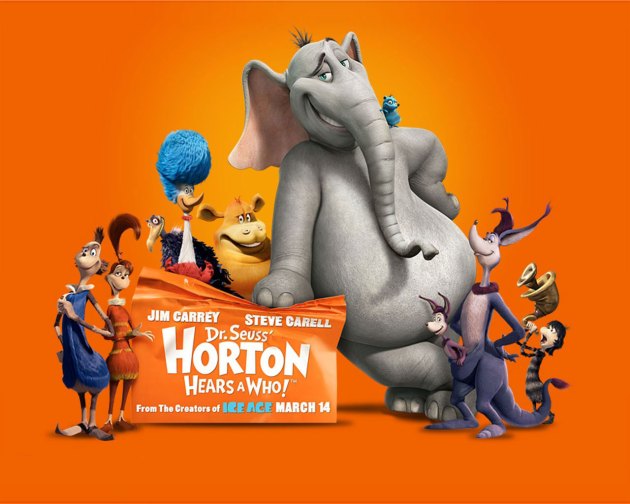
horton-hears-a-who_1“A humorous exaggerated imitation of an author, literary work, style, etc.,” is how The Concise Oxford Dictionary defines the word “parody.” If you spend an afternoon reading a book like The God Delusion, by Richard Dawkins, then set off to the theater with your family to see the new film Horton Hears a Who, you may be surprised to find yourself drawing parallels between the movie and the book.

Horton is the naïve, indiscriminate, credulous elephant. He gets it in his head that a speck that has come to rest on a clover is home to a civilization of “humans” who are invisible because they are too small to be seen. Kangaroo, on the other hand, is sensible and stern. She recognizes early on the danger posed to the community by Horton’s fantastic notions. She confronts Horton about his silliness and warns him to cease and desist. But Horton, being an elephant, is too “faithful” to abandon his convictions. And in due course, what began as a harmless idiosyncrasy evolves into a mission that imbues Horton’s life with fresh meaning and purpose.

Kangaroo is beside herself with concern, especially for the children, who—horrors—have begun to use their imaginations. Her motto is, “If you can’t see it, taste it, or feel it, it doesn’t exist.” Horton’s claim—that “the speck” is inhabited by humans who call themselves “Whos”—fails this test.

Or should I say, it almost fails this test? Horton, after all, hears intelligent noises coming from the speck. Eventually he even engages in meaningful conversation with the diminutive mayor of Whoville. So Horton, at least, has empirical evidence for his belief. And that seems to be all that Kangaroo requires.

But that isn’t all that Kangaroo requires. She also stipulates that it’s impossible for there to be anything so small and human. So she is a radical empiricist with an a priori prejudice against the existence of things she can’t see. And her a priori commitment diminishes her ability to hear what Horton can hear. Of course, Horton is equipped with ears that are especially sensitive to very slight auditory data. Since he is unique in this respect, no one really believes him. This despite the fact that he has no special motive to mislead a community of individuals he obviously cares about.

Horton isn’t a complete doofus. He can’t get Kangaroo to listen for what she isn’t willing to hear. So he challenges her prejudice with a thought experiment. “What if our own world is just a speck from the point of view of some greater being?” he asks. Kangaroo is unable to entertain this possibility. She is as absurdly sure of herself as she believes Horton to be.

A major difference between Horton and Kangaroo is that Kangaroo is a demagogue, and most members of her community are lemmings. They may not follow her logic, but they do follow her lead. She adopts the posture of an infallible authority figure and whips up alarm among those who are no more able to think for themselves than Horton is supposed to be.

The mayor of Whoville suffers a similar fate. He’s called a “boob” by a leading member of the town council. This is a painful slap in the face. The mayor’s influence is fanciful. And his explanation for what is happening in Whoville is believed to be delusional. Like Horton, he risks ridicule for what he believes to be true. But that’s not all there is to it.

The mayor fears for his community, which does not recognize the danger that threatens Whoville. Initially, he does not seek to convince the citizens of Whoville. He knows they will not believe that an invisible elephant in the sky is their protector. Still, he takes responsible action on the basis of what he knows, even though he risks humiliation.

Horton Hears a Who is a smart and entertaining film. I doubt that it’s a deliberate parody of the emotionalism exhibited by the “new atheists.” But I can’t help thinking Richard Dawkins will not be happy with it. At least he can’t complain that he was tricked into doing the voice-over for Kangaroo.

horton-hears-a-who-1396

8 Weeks to Learn Russian: Send Me Your Tips


In eight weeks I’ll be in Kiev, the Ukraine, for a full week. My mission: to teach a course in philosophy for five straight days. I’ll have an interpreter. So I don’t have to know a single word of Russian to get by. But I don’t want to get by. I want to have as much useful Russian under my belt by the time I get there.

I’ve found that a trip to a new destination, where they speak an unfamiliar language, provides me with the greatest initial inspiration to learn that language. I want to exploit that initial burst of energy and learn as much as I can. I won’t be fluent when I reach my destination, but people will know that I’ve made the effort and will realize that I want to learn their language. So I’ll get more help when I’m there, and I’ll have something to build on. My question for you: What’s the best way to build that foundation when I have eight weeks to go?

Quotes to Live By


“No matter what side of an argument you’re on, you always find some people on your side that you wish were on the other side.” —Jascha Heifetz

“Genius is only a superior power of seeing.” —John Ruskin

“I not only use all the brains I have, but all that I can borrow.” —Woodrow Wilson

“Every war movie, good or bad, is an antiwar movie.” —Steven Spielberg, “Of Guts and Glory”

“Happy is the man who learns from his own failures. He certainly won’t learn from anyone else’s.” —Austin Farrer, “St. Mark”

“. . . there is a tremendous social responsibility that comes with any public act we do, and that includes creative acts, as well.” —Charles Johnson, in his interview with Diane Osen for The Book That Changed My Life

—Charles Johnson, in his interview with Diane Osen for The Book That Changed My Life