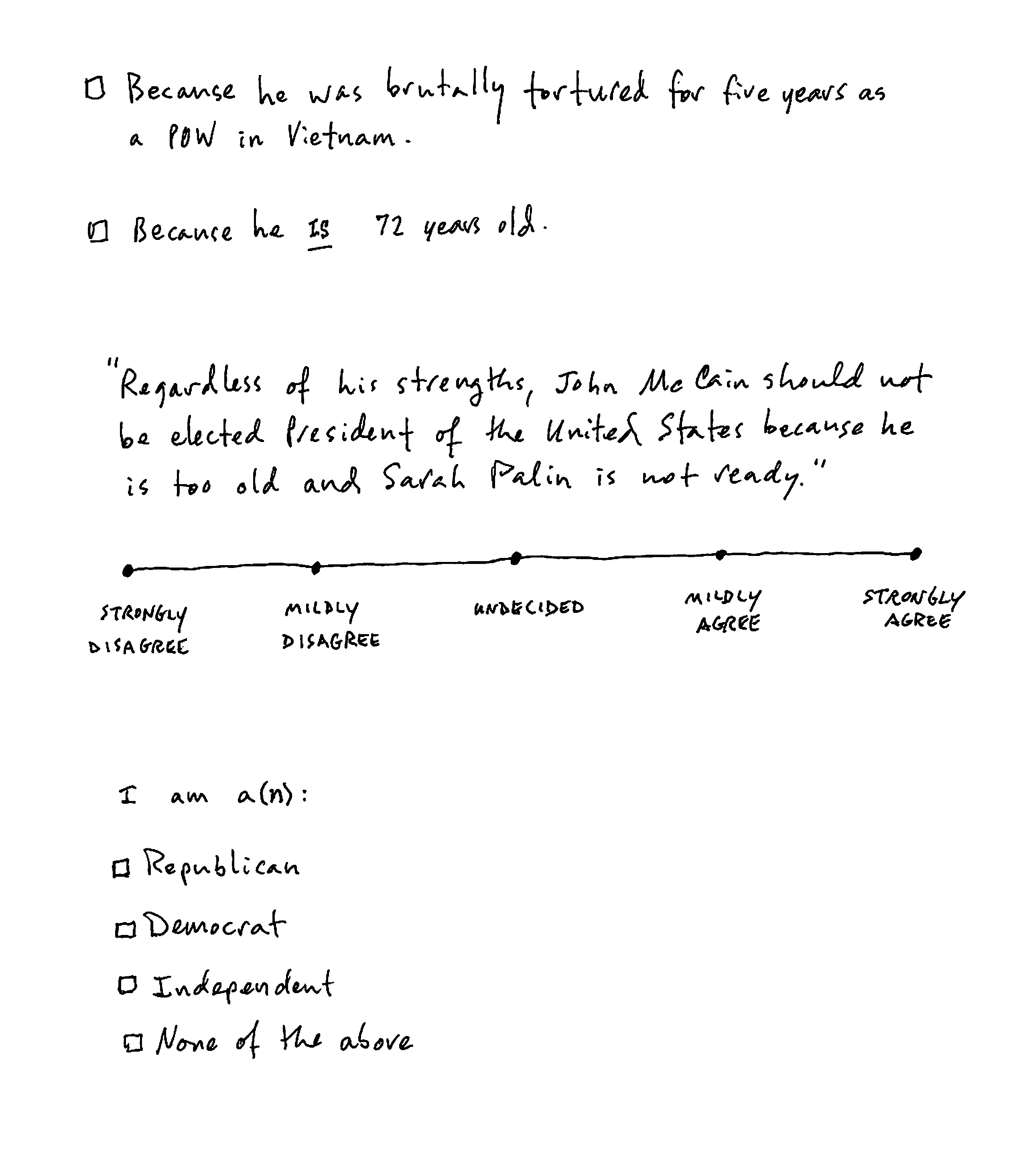
A Poll for Twenty-Somethings and Thirty-Somethings


If you’re in your 20s or 30s, I invite you to participate in this poll.

As you think about common characteristics of your generation, indicate which of the following statements you agree with and which you disagree with. Please use the reply box below.

  1. “My generation is driven by our individual needs and desires, and pursuing our own individual happiness is the most important thing.”
  2. “My generation thinks it’s more important for children to learn to think for themselves than to learn to respect authority.”
  3. “Members of generation would say, ‘As long as I believe in myself, I really don’t care what other people think.’”
  4. “Probably, most of my generation would agree with this statement: ‘It doesn’t really matter if you’re a Communist or not—this is America, and you can be one if you want.’”
  5. “My generation thinks that if you put your mind to it, you can accomplish anything.”
  6. “Older generations trusted God, the church, government, and their elders. My generation questions things and people that earlier generations never would have.”
  7. “In my generation, as opposed to my parents’ or my grandparents’, we’re told to express our feelings and anger and sadness about our surroundings and not to hold them in.”

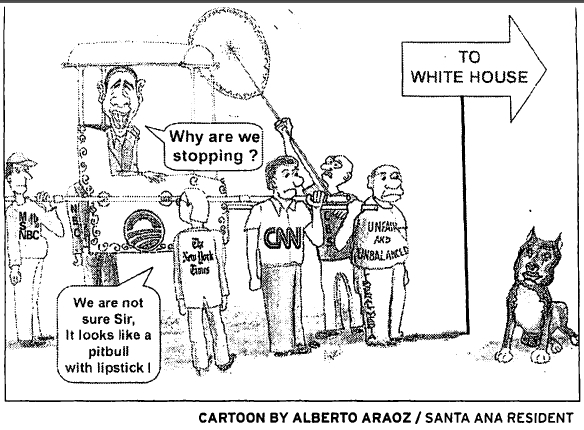
Never Say “Lipstick”


Barack Obama’s supporters recognized a smear that he didn’t intend. When he spoke of putting lipstick on a pig, the house exploded with laughter. Talk about red meat.

Only problem is, Obama didn’t mean it “that way.” And that’s Barack’s problem, not McCain’s, or Sarah Palin’s. Barack said it, paused (as he is wont to do), and his audience punctuated his remark with wild enthusiasm as if they believed it was about Sarah Palin. And right at that moment it became about Sarah Palin. And there was almost nothing Barack Obama could do about it.

The McCain campaign posted a web ad exploiting Obama’s slip. Big mistake, if you ask me. Or maybe not so big if the real “catnip for the media” (Obama’s estimation of his comment) continues to be the video of Obama’s slip and not the McCain ad.

Dennis Miller has an interesting theory about what happened. “Lady Palin,” he said, “is deep inside Obama’s mellon.” I’m from California, so let me translate. The esteemed governor Palin has become so popular and has so effectively derailed the Obama campaign that Obama can’t get her out of his head and he doesn’t know what to do.

What’s this got to do with the lipstick gaffe? Ms. Palin’s most memorable remark during her convention speech was the alleged extempore joke about the difference between a hocky mom and a pitbull. She pointed to her mouth and said, “Lipstick.” America liked that, and they liked Sarah Palin. Still do.

So the lipstick motif became a fixture of the McCain camp. Miller speculates that this motif took subliminal root in Obama’s consciousness. Without malice or forethought, the motif surfaced in the form of a long-standing aphorism. Obama’s problem is that this aphorism had never before been used in this peculiar political context.

People are beginning to speculate that Obama has a liability that could injure him in his upcoming debate with John McCain. He seems constitutionally incapable of packaging his ideas in the form of a sound byte. When commenting without a script, his statements are neither crisp nor compact. (In this respect, he is more like President Bush than John McCain is.) Obama may be thinking now that going for the spontaneous repartee may be more dangerous than his typically long-winded answers to questions he could answer with a simple “yes” or “no.”

***

By the way, suppose Obama was actually intentionally ambiguous when he said what he did. Would that really be sexist?

What say you?

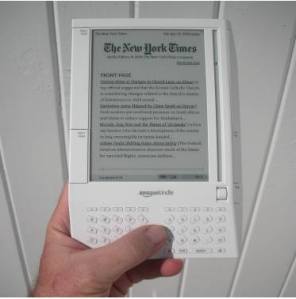
How to Get the Most Out of Your Kindle—Tip #3


Is it even possible to document references to works researched using your Kindle?

Sure. But the technique isn’t conventional. While there are no page numbers, there are location numbers for every line of text. These appear at the bottom of each Kindle page. And they remain constant regardless of the font size you adopt for reading.

So the only thing you have to do differently when documenting a quotation from the Kindle edition of a book is give the location number where you would indicate the page number of a standard book.

This issue has been thoroughly discussed at various sites, including Amazon’s own Kindle blog. Many who write about this seem to be ill-informed.

Some books exist only in e-book format; indeed, some exist only in Kindle format. E-books are legitimate sources of information. It ought to be possible to cite them and to do so accurately and clearly. Even an academic paper evaluating e-books and reporting research about their contents would have to include specific documentation, even if the researcher was arguing that they are not a legitimate form of information dissemination.

There are e-books aplenty, and scads of formats among them. The Kindle has a proprietary format. Amazon’s well-known presence and general reputation worldwide should ensure that this format comes to be widely accepted.

Kindle and the Purpose of Citations

Let’s remember why citations are required in the first place. First, and foremost, they give credit to whom credit is due. This is not merely a matter of paying respects. It is a matter of protecting someone else’s intellectual property.

A secondary reason for documentation is that it is an aid to readers who might wish to chase down the reference and study the larger context of what is cited.

Both of these objectives are easily accommodated by using location numbers for Kindle citations.

A Possible Liability and Its Remedy

One liability of referencing material as it appears in an e-book rather than a traditional book has directly to do with the variability of formats from one e-book publisher to another. Readers of material that cites an e-book will often have more difficulty finding the specific source.

A partial remedy is to be sure to indicate that the source you cite is the Kindle edition of a book. This will prevent confusion about which e-book is cited. But the Kindle is not yet ubiquitous. A majority of readers may not yet have access to one. So they’re a bit stuck until the Kindle becomes more widely used—as it surely will. They’re only a bit stuck, though, because they may not have much trouble following up on a citation within a traditional book version of the material.

What about Citing a Kindle Book for a Term Paper?

Some have advised students to take care to consult their teachers before citing a Kindle book in a research paper with footnotes and a bibliography. That’s not a bad idea.

I must say that if one of my students submitted a paper with Kindle book citations, and without first confirming my approval, I would be very reluctant to deprive her of that option. There’s nothing irresponsible about what she’s done. But the student should be certain that her teacher’s syllabus does not explicitly prohibit the citation of Kindle books.

What about Citing a Kindle Book in a Book or Article for Publication?

There should be no concern that an author risks being accused of plagiarism if he cites a Kindle book, as long as he provides all the information needed to confirm his source.

Publishers themselves often have special citation requirements, a standard way they handle each kind of citation for their books, journals, or magazines. It’s an author’s responsibility to provide all the necessary bibliographical details when submitting a manuscript for publication. It’s recommended that he use the publisher’s guidelines for formatting. If a publisher doesn’t address the question of formatting e-books, the author has two choices, enter the data in a format that can be understood and revised by the copy editor, or consult the publisher for guidelines about the matter.

If a publisher refuses to allow Kindle book citations, get another publisher. Alternatively, if there’s a good chance you’ll wish to cite a Kindle book in what you’ll be writing for a specific publisher, discuss it with the publisher before signing a contract. A publisher will most likely accommodate you, and even express their approval in the contract for publication.

A Future for Kindle Books Among Scholars

Every time I see my high school daughter leave for school with a book bag loaded with heavy textbooks I wonder how she manages. Wouldn’t it be great if she could get those same books on a Kindle and just carry that in a shoulder bag or something? All it would take would be for Amazon to perpare Kindle versions of those books.

I can assure you that Amazon is pursuing this avenue. As it is, they already have a growing list of textbooks available in Kindle version. I’ve been surprised to see many philosophical texts used at the university level available in this format. The day may come when a student can get every textbook on a Kindle . . . and get a substantial discount to boot.

Here’s an advantage that hits closer to home for me. If I wish to conduct sabbatical research at a remote location, it would be unrealistic if I had to ship all the books I think I might wish to consult. I have friends who have done this, but time and cost would be prohibitive for me.

What I might do, though, is browse the Kindle inventory at Amazon for books related to my research. I could download these before I leave on sabbatical, or on location while on sabbatical. The crucial thing for me would be to be able to quote accurately from a source of valuable material. A Kindle version would make that possible. After returning from sabbatical, I could, if I felt the need to, check my Kindle citations against traditional book editions and convert the documentation. (Or I could assign this to a research assistant.)

New to Kindle? Check it out here.

For a good resource on electronic documentation, see Diana Hacker’s book Research and Documentation in the Electronic Age

Related Posts:

Kindle Your Reading Habits

How to Get the Most Out of Your Kindle—Tip #1

How To Get the Most Out of Your Kindle—Tip #2

How to Get the Most Out of Your Kindle—Tip #4

Getting the Most Out of Your Kindle—Tip #2


Sarah Palin was a newsmaker when her selection as John McCain’s running-mate was announced. Suppose you wanted to read prominent newpaper coverage of her convention speech the following day—in The New York Times, The Washington Post, The Los Angeles Times, The Boston Globe, or even The Times of London or Germany’s Allgemeinde. Suppose you wanted to sample editorials from all of these papers.

You could have your dog fetch them from the front driveway (if he hasn’t been retired because of illegal immigration). You could make a special trip to your local bookstore and pick up copies of each of these papers. Or you might go online and scan the web editions.

But have you considered using your Kindle? You can subscribe to all of these papers, and more, to be downloaded automatically to your Kindle as soon as they are off the press. But you don’t have to subscribe to several papers, or any papers. Why not just purchase each of these papers for that day only, and read the bits you like? Kindle gives you that option.

Sure, you could go the laptop route and be more or less portable. But you’d need an internet connection, and you’d have something larger and heavier to carry around—unless you have one of those fancy cell “phones” that does it all. What you wouldn’t have, even with the cell phone, is the possibility of reading on a screen more than half the size of an iPhone screen, wi-fi uploads wherever you go, the freedom to read offline with no extra effort, portability when you travel on airplanes, bookmarking wherever you’ve left off in your reading. You wouldn’t be able to mark passages or make notes with ease. You wouldn’t be able to adjust font size to accommodate your reading environment. You wouldn’t have hours or days of battery power.

Use your Kindle to read the newspaper. You’ll be glad you did.

Related Posts:

Kindle Your Reading Habits

How to Get the Most Out of Your Kindle—Tip #1

How to Get the Most Out of Your Kindle—Tip #3

How to Get the Most Out of Your Kindle—Tip #4

Stuff I Have to Read (Not That I Don’t Want To)


<script type=”text/javascript” src=”http://www.assoc-amazon.com/s/impression-counter?tag=faifilandphi-20&o=1″></script&gt;
<noscript><img src=”http://www.assoc-amazon.com/s/noscript?tag=faifilandphi-20&#8243; alt=”” /></noscript>

BlogLogic—Rumors of Sarah Palin’s Affiliation with the Alaska Independence Party


It’s been interesting to see how things have unfolded on the Mudflats blog, which purports to be “tiptoeing through the muck of Alaskan politics.”

The host goes by the handle “AKMuckraker.” Today she published a post titled “Palin – Republican Party Infiltrator? Damning Video.” With a title like that, you hardly need to read further to know what’s up:

There’s a video that incriminates Sarah Palin by showing her past ties to the Alaska Independence Party (AIP) and her secret plan to advance that party’s aims by infiltrating the Republican party.

That’s the muckraker’s thesis.

If you want to know what’s so damning about the video, or whether it’s damning at all, then you might want to read the post. The muckraker connects the dots that lead to her conclusion. And she’s remarkably confident of her conclusion.

The only problem is, her evidence doesn’t support her conclusion. Her argument is fallacious. If it’s not a specimen of conscious bias against Palin, it’s at least a case of wishful thinking gone awry.

The video features a small gathering of crazies scheming about how best to achieve the secessionist goals of the Alaska Independence Party. So we’re told. We have to take the muckraker’s word for it that this video is not a setup. We’ll give her the benefit of the doubt here. We’re also told that a key participant seen and heard on the video is Dexter Clark, vice chairman of the Independence party. Fine. We’ll go with that.

The muckraker then provides transcripts of bits of the video. Since these are the portions she uses to make her argument, let’s assume that they are the most damning evidence in support of the muckraker’s conclusion.

The first excerpt shows Dexter Clark estimating the number of American soldiers and dependents who “could be eligible to vote” for Alaska “Statehood.” Of course, Alaska has been a state since 1959. Ah, but it isn’t yet a “State,” as in “independent nation state.” The excerpt doesn’t disambiguate for us, but I take it that Clark is referring to the independent-nation-state kind of state, and he’s calculating the number of votes his party might be able to count on in a referendum on Statehood.

OK?

Well, maybe not. The ensuing paragraph, where the muckraker explains things for us, leaves us in greater suspense. How is “Statehood” really being used here? It isn’t easy to tell.

It might not matter. The basic idea seems to be that the Independence party was shafted by a rigged vote about Alaska Statehood, and the desired result of the AIP went down in smoke.

We come, then, to the next excert, what the muckraker calls “the good part.” Here Clark lauds the election of Sarah Palin to become Alaska’s governor, even though she did so as a Republican. Clark explains why this is good news for his Independence party. Palin had once been a member of the party. The only reason she switched parties and became a Republican was to “get along and go along” (Clark’s words).

At this point, vagueness corrupts the argument. What does Clark mean by “get along and go along”? Presumably, he’s suggesting that at the time of Sarah Palin’s move to the Republican party, she was still an Independence party member at heart and that her new role as a town mayor might work out better if she had the appearance of being a Republican. She couldn’t have been much of a Republican, suggests Dexter Clark, since she discovered that “she all kinds of problems with their ethics.” This is clearly the message that muckraker gleans from Clark’s musings.

The joy in seeing Sarah Palin become governor of Alaska is rooted in Dexter Clark’s perception that Palin remains sympathetic with the AIP cause. And this is based on two things, Palin’s prior membership in the AIP, and Clark’s perception that Palin isn’t a sincere Republican. Clark’s perception that Palin isn’t a sincere Republican is itself based, in part, on Palin’s past association with the AIP. Clark’s perception of Palin’s continued affinities for the AIP is reinforced by his perception of a clash between Sarah Palin and the Republican party over the ethics of the party.

The net effect is supposed to be that Alaskans now have an AIP governor, disguised as a Republican, who can be counted on to reintroduce the issue of Statehood and perhaps facilitate the achievement of the AIP’s primary objective. What makes the whole thing really rich is that, because governor Palin is such a popular figure in her state, many Alaskans would probably vote with the AIP and everything turn out hunky-dory for the AIP.

So strategists in the AIP propose to infiltrate the two mainstream parties, get these pseudo-members elected to municipal and state offices, and watch them use their positions—synchronizing their efforts, of course—to bring about independence for Alaska.

This seems to be the basic trajectory of Clark’s reasoning process.

And the muckraker is floored by this. The video excerpts are so unbelievably damning that the muckraker thinks her readers might want to sit down before they are presented with the evidence she presents.

What’s truly unbelievable is that the muckraker finds the argument so compelling. Indeed, to sort it out you might need to sit down for a spell.

Here’s the argument:

  1. Dexter Clark is the vice chairman of the Alaska Independence Party (AIP). [Fact]
  2. If Dexter Clark is the vice chairman of the AIP, then his proposed strategy for achieving independence has been adopted by the AIP and its members. [Assumption]
  3. Dexter Clark’s strategy for achieving independence has been adopted by the AIP and its members. [MP, 1 and 2]
  4. Dexter Clark’s strategy for achieving independence is for members of the AIP to switch to one of the two main parties, get elected to government positions, and use their new authority to sponsor independence for Alaska.
  5. Members of the AIP agree to switch to one of the two main parties, get elected to government positions, and use their new authority to sponsor independence for Alaska. [Conjunction of 3 and 4]
  6. No member of the AIP ever leaves the AIP except in pursuit of Dexter Clark’s strategy for achieving independence. [Assumption]
  7. If a person who was once a member of the AIP and is now officially a member of the Republican party, then that person has left the AIP and inflitrated the GOP in order to advocate for independence. [Direct implication of 6]
  8. Sarah Palin was once a member of the AIP and is now officially a member of the Republican party. [Assumption or fact, as the case may be; that depends on the truth value of the first conjunct; we can safely believe that the second conjunct is true]
  9. Sarah Palin has left the AIP and inflitrated the GOP in order to advocate for independence. [MP, 7 and 8]
  10. If Sarah Palin has infiltrated the GOP in order to advocate for independence, then Sarah Palin is not a genuine Republican. [Direct implication of 7]
  11. Sarah Palin is not a genuine Republican. [MA, 9 and 10]
  12. If Sarah Palin is not a genuine Republican, then Sarah Palin is unfit to become Vice President of the United State. [Assumption]
  13. Sarah Palin is unfit to become Vice President of the United States. [MP, 11 and 12]
  14. If Sarah Palin is unfit to become Vice President of the United States, then we should not vote for John McCain in this year’s presidential election. [Assumption]
  15. We should not vote for John McCain in this year’s presidential election. [MP, 13 and 14]

Statements 10-15 do not appear in the muckraker’s post. They are gleaned from the tone and content of this and other posts at her blog, and my suspicion that she does not want John McCain to be the next President of the United States. In any case, we can dispense with them here.

The above argument can be simplified by extracting three of the numbered statements, 7-9. The resulting argument is as follows:

  1. If a person was once a member of the AIP and is now officially a member of the Republican party, then that person has left the AIP and inflitrated the GOP in order to advocate for the independence of Alaska. [Assumption]
  2. Sarah Palin was once a member of the AIP and is now officially a member of the Republican party. [Assumption or fact, as the case may be; that depends on the truth value of the first conjunct; we can safely believe that the second conjunct is true]
  3. Sarah Palin has left the AIP and inflitrated the GOP in order to advocate for the independence of Alaska. [MP, 1 and 2]

Notice three things about statement number 1.

First, it is an assumption that is never actually stated in the argument.

Second, it is crucial to the argument, since the muckraker never so much as hints that Sarah Palin was in the room when the video was shot, or even that Sarah Palin has unequivocally embraced Dexter Clark’s strategy for achieving Alaska’s independence.

Third, it isn’t true.

How’s that for a specimen of BlogLogic?

* * *

Why have I written this post?

One should not infer from what I’ve said here that I support the McCain/Palin ticket. That would require another instance of specious reasoning.

I have two reasons for writing this post.

First, Sarah Palin should be defended against arguments that violate the principles of sound reasoning. So should any other candidate. But Palin has been the target of incessant, vicious attack with arguments constructed on manufactured evidence. This seems to be the current number one priority of the muckraker. (Again, that’s what muckrakers do.)

Second, I can at least hope that exposing the barrenness of a BlogArgument—or Blogument, if you will—is a contribution to the common good, as a call to sound reasoning in the public square.

From Unbox to Amazon Video on Demand


Image representing Amazon Unbox as depicted in...

Image via CrunchBase

I’ve touted Amazon’s Unbox program for video rentals and purchases online. This program just got a new name and a new look. It’s now called Video on Demand.

You can purchase or rent movies and TV episodes. A recently added feature allows you to view the first two minutes of a movie for free before deciding whether to buy or rent. Prices, as you would expect, are very competitive.

I write about film at this blog and elsewhere. When I’m looking for a video, I start with Video on Demand. Their inventory is good and growing. If I can’t find what I’m looking for, I go to Netflix. The local Blockbuster store is my last recourse.

The greatest advantage of Video on Demand is that your selection can be downloaded to your computer or TiVo device. Within minutes you can be watching your choice of video, without leaving home.

To learn more, click here.

If you give it a whirl, let me know what you think.

Best Political Cartoon of the Weekend—7 September 2008


Why Does John McCain Look Like He’s 72 Years Old?


How To Cultivate the Reading Habit


Reading takes effort. But with the right habits and tools, it is richly rewarding. Here’s a list of tips for improve your reading skills and achieving more of your reading goals.

  1. Relate your reading goals to your larger goals. If you’re powerfully motivated to achieve some larger goal, try thinking about reading as a component in achieving that goal. One goal will fuel another.
  2. Understand that you don’t have to read everything on your list to benefit from the reading habit.
  3. Set specific reading goals. How many books do you want to read in the next year, or month? What kinds of books do you want to read? Make a note of the specific reasons you want to read these books.
  4. Select several books to have on hand to read at the same time.
  5. Use procrastination to your advantage. If you’re procrastinating about reading a particular book in your pile, use that procrastination to read another book in the pile.
  6. Select books that are practical and books that are theoretical. Books of the practical sort recommend solutions to interesting problems, provide guidance for self improvement, or explain how to do something. Books of a theoretical nature expand your knowledge base and enlarge your powers of critical thinking.
  7. In each broad category—the practical and the theoretical—include books that fit different subcategories. You might pick one book from each of ten subcategories: literary fiction (a novel), light fiction (another novel), short fiction (a collection of short stories), poetry (an anthology of works from a specific period, or on a common theme, or by the same writer), biography, history, inspirational literature, cultural commentary, and two practical books (for example, a book that will help you improve your writing and a book about sea kayaking).
  8. Make a note of the primary reasons you have for reading each of the books you’ve selected. Don’t settle for mere enjoyment. Assume that you’re going to enjoy the books you’ve compiled and refine your reasons for reading each book. Is one book in your pile because you want to improve your motorcycling skills? Is a book in the history category going to help you understand some event in the present? Will a particular novel enlighten you about a personally puzzling aspect of the human condition? Will the poetry you’ve picked improve your powers of imagination, or help you see the ordinary in extraordinary ways? Are you reading this book on cosmology in order learn the latest theories about the origin of the universe? Is that book about the narcissistic personality disorder going to help you understand a difficult colleague at work? Write these aims into each book.
  9. Keep these books together in a place where you feel relaxed and are most likely to have the inclination to read. This may be a cabinet next to your bed. Otherwise, use your imagination.
  10. Develop the habit of reading whenever your book stash in nearby. If you have a varied selection of books in different categories, just read what most suits your mood at the time.
  11. Pre-read each book to get an idea what it’s is about and how it’s organized. This will save time in the long run. It will help you decide whether to read the book more carefully, how to re-read the book to achieve your specific goals, and how much time to allocate for a closer read.
  12. Guard against time consuming eye movements. Keep your eyes moving from left to right, without regressing (even if you feel you’ve missed something). Train your eyes to “land” (ever so briefly) on points along the trajectory of your reading path, without moving your head. Work at reducing the number of “landings” for each line as you subconsciously scan for key words and phrases in the line.
  13. Separate the wheat from the chaff. Based on your pre-reading, decide which books deserve to be read more closely.
  14. While reading more analytically, pace yourself to fit the specific goals of your reading and the nature of the material as it changes from one passage to another. Skip over the bits that you already understand, or are repetitive, or don’t serve your reading objectives. Slow down for the complex parts, where key concepts are explained, or crucial details of a plot are revealed, or the line of a major argument is delineated.
  15. Mark your book in pencil as you read. Underline, circle, add symbols in the margins to identify a feature of special significance (for example, asterisks, question marks, explanation marks, bracketed numerals for lists or numbered items, arrows, horizontal lines for significant but unmarked breaks in the progression, check marks, squares, triangles). Create a simple shorthand system with letters of the alphabet for frequent kinds of marking. (If a passage is quotable, I draw a ‘Q’ in the margin. If it should be noted elsewhere in my files, I draw a cursive ‘f’.) Use vertical lines. Bracket sections with corner marks. Experiment with squiggly lines, double lines, light lines and heavy lines, and lines that are mostly light with brief stretches of heavy lines.
  16. Write unfamiliar words in the top or bottom margins—and look them up in a dictionary. This is the best way to improve your vocabulary. Over time, you’ll write fewer words and have a record of the growth of your vocabulary.
  17. Write out questions that come to mind—questions stimulated by what you’re reading. Interrogate the author. (Or, if you prefer, have a “conversation.”)
  18. Draw simple charts to show relationships that have been describe.
  19. Create your own index to the book, using the back endpages. Index key terms and concepts. If necessary, invent names for concepts.
  20. Reserve space in the back endpages to index passages that relate to research, writing, or speaking you may be doing. If you have an abbreviated title for each project, you can use this title for indexing purposes. Later, you’ll be able to return to these notes and enter them elsewhere as needed.
  21. Keep track of the structure and progression of the book.
  22. Write a summary and/or general outline of the entire book into the front endpages, and make a note about the general value of the book relative to your purposes. You may want to draft this on separate paper or with a word processor, and then transfer your final version into the pages of the book. Another option is to use Post-It notes that are nearly the size of a trade book and stick them into the front of the book with these notes and comments.
  23. For maximum portability and time management in pursuit of your reading goals, buy a Kindle and learn how to use it efficiently. (See separate posts with Kindle Tips on this blog.)

***

NOTE: Some of the ideas described in this post can also be found in How to Read a Book, by Mortimer Adler and Charles Van Doren. As the subtitle says, this is The Classic Guide to Intelligent Reading.

Two Heartbeats Away from the Presidency


Many people have said that this year’s presidential election is a referendum on President Bush, and this is a problem for John McCain—because with McCain we would just get a four-year extension of the tired-out Bush policies.

Others have suggested that the election is a referendum on senator Obama because of his inexperience.

Could it be that this year’s presidential election is a referendum on . . . Nancy Pelosi?

John McCain has tapped governor Sarah Palin as his VP running-mate. Many are asking, “But is she ready?” Ready for what? Ready to be the President of the United States if—God-forbid—something should happen to John McCain. After all, the Vice President is only one heartbeat away from the presidency.

So what’s that got to do with Nancy Pelosi?

Nancy Pelosi is a congressional representative from the state of California, and one of the most liberal members of Congress. She also happens to be the Speaker of the House of Rrepresentatives. The United States Constitution provides for the Speaker of the House to assume the reigns of power if—God forbid—something should happen to both the President and the Vice President. We actually saw Gerald Ford become President in the 1970s through this mechanism—and neither the President nor the Vice President had died!

So Nancy Pelosi is only two heartbeats away from the Presidency . . . right now. That won’t change when we elect a new President and Vice President in November. Maybe we should be looking at her record and experience.

John Wyndham Book Covers


I’m still reading John Wyndham’s classic sci-fi novel The Day of the Triffids. This one’s on my Kindle. I’ve now discovered what amounts to a virtually exhaustive catalog of book covers for all of Wyndham’s novels:

The John Wyndham Post That Made My Brain Hurt

Here are two of the best book covers for The Day of the Triffids:

Bedside Books—The Stuff I Don’t Have to Read


6 September 2008

7 September 2008

14 September 2008

1 October 2008

American Religion and the Loss of Community


What is the future of religion in America? That depends on the twenty-somethings and the thirty-somethings of today.

Robert Wuthnow, a sociologist at Princeton University, has sifted through a complex tangle of data about the religious outlook of Americans between the ages of 21 and 45. In his book After the Baby Boomers: How Twenty- and Thirty-Somethings Are Shaping the Future of American Religion, Wuthnow shares his findings about this generation’s perspective on organized religion, worship, the plurality of faiths, the intersection of faith and politics, and the nature of spirituality.

This book presents the case that the 20s and 30s are experiencing a unique form of social isolation. It’s tied, in part, to their tendency to postpone marriage. This influences their relationship to faith and traditional faith communities. But more important, I think, is the disaffection this generation feels in relation to the structured faith of their fathers and mothers.

This generation is no different than any other in its need to experience social integration and cohesion. But the opportunities for authentic participation in community have shifted. Old frameworks are disappearing and new structures are taking their place. Youth programs at traditional churches are still “youth programs”—that is, they enjoin young adults to participate on terms that might have been effective a generation ago but seem to be slipping today. More and more social networking is happening through computers and tools like MySpace, FaceBook, and LinkedIn.

Genuine interpersonal contact relates the souls of persons to each other. But our techno-world literally short circuits the spiritual dimension of soul-to-soul relationship. The result is a kind of spiritual exhaustion that comes, not from over-use, but from atrophy.

The religious life is a communal life. As the nature of community is reconfigured, religious belief and practice is bound to be ordered along a dramatically different trajectory.

What Former Aide to Sarah Palin Told CNN


CNN correspondent Christine Romans checked up on some of the bravado expressed by an exuberant Sarah Palin during her speech at the Republican National Convention. You’ll recall that Governor Palin said she had put her predecessor’s luxury airplane on eBay.

CNN thought they should look into that. So they arranged an interview between Wolf Blitzer and Meg Stapleton, former aide to Governor Palin. Stapleton spoke from Anchorage, Alaska. The official CNN version of this interview is recounted with utmost brevity by Romans in her online article “Alaska state jet didn’t fly on eBay”:

“Upon taking office, she [i.e., Governor Palin] wanted to unload what former aide Meg Stapleton called ‘a symbol of corruption.’

“Stapleton told CNN that Murkowski paid too much for the jet, and that it was costing taxpayers money just sitting in the hangar.”

CNN Political Ticker: All politics, all the time – Blogs from CNN.com.

The real story is that, while it’s true that the Governor had the plane listed on auction at eBay, it wasn’t actually sold on eBay, but through a broker, after eBay bids came in too low.

The subtext here is that Palin might have fibbed just a little, or exaggerated the facts . . . or something.

But the real story reported by Christine Romans of CNN is not the whole story. She doesn’t even indicate that Meg Stapleton’s remarks were made during a live and compelling interview she gave with Wolf Blitzer on television today.

You really should see it. I can only imagine what the sophisticates at CNN were expecting from a former aide to Sarah Palin, ensconced in the chilly and woodsy frontier of Alaska. But Ms. Stapleton was impressive. She answered all of Blitzer’s questions about a full range of possible problems candidly and professionally. Every insinuation of possible wrong-doing by Palin was corrected with an articulate and plausible response. And Ms. Stapleton demonstrated unqualified admiration for Sarah Palin that only complemented the favorable impression that Palin herself has made since she was first introduced by John McCain as his running-mate.

Stapleton also demonstrated that Sarah Palin had very capable people working for her in Alaska, and that the big-shot media in the Lower 48 are mistaken if they think their experience and style will intimidate Sarah Palin and the likes of her remarkable associates.

***

For a transcript of Wolf Blitzer’s broadcast from the CNN “Situation Room,” check here. For the complete video of the interview, go here.