Does “Somewhere in Between” Mean “Ideologically Neutral”?


At Politico.com, Michael Calderon has a piece assessing the significance of the drop in viewership at CNN—“CNN fades in prime-time picture.” The brief article is mostly just straight reporting.

  1. Viewers seem to rely on CNN the most at election time, while turning to other cable networks during the long intervals between elections.
  2. CNN just won a Peabody Award.
  3. Doubts have been raised about whether CNN will be able to compete with MSNBC and FOX.
  4. CNN president Jon Klein says yes and that he can explain evidence to the contrary.
  5. Anderson Cooper is CNN’s most valued trick pony, followed by Campbell Brown (who’s about to return from maternity leave).
  6. Cooper’s ratings have fallen off dramatically in recent months, and it’s expected that this will continue.
  7. CNN staffers and former staffers report that concerns within the ranks are greater than reported by Klein.
  8. The critical demographic is viewers ages 25-54.

These are the “facts”—except for the part about the trick ponies, which I slipped in. And there’s a reason why I use the term “trick pony” to refer to cable TV “news” anchors. To begin, the persona of an anchor is crucial to nabbing and keeping viewers. Everyone acknowledges that. But we should wonder why.

The answer may seem obvious. Take CNN, for example. They claim to be “the most trusted news . . .” Leave aside the question whether the tag captures the truth. Why would they be trusted more than the other networks? Remember, the answer has to have something to do with persona. So why would Anderson Cooper, the leading news anchor for CNN, be, in effect, the most trusted news reporter, period?

The answer we’re supposed to come up with is that CNN is ideologically neutral, and Anderson Cooper is the embodiment of that neutrality. And, we must remember, ideological neutrality is good . . . if it’s news you want.

Calderon begins to reveal this outlook early on, when he contrasts the CNN strategy with the “more opinionated programming” at FOX and MSNBC. Notice that—FOX and MSNBC are “more opinionated” in their programming. Maybe that’s true. But what does it mean, and why believe it?

Well, a network can be more or less opinionated. FOX and MSNBC are “more.” So CNN is “less.” Thus, it follows that CNN may also be airing “opinionated programming,” but just not as much as FOX and MSNBC. But then, what is this more or less of opinionated programming? And are viewers supposed to be able to tell when it’s happening and when it isn’t?

Surely things aren’t that simple.

I think we can agree that Keith Olberman is an opinionated guy, and that he unleashes his opinions pretty regularly on his show at MSNBC. Sean Hannity comes to mind when thinking of FOX. So does Bill O’Reilly, who has created a whole new meaning for the phrase “I’ll let you have the last word.” (If you’re a guest with whom he disagrees, he will, indeed, “let you have it.”)

We agree in thinking that prominent anchors at MSNBC and FOX are “opinionated” because it’s obvious. But here’s the significant point: what’s obvious is what their opinion is. That is, they make it obvious that they are presenting an “opinion” because they tell us when they are giving us their opinion.

Why is this so significant? Because opinions don’t always come flying at us with banners telling us that we’re in the trajectory of an opinion. Often they sneak up on us, clothed with disclaimers that their message is completely “objective.”

Calderon is mistaken in suggesting that CNN is ideologically neutral on the grounds presented by him in his piece. Being neither overtly conservative nor overtly liberal, in the style of FOX and MSNBC, respectively, does not mean that CNN is “in the middle” or “neutral.” It has been convincingly argued that they are not neutral but considerably left of center.

Viewers need skills in detecting the ideological commitments of media outlets, the more so when their commitments are more subtly packaged and publicly advertised as “neutral.”

BlogLogic: “Christian Fundamentalist Terrorists” Outed?


It would happen at The Huffington Post. Contributor Shannyn Moore shocks the world today with her post warning us all about “Christian fundamentalist terrorists.” Her contention is that Jim D. Adkisson is a Christian fundamentalist terrorist. He’s the scurrilous individual who killed 2 people at the Tennessee Valley Unitarian Universalist Church as a result of firing 76 rounds and a shotgun.

Her complaint is that this Adkisson guy, who was charged with murder, “should have been charged with terrorism.” This suggests that she believes that terrorist acts are distinguishable from murder in general, that terrorist acts are in the category of worse or worst, and that perpetrators of such acts should be regarded and treated differently, i.e., more severely.

On the face of it, this is an odd thing for someone on the far left to say. Liberals on the far left are better known for rubbing out such distinctions. So it is initially heartening to see one of their own take up this cause.

It is disconcerting, on second thought, that this apparent shift is more likely an expression of the left’s characteristic animosity toward a certain brand of Christianity—the “fundamentalist” brand.

Moore thinks she’s making a sound argument for a definite position. But really she sounds angry, rather than calmly rational. In her post for today she spools out another specimen of BlogLogic. “BlogLogic” is the endearing term I use to denote digitally viral fallacious reasoning spread by bloggers and infecting unsuspecting readers who are ill-equipped to pick out the flaws.

The first problem with Moore’s argument is that her conclusion is too vague to be useful. She doesn’t define this term that she’s applying with such gusto to specific individuals: “Christian fundamentalist terrorist.” Maybe she thinks the meaning of her label is obvious—a Christian fundamentalist terrorist is a Christian fundamentalist who happens to be a terrorist; or maybe a Christian fundamentalist terrorist is a terrorist who happens to be a fundamentalist Christian.

It’s doubtful that this is quite what Moore means. She seems to be plugging for a stronger link between terrorism and Christian fundamentalism. Part of what makes this murderer, Adkisson, a terrorist is that he is a fundamentalist Christian. Otherwise, he would simply be a murderer. It’s as if he killed in the name of, or for the sake of, or out of commitment to Christian fundamentalism.

I’m not sure this is quite a strong enough link to satisfy Moore. Adkisson could be more of a nutcase than a Christian fundamentalist, and still kill in the name of, or for the sake of, or even out of (fanciful) commitment to Christian fundamentalism.

It seems, then, that Shannyn Moore deliberately employs the phrase “Christian fundamentalism” in connection with terrorism in order to shame Christian fundamentalists. And this, it has to be said, is itself shameful. Moore is simply poisoning the well against a block of conservative Christians who do not, as a group, sanction the heinous crimes of Adkisson and others. If she thinks there is something inherent in the belief system of people broadly considered Christian fundamentalists that incites the exceptional and incalculably immoral behavior of persons such as Adkisson, then she needs to demonstrate that with evidence. She, of course, cannot.

So Moore’s conclusion is vague because her use of the phrase “Christian fundamentalist terrorist” is vague—or not. If not, then her reasoning is specious and onerous, because it is maliciously ad hominem.

There are more problems with Moore’s thesis. She does not say precisely what distinguishes an act of terror from any other murderous act. There’s also a confusion in her understanding, both of the law and of ordinary application of the concept of terrorism. Clearly she believes that Adkisson should be tried as a terrorist. But one need not commit a murder to perform an act of terrorism. There are terrorists who do not commit murder, nor even conspire to commit murder. And whether or not Adkisson’s action was a form of terrorism, it was an act of murder. He can and should be tried for murder; he almost certainly will be found guilty.

Moore isn’t satisfied with the charges. They don’t go far enough. Why? Surely things wouldn’t be any worse for Adkisson if he was tried for terrorism rather than murder. So how does Moore calculate that more would be accomplished, as she seems to think? Well, for starters, it would stigmatize a large segment of the Amerian population. It would place them under suspicion. Is that really what Moore wants?

Shannyn Moore seems to confuse hate crimes with terrorism. She should consider the difference. Terrorism, as that concept is applied most broadly today, constitutes a threat to national security. Terrorist acts may be motivated by hatred, but they are not merely “hate crimes.” They usually involve conspirators whose ideology entails a denunciation of all other ideologies, and violent action against those ideologies.

Use of the term “terrorist” has evolved considerably since 9/11. Shannyn Moore would like to see the concept stretched even more broadly to encompass those she calls “Christian fundamentalist terrorists.” If she wants to make her case rsponsibly, she’ll need to tidy up her definitions of key terms, locate incentives to perform acts of terrorism within an ideology that can justly be called “Christian fundamentalism,” demonstrate that Adkisson and similar characters are appropriately affiliated with Christian fundamentalists and not lunatics who can call themselves whatever they want, and establish her generalizations on the basis of a sufficient (i.e., far greater, number of cases).

Meanwhile, she should cease and desist her use of the phrase “Christian fundamentalist” in connection with terrorism. And, consistent with the culture of the left, it seems reasonable to ask that she apologize to Christian fundamentalists nationwide for carelessness in her use of this phrase.

* * *

Note to Shannyn Moore: I’ve linked this post to the comment section of your post with a trackback. If I’ve misrepresented your position, or you wish to add the clarification that I claim is needed for your argument to work, I welcome your response.

Our Role in the Appointment of a Supreme Court Justice


A few days ago, President Obama announced his first nominee for Supreme Court Justice. Among the various tools the President has used to get his message out is his website, where a 4-minute video announcement is posted here. I encourage you to view this video. I also encourage you to think carefully about what the President says at each stage in his announcement.

We live in a democracy. We have the opportunity and the responsibility to pay attention to major developments occurring in the executive, congressional, and judicial branches of our federal government. We should not simply elect a new President and our congressional representatives, and then forget about it. We have a duty to unceasing vigilance. The survival of democracy depends upon it.

The appointment of a new justice to the United States Supreme Court involves all three branches of our government, starting with the executive branch and the President’s nomination of the person he or she believes is best suited to the role. Congress then deliberates and votes up or down on the President’s nomination. If the nominee is approved, he or she steps into the vaunted role of applying the United States Constitution to the most sensitive legal cases of the age. If Congress does not approve the nominee, then the whole process begins again, with the President’s selection of a new nominee.

Now is a good time to consider why so much circumspection is required—required by the Constitution. When drafting the Constitution, the founders of our nation recognized that the degree of authority vested in justices of the Supreme Court is, well, supreme. What they say goes. Each appointment is a life appointment. It ends only when an individual justice decides to retire or that justice dies—whichever comes first. It is not unusual for justices to sit on the highest court for several decades. Except in very rare cases, a justice’s tenure on the Supreme Court is years and years longer than the maximum eight years any person can serve consecutively as President of the United States.

In addition, the decisions made by our Supreme Court justices outlive the justices themselves and stand indefinitely. Reversing the effects of a Supreme Court decision is far more complicated than appointing justices to the Court. It is probably the most unlikely action our federal government can make.

Finally, decisions made by the Supreme Court are compelling for all 50 of the United States.

You may wonder what difference ordinary citizens can make in the process of appointing justices to the Supreme Court. Here are a few key opportunities:

  1. Our responsibility begins with the election of a President.
  2. We then are free to follow the nomination and confirmation process. This is mostly a matter of staying informed. This takes some skill, since media outlets themselves have political agendas.
  3. Being informed is not enough. We must be thoughtful about what we hear. We must consider how a nominee is being pitched to “we, the People.” This requires skills of another kind, the skills associated with critical thinking.
  4. We are represented by elected officials in Congress. Our representatives are sensitive to our expressed will to be heard. Citizens hold some power, then, in influencing the approval process.

The single most significant aspect of our duty as citizens is vigilance and critical thinking.

This post reveals nothing about my response to President Obama’s nomination. I may add posts about that later. Meanwhile, I’m especially interested in the way the nominee is being presented to “the public.” That’s us. Except that we aren’t “the public.” We are the People. And We the People must do our part.

To that end, I’ll be adding posts that encourage critical reflection on aspects of the media coverage. My first post about this can be found here. It begins at the beginning with the President’s announcement.

Geivett’s Book Recommendations:

President Obama’s Argument for Bipartisan Support for the Confirmation of Sonia Sotomayor


A few days ago, President Obama announced his first nominee for Supreme Court Justice. Among the various tools the President has used to get his message out is his website, where a 4-minute video announcement is posted here. I encourage you to view this video. I also encourage you to think carefully about what the President says at each stage in his announcement.

Here’s a specific question to consider:

  • Can you identify President Obama’s argument that Sonia Sotomayor should be a bipartisan slam dunk for confirmation by the Congress?

He makes an argument toward the end of his speech. He doesn’t say, “Let me give you a good argument for this.” But he does make an argument. If we’re paying attention, we’ll recognize the argument. And if we’re critically engaged, we’ll make a sober judgment about the plausibility of his argument.

So the second question I have for you is:

  • Does the President make a good argument that Sonia Sotomayor should be a bipartisan slam dunk for confirmation by the Congress?

These questions are rooted in my goal to encourage greater understanding of media messages—whether from the President, or anyone else.

By greater understanding I mean deeper awareness of what the message is and whether that message is reasonable. The President’s speech, because it is addressed to ordinary citizens and because it can be viewed very conveniently online, presents us with a great opportunity to hone the skills needed to be responsible citizens of a fragile democracy.

Book Recommendations:

If you have any questions about these recommendations, please use the comment box below.

Related Posts by Doug Geivett:

Paranoid Atheists, Take Note


There are varieties of atheists. Some manifest symptoms of paranoia about the vigor of religion in the Western world. They decry everything about religion and are determined to curb its altogether negative social effects. A good example is Christopher Hitchens, whose book is titled god Is Not Great: How Religion Poisons Everything. Their publications, blogs, speeches, radio and TV appearances are rants against religion, litanies of what is dangerously wrong with religion. The paranoid atheists are not discriminating. And they are loud and vociferous.

Then there are atheists who are reconciled to the fact that religion is here to stay, and even believe that positive goods have been produced by religion—social goods that would not exist but for religion. They see religion as neither good nor bad, as such, but as something capable of extraordinary good and unparalleled evil. They are discriminating. They are willing to cheer what is good about some manifestations of religion. And now they are calmly entering the fray with a distinctively different and refreshing tone.

Excellent examples are the authors John Mickelthwaite and Adrian Wooldridge. Their new book, God Is Back: How the Revival of Religion Is Changing the World, is a kind of protest against the excesses of paranoid atheism. They argue that modernity is a boon to religion, and that more of religion in certain of its forms, especially as it is exhibited in America, should be encouraged. Mickelthwaite and Wooldridge cannot be ignored. They are prominent journalists who write for the prestigious British periodical The Economist. Their message of good news about religion is bad news for scoffers like Christopher Hitchens, Richard Dawkins, Sam Harris, and Bill Maher.

God Is Back is a book for your summer reading list. With 400+ pages, it may be the only summer reading you do. But the price is right and the balanced consideration of religion as a social good is timely

Helpful reviews of God Is Back, by John Mickelthwaite and Adrian Wooldridge:

Gearhead Philosophers


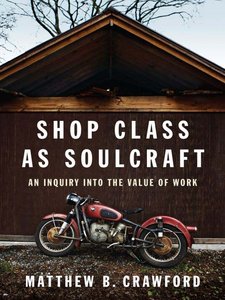
Book Cover.Crawford.Shop ClassWhat would you expect from a book by a trained philosopher who quit his job as a Washington think tank shill (I almost said “tankard”) to work as a motorcycle mechanic?

If you know anything about the academic job market, you might think I have things backwards. It wouldn’t surprise to hear that a professional philosopher ended up—or rather, started out—rebuilding motorcycle engines. But philosophers do strange things. And Matthew Crawford, with a Ph.D. in political philosophy, is a good example.

Crawford is the author of  a new book called Shop Class as Soulcraft: An Inquiry into the Value of Work. I learned about his book from a “Tweet” (i.e., a Twitter post) linking to a review of the book by a  Slate contributor named Michael Agger. The article, titled “Heidegger and the Art of Motorcycle Maintenance,” praises the book and suggests that a copy be given to everyone you know who is graduating from college and about to “commence real life.” (Never mind that a majority of college graduates postpone commencing real life, some of them indefinitely.)

Every year, grads take jobs they’ve dreamed about, then become so absorbed in them that they are absorbed by them, little noticing that their work is not particularly absorbing in the sense that matters most. Crawford’s book is supposed to get office grunts, from secretaries to CEO’s, to consider more carefully the work they’re doing.

Of course, this year a much higher percentage of college graduates will look in vain for jobs that they believe will satisfy. Maybe that’s a good thing. Maybe they’ll have time for some profitable reading. A book like this could help them get their heads together. Soulcraft versus bank draft. It’s an interesting contrast. Leave it to a philosopher to subvert the values of our age.

Two questions. What does any of this have to do with motorcycle maintenance? And what does it have to do with Heidegger?

The first question, presumably, is answered in the book. Crawford the philosopher became Crawford the disillusioned “knowledge worker,” which led him to become Crawford the motorcycle mechanic. And Crawford the motorcycle mechanic, who had apparently dropped out of the knowledge enterprise, learned what was of real value where life intersects work.

The answer to the second question isn’t obvious from reading the Slate article. There’s no attempt in the article to tie Crawford’s ideas and conclusions to the work of any philosopher named Heidegger. One naurally assumes that Agger is thinking of the Heidegger, as in German philosopher Martin Heidegger (1889-1976). But Agger doesn’t connect the dots. Maybe he just latched onto the name of the first philosopher he thought of. Heidegger is not known for his luminosity—nor for motorcycle expertise. So Agger’s choice of a title may be bad in more ways than one. On the other hand, there’s the possibility (admittedly remote) that Crawford draws valuable concrete lessons for life from one of the most austere philosophers of the past 100 years.

So far I’ve only read about the book. But I’m definitely interested. And if Crawford leaves Heidegger out of it, even more so.

***

Notes:

  1. Michael Agger is also playing off the title of Robert Pirsig’s 1973 classic Zen and the Art of Motorcycle Maintenance. Maybe there’s a subtle connection between Heidegger, Zen, and motorcycle maintenance that escapes me just now. If so, my apologies to Michael Agger.
  2. As I write this, Shop Class as Soulcraft is #30 in sales rank at Amazon.
  3. Kudos for Crawford’s book include the following by Harvard professor of government, Harvey Mansfield: “Matt Crawford’s remarkable book on the morality and metaphysics of the repairman looks into the reality of practical activity. It is a superb combination of testimony and reflection, and you can’t put it down.” (Source: Amazon.com)
  4. As long as we’re onto Heidegger here, I should note that there’s an interesting BBC documentary on the man that’s available on YouTube, starting with this 8-minute installment here.

Related Posts:

Stylus Pen a Good Idea for the iPhone


Apple iPhone 3g Stylus Pen

Apple iPhone 3g Stylus Pen

I’m starting to like the touch-screen experience on my iPhone. I notice, though, that the QWERTY keypad is more difficult to use when I’m typing notes. I like to do this when I’m listening to presentations, or writing out ideas when I’m away from my laptop. For this I need speed. And, wheer accarucy matters, the fingers are better at walking than sprinting.

Because of my Palm Pilot days, I’d been wondering whether a stylus might work in these situations. Today I discovered a stylus that is an iPhone accessory. Called the Apple iPhone 3G Stylus Pen, it looks like it would do the trick.

As of this moment, this tool is 97% off at Amazon.com. It’s also listed as the #1 selling item in women’s apparel, and #10 in cell phone accessories. This is initially puzzling. I figure women buy more apparel than cell phones. But maybe there are women who are accessorizing with the Apple iPhone 3G Stylus Pen without using it on an iPhone!

It comes in silver or black.

Best iPhone Sights in Brea


Brea Transportation Department

Brea Transportation Department

Now that I’ve got this iPhone that can do everything except transport me to the Starship Enterprise, I thought I should test its photo power by snapping some pics of the best places in my town. Some of these are taken at dusk.

Reflections on My House

A Rebel Perspective on My House


Downtown Brea:


This Building Is Still Up for Lease

This Building Is Still Up for Lease

Gateway to Birch

Gateway to Birch Street

"To Protect and to Serve"

"To Protect and to Serve"

Best Milkshakes

Best Milkshakes

Laboratory for Film Research

Laboratory for Film Research

Edwards10.Brea

Close-up of the Lab

Palms on Birch Street?

Palms on Birch Street?

Brea and Birch Parking

Vital Information

Vantage Point (AKA "Parking Structure")

Vantage Point (AKA "Parking Structure")

Brea Skyline

Brea Skyline

Brea Promenade

Brea Promenade

The Improv

The Improv

The Yard House

The Yard House

Brea Flag

Brea Flag

Brea Sunset

Brea Sunset

Brea Sunset

Brea Sunset

$1.00 Per Scoop on Tuesday Nights

$1.00 Per Scoop on Tuesday Nights

For the Serious Aquarist

For the Serious Aquarist

I Don’t LOL


LOL on iPhoneTwittering. Blogging. Facebooking. And yes, for those stuck in ancient technology, emailing. Every time you check your site, someone, somewhere has ended a post with “LOL.” Not me. I don’t LOL. Here’s why: it’s TC. I mean, it’s totally cliché. Or, if you prefer, it’s LTC—that is, “like, totally cliché.”

Apparently, “TC” is already spoken for; it’s the official text messaging acronym for “take care.” OK, fine. I can live with that. So TC; in fact, TCWYA—take care with your acronyms.

I’ve got nothing against acronyms. But social networking has taken this way too far. I just don’t believe there are that many people out there “laughing out loud” at any given time, and telling the rest of the world, or maybe only their 4,658 friends on Facebook.

KWIM?

Top 10 Reasons for Motorcycling


The other day, Barry Corey—President of Biola University—caught me leaving my office holding a motorcycle helmet. He asked me about it and I gave him the first answer that came to mind: “I walk to work, and it’s gotten more dangerous than it used to be.” (Biola is in La Mirada, which is in Los Angeles County.)

The truth is, I don’t walk to work and I do ride a motorcycle. Oh, and La Mirada is a pretty safe place.

But why ride a motorcycle?

Here are ten of my own reasons:

  1. Parking. Shopping the Brea Mall at Christmas, attending the Biola University commencement, and showing up late for work can be sources of panic because open parking spaces are nonexistent. With a motorcycle this is not a problem. Many parking structures now have specially reserved parking for motorcycles. And here’s the real kicker: they are often located immediately adjacent to the handicap parking! How ironic is that?
  2. Praying. Motorbiking improves your prayer life. It adjusts your priorities, so that praying becomes serious business. Instead of praying for a space in the mall parking structure, you learn to pray for survival.
  3. Vanity. No, I don’t mean the vanity displayed by so many motorbikers who look and ride like the biker’s version of the runway model. I’m talking about the vanity of life, the Ecclesiastes kind of vanity. Riding can reinforce the counterbalancing impressions of power to pursue your dream and confronting the fragility and brevity of life, both at the same time. This is biblical.
  4. Adrenalin. Chemical Structure of AdrenalinAlso called epinephrone, adrenalin is a hormone and neurotransmitter that is instantly activated in situations perceived as dangerous, creating a feeling of euphoria—an “adrenalin rush.”
  5. No seatbelts. This is one of the first things that struck me (I know, bad choice of words) when I took up motorcycling.
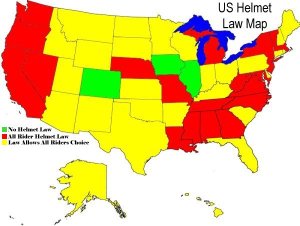
  6. Antinomianism. I’m not talking theology here. I mean something more general, namely, antinomianism as opposed to hyper-legalism. Some traffic laws simply don’t apply to motorcycles and their riders. For example, there is no seatbelt law, riders are legally entitled to split lanes, and there is practically no danger of being pulled over for violating the cell phone law that requires using a headset. Question: How many times have you seen a motorcycle cop ticketing a biker?
  7. No qeues at stop lights. First, because of the gear ratio on a motorcycle, there’s a greater chance of being the first at a stop light (if, indeed, you aren’t able to streak across the intersection just in time—legally, of course). And if you come upon a ten-car backup in three lanes at a traffic signal, you can use the special lane reserved for bikers, approximately four feet wide, and lined by parked vehicles (otherwise known as “cages”), waiting interminably for the opportunity to cross the intersection. Yesterday, a driver actually moved over slightly to allow me room to slip between cars and trucks. (Tip: to take full advantage of this benefit, the smaller the bike, the better. A Honda 250 Rebel is ideal.)
  8. Greater head protection in case of accidents. How many drivers wear helmets in their cars? Now, how many bikers where helmets? I rest my case.helmet-law-map
  9. Fraternity. The most notable symbol of this is the wave. Bikers, when passing each other going opposite directions, give each other a wave. If you want to understand this better, check out the five-minute YouTube video by Mordeth13 here.
  10. Joie de livre. This is a French concept perfected by Harley Davidson, Triumph, and Ducati.

Related Posts:

Divine Guidance and the Decisions You Make


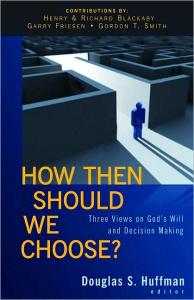
Book Cover.How Then Should We ChooseI spoke in chapel at Biola University on the subject of divine guidance recently. Some have asked for a suggested reading list on this topic. On issues of divine guidance and decision making, I recommend the following three books, suggest reading them in the following order, and urge you to read the Friesen book if you read only one:

Each of these is linked to Amazon for your convenience. Much of the Waltke book is available at this link on Google. For a convenient outline of Friesen’s view, click here. This overview of Friesen’s position will give you a good idea of the approach he takes. But to really understand the position, you’ll have to consult his book. I encourage this because his careful study of the scriptural material on this topic has done the most to shape my view and practice.

A new book compares three approaches, presented and defended by their respective proponents: How Then Should We Choose? Three Views on God’s Will and Decision Making (Kregel, 2009). Garry Friesen is a contributor, along with Henry and Richard Blackaby, and Gordon T. Smith.

Comment on “Euthyphro’s Lament”


Portrait of Socrates. Marble, Roman artwork (1...

Image via Wikipedia

Roger Morris has kindly referred me to a blog where the relation between God and morality is discussed in two unsigned posts: “Euthyphro’s Lament” and the briefer “One Other Thing” (in which the author promises that this is “the Absolute Bloody Final word from me” on the issue he raises).

The “Euthyphro problem” lies at the heart of a dialogue recorded by Plato, between Socrates and one called Euthyphro. This dialogue has a fitting title: Euthyphro; it is sometimes called The Euthyphro. Euthyphro is a great introduction to the Socratic method on a topic of broad interest because it concerns the nature of ‘piety.’ Socrates presses the question, “Is the pious loved by the gods because it is pious, or is it pious because it is loved by the gods?” This is called a ‘dilemma’ because it seems to present Euthyphro with stark choices, both of which are troubling in their own way.

Let it be noted that the problem of the nature of piety is not resolved in this dialogue of Plato’s. Nor is it definitively settled that both lemmas set forth in Socrates’ question are impossibilities.

It’s worthwhile keeping this in mind when considering a modified version of the problem in contemporary discussions of the relation between God and morality. The question in this context differs from the original in two main respects: (1) the dilemma now assumes some version of monotheism, and (2) the dilemma may be expressed in terms of the will or commands of God, rather than in terms of what is loved or hated by God. Another possible difference is that (3) the dilemma is now less concerned with piety as a character trait than with moral actions (in obedience to divine commands).

Here’s a characteristic statement of the new form of the dilemma, expressed as a question:

Is a morally right action right because it is willed or commanded by God, or is it willed or commanded by God because it is morally right?

If an action is morally right because it is willed or commanded by God, then whatever God wills or commands is right, and would be right just in virtue of his willing or commanding it. It’s supposed to follow that God could will or command anything whatsoever—including actions we rightly abhor, such as rape and murder—and what is willed or commanded would be (for that reason alone) morally right.

On the other hand, if a morally right action is willed or commanded by God because it is right, then it’s supposed to follow that God, who is otherwise thought to be utterly sovereign over all things, is subservient to an ontologically independent (objectively existing) standard of right and wrong.

So we have it that either (a) the goodness of any right act is arbitrary, subject to divine whim, or (b) God is less than sovereign because subject to an independent moral authority.

From these stark choices it is sometimes argued that God does not exist, or that the concept of God is incoherent.

Consider the first horn of the dilemma. Why is the morality of a right act thought to be arbitrary? Because its rightness is linked to the will or commands of God. But that, it seems, is tantamount to saying that God’s will and commands are themselves arbitrary. But why think that? I see no reason to seize the other horn of the dilemma in order to avoid this supposed implication.

What about the second horn? Most of its formulations use terminology without clear delineation of their significance. We must know, for example, in what sense God is presumed to be sovereign, in what sense ultimate moral authority is thought to be independent or external to God (or God’s character), and in what sense God is to be considered subservient to this external standard. The burden of making these notions precise is weighty. It is also frequently ignored.

In “Euthyphro’s Lament,” the author attempts the required clarification by saying that “there is an objective standard – logically prior to God’s character – that constrains God’s character.” But I must say that the notion of an objective (moral) standard as “logically prior” to anything (be it God or something else) is less than clear, and the suggestion does little to illuminate the supposed problem. Further, we must understand this vague notion of “logical priority” before we can make any sense of the claim that some logically prior standard “constrains God’s character.” How does it “constrain”?

I think it also needs to be said that the formulation of divine command theory in the essay is awkward. The author says,

Briefly, Divine Command theory states that it is good to obey God’s commands.

A more adequate formulation is needed. Here’s a better approximation, I think:

What makes a morally right action right is that it is commanded by God, and what makes a morally wrong action wrong is that it is prohibited by God.

From this it does follow, I suppose, that it’s (morally) good to heed God’s commands. But that is a different matter.

On the divine command theory, God’s will determines the rightness or wrongness of morally significant human actions. The theory, as a theory of morality, is concerned with the moral character of human actions. It is a separate question why God wills what God wills.

I conclude with three brief points.

First, this post is not a defense of divine command theory, but an attempt to impose clarity in relation to a less than clear statement of the associated problems in a particular blog post.

Second, it is odd if the envisioned dilemma concerning God’s relation to morality implies that God does not exist. It is so odd, in fact, that it’s far more likely that the proposed dilemma is a clever contrivance with less bite than is often imagined.

One may say that the dilemma is not the mainstay of an argument against theism, that it is merely rhetorical, a challenge to the theist to explain precisely what is God’s relation to morality. Ah, and if the theist falters? What then? Surely this is supposed to mean something.

Or one may say that the dilemma showcases a problem for theism that—whether or not it entails that theism is false—delivers the naturalist from the threat of any moral argument for God’s existence. The proper answer to that is that there are varieties of arguments from morality for theism, some better than others (and some no good at all). The best arguments are invulnerable to the dilemma we have been considering. And they have the further advantage of highlighting severe limitations of utterly naturalistic conceptions of ethics.

Third, adapting the dilemma posed in Plato’s Euthyphro to current discussions of God and morality may preempt proper consideration of what is “logically prior” (if that means anything), namely, the question, “Why does God will what God wills?” The answer to that must depend on what sort of being God is. Suppose God is such that he is neither subject, in any meaningful sense, to some external standard of morality, nor good in some merely arbitrary sense. Is there really anything deeply disturbing about such a conception? Mysterious perhaps. But disturbing?

Suggested Reading:

Best Movies Set in Venice


rialto_1Ever been to Venice? Ever get a hankering to be there, like, right now? Sometimes that happens to me. Today it happened to one of my daughters.
Last night I saw the new Star Trek movie. Not to ruin the plot or anything, but you find out (sort of) how the transporter technology was devised by Scotty. Wouldn’t it be great to be able to just beam yourself to a nostalgic place for a day? “Southern California too boring for you? How about Venice? Beam me up, Scotty!”

Unfortunately, there isn’t an iPhone application for that. I checked. (Apple, are you listening?) But there is another option, another way to “take you there,” and that is to select a movie that is set in Venice.

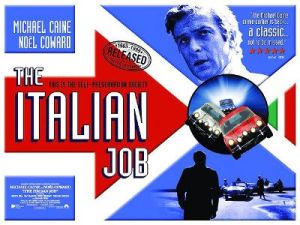
200px-ItalianjobSo tonight we’ll be watching The Italian Job. It’ll bring back pleasant memories of our leisurely time strolling the Piazza San Marco, shopping the Rialto Bridge, and taking in the half-believable vista of the Grand Canal.

Or not.

“The Italian Job is hardly a film to slow your heartbeat.” Agreed. So our recollection of Venice will be accompanied by a high level of manufactured adrenalin. Anything wrong with that?

The 1969 version of The Italian Job, starring Michael Caine and Noël Coward, is different in interesting ways. (This was Noël Cowards last movie.) In fact, it’s different in so many ways that seeing the 2003 film, with Mark Wahlberg and Charliz Theron, does nothing to make the 1969 film predictable. Fortunately, there is one great similarity, and that is the role cast for the Mini Coopers used in the heist. The two movies begin and end very differently.

Other options for movies set in Venice include Casino Royale (for it’s ending), A Death in Venice (not a happy film), Everyone Says I Love You (a Woody Allen musical), Indiana Jones and the Last Crusade (more action and adventure in Venice), Just Married (a romantic comedy), The League of Extraordinary Gentlemen (yep, the one with Sean Connery as Allan Quartermain), A Little Romance, (a comedy in which a 13-year-old American girl enjoys reading Heidegger!), The Merchant of Venice (Venice in 1596), Moonraker (James Bond movie #11, featuring Venice and a gondola/hovercraft contraption), Othello (take your pick: 1952 with Orson Welles, 1965 with Laurence Olivier, or 1995 with Laurence Fishburne and Kenneth Branagh), Pokémon Heroes (the fictional location “Johto” is supposed to be based on Venice), Sharks in Venice (for those who like implausible great white shark movies), Summertime (with Katherine Hepburn and probably the best cinematic exploitation  of Venice), The Thief Lord (co-written by children’s adventure novelist Cornelia Funke), The Venetian Affair (spy thriller starring Robert Vaughn and Elke Sommer, vintage 1967, and hard to find), The Wings of the Dove (“Venice has never been portrayed so beautifully, or romantically,” says Leonard Maltin’s 2007 Movie Guide).

Myself, I’ve seen exactly four of the movies on this list. Wanna’ guess which ones? I’ll send an Amazon gift card for $5 to the first person who gets it right, within 24 hours of this post. I’ll announce the winner—if there is one—at the end of 24 hours. (Setting my mobile phone timer . . . now.)

Good luck!

Oh, and by the way, you also have to explain why you picked the four you did AND tell me your favorite movie with a Venetian setting.

Pursuit of a PhD—Does It Make Sense?


Theologian John Stackhouse offers sobering but sane advice to those “Thinking about a PhD.” Over 100 of my past students have gone on to do PhD research, most of them in philosophy. And every year a new crop comes along with the same questions: Should I pursue a PhD? What does it take? How’s the academic job market? Thank you, John, for providing a resource where these students can make sense of the challenges.

Am I a Calvinist? Not Exactly


Recently I received this note from a friend on Facebook:

Dr. Geivett,

What is your view on Calvinism, election, and free will? Do you have any good resources you could recommend?

Since I am occasionally asked this question, I thought it might be helpful to others to post my reply here, together with Amazon links for the reading I recommend:

Hi . . . ,

I’m not a Calvinist. I’m a libertarian regarding human freedom, and I reconcile human freedom and divine sovereignty on the basis of the doctrine of divine middle knowledge. I can recommend several books on this:

(1) Luis de Molina, On Divine Foreknowledge

This is an early primary source for the doctrine of divine middle knowledge. Luis de Molina was the first to develop the doctrine systematically. This is Alfred J. Freddoso’s translation from the Latin text. Freddoso’s lengthy introduction to the volume is an excellent sympathetic introduction to the doctrine. This is the ideal place to begin your study of middle knowledge if you’re prepared to read a fairly sophisticated treatment of the topic.

(2) William Lane Craig, The Only Wise God

William Lane Craig is an evangelical Christian apologist and a leading proponent of the doctrine of divine middle knowledge. This book explains the doctrine, contrasts it with alternative views of the relation between divine sovereignty and human freedom (e.g., Calvinist views), and includes careful examination of the relevant texts of Scripture. If you read only one book on this topic, this is the book to study. The topic is complex, so any exposition of the doctrine and related issues will generally be written above the popular level. This is the most accessible detailed treatment of the topic (at a very reasonable price).

(3) Thomas P. Flint, Divine Providence: The Molinist Account

This is an exceptional treatment of the doctrine of divine middle knowledge by a prominent Catholic philosopher of religion. Exposition and defense of the doctrine is more developed here than in William Lane Craig’s book, so it’s a good place to go next if you plan further study of the topic.

(4) Dennis L. Okholm and Timothy R. Phillips, eds., View Views on Salvation in a Pluralistic World

For an application of the doctrine of divine middle knowledge to the question of the fate of the unevangelized, see the contributions in this book that I co-authored with Gary Phillips. Another source for this material is my chapter in the book Jesus Under Fire (see below).

(5) Michael J. Wilkins and JP Moreland, Jesus Under Fire

My concluding chapter to this volume presents the same material contained in my contribution to the book Four Views on Salvation in a Pluralistic World, on the fate of the unevangelized (see above).