The Missing Ontological Argument in the Craig vs. Law Debate


October 17, 2011, William Lane Craig and Stephen Law met in London to debate the topic “Does God Exist?” Subsequent to the debate, Law has posted briefs that he prepared for arguments and objections that Craig might state during the debate. I’m not sure why—since I haven’t known Craig to include an ontological argument in his arsenal of theistic arguments during a debate—but Stephen Law had prepared notes in case the ontological argument did get presented. He has posted these at his website.

Here is what Law writes, in order to meet the ontological argument in case it is presented:

4. ONTOLOGICAL ARGUMENT

It’s possible a maximally great being exists.

…Therefore, a maximally great being exists.

This argument has no force at all against the evidential problem of evil. In fact, ironically, it actually serves to reinforce my conclusion. For if I can use the evidential problem of evil to show there’s actually no god – that the conclusion of Craig’s ontological argument is false – then the validity of the argument entitles me to draw the further conclusion that’s it’s not even possible that god exists!

So my thanks to Professor Craig for furnishing me with an argument that serves actually to amplify my conclusion – allowing me to move from: there’s no god to: necessarily, there’s no god.

Stephen Law here anticipates a modal version of the ontological argument, which might be sketched as follows:

1. If God (a maximally great being) exists, then God exists necessarily.
2. It is logically possible that God exists.
3. If it is logically possible that God exists, then there is a possible world in which God exists.
4. In any possible world in which God exists, God exists necessarily.
5. To exist necessarily “in” any possible world is to exist necessarily.
6. To exist necessarily is to exist in all logically possible worlds.
7. Therefore, God exists.

A premise like (2) is characteristic of modal versions of the ontological argument.

Now Law seems to think he can defeat this argument with an evidential argument from evil. His confusion on this point is breath-taking. His evidential argument from evil, at its very best, shows, at most, that it is probable that God does not exist. The probability is less than 1. To defeat the ontological argument with an argument from evil, his argument would have to entail that God does not exist. The probability that God does not exist would have to be 1. It would have to prove, as he says, that the conclusion of Craig’s argument is false. But Law’s own argument, as a matter of logic alone, cannot achieve this goal. It is a probabilistic argument. As such, it leaves open the possibility that God exists, even if the probability is quite low.

Law might embellish his rebuttal by suggesting that premise 2 of the ontological argument (as stated above) is not necessarily true. There may only be some degree of probability, less than 1, that premise 2 is true. But because the argument is not formulated in this way, Law would bear the burden of showing that premise 2 has a probability of less than 1. He would actually have to do more than that. He would need to show that premise 2 is improbable. His evidential argument against the existence of God is of no use to him for that purpose. For that matter, I have no idea how he, or anyone else, could show that premise 2 is improbable.

Or Law might seek to rescue his defeater by claiming that God cannot be maximally great if there is enough evidence from evil to make it likely that God does not exist. But this wouldn’t work, either. For his evidential argument cannot prove that a maximally great being does not exist. It can, at best, show that it is unlikely that such a being exists.

Notice that, in his post-debate recapitulation of his argument during the debate, Law’s basic aim was to show that belief in Craig’s good God is not sufficiently more reasonable than absurd belief in an evil god. He cast his argument in terms of probabilities.
Here’s the main point: an evidential argument from evil leaves open the possibility that God exists. Clearly, Law believes his evidential argument makes the probability of God’s existence extremely low. But it cannot, as a matter of logic, reduce the probability of God’s existence to zero.

So the ontological argument, whatever its merits or demerits, remains unscathed by Stephen Law’s “ready-in-the-wings” counter-argument.

I’m afraid this means that he understands neither the ontological argument, nor his own evidential argument from evil. So William Craig might as well have presented the ontological argument. This would have presented him with a golden opportunity to expose this confusion.

Archbishop Worries That Atheism is “Cool,” and This Makes Atheists Happy


Recent statements by Britain’s Archbishop, Rowan Williams, have provoked some interesting discussion. Williams has said, “Atheism is cool, so books about atheism are cool.” He’s thinking of books like The God Delusion, by Richard Dawkins.

For news coverage, see the article by Jonathan Wynne-Jones, published in The Telegraph September 19, 2011.

Today I read a post about the Archbishop’s statement at an atheist blog hosted by Martin Pribble

Dr Rowan Williams PC, DPhil, DD, FBA the 104th...

Image via Wikipedia

. I then left a comment in the comments stream, which otherwise appears to be uniformly atheistic in orientation.

Here’s my comment:

Hasty generalization is a blight on much thinking on all sides of most issues. (I hope that statement isn’t an example of hasty generalization!)

In this case, the good Archbishop surely over-generalizes if he claims that a recent bump in the popularity of atheism is due to its “cool” factor. The explanation is far more complex than that, and the weighing of evidence for and against the existence of God is surely a factor for many people.

On the other hand, I think that Martin is a bit hasty in his generalization about theistic responses to current atheism advocacy. To be sure, there are books that pass over evidence and argument in breezy fashion and simply attack the messenger. But Martin implies that this is true of all published responses to Dawkins. He can’t be serious. One might, as he suggests, do a simple Google search to turn up more sophisticated treatments, of Dawkins’ work, yes, but also of the atheistic or naturalistic position more generally. Some are published by prestigious presses that are careful to publish only the best serious and academic work on such topics: Oxford University Press, Cambridge University Press, Blackwell, and Routledge, for example.

Also, I notice that ad hominem rhetoric is tossed about on both sides of this issue. In the comment stream for this post, for example, Rowan Williams is chided in uncharitable terms and William Lane Craig is said to be stupid.

I’m new to this website, so I don’t know about its general tenor or the tone of regular commentators. But if the byline is “Attempting to make sense,” then I urge Martin to admonish his readers to take greater care to marshal evidence in support of their claims rather than to make safe and provocative assertions and tender emotional arguments.

If this site seeks to engage readers in meaningful dialogue, I suspect it will attract more thoughtful responses, from a spectrum of positions, if it monitors the discussion and facilitates reasoned debate. A wise proverb says, “Answer not a fool according to his folly.” In other words, if sophistry prevails, find someone else to talk to.

Last I checked, my comment was “awaiting moderation.”

Update: My comment at Martin Pibble’s site has been approved, so it now appears there, as well. I should note that here at my own site comments “await moderation” until “approved.” I believe a process of screening to be good practice.

Doug to Speak in Fairbanks, Alaska October 2011


Doug will be speaking in Fairbanks, AK. Here is the schedule for his presentations:

Thursday, October 27/1:00-3:00 p.m.
“Does God Exist?” a debate with Ed Wilner, Chair of the Philosophy Department at the University of Alaska
Location: University of Alaska

Thursday, October 27/7:00-8:30 p.m.
“Evidence for the Resurrection of Jesus”
Location: Bethel Church

Saturday, October 29/7:00-8:30 p.m.
“Answering the Atheist”
Location: West Valley High School Auditorium

For further details, consult Doug’s Speaking Calendar.

Word Cloud for Doug Geivett’s Blog


Word Cloud for Doug Geivett's Blog/September 25, 2011

Another Small Coincidence? The X-Men: First Class, a Photo of Einstein, and a 1959 Book by C. Broad


C. D. Broad (1887-1971)

I’ve written before of odd coincidences and their possible significance. These happen with remarkable regularity. Here’s the latest.

While in San Diego a week ago I visited a second-hand bookshop and bought several books. Tonight I switched on the movie The X-Men: First Class, rented on my Apple TV, and settled in to catalog the books I bought by entering useful data in my “Delicious Library” database. I was entering subject topics for the book Scientific Thought, by C. D. Broad (1959), and typing in “Einstein’s Theory of Relativity” when I looked up, two minutes and twenty-four seconds into the movie, to see a photo of Albert Einstein displayed on a young boy’s nightstand.

I just happened to be holding in my hand a book that treats the general theory of relativity at the same precise moment that there appeared on the TV screen a photo of Einstein, only visible for about two seconds.

I won’t speculate on the possible significance of this. All I want to do is make a record of this coincidence and ask, “How often does this sort of thing happen to you?”

The GOP Tea Party Debate


Caricatures: GOP Presidential Debate Participa...

Image by DonkeyHotey via Flickr

The Republican candidates have done two debates this week. Tonight’s debate was the best of three. The questions were focused and the candidates showed vim and vigor. Those lagging behind Romney and Perry in the polls needed to up their game, and two of the candidates did. Michelle Bachman shined and Rick Santorum did pretty well. Bachman is still in the game. Santorum is probably going to continue to lose traction.

Until tonight, I was looking forward to hearing more from John Huntsman. After tonight, I don’t care if we never hear from him again. I don’t see any potential there for this guy to break out. He’s glib, the opposite of self-effacing, and petty.

Ron Paul’s only real potential is as a spoiler. Tonight, as a senior congressman from Texas, he played the spoiler to Rick Perry. Paul’s presence will be a nuisance to Perry as long as Paul stays in the race.

Perry proved vulnerable on several points, including his HPV vaccination plan and his handling of illegal immigrants. Michelle Bachman may have succeeded in raising Perry’s weaknesses on these points to a level of appreciable resonance with his own base. Perry was on the defensive most of the evening. He limped through one defense after another in front of ultra-conservative Republicans, many of whom want to see Perry do well. And he was booed following one of his comments about the immigration issue.

Sometimes Perry looks and sounds like he’s channeling George Bush. He’s not an effective debater. I have real doubts about his ability to survive under close scrutiny in future debates.

Mitt Romney hit harder than he has in the past, but with the aplomb we’ve come to expect from him. I believe his problem is that he is uninspiring. He also comes across like a real establishment-type politician. But he’s in this race for the long haul and is the candidate to beat if Perry peters out. Romney projects stability. But he looks like the rich guy he is and hasn’t been comfortable reaching out to Tea Party Republicans who will, for better or worse, make a difference in the Republican nomination process.

Herbert Cain is a refreshing presence at these debates, and he’s doing a number of things well. Can he go the distance? It will be interesting to see. It’s nearly certain that he won’t get the nomination and I doubt that he would be anybody’s first choice as a vice presidential running mate. He could have a place at the table in the next president’s cabinet, though. He’d make a fine good-will ambassador.

That leaves Newt Gingrich.

At every debate so far, Gingrich has excelled. John King of CNN agrees. Newt Gingerich has had “back-to-back-to-back strong debate performances.” King blames Newt’s low poll numbers on his age. He thinks that voters are looking for the younger candidates to get the job done. I’ve wondered about this. But Newt does look like the adult in the room. This could turn things in his favor. When others are petty, kicking sand in each other’s faces, Newt just keeps taking the battle to Obama. He understands that the coming election will be very much about whether Obama should be re-elected. Newt is singularly capable of challenging Obama head-to-head. I suspect he’s the candidate that Obama fears the most.

So why is New Gingrich lagging in the polls?

1. Gingrich is especially disliked by the liberal media. They almost uniformly acknowledge his political prowess. His debating strengths are readily acknowledged. But he’s dangerous to the liberal cause.

2. The media prefers to cover the sensational. This explains, I think, the favor that Rick Perry enjoyed before even announcing his candidacy. Gingrich’s strengths will not be noticed as long as attention is poured on candidates whose substance remains a mystery.

3. Gingrich is the elder statesman of the group. He’s been around longer than anyone, except Ron Paul. He isn’t such a fresh face and he hasn’t been leading the new Republican charge to change the way business is done in Washington.

4. Gingrich has a couple of personal negatives to overcome. These were bigger news earlier on. If he begins to garnish renewed attention, they may return to haunt him.

These aren’t deal-breakers for Newt. The personal issues may already have been aired as much as they can be, and his interval of invisibility may have been good for him on this score. Ron Paul is polling in double digits, and Gingrich is down around 7%—about even with Bachman. Ron Paul is an anomaly. He won’t last. That should give Gingrich room to move up. And if Perry peters, as I expect (hope?), he can move up dramatically. If Gingrich endures and moves up in the polls, that will be a sensation and the media will have to cover the story. And he isn’t ancient. John McCain was ancient.

Here’s how Gingrich improves his standing, if he can hang in there long enough. The Perry fanfare fizzles as his debate performance deteriorates. This depends on Perry’s own limitations. It’s also reinforced by Bachman’s vigorous and effective attacks, as seen in the Florida debate. Bachman needs to play the spoiler long enough for Perry’s cache to diminish. In due course, Ron Paul, John Huntsman, and Rick Santorum need to drop out of the race. Herbert Cain must follow suit. That would leave Romney (a known quantity, but a force to be reckoned with), Perry (paired down to size), Michelle Bachman (maybe), and Newt Gingrich.

Gingrich’s stature is sure to rise if there’s ever a two-way or three-way debate in which he participates. He can hold the Tea Party folks if their favorite candidates drop out, and he can win with independents who are weary of Obama.

But time will be a factor for Gingrich. He needs to win in the South Carolina primary. Rick Perry has the edge there now. Bachman could do well in SC, but for Perry. If the New Hampshire primary comes early enough, John Huntsman could cut into Mitt Romney’s strength there. This could minimize the effect of New Hampshire on a Gingrich bid.

I have no idea what to expect from Iowa, though it’s expected that Bachman could do well and is out of the game if she doesn’t.

Rick Perry has deeper pockets than Newt Gingrich. But Obama has deeper pockets than everyone. And I view it as cynical to suppose that the one with the most campaign money is the likely winner for that reason alone. (What kind of treasure chest did John McCain have during the last Republican primary?)

All of this may be wishful thinking. I would like to see a contest between Newt Gingrich and Barack Obama. This would be a contest between two radically opposed ideologies on a national stage that is itself deeply divided. Gingrich’s penchant for clarifying ideas might force Obama to be more explicit about his own ideology. The electorate would be faced with starkly contrasting agendas defended by more-or-less articulate spokesmen.

There is one other variable that is important to Newt Gingrich’s chances: Sarah Palin has to remain in the sidelines . . . .

The Charms of Motel Lodging: Nelson, BC


Despite my many travels, I had forgotten about the charms of classic motels. Memories from my childhood have roared back during our few days at the North Shore Inn in Nelson, BC. Here is a brief inventory of its classic features:

  • Our rental car can be parked conveniently near the front entrance to our quarters.
  • The parking lot has fewer spaces than the motel has rooms, yet, oddly, it is ample for the number of cars actually needing a space.
  • Landscaping is austere, but not without appearing that some effort has been made to dress it up. A park bench for three and a stack of white plastic chairs are there in the event that we wish to relax in front of our room and enjoy the view. (The view, by the way, thanks to Mother Nature, is spectacular! The motel overlooks Kootenay Lake.)
  • The exterior paint, such as it is, is monochromatic.
  • The lobby is no more handsome than the rooms themselves, as it, too, is carpeted in 1950s burber that has held up remarkably well. (Guests are mercifully spared the grotesqueness of shag that inexplicably sprang from the floors of most dwellings in subsequent decades.)
  • In our two bedroom unit with kitchenette, ceilings are exceedingly high, walls are painted a glossy white, and trim is in chocolate brown aluminum. The entry is enhanced with a safety chain of precisely seven links. In the kitchenette, the brown cabinetry and white appliances are fronted by a strip of linoleum, which marks off the space dedicated to watching TV and eating meals. A fire extinguisher is mounted above the sink. The TV itself is a Citizen of a vintage no longer available even at yard sales. (Our Apple TV device will remain packed.) The manually operated air conditioner is set over the front window some eight feet above the floor.
  • The first “bedroom” is adjacent to the kitchenette, has no door and no window, so that what little privacy it affords is improved by perpetual darkness. This room, furnished only with a queen bed, would make for a nice walk-in closet off the “master bedroom,” which does have a door, a nightstand, and a closet with folding doors. (The only chest of drawers is in the main room and is used to support the aforementioned Citizen.)
  • There are three inconspicuous and unremarkable wall hangings, thoughtfully distributed among the three rooms (one over the sofa and one over each bed). (I’m one who tends to notice wall hangings more by their absence than by their profusion.)
  • The bathroom is something special. It has no window. The white walls and flooring are accented with ocean blue tub, sink, and toilet bowl. We speculate that this room is the object of special pride on the part of the novelty-conscious proprietor. Heat and water pressure in the shower are superb. The blue wash basin is set in a plain formica counter-top that is glued to a press board cabinet with peeling veneer. A pool of water encircles the toilet pedestal, the result of heavy condensation forming around the toilet tank and running off it like a British Columbian waterfall. The fan switch has been installed on an unlikely wall opposite the shower, and is turned on, if at all, only when you—and the bathroom—have already been thoroughly marinated in steamy hot water.
  • The “Contl Breakfast” is meager, as it should be if your room is fitted out with kitchenette.
  • Wi-fi works efficiently, if slowly, and is free.

My favorite feature of the unit is the poster above our bed. It pictures, in sepia tones with enhanced shades of orange, a solitary rowboat anchored near a wood pier. Inscribed at the bottom are the words: “IMAGINATION. Believe in the glory of your dreams.”

The Rule of Incompetence – Featuring TimeWarner


Time Warner

Image via Wikipedia

We’ve experienced aggravating drops in internet access through our high speed line at home recently. Our first attempt to troubleshoot the problem resulted in a 2-hour conversation with a nice person at TimeWarner. After pinging our modem and router, she reported that the cable service to our home was in good working order. She suggested that there may be something amiss with our router, an Apple Airport Extreme.

I took the router for a visit to an Apple technician (a.k.a. “Genius”) and saw with my own eyes that the router worked.

I considered the possibility, then, that I needed a new modem. So off to Best Buy I went. Came home with a Zoom 3.0 Cable Modem. After setting up, my browser generated a message from Time Warner that I needed to follow a simple 3-step procedure: (1) call the number on the screen, (2) give the agent the MAC address for the new modem, (3) launch my browser.

The call lasted two hours and involved four different Time Warner people. The first was unable to help. She forwarded my call to a “modem expert.” Eventually, that person moved me on to a “Tier 3” specialist. He didn’t even know that Zoom sold modems; in fact, he’d never heard of Zoom. He tried to correct my impression that Zoom does make a modem, as I read, no less than three times, exactly what it said on the box and printed materials. When he started getting snarky, I asked to speak to a supervisor. He was obliging . . . sort of.

I was on hold for approximately 30 minutes waiting for the Super. About every 7 minutes, the Tier 3 specialist would come on the line just long enough to say, “It will be just a few more moments.” When the Super joined the call, I mentioned that I had been waiting a half hour. She said that no way had I been waiting that long. So I asked her when she learned of my call. She had just been told and got on the line immediately. So she said. This implied that the specialist before her had deliberately made me wait on the line before telling his Super that I had requested to speak with her. That was a new low in customer service (which, by the way, is advertised as “Turbo-Service” and “Number 1 in Southern California,” on a looped soundtrack you have to endure while you wait for someone to return to the phone).

The Super decided there was something wrong with Time Warner’s line to my house. This would require a visit from one of their traveling technicians, who wouldn’t be able to come to the house until the day after next (which was today).

Meanwhile, at every step in the process, I was urged to use one of Time Warner’s own modems, as if this would eliminate all of my headaches. “Not interested,” I said, countless times.

I asked the Super to explain to me how my modem worked well enough for Time Warner’s set-up window to appear in my browser. Her exact words were, “I’m not going to explain that to you.” Her response to my persistence was to say, “Now you’re not even going to get an appointment with Time Warner.” Moments later she was denying that she ever said that. I asked if she had a supervisor that I could speak to. Silence on the other end. This silence was followed by more silence. So I suspected that she did have a supervisor and was reluctant to put him or her on the phone. I said that she probably was obligated by company policy to put her supervisor on the phone if this was requested by a customer. To which she responded with more silence. I waited. About 30 seconds later, she hung up.

Her name is Jerry, by the way, and she works in the Colorado Springs facility.

I thought this called for a formal complaint—though I doubted that making a complaint would be effectual. I re-dialed the original number, answered by a very friendly and helpful agent who seemed genuinely scandalized by the experience I described. She gave me the phone number for the Office of the President (the President of Time Warner, I naturally assume). She then said, with maximum politeness, “Would you be so kind as to let me try to solve the problem for you?” And her voice communicated real optimism about the prospect of solving the problem.

Alas, even she could not get things working. So she forwarded my call to . . . Tier 3. That’s right. But this time the technician was in Anaheim, CA. The Tier 3 agent was quite confident she could solve the problem. She, at least, had heard of Zoom. My hopes began to rise. In just a few moments, however, she determined that my service level with Time Warner could not accommodate the 3.0 cable modem I had purchased. She recommended the Motorola Surfboard (which I had seen at Best Buy a few hours earlier).

I thanked her, hung up, and checked the clock. 9:15 p.m. Best Buy closed at 9:00.

So the next day I beat a path to Best Buy to exchange the Zoom for a Motorola. No problem.

After making the connections, I was back on the browser, staring in disbelief at the same TimeWarner invite to call a helpful agent for installation.

I made the call.

This poor lady was completely baffled and said I should wait for the tech guy to show up at my house “tomorrow.”

So today I was visited by a Time Warner technician, who also wanted to install one of their own modems. I explained that I wanted to see if my original modem, a Linksys that I’d been using for a couple years, would work. Reluctantly, he gave it a whirl. Voila! It worked.

Amazing.

But the guy also noticed that there was lots of rust and corrosion on the cable connection out at the curb in front of our house. So he cleaned that up.

When he left, I was in business. At least I had an internet link via direct ethernet connection between my laptop and my old modem. I was ready to try the system with my wireless router. The TimeWarner tech assured me it would work and got out of there as fast as he could.

I made the connections, held my breath, and . . . it works!

Now I can blog again. I can rent movies using my Apple TV.

* * *

Yesterday I happened across a passage from Tom Morris’s book True Success.

The world actually most often seems to be filled with plain old incompetence, punctuated here and there by a somewhat higher state of mediocrity.

I confess that I have a sense of entitlement to good service when I pay for it. But this consists in having unrealistic expectations. Unrealistic expectations lead inevitably to disappointment, and disappointment can lead to all sorts of nasty things.

Rational-emotive therapy advises an adjustment in expectations. I get that.

But if we adjust our expectations to match reality, why do we even bother with time-saving technology . . . like high-speed internet service?

While you’re pondering that, I have a call to make.

Now, where is that phone number for the President’s office?

Coincidences of Life – Ender’s Game and a UPS Truck


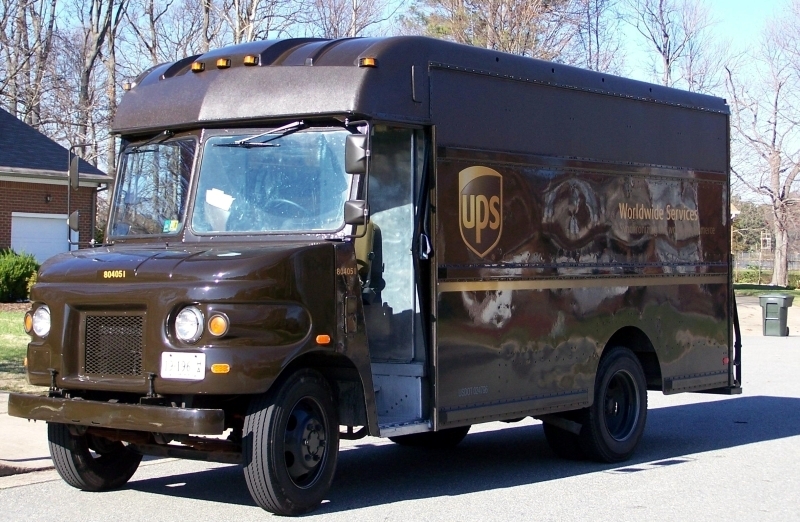
UPS Truck . . . without a driver

This afternoon I was waiting at a red light (northbound on Palm at Central in Brea, CA, if the coordinates matter) and listening to the audio-book for the sci-fi novel Ender’s Game, by Orson Scott Card. Just as the light turned green, one character said to the other, “I drive a truck for the United Parcel Service.”

This struck me as odd, showing up in a work of science fiction. But stranger still, as I shifted my motorcycle into second, a UPS truck passed me in the intersection going south.

Was it a coincidence? Of course it was. It was quite literally the coinciding of an auditory reference from one source and a visual reference from another source to the same company, UPS. These sensory experiences occurred simultaneously. They each conveyed information, and the information conveyed referred to the same thing. I heard a guy say through my headset, “I drive a truck for the United Parcel Service” just as I waved to a guy driving a truck for the United Parcel Service. (Well, actually, I didn’t wave.)

Uncanny?

Sort of.

The Merriam -Webster Dictionary defines “uncanny” in this way: “seeming to have a supernatural character or origin,” or “being beyond what is normal or expected: suggesting superhuman or supernatural powers.”

The concurrence of two causally unrelated references to the same informational content attracts our attention. It is so incredibly unlikely that this would happen, it seems almost to have been planned. Was it planned? And if so, who arranged it? It might take superhuman or supernatural powers to make it happen just so. What other explanation could there be?

“Coincidence,” we say, with palpable matter-of-factness. But of course it’s a coincidence. Saying so merely reports an observation of fact. The real question is, what kind of coincidence is it? What is the explanation for this coincidence?

We do explain coincidences in various ways. Sometimes we say, “It was just a coincidence.” By this we mean that there’s nothing more to it than that, a mere coincidence, with no deep explanation. There is no intelligible cause, and no intelligent agent, involved. There is no meaningful answer to the question, “Why did this happen?”

But the question does present itself. It does to me, anyway. Trivial coincidences like this happen in my experience with remarkable frequency. I say “trivial” because I infer no special significance when they happen. And yet it is both remarkable each time it happens and remarkable that it happens as often as it does.

Why is it remarkable if the coincidence is trivial? It’s remarkable because the concurrence is so improbable. The degree of improbability varies depending on the specific character of the information presented. But the improbability of the concurrence does not, as such, warrant attribution of some special significance.

Why not?

The answer, I think, is two-fold. First, we can think of no special reason why the elements in our experience have occurred together. (Note: No one else in the intersection, I believe, actually heard or thought of the words “United Parcel Service” at that moment.) Second, we can identify no  causal mechanism that would ensure that they did occur together. In other words, there is no apparent point in their concurrence, and no obvious causal account of their concurrence. If we thought their concurrence served some purpose, we would naturally be curious about the cause. And if nothing else will serve, we might say that the cause was superhuman and personal. Given a general reluctance to attribute causes to occult entities, we require that a coincidence be specially significant. Also, if the concurrence was caused for our benefit, then we should find some benefit in their concurrence. That is, if we who experience the coincidence were meant to experience it, then there was some reason why it happened and why it happened in our experience. And this suggests that we should be capable of discerning that purpose.

What purpose could possibly have been served by the coincidence I experienced on my way home this afternoon? Nothing comes to mind. “It’s just a coincidence.”

But wait, now that I think that thought, I recall that there was a UPS package for me when I arrived home not two minutes later. Was the coincidence a warning, then? It certainly didn’t have that effect on me when it happened. In fact, when it happened, my thought was, This is something I could blog about. And in retrospect it doesn’t seem that a warning was required. The contents of the package were innocuous. Some clothing I had ordered. I don’t know if it matters, but the package wasn’t waiting on the front porch, as if it had just been delivered by the very same UPS truck. It had been carried in by another member of my household who wasn’t home. (I know she wasn’t home because no one was home. And I know it was a she because I’m the only he in the household. Aren’t you impressed with my awesome powers of deduction?)

I suppose now I might take care trying on the clothing that was delivered. But I can’t seriously entertain the notion that I’m in some kind of danger.

If there was a message, it was totally lost on me.

Could there be some other purpose, completely unrelated to my goals or interests, so that the purpose might be achieved quite apart from my cognizance of it?

(c) 2009 Katherine Gehl Donovan

Sure. A minor demon might have been taunting some innocent angel with her powers of manipulation, claiming to be able to cause me to hear “I drive a truck for the United Parcel Service” and, at the same precise moment, cause me to see a guy driving a truck for the United Parcel Service.

In that event, would it really matter whether I recognized the concurrence of the appearance of a UPS truck just as I was hearing that bit of fictional dialogue? I can imagine a neophyte angel thinking, How did you do that? What if the line I’ve quoted from the story isn’t actually in the novel?

And what if there wasn’t really a UPS truck crossing the intersection in the opposite direction? Maybe the demon’s game was to present me with visual and auditory data that did not correspond with objects matching the data. Who knows what minor demons are capable of?

The point is, if there was a purpose in the coincidence, I have no idea what it was, and this makes it less likely that, if there was a purpose, realization of that purpose depended on my discerning that purpose.

Now, what do I actually believe? Do I believe there was a purpose in the coincidence? I do not. But this is imprecise. Not believing that there was a purpose is not the same as believing there was no purpose. I might simply be agnostic about whether the coincidence served some purpose.

So am I agnostic? No. I believe that no purpose was served.

I should have a reason for believing this, shouldn’t I?

My chief reason for believing that no purpose was served by the event is that attributing a reason does not comport with my worldview. Or rather, my worldview provides no basis for attributing a reason for the coincidence.

What we make of coincidences often is a matter of worldview commitments. Some coincidences do, for me, invite an inference to the agency of some superhuman or supernatural agent. Apparent answers to prayer, for example.

Here’s a question for fellow theists who believe that God exists and is a personal being who created the universe and sustains it in existence, others like me who affirm a doctrine of meticulous divine providence:

How do you decided whether this or that ‘coincidence’ is the occurrence of an event serving some special purpose intended by a superhuman or supernatural being?

Bonus Question: Is the angel/demon image posted here too provocative? Is it poor judgment to use it here?
Triumph Over Blogging


You may have noticed a shortage of posts recently. With this post, I’m back to flogging the keyboard. And I begin with an explanation.

In April I upped my commitment to motorcycling and purchased a new mount – a Triumph Thunderbird 1600. With plans to do some motorcycle touring this summer, I realized that I could use a little more torque and horsepower than my Honda 250 Rebel could provide. Ahem.

Triumph Thunderbird 1600

I have the good fortune of living within a mile of one of America’s best-selling retailers of one of Great Britain’s most enticing exports: the Triumph line of motorcycles. Though the temptation to make frequent visits proved irresistible, I managed for a couple of years to restrain my impulse to “gear up.” Then, in April, Triumph rolled in their 2011 demos. This was my chance to see what I really thought of the Triumph America that had me drooling. I rode it and liked it. Of course. Then I rode the Speedmaster and decided there wasn’t much difference between them. Somebody suggested I ride the newly-released Triumph Thunderbird Storm. Okay, why not?

Why not, indeed! The America quickly dropped from the radar. In other words, the 1700 cc displacement of the Storm blew the 860 cc powerplant of the America right out of my mind. Literally within seconds of starting out on the Storm, I knew it was too good to be true. I would have to “settle,” now, for the America while dreaming of a Storm receding on the horizon. The Storm was just too much bike for too much money.

Out of curiosity, I jumped into the saddle of the Thunderbird 1600, the “base model” Thunderbird. The difference in torque was significant, but it had a lot of the virtues of the Storm. And the price was a bit lower. Not low enough for my wallet, though.

2010 Triumph America

So I went home to study up on the America, hoping I could be persuaded that it was the right bike. Along the way, I made the mistake of reading reviews of the Thunderbird 1600, introduced in 2009. This Triumph was uniformly trumpted as the crusier to turn heads. In 2009 and 2010, it was judged best cruiser on the road in North America.

Meanwhile, back at SoCal Triumph, they were lowering the price on the 2010 Thunderbird 1600 to make room for the new 2011’s. Jay, their chief salesman, was by now a familiar face. He could read me pretty well. My commitment to the America had grown tentative. To his credit, Jay never pressured me to go for the T-bird. But he did see me gravitating in that direction. And he did tell me that in addition to the special they were running on the 2010, they would include a windscreen, a touring seat, and a sissy bar and pad in the price. The only thing that didn’t resonate with me (still doesn’t) was the concept of a sissy bar. But that wasn’t a deal-breaker. The only remaining question was what 2010 Thunderbirds they had in stock. I was in luck. There was one blue bike in the inventory, with a wide white stripe garnishing the tank and fenders.

I immediately realized that I would find a way to crunch the numbers in favor of the Thunderbird. This would take some time and effort. Intense concentration would be required. I would have to put a hold on blogging for a few days.

A few days. That was in April. So why so long getting back online?

I bought the Thunderbird, that’s why. And a new Thunderbird has to be broken in. You understand.

Now, 3500 miles later, I’m back to check in here. And since the next best thing to riding is talking about riding, here I am talking about the new ride. I’m sure future posts will report on specific rides. Here I’ll just note that a week ago I returned from a five-day, 1500-mile jaunt up the California coast and back. For the past week I’ve been scheming and planning. Mid-July I hope to be back on a northerly bearing, this time with Washington state’s Olympic Peninsula as a destination. The trip will include numerous visits with friends and family, some camping, and lots of great riding.

I’m already thinking about future trips. A guy’s got to justify his guilty purchases! Maybe some day my travels will bring me to your door, every bone in my body vibrating, a sleeping bag in my tingling hands, asking the favor of a roof over my head.

Note:

I didn’t see a single other Triumph on the road during my recent coastal tour. Lots of Harleys, though. I’m happy to report that Harley riders have been remarkably friendly. I won’t say they’re jealous. I might think it, but I definitely won’t say it. I’m outnumbered about a million to one.

Is President Obama a Birther?


Barack Obama - Caricature

Image by DonkeyHotey via Flickr

I argued recently that questions about President Obama’s birthplace may plague him more in the next election season than it did during the 2008 election. Donald Trump, who is rumored as of today to have decided to run for the presidency, could press the issue so that Obama is compelled to respond.

I’ve also argued that Obama would be wise to respond. Here are two reasons, stated succinctly:

  1. As president, it would be admirable for him to act in the interests of seeking national unity by providing what the birthers have asked for.
  2. It would also go far in deflating the steam that has built up among those who seriously believe that he was not born in the United States.

Obama needs to find a venue for doing this that looks less like a capitulation to demands and more like the act of a statesman. That means offering the long form version of his birth certificate sooner rather than later. It would be a relief to many of us who are not birthers if Obama would take this simple step and put it behind us all.

Let’s face it. This is the only way everyone will know for sure that Obama isn’t himself a birther.

Question: What do you think about the birther controversy?

Averaging 95,000 Visits Per Year—Thanks to You!


This is my 394th post.

Thanks to you, this blog has enjoyed an average of 95,000 visits each year since its beginning three years ago. Each consecutive year has seen more visits than the year before.

Upward and Onward!

I want to thank you for your interest. Without readers there wouldn’t be much point in blogging. Currently, there 22 readers subscribe to this blog. May I encourage you to subscribe, if you don’t already?

In addition to reading, you’ve left an average of 553 comments per year. Bloggers crave comments, and I’ve encouraged this. But I believe we can do better. I’ll keep striving to learn how to better to inspire you to share your thoughts, offer suggestions, and leave questions for discussion. I respond to nearly every comment.

With the new look I’ve adopted for this blog, I’m looking forward to the year ahead. Again, thanks for joining me on this journey!

Blog Improvements


Today, three improvements have been made to this blog:

  1. Headers at the top of the page are better organized and the resulting look is cleaner.
  2. Both levels of menus at the top of the page have extensive drop-down sub-menus, making navigation more convenient.
  3. If you have commented here before, and your post was approved, any future posts will initially be automatically posted without screening. (If, however, a post needs, in my judgment, to be removed, then it will be removed. Guidelines can be found by clicking on the “Comments Policy” tab at the top of this page.)

I welcome further suggestions, as always!

WordPress Blackbird Pie: Embed Tweets in WordPress Pages, Posts, and Comments


WordPress and Twitter have become more cleanly integrated with WordPress Blackbird Pie. This feature of WordPress allows users to embed tweets into pages, posts, and comments with a very simple 4-step process:

  1. Find the tweet you wish to embed.
  2. Click on the timestamp for that tweet.
  3. Copy the URL for that individual tweet.
  4. Paste the URL on a line by itself in the editor of your WordPress page, post, or comment.

Here’s an example of how things look and work when you’ve done this:

http://twitter.com/#!/wordpressdotcom/status/53202983353188352

This is better than a screenshot of a tweet because readers are hotlinked to the tweet itself. Click on the link above and see for yourself!

The Big Question:

What’s the advantage of embedding tweets in blog pages, posts, or comments? Please share your ideas about how using this tool might make your visits to this blog more useful to you.

Political Quote for the Day: Dick Morris on Obama & the Republicans


“A Democratic president cannot sustain popular support for a war by relying on Republicans.”Dick Morris

Who can disagree? In his March 23 blog, Morris notes that the President’s action in Libya enjoys support from only 51% of Democrats. He then outlines what he believes is a good explanation for Obama’s decision-making and strategy. Morris believes that Hillary Clinton played an important role. You can read his blog for details. (Morris knows both Clintons from his advisory role during Bill Clinton’s presidential campaign and subsequent presidency. His book Rewriting History is an alleged exposé of assorted factual claims made in Hillary Clinton’s memoir Living History, and a discourse on Hillary’s political aspirations and temperament.)

Morris goes on to describe a scenario under which Obama is faced with a primary challenge from Democratic Congressman Dennis Kucinich of Ohio. The theory is that Kucinich can cut deeply into Obama’s left-wing base and seriously injure his chances of being re-elected in 2012. The Kucinich play will be to stress that President Obama made a grave mistake in going to war in Libya.

Dennis Kucinich has been rattling his saber during the past few days, and he’s campaigned for the presidency before. Morris is pretty good at reading the political tea leaves and he may be right. In a separate blog from today, he ticks off a list of difficulties facing the President and judges that Obama is now “the hostage of events.” He concludes, “Not a good place for a president facing re-election to be.”

Agreed. But what about the rest of us? With all that’s at stake, we have to hope that our President will not be making politically motivated decisions.