On Christology


John Donne

John Donne

“Twas much that man was made like God before;/But that God should be made like man—much more.” —John Donne

“The central miracle asserted by Christians is the Incarnation. . . . If the thing happened, it was the central event in the history of the Earth—the very thing that the whole story has been about.” —C. S. Lewis, Miracles (chapter xiv)

Quotations: On Death and Immortality


Ted Kooser, Poet

“When the heart stops, my contemporaries say,/Shrugging their shoulders, that’s it.”

—Czeslaw Milosz’s poem “Treatise on Theology,” in his collection Second Space

“. . . after all, the manner in which a person dies, the little details of an autopsy, say, whether the corpse has spots on its liver or lungs, doesn’t in any way cancel the loss.”

—Ted Kooser, The Poetry Home Repair Manual

Writing about an important passage in Joseph Conrad’s canonical work Heart of Darkness, David Denby says, “It is perhaps the most famous death scene written after Shakespeare.” He then quotes at length in demonstration of his claim:

“Anything approaching the change that came over his [Mr. Kurtz’s] features I have never seen before and hope never to see again. Oh, I wasn’t touched. I was fascinated. It was as though a veil had been rent. I saw on that ivory face the expression of somber pride, of ruthless power, of craven terror—of an intense and hopeless despair. Did he live his life again in every detail of desire, temptation, and surrender during that brief moment of complete knowledge? He cried in a whisper at some image, at some vision—he cried out twice, a cry that was no more than a breath:

“‘The horror! The horror!’ . . .”

—David Denby, Great Books

“I think, just as you do Socrates, that although it is very difficult if not impossible in this life to achieve certainty about these questions, at the same time it is utterly feeble not to use every effort in testing the available theories, or to leave off until we have considered them in every way, and come to the end of our resources. It is our duty to do one of two things, either to ascertain the facts, whether by seeking instruction or by personal discovery, or, if this is impossible, to select the best and most dependable theory which human intelligence can supply, and use it as a raft to ride the seas of life—that is, assuming that we cannot make our journey with greater confidence and security by the surer means of a divine revelation.”

—Simmias, in Plato’s dialogue Phaedo 85 c-d

“A man should be mourned at his birth, not his death.”

—Charles de Montesquieu, Lettres Persanes (1721)

On Biography


“The history of my stupidity would fill many volumes./. . . . The history of my stupidity will not be written./For one thing, it’s late. And the truth is laborious.” —From Czeslaw Milosz’s poem, “Account,” in New and Collected Poems, 1931-2001

Quotations: On Love


“. . . it ought to make us feel ashamed when we talk like we know what we’re talking about when we talk about love.” —Raymond Carver, “What We Talk About When We Talk About Love,” a short story in What We Talk About When We Talk About Love

“Love is so short, forgetting is so long.” —From Pablo Neruda’s poem, “Tonight I Can Write”

Quotations: On Cognition and Thinking


“I don’t have to be drunk to say what I think.” —Raymond Carver, “What We Talk About When We Talk About Love,” a short story in What We Talk About When We Talk About Love

Quotations: On Suicide


“I’ve seen a lot of suicides, and I couldn’t say anyone ever knew what they did it for.” —Raymond Carver, “What We Talk About When We Talk About Love,” a short story in What We Talk About When We Talk About Love

Quotations: From Fiction


These are quotations culled from my reading of fiction, not easily categorized. If you can think of a good category for any of these quotations, please let me know using the Comment box below.

“I don’t think he hunted. But he could talk on any subject. In this regard, he was a good barber.” —Raymond Carver, “The Calm,” a short story in What We Talk About When We Talk About Love

Quotations: On Reading


“Some day you will be old enough to start reading fairy tales again.” —C. S. Lewis to his godchild, Lucy Barfield, to whom he dedicated The Lion, the Witch and the Wardrobe

“Don’t . . . be stingy with your underlining, because if you don’t save the book’s vibrant material now, it’ll be dead to you once you shut the cover. I’m being realistic. There’s too much to read, learn, and do in this life, and unless a volume stands out as particularly worthy, you’ll probably only thumb through it again to consult your highlights. The rest of the text might as well not be there.” —Mark Levy, Accidental Genius

“Rereading is often a shock, an encounter with an earlier self that has been revised . . . .” —David Denby, Great Books

Quotations: On Wisdom & Folly


“A word to the wise is always infuriating.” —Hunter S. Thompson

Quotations: On Angels


“Angels fly because they take themselves lightly.” —G. K. Chesterton

Quotations: On Atheism


“I try not to believe in God, of course, but sometimes things happen in music, in songs, that bring me up short, make me do a double take. When things add up to more than the sum of their parts, when the effects achieved are inexplicable, then atheists like me start to get into difficult territory.” —Nick Hornby, Songbook

“Agnosticism is not a state in which the mind of an intelligent being can permanently rest. It is essentially a condition of suspense—a confession of ignorance—an abdication of thought on the highest subjects. Generally, however, under the surface of professed Agnosticism, there will be found some more or less positive opinions about the origin and nature of things all of them agreeing in this, that they negate the belief in God. It is not, in the nature of things, possible for the mind to remain persistently in this neutral, passive attitude. It will press on perforce to one or other of the views which present themselves as alternatives—either to Theism, or to Materialism and dogmatic Atheism.” —James Orr, The Christian View of God and the Word

“The number of reasonable atheist questions versus condescending atheist sneers that I have run across just directed at me in [sic] less than one in four.” —SF writer, and former atheist, John C. Wright

Quotations to Live By


“The less routine the more life.” —Amos Bronson Alcott

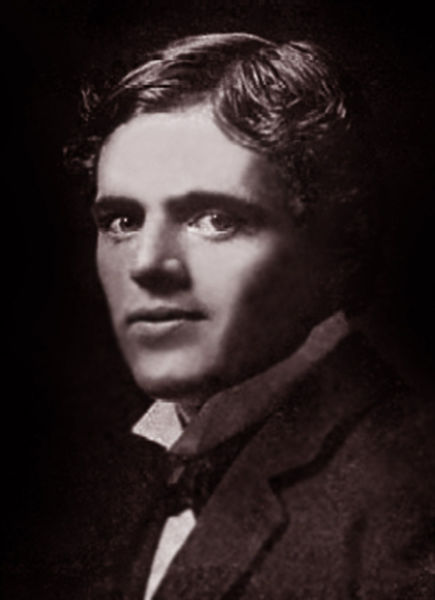
Jack London, 1900

“I would rather be ashes than dust! I would rather that my spark should burn out in a brilliant blaze than it should be stifled by dryrot. I would rather be a superb meteor, every atom of me in magnificent glow, than a sleepy and permanent planet. The proper function of man is to live, not to exist. I shall not waste my days in trying to prolong them. I shall use my time.” —Jack London

“Old age should burn and rave at close of day;
Rage, rage, against the dying of the light.”
—Dylan Thomas, “Do not go gentle into that good night”

First Lines: Thinking of the Future When It’s Become the Present


“Not until my ears popped and the plane was coming down over the winking lights of Bogatá—or really it looked like any other city at night—did I raise my eyes from the page I’d been puzzling at and begin to think of the girl, or woman, the friend or acquaintance, Natasha, whom I was flying so far to visit. That’s how it was with me then: I couldn’t think of the future until I arrived there.”

—Dwight B. Wilmerding, lead character in the novel Indecision, by Benjamin Kunkel

“I couldn’t think of the future until I arrived there.” In this case, the character is literally arriving by plane at

Book Cover for Indecision, by Benjamin Kunkel

Book Cover for Indecision, by Benjamin Kunkel

Bogatá, and he’s thinking—really thinking—for the first time about the point of his trip. Whatever he was reading before this moment had occupied his attention and had nothing to do with what was going to happen next.

Wilmerding was there to visit Natasha, and he’d come a long way by plane. Natasha doesn’t have a settled identity for this protagonist. She is, variously, “the girl, or woman, the friend or acquaintance” he’s come to see. These are his thoughts. But if this is so, why has he travelled so far to see her?

That’s what we want to find out, isn’t it?

As for Bogatá, on approach into the airport, it didn’t look different than any other city at night. Has he seen Shanghai, I wonder? But I take his point—in a way, cities do look alike, even the ones we’re seeing for the first time. We approach a new place intent on noticing what’s foreign about it. We’re romantics when it comes to travel. But if we think about it, we really must be more modest. We have projected a difference that doesn’t exist.

Wilmerding hints that his penchant for waiting ’til the future arrives before thinking about it is now past. That’s interesting. What accounts for this idiosyncrasy? And are we any different? Shall we find out?

That’s our question as we stand in the Barnes and Noble fiction isle trying to decide whether to buy and read Kunkel’s novel. We are in the grip of Indecision.

First Lines: What Does Sunday Sound Like?


Sometimes you read the first line of a novel and you just have to take the next step. If you’re lucky, the next sentence is equally galvanizing, and before you know it, you’re deep into another read.

The experience is rare. But it happened for me again the other day. The sentence that did it comes from John Wyndham’s book The Day of the Triffids: “When a day that you happen to know is Wednesday starts off by sounding like Sunday, there is something seriously wrong somewhere.”

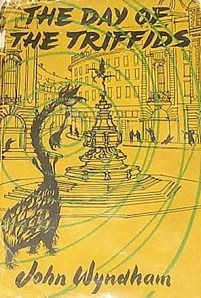
First Edition Cover of John Wyndham's Novel, The Day of the Triffids (1951)

First Edition Cover of John Wyndham's Novel, The Day of the Triffids (1951)

The Day of the Triffids is favorably reviewed by its numerous readers. For example, it averages four-and-a-half stars at Amazon for sixty-nine customer reviews. But it’s still not known very well outside the sci-fi community. Paul Thompson, of Devon, England, has dedicated a website to this book. It’s called “The Reader’s Guide to John Wyndham’s The Day of the Triffids.”

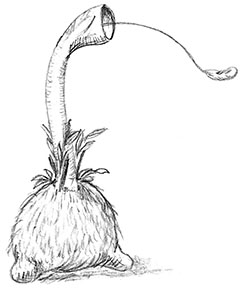
Here is an artist’s rendition of a triffid:

Sketch of a Triffid

Sketch of a Triffid

Best discussions of The Day of the Triffids:

If you’re familiar with Wyndham’s novel, please post your thoughts.

Quotations: On Philosophy


“Philosophy doesn’t begin in some abstract realm; the questions that philosophers concern themselves with begin in human experience.” —Charles Johnson, in his interview with Diane Osen for The Book That Changed My Life