Why Winning a Presidential Election Is No Big Deal


Of course, being the President of the United States is a big deal. For one thing, you get to sit behind a cool desk and look powerful. (Apparently, however, it does’t take long to discover that even a president-elect has limited powers. Our current PE, Mr. Barack Obama, has already revealed plans to be more realistic than his campaign promises.) You get to travel the world and talk to all the other really important people. You get to live in the Big White House. And someday, you’ll have a giant library with your own name on it, dedicated to reminding everyone of your past greatness.

Still, there’s a sense in which winning an election, even a presidential election, is no big deal. It may attest to your campaign prowess, your ability to raise more money than you can spend, and your ability to look presidential. But does it establish that you are the rightful heir to presidential power? Constitutionally it does, certainly. But is this the only sense that matters, in a democracy? It shouldn’t be. A citizen becomes President by garnishing a sufficient amount of support from voters. And it’s the constitution of today’s voter, not the Constitution of the United States, that requires chastened realism about the significance of an electoral victory.

Since the voters decide who is to be president, the quality of the decision correlates with the quality of the electorate’s decision making powers. With this in mind, I’m led directly to wonder: how does it feel to win an election, knowing that those who voted for you, as a block, have no idea why you deserve to be President? Fortunately, with all the preparations before Inaguration Day, there is precious little time for sobering thoughts along these lines. Unless you’re not the president-elect and you don’t have such great matters to distract you. Then you can ponder the wisdom of the electorate—if you have the stomach for it.

There’s a common form of argument called modus tollens. It goes like this:

  1. If P, then Q.
  2. Not-Q.
  3. Therefore, not-P.

If P stands for “The majority of the electorate in the 2008 general election voted wisely,” and Q represents “The decision to elect Barack Obama as the the 44th President of the United States was a wise decision,” then we get the following argument, using the above schema:

  1. If the majority of the electorate in the 2008 general election voted wisely, then the decision to elect Barack Obama as the the 44th President of the United States was a wise decision.”
  2. The decision to elect Barack Obama as the the 44th President of the United States was not a wise decision.
  3. Therefore, majority of the electorate in the 2008 general election did not vote wisely.

I don’t think we need such an argument to establish the conclusion in statement (3). That’s because there is plenty of independent evidence that the electorate did not vote wisely, and, strange as it may sound, this has almost nothing to do with Barack Obama. The most salient evidence has to do with the appalling illiteracy of the American electorate, about history and economics, about values and political theory, and a host of other things.

Some who voted in the recent election believe that the Revolutionary War was won at the Battle of Gettysburg, that the Holocaust is a Jewish holiday, and that Lithuania is stored in a bottle in mother’s medicine cabinet. Suppose we subtract from the electorate any person who believes any one of these things, or anything else akin to such things. Why would we do that? Not simply because their beliefs are silly in the sense of being mistaken, but because they are silly in the sense of being believed for the reasons people who believe such things believe such things. Wouldn’t that be a step in the right direction, a kind of minimalist step, to get decision makers with a modicum of knowledge and knowledge-acquisition skills, capable of making wise decisions about who gets to sit behind the Big Desk?

To be sure, the intelligence test I’ve just proposed is pretty minimalist. It doesn’t account for level of reasoning ability. We should want our voting citizens to be well-informed and capable of basic critical reflection. Two of my examples of “silly beliefs” are taken from Lewis H. Lapham’s article “Playing with Fire” (Lapham’s Quarterly, Fall 2008). Lapham writes, “Why would any politician in his or her right mind wish to confront an informed citizenry capable of breaking down the campaign speeches into their subsets of supporting lies?” That’s an excellent question. It’s meant to be rhetorical: no politician today would wish such a thing. If Lapham is right about that, then we need different politicians. But then they might not be the politicians we deserve.
Nominate Your Favorite Blog or Blog Post for Post-Election Obama Coverage


Question #1—What is the best conservative blog or blog post for post-election Obama coverage?

Question #2—What is the best liberal blog or blog post for post-election Obama coverage?

Don’t analyze this too carefully. If you’ve seen interesting and worthwhile general coverage or an especially good post, just let me know about it in the reply box!

Would You Like to Be Called a Family Friend by Bill Ayers?


So Bill Ayers was this morning’s Good Morning America celebrity. What a way to say “Good Morning” to America!

In the course of the interview, which lasted for quite awhile, Ayers was asked about a remark in his new book. In the book he refers to Barack Obama as “a family friend.” What’s that supposed to mean?

How would you like to be called a family friend by Bill Ayers? And if you really are a family friend of Bill Ayers, and now you’re also the United States President-elect, how do you respond to this bit of news?

What say you?

Oh, one more thing. How does Obama the “Elect One” respond without making it look like he’s trying to fool the American people about whatever relationship he may have had with Bill Ayers?

Is Obama Pro-Choice or Pro-Abortion?


There is a difference between being pro-choice and being pro-abortion. In other words, “pro-choice” is not just a euphemism for “pro-abortion.” The pro-abortion position is far more extreme than the pro-choice position. I’ll refer you to an argument for that in a moment.

First let’s ask the question: Is presidential candidate Barack Obama pro-choice or pro-abortion? In his public statements he has said he is pro-choice and that no one is pro-abortion. If he didn’t know better, I’d say this is naive. But he does know better, and his own record and future policy plans demonstrate that Barack Obama is pro-abortion. In fact, he is pro-abortion in the extreme. He is pro-actively pro-abortion.

I must confess, I find it difficult to believe that any American has such extreme views and will do everything in his power to make them a matter of enforceable law. But a recent article by Princeton University Professor of Jurisprudence, Robert P. George, makes the case with compelling force. If Professor George is right, then Americans who plan to vote in this election need to consider this carefully before they make their presidential choice. I urge you to read “Obama’s Abortion Extremism” at your earliest opportunity.

Here is the opening paragraph in Professor George’s chilling expose:

Barack Obama is the most extreme pro-abortion candidate ever to seek the office of President of the United States. He is the most extreme pro-abortion member of the United States Senate. Indeed, he is the most extreme pro-abortion legislator ever to serve in either house of the United States Congress.

Near the end of his piece, Professor George writes:

In perhaps the most telling comment made by any candidate in either party in this election year, Senator Obama, when asked by Rick Warren when a baby gets human rights, replied: “that question is above my pay grade.” It was a profoundly disingenuous answer: For even at a state senator’s pay grade, Obama presumed to answer that question with blind certainty. His unspoken answer then, as now, is chilling: human beings have no rights until infancy – and if they are unwanted survivors of attempted abortions, not even then.

Some reading this post may be thinking . . .

  • ‘Pro-choice’ . . . ‘pro-abortion,’ whatever—it’s just semantics.
  • I’m not a single-issue voter, and Obama’s strengths in other areas trump his weakness on this point.
  • I believe Obama is honest and sincere and has no hidden agendas. The Princeton professor must be the one with a hidden agenda.
  • There may be a handful of Americans who are pro-abortion extremists, and this is abhorrent and disgusting; but there’s no way a United States Senator on the cusp of winning a presidential election could possibly be this extreme.
  • This is the first opportunity to elect a person of color to the highest office in our Republic, and I’m willing to take a chance on Obama because of this unprecedented opportunity.

I assure you, we are not talking semantics here.

I understand the single-issue concern. But there are two things to say in this case. First, Obama’s unprecedented extremism on abortion is so extreme that no good he could possibly achieve as president could compensate for the permanent damage of his pro-abortion policies—not only to the unborn and the newly-born, but to many health-care professionals and women. Second, this is not a single-issue issue at all. If successful, Obama’s plan will constrain fundamental human liberties for many besides the unborn and the newly-born. Obama’s position on abortion is symptomatic of a political philosophy that is a direct threat to democratic freedom.

What about Obama’s honesty? You can’t tell whether a man is honest just by watching him on TV. You have to study his record and cross-examine his claims. Professor George does this in his article. Obama is not going to volunteer to go on television and talk about his position with this professor of jurisprudence. At most, he will make denials, not arguments that deal with the details of his record. Obama’s agenda, whatever it is, is hidden. By that I mean that he has not been candid about things we should like to know about him. If Professor George has an agenda, he at least has been clear in his claims and he has built a mountain of evidence that cannot simply be dismissed.

There is an extreme pro-abortion movement in this country. Leaders in the movement have been working a strategy for decades. They’ve raised millions of dollars. They understand the American democratic process. They have settled for small victories through less extreme advocates of a pro-choice position. They’ve patiently recruited charismatic individuals to their cause and groomed them for leadership of the movement for the next generation. It would be naive to believe anything else. The tectonic plates in this country are shifting. There is no reason why a major party candidate for the presidency could not, with the help of a minority of powerful insiders, sneak past the electorate into office with an agenda to “change the way politics is done in America,” an agenda that will challenge the moral integrity of American citizens and threaten social stability.

Barack Obama is the first black candidate on a major party ticket. Black men and women have every reason to be proud of the many black leaders, in business, in education, in politics, in the military. Every American should be proud of the progress that’s been made to break down racial barriers and ensure equal opportunity for all who share the American dream. I fully expect that we will eventually have a black president, and I welcome that prospect. I would encourage any voter who is eager to see a black person in that high office make that moment count. If Barack Obama is sworn in as President in January, that will be a historic moment, a proud moment for many black men, women and children. Many others besides will be excited and enthusiastic, and rightly so. But what will become of their pride if Obama disappoints and injects into our shared political bloodstream an ideology that threatens our core values as freedom-loving Americans?

Obama’s position on abortion and other fundamental issues has that potential. I predict, given his record, that this will be the effect if he is elected. Our social and political immune system will be tested then. But it is being tested now, as we contemplate the important choice of president in less than two weeks.

No one of us as individuals will ever have the kind of power a President Barack Obama would have to directly and profoundly influence abortion policy in this country. But we do make the decision whether Obama is invested with that kind of power and opportunity as one individual to transform our culture. And the outcome will be our responsibility.

Spinning Joe Biden


The Senator with the foot-shaped mouth fired off a real whopper this time:

Mark my words. It will not be six months before the world tests Barack Obama like they did John Kennedy. The world is looking. We’re about to elect a brilliant 47-year-old senator president of the United States of America. Remember I said it standing here if you don’t remember anything else I said. Watch, we’re gonna have an international crisis, a generated crisis, to test the mettle of this guy.

Barack Obama’s admirers are dumbfounded—that includes people running his campaign. How do you spin a statement like that? Biden’s remarks were so extensive and emphatic that even a retraction would do nothing to mitigate the unease he has created. Besides “the cynical electorate” already knows what retractions mean.

Media response should be interesting. If Obama really is “their candidate,” it may be gut-wrenching for them to report on this story. And let’s remember what “news reporting” means today—it means editorializing in an effort to influence viewers.

This time, Biden’s comments are not mere trifles. They are sober reminders of what everyone knows. The threat of more terror—the likes of which we may not have seen yet—is a real and present danger. That will still be true no matter who becomes President. But would an Obama presidency intensify the risk? That’s what Biden seemed to be saying. And no one can say it isn’t true, because no one knows that it’s false.

It is easy to see why a McCain presidency could have a different effect on our enemies. And now, consideration of that has suddenly become a factor in this election. Maybe this is the “October surprise” that pundits say could change the numbers that pollsters have been producing.

Foreign policy is back on the table, with only two weeks left in this election season. More specifically, the prospect of a new chain of crises has to be considered. Thus we find ourselves asking two questions:

  1. Is Barack Obama as ready as John McCain to lead our nation should new challenges come?
  2. Is it more likely that new challenges would come during an Obama presidency than during a McCain presidency?

Thanks to Joe Biden, the economy is not the only thing we’ll be thinking about when we vote on November 4th.

This Election as a Referendum on the Liberal Media


Voting for John McCain is a referendum on the liberal media. They have made it obvious that they support Barack Obama and will cover for him by not covering him when that’s in his (and hence their) best interests. They are doing what they can to get Obama elected a few weeks from now. This is patronizing and offensive. They presume to know better than voting Americans who should be the leader of this great nation. They filter the news and editorialize without restraint, believing that we must rely on them to get the facts that matter. Since we do rely on them for this, and they have not fulfilled their noble duty, voters can send a powerful message of disapproval to the media by voting for the McCain/Palin ticket. If they do, they will also have a President they actually know something about.

Is Barack Obama an Ingenue?


That’s what Dick Morris and Eileen McGann seem to be saying, all right:

“Now the Republicans must battle to underscore the threats this country faces, economically and internationally, and that we can’t let an ingenue take over.”

Dick Morris and Eileen McGann :: Townhall.com :: Democrats in Trouble (September 5, 2008)

So what exactly is an “ingenue”?

A reliable authority, The Concise Oxford Dictionary, defines the word this way:

“an innocent or unsophisticated woman,” or an “actress who plays this part”

Barack Obama has been called a lot of things, perhaps including “innocent” and “unsophisticated.” But an “innocent or unsophisticated woman“? That’s one for the records.

Do No Harm—John McCain’s Choice of Sarah Palin


In the world of politics, complexities are often encapsulated in squat phrases and nimble sentences. And when it comes to selecting a Vice Presidential running mate, the mantra has long been primum non nocere—”first, do no harm.” The principle is borrowed from the world of medicine and medical ethics. It’s been applied in situations where medical intervention poses considerable risk to a patient with an unknown or comparatively small margin for benefit. I guess it makes sense, especially during Presidential election campaigns, to liken major political decisions to life-and-death challenges in medical decision making.

When picking a running mate, what does it mean to Do No Harm? Earlier this month, William Kristol spelled out four criteria for choosing a vice president, and evaluated McCain’s options in terms of those criteria. (See “How to pick a vice president.”) Here were McCain’s basic options:

  1. Go with someone safe and predictable.
  2. Pick someone whose strengths will accentuate the opposing candidate’s weaknesses.
  3. Co-opt the public desire for change.
  4. Pledge to serve for a single term and stress the need for radical change in Washington politics.

If do no harm was uppermost in McCain’s mind, then criteria (1) and (2) should have been the determining factors. Judging by the shock registered in the media yesterday when McCain announced his choice of Alaska governor Sarah Palin, the first criterion was pretty low on his list of guidelines. Since the shock was proportionate to the perceived inexperience (measured in age and time served in elected office) of McCain’s choice, the second criterion doesn’t seem to have influenced McCain. So Do No Harm, by Kristol’s reckoning, wasn’t McCain’s chief concern.

Let’s consider two questions.

Was McCain right to ignore the Do No Harm principle in selecting Palin to be his running mate?

Had McCain been far behind Obama in polling, especially in the most contested states, the political value of the Do No Harm principle would have been more salient. The gap in support between Barack Obama and John McCain was negligible at the time of McCain’s selection of Palin.

A politician has to be practical—or pragmatic, if you will. But much of the pragmatism exhibited by our politicians is befogged with cynicism. It is permeated with jaded negativity, which leads to posturing and snarky rhetoric. And this translates into a malaise of cynicism among the electorate. Exasperated, would-be voters lose interest and stay home on election day. Many of those who make their way to the polls buy into this jadedness and cast their vote for the angry candidate, or the candidate who represents the angry party. It’s a bad omen for a democracy when its elected officials rise to power on a wave of angry sentiment.

It would be most refreshing to see America’s leading candidates demonstrate real-world understanding without the baggage of cynical pragmatism. The Do No Harm principle is naturally attractive to the cynical. It is a sign of McCain’s governing optimism that he did not let the political appeal of such a principle determine his choice of running mate.

Politics is full of ironies. One of the great ironies of the current election season is that the Democrat party, led by Senator Obama, has mounted a campaign rooted in anger, warning a cowering sector of the electorate to forego “four more years of George Bush,” while suggesting, at the same time, that McCain is the one with a jaded view of the world, as indicated by his approach to Iraq and Iran. George Bush has been demonized by pundits on the far left of the Democrat party as “the worst President ever” and “a moron.” These pundits have tutored Obama to exploit this caricature and emphasize that John McCain has voted in sync with President Bush 90% of the time. So electing John McCain would be like relecting Bush, and that means perpetuating the worst thing that ever happened to America. (Never mind that Obama has voted 97% of the time in league with his own party, which happens to be at the helm of a Do Nothing Congress.)

McCain was right to ignore the beckoning spirit of cynical pragmatism in his choice of a running mate. Maybe it’s a symptom of the audacity of his hope for this nation.

What is the risk potential of McCain’s choice of Palin?

Let’s assume that Sarah Palin’s only liability is the electorate’s perception of her readiness for the job relative to her age and experience.

When it comes to experience and getting elected to executive office, Sarah Palin’s record is more impressive than Barack Obama’s, Joe Biden’s, and even John McCain’s. Most noteworthy is the comparison with Joe Biden, who began running for President twenty years ago and has never been nominated by his party. This year he turned in a lackluster performance with around 7% of the vote in the Democrat primary. If it was executive experience that Obama wanted to complement his perceived gross inexperience, why didn’t he pick Hillary Clinton? Could it be that he didn’t want to be overshadowed by experience?

When it comes to real political change and reformation, Sarah Palin’s record, again, dwarfs anything Obama has accomplished. As suggested by David Brooks in yesterday’s editorial for The New York Times, Obama loves the future because “that’s where all his accomplishments are.” If Obama’s message is A Message of Change, then why select a career politician, an old boy from inside the beltway—Joseph Biden?

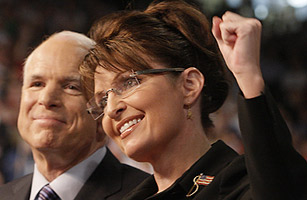
Together, McCain and Palin look bouyant and centered. In a single day since McCain’s announcement that Palin is his running mate, $4 million dollars have been contributed to the Republican campaign. And the Republican National Convention hasn’t even begun yet. Meanwhile, Obama stuttered in his customary way through an impromptu response to McCain’s announcement and looked, I thought, like a deer caught in the headlights. I’m talking about the guy at the top of the Democrat ticket who gave his acceptance speech before 85,000 people just the day before Sarah Palin was announced.

And that leads to a third question: Is there a new rock star in town?

***

Related Post:

Watch for this TV Ad about Barack Obama after the DNC Convention


pH for America will soon be running a TV ad featuring comments by Barack Obama about the proper use of the Bible in American politics. The ad is slated for release shortly after the Democratic National Convention is over. But you can see the complete video of the forthcoming ad now.

If you want to see the video, click here:

Here are a few discussion questions:

  1. What is the primary thesis of this ad?
  2. How is this thesis supported?
  3. What seems to be Obama’s approach to interpreting the Bible?
  4. Do you agree with this approach?
  5. What are the strengths and weaknesses of this particular ad?
  6. Will this ad influence voters? Do you think it should?

What say you?

Should Chelsea Green Be Ashamed?


“Who’s Chelsea Green?” you ask. Chelsea Green is a small, third-rate publishing house that has confirmed its third-rate status with its recent snub of independent booksellers by making a new pro-Obama book available through Amazon and at a special discount before it becomes available in bookstores. The book is Obama’s Challenge, by Robert Kuttner. Read the story here. Read more of this post

European Fuss Over Obama


Just curious. Do Europeans know better than Americans what’s best for Americans? Or is there something Americans know that Europeans don’t? There are things Americans want to know about Obama but can’t seem to find out, despite all of his mugging for the world. Do Europeans know what those things are? Do they care?

Barack Obama has been enjoying a rock star reception in Germany and elsewhere—so they say. That’s nice. Maybe he missed his calling. At least he knows where he’ll be most welcome if John McCain “steals” the election.

Some Obama supporters seem to think that European fandom is a reason for us to elect Obama. I’ve just returned from a visit over at the Dancing with Fire blog, and Kurt, there, hints at such a thing in a piece titled “Best Defense?”

Obama certainly wants Americans to notice the fanfare, and he hopes this will make him more electable. But there are two questions we need to ask:

  1. What difference does it make whether Obama is a celebrity in Europe?
  2. Why is Obama a celebrity in Europe?

If Americans had solid answers to these questions, European sentiment might actually be a reason to question Obama’s fitness for the job. And Obama has given us more reason to doubt by trotting around Europe instead of joining the debate at home to answer questions that matter to Americans.

Is the New Yorker Obama Cover a Parody of Itself?


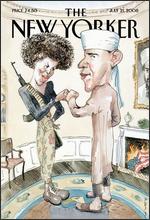
The New Yorker is a high-brow, literary magazine prominently displayed at bookstores everywhere. Its cover art is often eye-catching, a boon to sales, perhaps. But this time the editors at the magazine may have miscalculated. The July 21, 2008 cover features cartoonish renditions of Barack Obama and his wife, Michelle. Barack is portrayed as a stereotypical Muslim and Michelle is decked out in terrorist fatigues and assault weaponry. They seem to be standing in one of America’s iconic centers of political power and they’re doing a fist bump in expression of their solidarity. The American flag is in blazes. Even the afro is portentous.

What’s the message? Well, it’s a parody. That much is clear. A parody, as we all know, is the deliberate exaggeration of something for comic effect. But what does this image parody? The answer to that question lies at the center of a media storm, a controversy that has editors at The New Yorker engaged in feverish damage control.

There are two possibilities. The cover is a parody of Barack Obama’s background and ideology, or it is a parody of popular distortions of Obama’s background and ideology. If it’s the former, it’s an unprecedented expression of affinity for some fringe version of political conservatism and therefore . . . not likely. The New Yorker does not, in general, grandstand for conservative causes. Anyone familiar with the magazine would therefore assume that the cover is a deliberate a parody of popular distortions, mocking the suspicions of Obama’s more radical opponents. But the highbrow subtlety of this issue’s cover art may have backfired by reinforcing those suspicions.

This is what worries the Obama campaign, individual supporters of Obama, and the so-called mainstream media types who regard the cover as a kind of betrayal of liberal values. The cover shocks. That is often the intended effect of parody. The problem for the New Yorker is that this image of the Obamas does not have the right kind of shock value. Superficially, it appears to be an expression of suspicions about Obama, portrayed with exaggeration and comic effect, but with the hint of a genuine warning. Understood in that way, the shock value would be its evocation of fears about who Obama really is, what he really stands for, and where he might lead this nation if he becomes President. But the image isn’t meant to be an expression of suspicion; rather, it’s supposed to be a depiction of unwarranted suspicion. Understood in that way, however, the image itself has almost no shock “value.” What is shocking is that The New Yorker would run the risk of reinforcing a stereotype of Obama that is objectionable to the mainstream media, of which The New Yorker is perceived to be a member in good standing.

To be sure, many media commentators have been shocked by The New Yorker’s choice of artwork. In that respect, the Obama cover has become a parody of itself. And there’s nothing The New Yorker can do about it.

Does Barack Obama Speak Spanish?


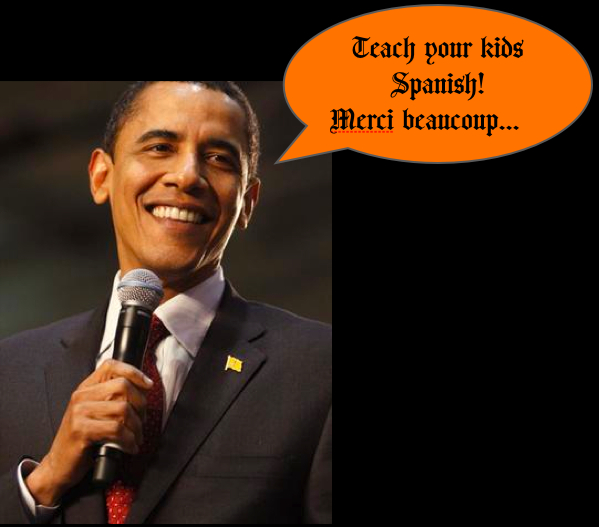
Barack Obama wants everyone to learn Spanish. He announced in Georgia yesterday that he agrees that immigrants to the United States should learn English. That’s a relief. Maybe he’s taken a stand that will hold firm for the duration of his campaign. But this was merely a prelude to his main point. Obama also thinks that every child in America needs to learn Spanish.

What tortured logic leads him to this conclusion? Reconstructed in the form of an argument, here’s the way he reasoned:

  1. If I, Barack Obama, am embarrassed by the fact that most Americans speak only one language, then all Americans should learn Spanish.
  2. I, Barack Obama, am embarrassed by the fact that most Americans speak only one language.
  3. Therefore, all Americans should learn Spanish.

Obama is embarrassed; so I should be teaching my children to speak Spanish. Interesting. I’m starting to feel embarrassed by the logic exhibited by the presidential nominee of a major American party.

Of course, Obama thinks we all should be embarrassed about our monolingualism. Why? Because, as he put it, “when Europeans come over here, they all speak English, they speak French, they speak German, but when we go over there, all we can say is ‘merci beaucoup.'” This got him some laughs from some people in the audience, maybe because they share in his embarrassment.

I’m not sure we should feel embarrassed. At any rate, maybe we should be proud of America’s influence in the world, an influence that has been so positive that people all over the world desire to learn English.

I, frankly, would be just as pleased to be as fluent in German or French as I am in Spanish (having lived in Mexico for six years). I’ve studied German, French, Swedish, and Russian, with mixed results. (I’ve visited China twice, but there’s little hope of my learning Mandarin.) So put me down in support of foreign language learning.

Still, I can’t join Obama in saying that American parents “need to make sure” that their children can speak Spanish. Here’s one reason. If a friend made this proposal in the course of casual conversation, I would think it a little exaggerated. But I’d take seriously the spirit of his admonition, because it would most naturally mean, in that context, that the responsibility to educate children to learn Spanish belongs to their parents. Obama, however, is a politician running for high office. So when he declares, during a campaign speech, that parents “need to make sure” that their children speak Spanish, he means something stronger. He means that if parents don’t ensure that their children speak Spanish, then the federal government may have to step in to make it happen.

This is rich. Tell parents what they should be doing as parents, as if it’s entirely up to them whether to go with his advice. But that’s not what Obama really has in mind. He was speaking as a politician. His words even had a totalitarian tone. If he’s serious, what he said is an indication of how he would reform education in America.

Of course, Obama may not be any more sincere than most politicians. I don’t know when he got this idea that American children should all be learning Spanish. Maybe it occurred to him over the weekend while he was meeting with strategists about how to attract the hispanic vote. There’s an easy way to find out. Just ask Obama’s children a few questions in Spanish.

An even better test would be to check up on Obama’s own proficiency in Spanish. I’d like to hear him give one speech in Spanish, without the use of a teleprompter or a manuscript. I suspect that would be more entertaining than any speech he’s given in English.

***

Here’s an irony for you. Obama mentions the Europeans who come over here and speak English in addition to German and French. I’ve traveled extensively in Europe. The English spoken in western Europe is not uniformly top-notch, although the scope of English-speaking proficiency is impressive. Now, Obama wants us to learn Spanish. Why? Because so many people south of the border have emigrated to the United States, and they don’t speak English. So maybe it’s not los Norteamericanos that Obama should be comparing with Europeans. He may think that Americans are dolts because they’re not bilingual. But at least they speak English!

The irony deepens. Most Europeans come over to visit, practice their English with us, and then return home, happy as clams. In contrast, hoards of Spanish-only speakers stream across our borders, not to visit, but to live and work here illegally. And we’re expected to learn Spanish for their sake!

Most legal immigrants from Mexico, Central America and South America have adopted the U.S. as their new home with a deep desire to assimilate. They have sought to learn English and taken pains to ensure that their children learn English. And opportunities for them to learn English have been made conveniently available. So it isn’t for their sake that every other American needs to learn Spanish.

Drill Now, or Pay More Later


I used to wonder why the United States didn’t work vigorously to free itself from dependence on “foreign oil.” It seemed like a good idea to me “back then”—during Jimmy Carter’s presidency. Popular opinion was that there wasn’t much oil to be found outside the OPEC region. After all, “OPEC” is the acronym for “the Organization of the Petroleum Exporting Countries.” And who were the petroleum exporting countries? The original five members of OPEC were Iran, Iraq, Kuwait, Saudia Arabia, and . . . Venezuela.

Do you see a pattern here? Four of these countries were and are dominant Middle East players. Venezuela, it should be recalled, is the heavy in South America, led today by Hugo Chavez—no friend to the United States. And Venezuela took the initiative originally to establish OPEC, by approaching the just-mentioned nations of the Middle East.

There are now thirteen member states in OPEC. Guess who’s not on the list? The United States. And why not? Because the United States does not export oil. On the contrary, for decades, the United States has been the chief importer of oil.

Why doesn’t the United States export oil? Because it doesn’t have enough oil to export. It doesn’t even have enough oil to meet its own demand. That makes us dependent on foreign oil. And that’s reason enough for us to be entangled in Middle Eastern politics and subject to the whims of blame-America-first terrorists born and bred in the Middle East.

At the outset of the war in Iraq, there was loud speculation that President Bush was making a grab for Iraqi oil. This speculation was interlarded with denouncements of the merit of such a motive.

And where do we find ourselves today? Gas at the pump where I live in southern California is very near the $5 mark, and the price of oil has just topped $140 a barrel, a new high. Market watchers are hyper-ventilating this afternoon. At CNBC, Maria Bartiromo is high on adrenalin as she reports the news.

What’s wrong with this picture? The United States has waited too long to tap its own oil resources. Do we have oil? Yes. And, no. We don’t have much oil for use, much less for export. But there’s oil out there, on the continental shelf and in ANWR. And it’s been there throughout our dependence on oil. And there’s lots of it. Enough there for us to tell OPEC we don’t need them anymore.

Imagine what it would mean geopolitically if we ended our dependence on oil in the Middle East. Setting aside the legitimate interest we have in protecting Israel, we might be able to sustain a responsible form of “protectionism.” As long as our economy runs on oil, we’ll continue to be enmeshed in worldwide conflicts that are fueled by oil dependence.

What are the primary objections to drilling the oil resources we have?

First, we’re being told that “we can’t drill our way out of the current crisis.” One element in this rhetoric is right: we are in crisis. The crisis goes deeper than the prospect of paying $5 and more per gallon of gasoline.
But that prospect is the sort of crisis that has Americans paying more than the usual degree of attention to political maneuvering in Congress and among the presumptive nominees for President, Barack Obama and John McCain.

Obama is the most visible opponent of drilling. He talks about developing alternative forms of energy. But that won’t address the crisis, either. Why? Because the crisis is at the pump. And most of us are stuck with pumping gas for the foreseeable future. It will take a few years to begin extracting crude oil from the ground. Will it take longer than the development of alternative energy forms? Almost certainly not.

Any major delays to drilling going forward will be due to obstructionist politics, mostly on the part of Democrats, and chiefly on the part of Barack Obama, if elected President. Obama could not now reverse his view about the wisdom of drilling without appearing to be the worst kind of flip-flopper. So he’s backed himself into a corner. What’s in the economic interests of the country is at odds with Obama’s interest in becoming President. Whose interests will command his attention? You know the answer. So ask yourself if that’s the sort of person you want to have as President.

What most Americans want is short-term relief at the pump and a long-term solution to our energy crisis. If the establishment of a drilling infrastructure—directed at the most promising locations off-shore and in ANWR—were to begin in earnest by the end of this year or early next year, we wouldn’t have to wait for the oil to make it to the corner gas station for prices to come down. The prospect of such a radical change in supply and demand within three to five years would place immediate pressure on current suppliers (i.e., OPEC) to do something about prices. John McCain has started making this point, and he’s right. How does Obama respond to that? If Americans elect John McCain, who favors drilling, OPEC will get the message before the end of the year. We’re only about four months away from sending that message.

Second, there’s the green-jerk reaction to drilling. “Drilling offshore and in ANWR is going to be environmentally catastrophic.” Show me the evidence.

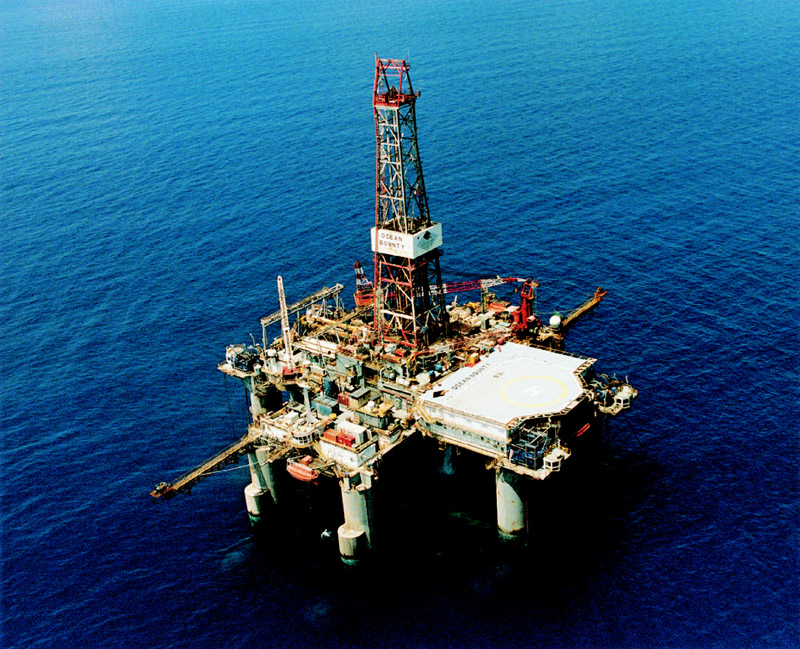
Opponents of offshore drilling exploit vernacular associations with the word “offshore,” as if America’s beaches will be cluttered with unsightly oil rigs. What’s the truth? Deep-water oil and gas platforms will be so far offshore that they couldn’t be seen from our beaches. We’re talking fifty to two hundred miles offshore. I could kayak the entire California shoreline and not be able to plot a single oil drilling site offshore. It would take an hour or longer to travel by helicopter to a typical offshore platform.

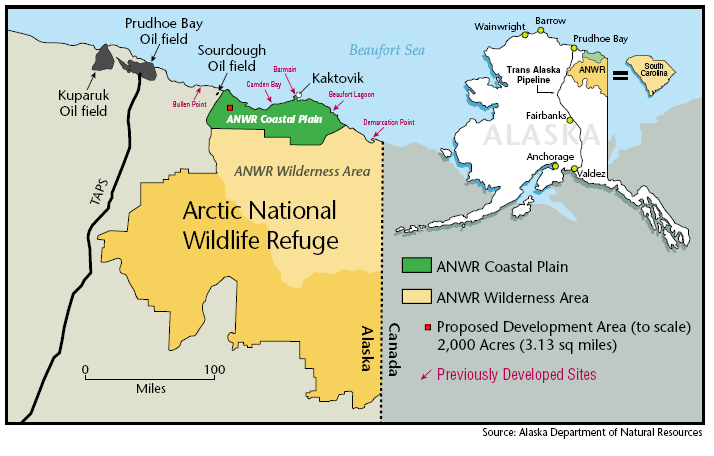
ANWR is another acronym (pronounced “Anwar”), short for “Arctic National Wildlife Refuge.” It’s located in the extreme northeastern region of Alaska and encompasses some 19 million acres. It includes what is literally the most remote territory in the United States. A portion of the region contains rich sources of petroleum. In contention is the effect drilling there would have on the habitat of diverse forms of animal life. ANWR is remarkable for its inclusion of six distinct biozones. But the petroleum rich subsection of ANWR is part of a 1.5 million acre extension of the refuge made in 1980. The move appears to have been as much an effort to protect this resource for possible future drilling as it was for any other environmental objective.

A very small percent, then, of ANWR is even considered attractive for oil-production purposes. And yet the resource is thought to be incredibly rich. And though approval by Congress is required to begin drilling in that area, it has, from the beginning, been regarded a potential source of oil production to be used under the right conditions.

Americans need to be educated about the potential for oil production in ANWR, the politics surrounding the possible use of this resource, and alternatives to drilling in ANWR. For the time-being, offshore drilling appears to be more imminent than drilling in ANWR. This is in part due to political vicissitudes. But off-shore production may also be more cost-effective. In any case, ANWR need not be the bone of contention that it has been, with such impressive resources closer to hand, both geographically and politically.

The emerging market demand for oil worldwide could position the United States to be a major exporter of oil. This demand will be so substantial by 2030 that prices for a barrel of oil could inflate to unimaginable levels. But by then, the United States could be online as a major oil producing country.

Meanwhile, by all means, we should be heavily invested in research and development for alternative forms of energy. And Americans should become better informed about the affordability, safety, and cleanliness of nuclear energy.

“John McCain Owes Michelle Obama an Apology”—Not


Barack Obama is disappointed in John McCain. In the ensuing months, he may have to get used to disappointment. Especially if he’s going to use his media opportunities to demand apologies from McCain for things he hasn’t done. First time at bat in this game, Senator Obama is disappointed that Senator McCain has not denounced the rumor and innuendo that Mrs. Obama (do we still call our First Ladies “Mrs.”?) used the racist word “whitey” in a speech some years ago. But rumor has it that it was someone close to Hillary Clinton who threw the first pitch, presumably in an effort to discredit Senator Obama during the Democrat primaries.

So what has Senator McCain done wrong in this inning? His sin is one of omission rather than commission: he hasn’t had the decency to denounce the scurrilous rumor. Must McCain now monitor every negative thing that’s said about the Obamas and use his own media opportunities to distance himself from the source of each rumor? Come on—this is the Big Leagues. Champions don’t play ball in the sandbox.

Whether he should be the next President or not, it surely is clear that McCain does not owe the Obamas a public expression of sympathy in this matter. McCain should ignore the other Senator’s challenge. Here’s why:

First, McCain’s credentials as a man of fairness do not depend on what other people say about his political opponents, unless those other people speak in some suitably official sense on his behalf.

Second, Mr. Obama has insinuated that Mr. McCain is comfortable with putting families under the microscope during Presidential campaigns, and Obama assumes that this is a no-no. But this tactic is misleading. Certainly, there is a tradition of respecting the privacy of a candidate’s children, especially if they are young children. Older children who campaign for a parent deservedly come under closer scrutiny. But in Big League campaigns—like campaigning for President of the United States—spouses naturally come under public scrutiny. There are several legitimate and important reasons for this:

  • A President’s spouse is, presumably, an intimate life-partner and a reflection on the President’s values and wisdom when making substantive decisions.
  • In recent years, it’s come to light that Presidential wives influence policy through their relationships with their husbands. (We’ve also seen the potential for a Presidential spouse to blackmail her high-profile and politically powerful mate, should he violate a sacred trust.)
  • Presidential wives have exercised considerable independent leadership on issues of national interest, exploiting (rightly or wrongly) the opportunity created by virtue of nuptial relations with the President.
  • A President’s spouse is a key ambassador to the world and a barometer of what is best about America. American citizens have a vested interest in how their First Lady represents them.

That last point leads to a third reason why McCain should not swing at Obama’s pitch. It’s likely that a non-trivial number of Americans would like to know whether Michelle Obama actually spoke (or mis-spoke) as alleged. And public opinion has to be respected by candidates for high office.

The influential role of public opinion isn’t some necessary evil made inevitable by democracy. The influence of public opinion is a public good, especially when it is well-informed opinion. It is one of the few means available for the electorate to hold its leaders (or would-be leaders) accountable. Some political leaders have been remarkably obtuse about this. Ours is an open society in ways unimaginable just decades ago. Still, an astonishing number of politicians today behave in an impolitic manner, as if no one will notice.

Barack Obama’s decision to bait John McCain may prove to be a strategic error, for it’s likely to encourage the electorate to make more deliberate comparisons between Michelle Obama and Cindy McCain. Who can be predict what that will mean? The two woman are conspicuously different in many respects. Polling the electorate on this point probably won’t be very illuminating, since many people would consider questions about potential First Ladies to be indelicate, even if their Presidential preference is influenced by impressions they have of candidates’ wives. And Obama’s recent comments suggest that he prefers to re-direct focus on his wife.