Clever Edit of Mexico Debate a Challenge to Richard Dawkins


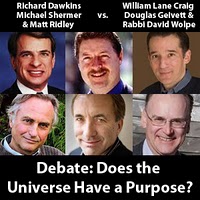
Apparently, Birdie.com has edited the YouTube video made of the debate in Mexico from November 2010, in which I, Bill Craig, and David Wolpe debated Richard Dawkins, Michael Shermer, and Matt Ridley. The aim of this 6 minute feature is to show the mistakes that Richard Dawkins made in understanding and assessing our case in that debate.

If you wish to see this clip, click here.

Shermer, Ridley, and Dawkins vs. Craig, Wolpe, and Geivett: Retrospective on the Debate


I’ve finally returned home after two weeks of travel and speaking, which included a debate in Puebla Mexico. I posted details about the event here prior to leaving for Mexico. There you’ll find links to English and Spanish versions of YouTube recordings of the debate.

I’ve had the chance to read some reactions posted in the blogosphere about this debate. I now want to list some specific points and observations of my own, partly to add clarity and partly to set the record straight about some things I’ve seen written.

I hope you’ll watch the debate and leave your objective evaluation in the comments box of this post.

  1. Usually, a debate question features one side taking the affirmative and the other side taking the negative. Here, the question for debate was “Does the universe have a purpose?” It was obvious from the correspondence I received from the debate organizers that I was to team with two individuals who agreed in taking the affirmative, and that the other three would take the negative—that is, they would deny that the universe has a purpose.
  2. The three of us on the affirmative side—William Lane Craig, David Wolpe, and Doug Geivett—all believe that whether the universe has a purpose depends on whether or not God exists. So we could argue that the universe does have a purpose if God exists, even if time did not allow for detailed arguments that God in fact exists. It would be up to the others—Matt Ridley, Michael Shermer, and Richard Dawkins—to argue that the universe does not have a purpose. Presumably, they would have to include arguments that God does not exist, since that would be crucial to their claim that the universe does not have a purpose. Or, they might argue that even if God exists, the universe does not have a purpose.
  3. The moderator introduced us as “theists” and “atheists,” and framed the debate as a debate between theists, who affirm the existence of God, and atheists, who deny the existence of God. Thus, two questions were conflated from the beginning: (1) “Does the universe have a purpose?” and (2) “Does God exist?” The question for any participant, then, was whether to focus on question (1) or question (2).
  4. Each of the six of us was allotted exactly six minutes for initial arguments. We were timed and stopped at six minutes. Strict enforcement of time limits is characteristic of debates, but not always understood by observers. I’ve noticed that some who’ve commented on the debate at various blogs have remarked that the moderator should not have interrupted debaters when they were about to make an important point. (The debate was part of a larger conference program.)
  5. Rebuttals were limited to three minutes each. Following rebuttals, Michio Kaku was permitted time for a few comments on the debate through that point. His remarks were followed by 90-second closing statements.
  6. The decision about which side would go first was determined by a coin toss. The atheist side won the coin toss and Matt Ridley went first. Each team was permitted to sequence its presenters in the order they preferred. Our side followed the order Craig-Wolpe-Geivett for all three components of the debate. We made our decision based on the tasks we each had agreed to perform during the debate. In my judgment, this sequence proved to be effective.
  7. How did the opposing teams work together as teams? It should be obvious that our team of theists worked very closely together. Our individual presentations complemented each other neatly and intentionally. We provided a united front in our presentation of evidence and response to objections. We worked together across the board. To illustrate, in his rebuttal, Bill Craig used a brief that I had prepared in response to the problem of evil, should it come up. Collectively, we argued for two main contentions: (1) If God exists, then the universe has a purpose, and (2) If God does not exist, then the universe does not have a purpose.
  8. Close observers will understand that our two main contentions directly addressed the published topic of the debate: “Does the universe have a purpose?” Further, they speak to the question of God’s existence in a direct manner. Third, as conditional statements, they do not require for their support any argument that God does, in fact, exist. Fourth, we repeated these two contentions for two primary reasons. First, to remind the audience of our claims, as debaters on both sides took turns speaking. This is a matter of effective communication. Second, to remind the atheist team that this was our position and that it was this that they must address in their response to us. This is a matter of holding the other side accountable to the actual arguments we mustered during the debate. I’ve seen some in the blogosphere complain that I repeated our two fundamental claims in my opening statement. But this was after David Wolpe’s opening statement, which did not repeat the claims, and three opening statements by the atheists. Nearly half an hour had passed since the two claims had been explicitly stated.
  9. In his opening statement, Bill Craig explained why the universe would have purpose if God exists, thus supporting our first contention. He then acknowledged that whether the universe actually does have purpose, supposing our two contentions are true, depends on the existence of God. So he used the balance of his six minutes to list several arguments for the existence of God, which all have been developed in detail in his books. In effect, he placed them on the table for the atheist side to refute.
  10. In his opening statement, David Wolpe developed the argument from fine-tuning for the existence of God, and hence of purpose for the universe. He then drew a close existential connection between this argument and the human quest for meaning and purpose.
  11. I my opening statement, then, I—Doug Geivett—recalled our two main contentions, then addressed the possibility that some on the other side would argue that the universe has purpose even if God does not exist. Following that, I developed an argument, not often heard in debates, that our very interest in the question of the debate is evidence that God does exist.
  12. So the trajectory of our three arguments on the theist side was itself purposeful and progressive. Together they represented an eighteen-minute opening argument for theism and purpose. If you put these together in the order in which they were presented, you’ll see that they made for a natural progression, with a build-up along the way toward a climax.
  13. It would be absurd, then, to expect any one of us to “carry the day” within the narrow scope of our individual presentations. For example, it’s ridiculous to scold Bill Craig for failing to develop theistic arguments more fully. Considered as a unified whole, our three opening statements complement and serve each other.
  14. Now what about the atheist side? This is my opinion and people are free to disagree, but I believe the atheists operated much more independently of each other, and even contradicted each other. In his opening statement, Matt Ridley argued against the idea that the universe has a purpose. Michael Shermer, on the other hand, argued for purpose, precisely as I predicted he would when Bill Craig and David Wolpe and I discussed strategy prior to the debate. This is why my opening statement includes a response to this type of claim with a special argument for the existence of God (see description above), and why my opening statement was third in the series. The atheists struggled to clarify the distinction between purpose in the universe and purpose on the level of human existence. Thus, they seemed sometimes to be arguing against purpose and sometimes to be arguing for purpose.
  15. While the atheists alluded to the argument from evil against theism, no one developed the argument in any detail. This was quite surprising and seemed to me a missed opportunity for their side. Of course, we were prepared for something more strenuous, and Bill Craig did address the argument, even more fully than it had been presented. Notice, too, that Craig’s response compounded the evidence we presented for the existence of God, since it embedded an argument from evil for theism. The atheists never had another word to say about this. Nor did the atheists answer my argument for theism. And in response the Wolpe’s fine-tuning argument, they simply mentioned the possibility of multiple universes and the like.
  16. Richard Dawkins is hero to many atheists today. So his participation and relation to the other two atheists deserves special notice. You’ll find that Dawkins made numerous assertions and almost no arguments. If you disagree, you should be able to reconstruct his arguments by identifying individual premises and specific conclusions. So far, those who have praised Dawkins’s performance in the debate, all of whom have been atheists themselves, have not attempted this reconstruction. I urge them to try. I will gladly address carefully reconstructed arguments in the comments section of this post. Dawkins called religious belief “pathetic” and accused Bill Craig of making an emotional argument. As I stated in my brief closing statement, it was Dawkins, more than anyone else, who made an “emotional argument.” First, he gave no arguments against the existence of God. Second, he offered no rebuttals of the arguments we presented, and third, he dismissed religious belief as pathetic without argument. If I’m wrong about any of this, I would be happy to see evidence of my error and respond to whatever arguments he did present.
  17. There has been considerable commentary about the “Craig vs. Dawkins debate” as a result of this event. Prior to this debate, Richard Dawkins had refused all invitations to debate Bill Craig. It’s for this reason that Bill was surprised to learn that Dawkins had agreed to participate in this debate. This, clearly, was the safest venue for Dawkins to appear in debate with Craig, since it was a three-on-three debate with unusually brief allocations of time for each speaker. But Dawkins was not debating Bill Craig only. He was in debate with three theists, in partnership with two fellow atheists. There was nothing the least bit threatening or intimidating about Dawkins on this occasion. I would happily debate him in a one-on-one situation. So if he prefers not to debate Bill Craig, for whatever reason, he’s welcome to debate with me.
  18. Some have criticized the moderator of the debate for the style of his facilitation. But people fail to consider the total context of the debate. This was but one of many events scheduled in a three-day conference. Also, the debate was aired at the end of the day following the much-watched boxing match between Manny Pacquiao and Antonio Margarito. Hence, the pugilism metaphor so emphasized during the debate. I happen to know that some who watched the boxing match on Mexican television stayed tuned to channel 7 and watched the debate. I’ve heard it estimated that around 2 million viewers have seen the debate as a result. Andreas Roemer seems to have good instincts about how to raise public awareness of an event worthy of more attention.

Again, I hope to hear from you with your reflections about the debate. Before leaving comments, you may want to review the comments policy for this blog here.

Other places where the debate is being discussed:

What is it about them philosophers?


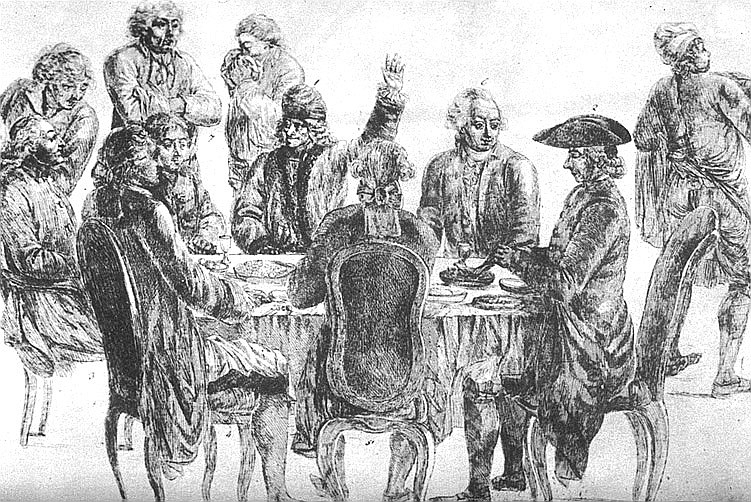
Voltaire and Diderot at the Cafe Procope

Do philosophers today

know what they say;

or do they conspire

to make us tire

of frumpery and fog,

to feel like a cog

and slip a gear

from some primal fear

that every word

is genuinely dear

—or simply absurd?

– RDG

Using “Google Sites” for a Course Project


Image representing Google as depicted in Crunc...

Image via CrunchBase

Today TOMD73’s blog has a post that explores the possibility of using blog assignments as part of a course.

I did something very like this with a class of about 75 university students, mostly juniors and sophomores.

Instead of calling it a blog, I called it a website. I had all of them use the Google website app so that (1) everyone was required to follow the same steps and (2) they could very easily create access to each other without “going public.”

With so many students, I formed the group into teams. Students would comment on the websites of those in their team. I gave very specific instructions about the kinds of comments they were to make, and explained that the quality of their comments would be a variable in their final grade evaluation.

Building a website of 5-7 linked pages was the major course project. Students could select their own topics, with two provisos: (1) the topic had to be related to the course topic; (2) I had to approve their selection.

Class met weekly. Each week students were given a series of steps to be completed by the next class period. These steps moved them gradually to completion of their website projects by the end of the semester.

The course was a philosophy of religion course for non-philosophy majors, with special focus on the New Atheism.

Many of the students produced excellent websites that they could be proud to make available to the public.

On the whole, I was pleased with the results. Most difficulties related to the size of the class. This type of assignment would have been much easier for me to manage with fewer students.

Here are some of the more significant challenges I encountered:

  1. Mastering the technology so that I knew what I was asking of the students and so that I could explain it to even the most technologically timid.
  2. Getting teams to work with so many students. There was considerable troubleshooting early on while students were learning the steps to get up and running. But more important, some students simply didn’t participate. I hadn’t counted on this since they were required to. This complicated things for the conscientious students, since part of their assignment was to respond to the comments they received.
  3. Helping the students work within a template of 5-7 pages that would do justice to their topics. Creating website pages differs from writing a paper. Developing and linking ideas is handled differently. Ideally, a decision to create a website rather than to write a paper should be grounded in the conviction that a website better serves the purposes of the project—especially because of the way material can be packaged (e.g., audio and visual tools can be included, and convenient links to other valuable items can be made).
  4. This project required more assistance from me than many other assignments. The student-teacher ratio made this a challenge. But one advantage is that I did get better acquainted with many of the students.
  5. Grading these assignments proved to be time intensive. This isn’t a bad thing. But you need to expect this when planning a course that includes this type of project.

Would I do it again? Absolutely! It would be much easier the next time around. But it has to be the right kind of course for this to count as a suitable assignment. I especially like it that students that have excelled have something to offer the rest of the world the moment the course is over!

Interview with Brian Auten


I was interviewed recently by Brian Auten. Most of Brian’s questions concern the topic of miracles. Today Brian has posted this audio interview at his website and can be heard here.

Doug’s other posts on the subject of miracles:

“If God, Why Evil?” Presentation Slides


Today I participated in the “Always Be Ready” conference in Downey, CA. The title of my presentation was “If God, Why Evil?”

You’re welcome to view the Keynote slides I used for this presentation. Just click on the following link:

Doug Geivett, “If God Why Evil” (2010.07.31)

Related post here.

Doug to Speak at the “Always Be Ready” Conference July 31


Doug will be speaking at the “Always Be Ready” conference at Calvary Chapel, Downey, CA—July 31, 2010—2:00-2:55 pm. Topic: “If God, Why Evil?”

For registration information and other details:

“Always Be Ready” Conference—Calvary Chapel Downey

This conference is sponsored by the Veritas Evangelical Seminary.

Update (1 August 2010):

Keynote slides for this presentation can be viewed here.

Polling Today’s Philosophers about What They Believe


Want to know what today’s philosophers believe? Anthony Gottlieb reports results of a poll taken by Australian philosopher David Chalmers. The Chalmers poll probes philosophers’ beliefs about Read more of this post

Did Rahm or Rush Use the R-word?


The word “retarded” is not the commonplace it once was. Today we rightly refer to people with mental disabilities in other ways. One severe problem with “retarded” as a noun (i.e., the collective noun “the retarded”) is that it is easily used too generally as a label for those with mental disabilities—as if having a disability is their essential attribute, the feature that defines them as human beings. Read more of this post

Thought for the Day—December 17, 2009


If you yank the heart out of truth, you have nothing left but a bloodless form of belief. —RDG

Arthur Schopenhauer’s Penchant for Animals


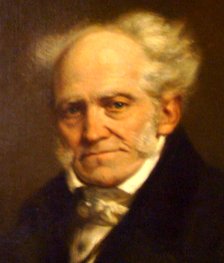
Schopenhauer

Schopenhauer (1788-1860)

I don’t know whether Arthur Schopenhauer liked animals, but he sure did talk about them a lot. And what he had to say makes you wonder if he wasn’t Plato come back as a 19th-century zoologist pretending to be a philosopher.

If his philosophical theory is right, he really had no choice.

Sources:

What would I be if not a Philosopher?


Bill Valicella:

Philosophy for me is the unum necessarium. I cannot imagine who I would be were I not a philosopher.

Ad amussum (same here). Can there be any other way to be a philosopher than to be some person who cannot imagine who that person would be if that person were not a philosopher?


Speculative Fiction by and for Christians


Twitter led me to a blog called My Friend Amy, where there’s an interesting take on speculative fiction in today’s “Faith ‘n Fiction Saturdays” category. The post addresses several questions:

  1. What is speculative fiction?
  2. What is “Christian speculative fiction”?
  3. What are the standards for high quality Christian speculative fiction?

This short post got me thinking about these and related questions. The result is a longer post sketching some of my thoughts about the general topic.

What Is Speculative about ‘Speculative Fiction’?

My Friend Amy quotes Wikipedia for an answer to this question:

Speculative fiction is a fiction genre speculating about worlds that are unlike the real world in various important ways. In these contexts, it generally overlaps one or more of the following: science fiction, fantasy fiction, horror fiction, supernatural fiction, superhero fiction, utopian and dystopian fiction, apocalyptic and post-apocalyptic fiction, and alternate history. (Click here for the complete Wikipedia entry for “Speculative fiction.)

The term is of relatively recent vintage. It doesn’t appear in any of the three handbooks I consult for such things:

  • Benet’s Reader’s Encyclopedia, 4th edition published in 1996. A new edition was published in 2008, and no doubt includes novel entries (no pun intended).
  • The Reader’s Companion to World Literature, 2nd edition published in 1984. This edition was updated in 2002. Of the three books listed here, this is the best value—very affordable and reliable, with excellent coverage of authors, titles, literary movements, historical periods, terms and phrases.
  • Kathleen Morner and Ralph Rausch, From Absurd to Zeitgeist: The Compact Guide to Literary Terms (1997). I believe this book is out of print, but I see that (at the time of this post) one copy is in stock at Powell’s Books.

I once read an essay on speculative fiction that developed a convincing account of the form. Unfortunately, I don’t remember the author or where I came across the item. But I do remember thinking then that “speculative fiction” is an apt label for fiction that explores counterfactuals—ways things might have been but weren’t, or ways things might yet be but won’t. [FN: For more about counterfactuals at this website, “Run Lola Run—A Discussion Guide.”]

The interesting examples of counterfactuals are worlds very close to this, the actual world. “What if, instead of X happening at time t, something else that could easily have happened, Y, had happened at t? How would things have turned out then?” (One serious philosophical problem with speculation of this sort is that the sequel to any counterfactual at time t—the succession of events following Y, for example—may itself vary in numerous counterfactual ways. There may be many ways things might have turned out if Y had happened rather than X at t. And it’s puzzling to think that there is just one way things would have turned out in such a counterfactual setup. But I digress.)

The better fictional depictions of counterexamples would be at least minimally ‘literary.’ And they would explore themes of enduring human interest.

Could a Christian author write speculative fiction? Of course. The author at My Friend Amy’s blog alludes to several. The most obvious examples are ones that are most obviously ‘Christian.’ They broadcast a Christian message so overtly that it cannot be missed. For example, as noted in the blog post over at My Friend Amy, much Christian fiction depicts battles in the spirit world between angels and demons and the role of intercessory prayer by humans caught in the conflict. This kind of speculative fiction will appeal mostly to Christian readers, and then only to a certain kind of Christian reader. They don’t appeal to My Friend Amy for example. [FN: Some Christians, you may be surprised to hear, would argue that many such specimens of fiction are not properly Christian.]

C. S. Lewis and Others

It is interesting to me that C. S. Lewis is not mentioned. In addition to his cherished Narnia series of fantasy novels, Lewis wrote a very sophisticated series of three novels in what might be called the category of ‘space fiction.’ These are Out of the Silent Planet, Perelandra, and That Hideous Strength. Lewis wrote with subtlty and grace. It’s well-known that he wrote from a Christian worldview. But these novels do not ‘preach.’

Lewis also wrote The Screwtape Letters and The Great Divorce. These must surely count as paradigm cases of ‘speculative fiction.’ Next time you read them, consider this question: “What sort of ‘what-if’ question is Lewis endeavoring to answer in this book?”

I think that’s the question to put to any book if you want to be sure it counts as ‘speculative fiction.’ This opens the way for ostensive definition of the term. That is, it facilitates understanding of the term ‘speculative fiction’ by pointing to clear cases of it. Two examples that come immediately to mind are Shikasta, by Doris Lessing (1979), and The Children of Men, by P. D. James (1992).

It’s interesting to consider these examples in connection with questions raised by My Friend Amy. My view is that speculative fiction is a particularly congenial form for writing from a distinctive worldview, be it Christian or otherwise. It is congenial in part because it permits experimentation with the implications of a worldview without wearing that worldview on its sleeve. Doris Lessing and P. D. James both write with religious sensibilities—Lessing with the perspective of Sufism, James with a Christian worldview. [FN: Lessing was once offered the honorific title of “Dame” by Queen  of England. Lessing declined the honor. James was created Baroness James of Holland Park in 1991.] The guiding perspective in each case, though often discernible, is subtly layered into the narrative. This is akin to what the great authors Flannery O’Connor and Graham Greene accomplished in their more ‘realist fiction.’ [FN: See for example, and the short stories of Flannery O’Connor, and The End of the Affair, by Graham Greene.]

For many readers of this post, the film adaptation of The Children of Men will be better known than the book. While watching the first few scenes, I thought about how this darkly apocalyptic film might render the religious component of the human condition when humanity is faced with extinction. My guess was that it would represent society as completely secular, and that any portrayal of religious people would characterize them as the kind who stand on street corners warning passersby of imminent divine judgment, in a tone that betrays their conviction that ‘none who hear will convert, and it’s just as well anyway, since they deserve to go to hell.’ That pretty much is how religion was ‘treated’ in the film.

That last statement needs qualification. What I should say is that religion, imagined under the conditions described in the film, is presented a certain way. This may be a commentary on how religion is manifest in the world today. But it’s pretty striking that no one I would call a ‘serious believer’ shows up in the movie. I imagine they don’t exist, or, if they do, they are marginally significant to the storyline. But then what would account for their nonexistence? Or what would explain their insignificance to the unfolding story? It is precisely the apocalyptic character of the story that makes their absence conspicuous. And that is interesting.

So a film or a novel may have something to say about religion even when it makes no direct reference to anything explicitly religious.

Vampires

The Amy post also asks whether fiction featuring vampires might be a venue for developing Christian themes. I’ve thought about this myself. That would be an excellent question for Anne Rice, the bestselling author of vampire fiction, and an adult convert to Christianity. Books in her newer series based on the gospel narratives has not been quite as successful as Interview with the Vampire. They are, to be sure, friendly presentations of the life and influence of Jesus. I suspect they have generated a new set of fans.

Susan Howatch

Another contemporary author known for her Christian worldview is Susan Howatch. Also a bestselling author (and British), Howatch composes stories with a realist cast. They take place in our world, you might say. See, for example, her acclaimed series beginning with the novel Glittering Images. One of her best is The High Flyer, which can be recommended to any reader with a taste for literary fiction set in the contemporary context.

* * *

A blog permits the expression of random thoughts during idle moments. I’ve exploited that opportunity here. As often happens, the flood of thoughts swelled to the point of necessary expression because of a bit of reading. This time I happened to be reading another blogger who reads.

Thank you, Amy my friend—whoever you are.

Related Posts by Doug Geivett:
Teach Yourself Epistemology


Epistemology is the branch of philosophy devoted especially to study of the concepts of knowledge and justified belief. The name for this discipline, epistemology, comes from the Greek word episteme, signifying “knowledge.” This is why epistemology is sometimes called “the theory of knowledge.” Unfortunately, this designation leads to a truncated view of a complex subject matter ranging over a wide variety of issues having to do with the status of belief.

The study of epistemology is notoriously difficult. It is also difficult to teach. Most university professors in the Anglo-American analytic tradition present the subject as a series of problem-solving ventures. The most persistent theories addressing these problems are presented and compared. Sometimes the teacher favors a general approach in epistemology and gives special attention to explaining and defending that approach and spelling out its implications.

One of the great problems of epistemology is how to think about the subject matter. This is the most fundamental problem for the enterprise of epistemology (which I distinguish from the enterprise of knowing and responsible believing). And yet this problem is often passed over, not only in the classroom, but by epistemologists in their own systematic work.

In my view, this places the student at risk. The student new to epistemology is liable to learn epistemology second-hand, taking as given the various problems and their proposed solutions, arranged in whatever order suits the professor or textbook writer. One very common approach is to begin with the threat of skepticism, which hangs as an ominous spectre over the whole enterprise—and is perhaps never completely exorcised.

A proper approach to “doing epistemology” would have to be delineated with great care and in more space than I have here. But there is a sense in which the self-educated have an advantage when coming to this subject matter. They are more likely to embark upon the enterprise of epistemology with that sense of wonder that is characteristically Aristotelian. In this case, the wonder is that we are capable of knowing so many things in such diverse areas of investigation, and that we move confidently through the world believing much that we do not know or would claim to know.

Still, the student needs a guide to such a complex subject. And while no text can serve in place of careful reflection on aspects of knowing and believing as they present themselves, there are a few very good books to guide the student and prompt examination of long-standing issues in epistemology.

In my own teaching, I have favored three books on the subject:

These books complement each other nicely. The book by Robert Audi will require a tutor for most who are new to the subject. It is rich and comprehensive, and, most important, very sensible about the topics it addresses. Better than any other book I know of, this book presents the subject in a natural order that is conducive to proper progress through to thorny issues it addresses.

To anchor a course in epistemology, I’ve found that the books by Feldman and Bon Jour complement each other neatly. They are concise and readable surveys of major topics. Laurence Bon Jour adopts a method of presentation that he explains clearly at the outset. While I think the method he adopts is unfortunate, it does give readers a sense of the rootedness of trends in contemporary epistemology in the influential work of the great 17th-century philosopher René Descartes. Of special value is Bon Jour’s treatment of the contest between foundationalists and coherentists in epistemology. A convert from coherentism to foundationalism, Bon Jour excels in his exposition of this debate; yet he is also realistic about the persistent philosophical challenges raised by foundationalism.

Richard Feldman demonstrates the exacting technique of analytic philosophy in a way that is accessible and interesting to newcomers. His book is a pleasure to recommend for that reason alone. But it is strong in many other respects. Feldman selects only the most fundamental issues in epistemology, and his book is a natural choice for someone with my anti-skeptical predilections for foundationalism and internalism in epistemology. His juxtaposition of evidentialism on the one hand and internalism and externalism on the other hand is initially puzzling. The presentation of evidentialism is a model of exposition at the introductory level.

Neither Feldman nor Bon Jour does justice to the problems associated with sensory perception. This large area of study in epistemology is set aside by Feldman, perhaps in the interests of conserving space. I think the decision to postpone consideration of the theory of perception can be defended. Feldman simply ignores the topic. Bon Jour, on the other hand, takes pains to explore the theory of perception. He defends a position called indirect or representative realism. As a direct realist, I believe this is a mistake. The presentation is well-organized and focused. And, in my judgment, Bon Jour’s development and defense of indirect realism creates opportunities to indicate significant problems for his position, which is part of any thorough defense of direct realism.

Several other books make useful companions to the ones I’ve recommended above:

The student also needs a collection, or anthology, of readings in epistemology. The best anthologies include selections from influential thinkers going back to Plato, as well as seminal essays by more recent philosophers. Among the best are:

Epistemology, like all professional philosophy, is “trendy.” The serious student of the discipline must understand these trends, even at the risk of being misled about their importance or being distracted from the real business of epistemology. The books I’ve described and recommended here contribute greatly to that task.

Postscript

While I strongly recommend the books by Rober Audi, Richard Feldman, and Laurence Bon Jour as places to begin the systematic study of contemporary analytic epistemology, several other introductory texts make excellent ancillary reading:

A Plan for the Study of Epistemology

  1. Read the three introductory texts recommended at the beginning, by Robert Audi, Richard Feldman, and Bon Jour. Sketch a plan to read them simultaneously, following the topical sequence in Audi.
  2. Read a sample of classic and contemporary essays from one of the anthologies listed above. Read according to interest and accessibility and note those authors who are mentioned in Audi, Feldman, and Bon Jour. Follow the order of coverage by topic in your reading of Audi and the others.
  3. Use Jonathan Dancy’s Companion to Epistemology as a quick reference on sundry topics in epistemology.
  4. Consult the other companion volumes for more detail and discussion.
  5. Survey several other introductions listed in the Postscript above. Especially deserving of careful study are Chisholm, Lehrer, and Pollock.
  6. Begin reading on topics of special interest to you, in books and essays that focus especially on those topics.
  7. Think about issues in meta-epistemology, or the study of the proper study of epistemology. On this topic I especially recommend Chisholm, Theory of Knowledge (already listed) and his essay on “The Problem of the Criterion,” George Chatalian, Epistemology and Skepticism: An Enquiry into the Nature of Epistemology, and P. Coffey, Epistemology, or the Theory of Knowledge (1917).
  8. For a realist approach to epistemology, I suggest reading seminal essays by the so-called “New Realists” in 20-century American philosophy.

Gearhead Philosophers


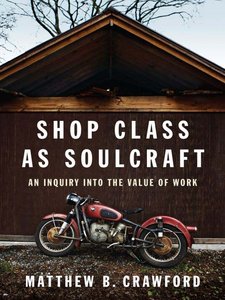
Book Cover.Crawford.Shop ClassWhat would you expect from a book by a trained philosopher who quit his job as a Washington think tank shill (I almost said “tankard”) to work as a motorcycle mechanic?

If you know anything about the academic job market, you might think I have things backwards. It wouldn’t surprise to hear that a professional philosopher ended up—or rather, started out—rebuilding motorcycle engines. But philosophers do strange things. And Matthew Crawford, with a Ph.D. in political philosophy, is a good example.

Crawford is the author of  a new book called Shop Class as Soulcraft: An Inquiry into the Value of Work. I learned about his book from a “Tweet” (i.e., a Twitter post) linking to a review of the book by a  Slate contributor named Michael Agger. The article, titled “Heidegger and the Art of Motorcycle Maintenance,” praises the book and suggests that a copy be given to everyone you know who is graduating from college and about to “commence real life.” (Never mind that a majority of college graduates postpone commencing real life, some of them indefinitely.)

Every year, grads take jobs they’ve dreamed about, then become so absorbed in them that they are absorbed by them, little noticing that their work is not particularly absorbing in the sense that matters most. Crawford’s book is supposed to get office grunts, from secretaries to CEO’s, to consider more carefully the work they’re doing.

Of course, this year a much higher percentage of college graduates will look in vain for jobs that they believe will satisfy. Maybe that’s a good thing. Maybe they’ll have time for some profitable reading. A book like this could help them get their heads together. Soulcraft versus bank draft. It’s an interesting contrast. Leave it to a philosopher to subvert the values of our age.

Two questions. What does any of this have to do with motorcycle maintenance? And what does it have to do with Heidegger?

The first question, presumably, is answered in the book. Crawford the philosopher became Crawford the disillusioned “knowledge worker,” which led him to become Crawford the motorcycle mechanic. And Crawford the motorcycle mechanic, who had apparently dropped out of the knowledge enterprise, learned what was of real value where life intersects work.

The answer to the second question isn’t obvious from reading the Slate article. There’s no attempt in the article to tie Crawford’s ideas and conclusions to the work of any philosopher named Heidegger. One naurally assumes that Agger is thinking of the Heidegger, as in German philosopher Martin Heidegger (1889-1976). But Agger doesn’t connect the dots. Maybe he just latched onto the name of the first philosopher he thought of. Heidegger is not known for his luminosity—nor for motorcycle expertise. So Agger’s choice of a title may be bad in more ways than one. On the other hand, there’s the possibility (admittedly remote) that Crawford draws valuable concrete lessons for life from one of the most austere philosophers of the past 100 years.

So far I’ve only read about the book. But I’m definitely interested. And if Crawford leaves Heidegger out of it, even more so.

***

Notes:

  1. Michael Agger is also playing off the title of Robert Pirsig’s 1973 classic Zen and the Art of Motorcycle Maintenance. Maybe there’s a subtle connection between Heidegger, Zen, and motorcycle maintenance that escapes me just now. If so, my apologies to Michael Agger.
  2. As I write this, Shop Class as Soulcraft is #30 in sales rank at Amazon.
  3. Kudos for Crawford’s book include the following by Harvard professor of government, Harvey Mansfield: “Matt Crawford’s remarkable book on the morality and metaphysics of the repairman looks into the reality of practical activity. It is a superb combination of testimony and reflection, and you can’t put it down.” (Source: Amazon.com)
  4. As long as we’re onto Heidegger here, I should note that there’s an interesting BBC documentary on the man that’s available on YouTube, starting with this 8-minute installment here.

Related Posts: