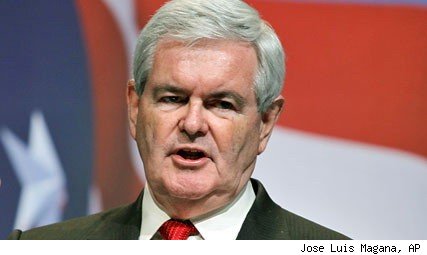
Poll: Mike Huckabee’s Forum in South Carolina


Mike Huckabee stipulated that no candidate could mention any other candidate by name in his answer to questions at the Huckabee forum in South Carolina tonight. Who benefits most from this kind of rule?

Newt Gingrich vs. “The Republican Establishment”


Less then ten days ago, Newt Gingirich offered another zinger in the pre-holiday debate among Republican candidates for the presidency. He noted the need to do something to constrain the excesses of arrogant activist judges and he presented a concrete strategy for doing so. He said, “If judges are so radically anti-american that they thought One Nation Under God was wrong, then they shouldn’t be on the court.” In this he was referring to a specific recent court ruling that many Republicans agree was nerdy and over-reaching. Newt has proposed various measures for enforcement of judicial responsibility in relation to the other two branches of government. In certain cases, judges should be compelled to explain their rulings before Congress or risk impeachment.

Newt has been pummeled with criticism from the so-called “Republican Establishment,” a possibly self-marginalizing cadre of naysayers who now must prove that Newt is unelectable by doing everything in their power to make sure that he isn’t elected. Charles Krauthammer appears to be one such critic. From his comfortable perch as a Fox News regular, he has denounced Newt’s proposal and has suggested that Newt probably couldn’t win the election next November.

So far, no one I can think of has effectively countered Newt’s actual argument supporting the viability of his idea. During the recent debate, Newt, who is a historian, noted, for example, that in 1802, Thomas Jefferson abolished 18 of 35 judges. Megyn Kelly, a panelist asking questions of the candidates parried, saying, “Something that was highly criticized.” And Newt replied, “Not by anybody in power in 1802,” and then extended the history lesson by pointing out that Lincoln repudiated the Dred Scott decision in his first inaugural address of 1861.

On Sunday, Bob Schieffer, on “Face the Nation,” invited Newt to explain his position. For Newt’s answer, click here.

I would like to hear a fuller explanation of Newt’s notion, and a more complete response to it. Mitt Romney won’t debate Newt before Iowa. So here’s an idea for Newt to consider: Challenge Charles Krauthammer, George Will, Karl Rove, Michael Mukasey—or any other of the conservative advocates mocking your proposal—to a debate or public discussion about the issue of judicial activism, the need for constraints, and your plan for putting restraints in place. Clearly, you’re a man of bold new ideas. As far as I know, a direct challenge to debate some TV talking head wielding disproportionate influence among the electorate, or a former Republican Attorney General, like Mukasey, is unprecedented. Maybe it’s time.

For Newt’s detailed position on reigning in activist judges, click here.

I invite comments, and I especially welcome answers to any of these questions:

1. Is there a problem in the United States with “activist judges”?

2. What are the strengths of Newt’s plan for addressing this problem?

3. What are the weaknesses of Newt’s plan for addressing this problem?

4. Would you like to see a public debate or conversation between Newt Gingrich and members of the Republican establishment who object to his plan?

The Missing Ontological Argument in the Craig vs. Law Debate


October 17, 2011, William Lane Craig and Stephen Law met in London to debate the topic “Does God Exist?” Subsequent to the debate, Law has posted briefs that he prepared for arguments and objections that Craig might state during the debate. I’m not sure why—since I haven’t known Craig to include an ontological argument in his arsenal of theistic arguments during a debate—but Stephen Law had prepared notes in case the ontological argument did get presented. He has posted these at his website.

Here is what Law writes, in order to meet the ontological argument in case it is presented:

4. ONTOLOGICAL ARGUMENT

It’s possible a maximally great being exists.

…Therefore, a maximally great being exists.

This argument has no force at all against the evidential problem of evil. In fact, ironically, it actually serves to reinforce my conclusion. For if I can use the evidential problem of evil to show there’s actually no god – that the conclusion of Craig’s ontological argument is false – then the validity of the argument entitles me to draw the further conclusion that’s it’s not even possible that god exists!

So my thanks to Professor Craig for furnishing me with an argument that serves actually to amplify my conclusion – allowing me to move from: there’s no god to: necessarily, there’s no god.

Stephen Law here anticipates a modal version of the ontological argument, which might be sketched as follows:

1. If God (a maximally great being) exists, then God exists necessarily.
2. It is logically possible that God exists.
3. If it is logically possible that God exists, then there is a possible world in which God exists.
4. In any possible world in which God exists, God exists necessarily.
5. To exist necessarily “in” any possible world is to exist necessarily.
6. To exist necessarily is to exist in all logically possible worlds.
7. Therefore, God exists.

A premise like (2) is characteristic of modal versions of the ontological argument.

Now Law seems to think he can defeat this argument with an evidential argument from evil. His confusion on this point is breath-taking. His evidential argument from evil, at its very best, shows, at most, that it is probable that God does not exist. The probability is less than 1. To defeat the ontological argument with an argument from evil, his argument would have to entail that God does not exist. The probability that God does not exist would have to be 1. It would have to prove, as he says, that the conclusion of Craig’s argument is false. But Law’s own argument, as a matter of logic alone, cannot achieve this goal. It is a probabilistic argument. As such, it leaves open the possibility that God exists, even if the probability is quite low.

Law might embellish his rebuttal by suggesting that premise 2 of the ontological argument (as stated above) is not necessarily true. There may only be some degree of probability, less than 1, that premise 2 is true. But because the argument is not formulated in this way, Law would bear the burden of showing that premise 2 has a probability of less than 1. He would actually have to do more than that. He would need to show that premise 2 is improbable. His evidential argument against the existence of God is of no use to him for that purpose. For that matter, I have no idea how he, or anyone else, could show that premise 2 is improbable.

Or Law might seek to rescue his defeater by claiming that God cannot be maximally great if there is enough evidence from evil to make it likely that God does not exist. But this wouldn’t work, either. For his evidential argument cannot prove that a maximally great being does not exist. It can, at best, show that it is unlikely that such a being exists.

Notice that, in his post-debate recapitulation of his argument during the debate, Law’s basic aim was to show that belief in Craig’s good God is not sufficiently more reasonable than absurd belief in an evil god. He cast his argument in terms of probabilities.
Here’s the main point: an evidential argument from evil leaves open the possibility that God exists. Clearly, Law believes his evidential argument makes the probability of God’s existence extremely low. But it cannot, as a matter of logic, reduce the probability of God’s existence to zero.

So the ontological argument, whatever its merits or demerits, remains unscathed by Stephen Law’s “ready-in-the-wings” counter-argument.

I’m afraid this means that he understands neither the ontological argument, nor his own evidential argument from evil. So William Craig might as well have presented the ontological argument. This would have presented him with a golden opportunity to expose this confusion.

Archbishop Worries That Atheism is “Cool,” and This Makes Atheists Happy


Recent statements by Britain’s Archbishop, Rowan Williams, have provoked some interesting discussion. Williams has said, “Atheism is cool, so books about atheism are cool.” He’s thinking of books like The God Delusion, by Richard Dawkins.

For news coverage, see the article by Jonathan Wynne-Jones, published in The Telegraph September 19, 2011.

Today I read a post about the Archbishop’s statement at an atheist blog hosted by Martin Pribble

Dr Rowan Williams PC, DPhil, DD, FBA the 104th...

Image via Wikipedia

. I then left a comment in the comments stream, which otherwise appears to be uniformly atheistic in orientation.

Here’s my comment:

Hasty generalization is a blight on much thinking on all sides of most issues. (I hope that statement isn’t an example of hasty generalization!)

In this case, the good Archbishop surely over-generalizes if he claims that a recent bump in the popularity of atheism is due to its “cool” factor. The explanation is far more complex than that, and the weighing of evidence for and against the existence of God is surely a factor for many people.

On the other hand, I think that Martin is a bit hasty in his generalization about theistic responses to current atheism advocacy. To be sure, there are books that pass over evidence and argument in breezy fashion and simply attack the messenger. But Martin implies that this is true of all published responses to Dawkins. He can’t be serious. One might, as he suggests, do a simple Google search to turn up more sophisticated treatments, of Dawkins’ work, yes, but also of the atheistic or naturalistic position more generally. Some are published by prestigious presses that are careful to publish only the best serious and academic work on such topics: Oxford University Press, Cambridge University Press, Blackwell, and Routledge, for example.

Also, I notice that ad hominem rhetoric is tossed about on both sides of this issue. In the comment stream for this post, for example, Rowan Williams is chided in uncharitable terms and William Lane Craig is said to be stupid.

I’m new to this website, so I don’t know about its general tenor or the tone of regular commentators. But if the byline is “Attempting to make sense,” then I urge Martin to admonish his readers to take greater care to marshal evidence in support of their claims rather than to make safe and provocative assertions and tender emotional arguments.

If this site seeks to engage readers in meaningful dialogue, I suspect it will attract more thoughtful responses, from a spectrum of positions, if it monitors the discussion and facilitates reasoned debate. A wise proverb says, “Answer not a fool according to his folly.” In other words, if sophistry prevails, find someone else to talk to.

Last I checked, my comment was “awaiting moderation.”

Update: My comment at Martin Pibble’s site has been approved, so it now appears there, as well. I should note that here at my own site comments “await moderation” until “approved.” I believe a process of screening to be good practice.

Doug to Speak in Fairbanks, Alaska October 2011


Doug will be speaking in Fairbanks, AK. Here is the schedule for his presentations:

Thursday, October 27/1:00-3:00 p.m.
“Does God Exist?” a debate with Ed Wilner, Chair of the Philosophy Department at the University of Alaska
Location: University of Alaska

Thursday, October 27/7:00-8:30 p.m.
“Evidence for the Resurrection of Jesus”
Location: Bethel Church

Saturday, October 29/7:00-8:30 p.m.
“Answering the Atheist”
Location: West Valley High School Auditorium

For further details, consult Doug’s Speaking Calendar.

Word Cloud for Doug Geivett’s Blog


Word Cloud for Doug Geivett's Blog/September 25, 2011

The Charms of Motel Lodging: Nelson, BC


Despite my many travels, I had forgotten about the charms of classic motels. Memories from my childhood have roared back during our few days at the North Shore Inn in Nelson, BC. Here is a brief inventory of its classic features:

  • Our rental car can be parked conveniently near the front entrance to our quarters.
  • The parking lot has fewer spaces than the motel has rooms, yet, oddly, it is ample for the number of cars actually needing a space.
  • Landscaping is austere, but not without appearing that some effort has been made to dress it up. A park bench for three and a stack of white plastic chairs are there in the event that we wish to relax in front of our room and enjoy the view. (The view, by the way, thanks to Mother Nature, is spectacular! The motel overlooks Kootenay Lake.)
  • The exterior paint, such as it is, is monochromatic.
  • The lobby is no more handsome than the rooms themselves, as it, too, is carpeted in 1950s burber that has held up remarkably well. (Guests are mercifully spared the grotesqueness of shag that inexplicably sprang from the floors of most dwellings in subsequent decades.)
  • In our two bedroom unit with kitchenette, ceilings are exceedingly high, walls are painted a glossy white, and trim is in chocolate brown aluminum. The entry is enhanced with a safety chain of precisely seven links. In the kitchenette, the brown cabinetry and white appliances are fronted by a strip of linoleum, which marks off the space dedicated to watching TV and eating meals. A fire extinguisher is mounted above the sink. The TV itself is a Citizen of a vintage no longer available even at yard sales. (Our Apple TV device will remain packed.) The manually operated air conditioner is set over the front window some eight feet above the floor.
  • The first “bedroom” is adjacent to the kitchenette, has no door and no window, so that what little privacy it affords is improved by perpetual darkness. This room, furnished only with a queen bed, would make for a nice walk-in closet off the “master bedroom,” which does have a door, a nightstand, and a closet with folding doors. (The only chest of drawers is in the main room and is used to support the aforementioned Citizen.)
  • There are three inconspicuous and unremarkable wall hangings, thoughtfully distributed among the three rooms (one over the sofa and one over each bed). (I’m one who tends to notice wall hangings more by their absence than by their profusion.)
  • The bathroom is something special. It has no window. The white walls and flooring are accented with ocean blue tub, sink, and toilet bowl. We speculate that this room is the object of special pride on the part of the novelty-conscious proprietor. Heat and water pressure in the shower are superb. The blue wash basin is set in a plain formica counter-top that is glued to a press board cabinet with peeling veneer. A pool of water encircles the toilet pedestal, the result of heavy condensation forming around the toilet tank and running off it like a British Columbian waterfall. The fan switch has been installed on an unlikely wall opposite the shower, and is turned on, if at all, only when you—and the bathroom—have already been thoroughly marinated in steamy hot water.
  • The “Contl Breakfast” is meager, as it should be if your room is fitted out with kitchenette.
  • Wi-fi works efficiently, if slowly, and is free.

My favorite feature of the unit is the poster above our bed. It pictures, in sepia tones with enhanced shades of orange, a solitary rowboat anchored near a wood pier. Inscribed at the bottom are the words: “IMAGINATION. Believe in the glory of your dreams.”