Book Prize for Being Good


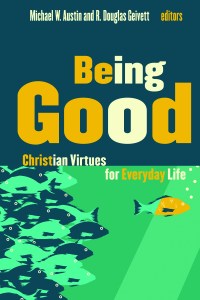
Austin and Geivett.Being Good.Book CoverIn June 2013, our book Being Good: Christian Virtues for Everyday Life (Eerdmans, 2012) received the “Character Essay and Book Prize,” awarded by the Character Project at Wake Forest University. Here’s the Character Project’s description of criteria for awarding prizes:

Several Character Essay and Book Prizes were awarded to essays or books on character which are accessible to non-academic audiences in venues with a wide readership. We received many outstanding entries, and awards were made in three areas: the psychology of character, the philosophy of character, and the theology of character.

We wish to thank Christian Miller, Director of the Character Project, for his generosity and warm hospitality. Rebecca Konyndyk-DeYoung’s chapter on “Courage” received an independent award in the essay category. Congratulations, Rebecca!

Mike Austin and I continue to be grateful to Eerdmans for their enthusiastic support in publishing this book.

Doug’s Publications List Updated


Doug’s Publications list has been updated to reflect more recent publications. Click here.

Doug’s Speaking Calendar Is Public Again


Doug’s Speaking Calendar can once again be viewed from inside his website. Click here for information about scheduling a speaking event with Doug.

One Last Chance to Blame George Bush


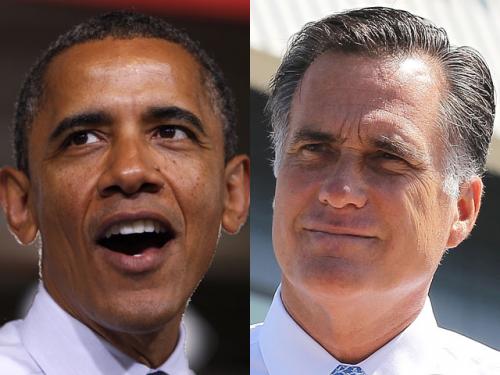
If President Obama loses to Mitt Romney next week, wouldn’t it be ironic if he blamed George Bush?

Bible.Is App for iPhone and iPad


Nothing can replace reading the Bible from the page, and this iPhone and iPad app—called Bible.Is—is no substitute for that. But audio is an excellent supplement to a Bible reading and study program. This app is convenient to use and makes the Bible available in surprisingly many languages.

  • Use it to “read” whole books of the Bible one at a time.
  • Learn unfamiliar dimensions of Scripture truth from the cadences of the spoken Word (e.g., the Book of Leviticus).
  • Learn and improve your knowledge of a foreign language through audio exposure to biblical truth.
  • Memorize extended passages through repetition.
  • Listen with your Bible open and read along with the audio.

I doubt if any app does as well what this app so effectively does what it’s designed to do. It rivals every audio version of the Bible I know of. I would like to see the New American Standard Version (NASV) in its repertoire, since this is my preference for Scripture memory. But publishers of the NASV have enforced strict proprietary controls on the publication of this valuable translation, and so have, regrettably, limited its dissemination—not the fault of this app designer (though they might be able to obtain permission at a price). The English Standard Version (ESV), available on Bible.Is is an excellent alternative to the NASV.

You can also use Bible.Is from any computer with a browser. Just visit their home page here.
By the way, the Bible.Is app can be downloaded to your iOS device for free. And yes, it is available for Android, as well.


Brief Post about “Undecideds”


Here’s my take on the much talked-about “undecideds” in this general election:

Undecideds won’t go for President Obama. This explains why they’re “undecided.” They’ve had plenty of time to decide (four years), so why are they undecided? Either they aren’t really undecided and are planning to vote for Mitt Romney, or they’re undecided about Romney, if not about Obama. In the first instance, Romney wins. In the second, undecideds stay home—unless the undecideds make a last minute decision as undecideds to vote against Obama by voting for Romney. In other words, undecideds represent a referendum on President Obama.

Ditto for independents.

This assumes a rational electorate. And if the electorate can be counted on to be rational, this bodes well for Romney. Of course, the electorate cannot be counted on to be . . . . well, you know.

The President a Lame Duck Incumbent?


It’s a rare phenomenon when an incumbent seeking re-election is faced with the prospect of being a lame duck on the very eve of the election. President Obama is the incumbent in this race. He is a sitting president seeking re-election. As the incumbent, he is eligible to run for a second term and may well win a second term. He is not, in the usual sense, a lame duck president.

A lame duck holds office during the relatively brief interval between an election, when it is determined that someone else will be the next president, and the moment when the new president assumes office at his inauguration. A politician in this position is called a “lame duck” because he or she has comparatively little influence as the clock simply runs out on his or her term.

If a president has completed two terms, then he will not be an incumbent seeking re-election. His party will nominate a different candidate to run in the general election. In this case, the outgoing president will automatically be a lame duck. He will hold office until the new president-elect is sworn in.

If an incumbent president seeking re-election loses the election, then he becomes a lame duck president until the new president-elect is sworn in. He is no longer the incumbent because the election has been decided. He is still president, but his days are numbered.

An incumbent may become a lame duck, but only after the election returns. At least, that is technically the case. But the term “lame duck” is a metaphor for a president whose power is ineffectual because his term is about to run out. But does it stretch the metaphor to say that a president is a lame duck if his power is bound to be ineffectual until his term runs out, even if that won’t happen for another four years? And what if there are strong indicators, prior to a general election, that this will be the case if the incumbent wins the election? He might then that be called a “lame duck incumbent.”

This, I believe, could be President Obama’s situation. He is now the incumbent and may win a second term. If he does, he will not be a lame duck in the usual sense until the next general election four years hence. But there are indicators that Obama’s leadership, should he be allowed a second term, will be threatened by grave difficulties of his own making that could seriously curtail his executive influence, however long his second term lasts. And most recently the most severe challenge has emerged in the form of the massacre that took place at our embassy in Libya in September and the growing impression that the President shirked responsibility, both during the horrific attack and afterward during his effort to manage the flow of information until the election clock runs down.

Here’s the point: if it turns out that a thorough investigation of the facts, called for by the President and the Democrat party, reveals a demoralizing leadership failure and deception by his administration, and this investigation cannot be concluded until a few weeks after the election, and the President wins re-election, then the President will have to face a nation in shock after learning definitively of his dereliction of duty, now compounded by the fact that he was just re-elected and the electorate is stuck with him for four more years. If his popularity has been slipping in the polls during the past few weeks, his approval rating would surely plummet dramatically following the election and detailed knowledge of the events in Libya—if the President has goofed.

This would not be the most auspicious beginning to the President’s second term. And it would not bode well for the future of this country if that should happen.

Still, why think of the President in these final days before the election as a “lame duck incumbent”? That depends on what you make of the evidence against his claim to be oblivious of events occurring at the embassy in Libya when four Americans, including our ambassador, were lost. If you think that he’s disqualified himself already for enjoyment of a second term, then you may think that if he wins he will start his second term in deep trouble that will be a distraction from all else that requires presidential leadership. You may think that, given his incumbency status now, and assuming that he wins re-election, Obama is, even now, a “lame duck incumbent.”

If you think that, you may be right. And if you’re right, then Obama’s in big trouble soon after the election, trouble that will plague his second term as long as it lasts. Not only that, America’s in big trouble. Don’t be surprised if  a predominantly Republican congress calls for impeachment proceedings as soon as the investigation is concluded.

Finding the Missing Pieces That Make Sense of Life: A Book Notice


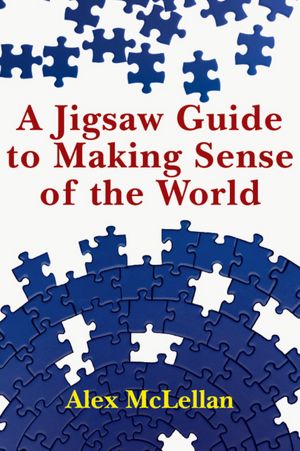
I just read a pre-publication copy of the book A Jigsaw Guide to Making Sense of the World, by Alex McLellan. If you’re looking for a practical but reliable guide to engaging others in the great conversation about truth, I encourage you to pre-order your copy from Amazon here.

Alex draws from his extensive experience making bold forays into the jungles of relativism and the deserts of indifference. Though his aims are broader, I believe this book has especially helpful words for Christian believers dealing with doubt or have deep reservations about talking with others about their faith.

This is not an academic treatise; it is a stimulating guide to building on what you already know so that you might come to know more about the things that matter most—and so that you might act with greater confidence on the basis of what you know.
I know Alex well, and I can recommend him as a speaker for your next event on these topics.

Alex has worked closely with Ravi Zacharias and is now Executive Director of Reason Why International.

Problem Solved: Note-Taking While Surfing Amazon


What do you do when you’re surfing Amazon and you want to keep records of your valuable findings, especially when you follow the serendipitous trail from topic to topic that is so typical of the Amazon “research” experience? You know how it is—you start off in single-minded search of a specific title and before long you’re cavorting through an endless array of tantalizing titles, completely unrelated to your immediate objectives, but somehow pertinent to other interests and projects.

Here’s a simple, low-tech solution that I use:

  1. Orient a few sheets of legal size paper (8 1/2″ x 14″) horizontally and fold them in half from left to right. The resulting dimensions are 5 1/2 inches along the top and bottom edges and 8 1/2 inches along the sides. You now have four “pages” on each sheet to write on. This should be ample space for any single note-taking session.
  2. On one sheet, with the folded edge on the left, write in capital letters a brief title (one to three words) for the first note you’re taking. This label should reflect the kind of note you’re taking, which will depend on the occasion for taking notes. In this example, you’re surfing pages on Amazon for books of interest. You’re guided to some degree by a definite purpose, but you’re also letting yourself trip along new pathways. Your first note, let’s say, is to be a list of titles on a related topic or theme. Or maybe it pertains to a project you have in progress. You write the theme or the name of the project in capital letters at the top and to the left.
  3. Write the date of your note-taking in the top right-hand corner of the sheet. This will be useful for arching and retrieval. [See below.]
  4. Use bullet points for each entry on your notes page. In our example, many of these entries will be titles of books found on Amazon, so you’ll be creating a bulleted list of titles. Suppose you’re looking for sources on SCIENCE AWARENESS. You come across a couple of promising titles. You scroll down to the Amazon section titled “Customers Who Bought This Item Also Bought,” where other titles are listed horizontally across the page, often with a navigation button for scrolling through several “pages” of items in this category. Since you’re looking for titles related to your theme, you work your way across the list and note as a separate bulleted item on your first notes page anything that you may want to pursue later. As you scroll across, however, you encounter an unlikely entry for a book of poems. It looks interesting. What do you do? At this point, create a new notes sheet like the first folded sheet and enter the title POETRY, then create a bulleted entry for the book of poems. At some point, if things go contrary to plan, you’ll click on one of these titles for more information, and you’ll be presented with additional titles that other customers have bought. This can go on endlessly. Your curiosity about the poetry book has take you to its main page, where, for some reason, you see a title about writing memoirs which, for some reason, interests you. Now you create a third notes sheet with an appropriate title, WRITING or WRITING: MEMOIR. (Note the utility of colons to punctuate designations for your notes pages). By a similarly haphazard process, you’re dazzled by yet another title, one about BOOKS & READING. And so it goes.
  5. Meanwhile, you find that you can’t resist peeking “Inside the Book” now and then. This is a great, but potentially hazardous, feature on Amazon. For a title on CARTOGRAPHY, a subject that came up in that serendipitous way so characteristic of Amazon surfing, you dip into the sample pages and start reading. Now your note-taking follows a different trajectory. You begin making a list of QUOTATIONS, each one with its own bullet point and the author’s name, book title, and page number. After the quotation and source information, you add in [brackets] a brief label for the quotation. Or something about the organization of a page is striking to you and you think it might be useful for one of your own writing projects. So you create a new notes sheet (same as before) and give it a label. This label will be the WORKING TITLE of your project. On the first page you draw in outline form a template that resembles the page layout in the book on cartography that you’re examining.
  6. As you collect notes sheets, take care to write the page number on each of the four “pages” of the sheet. Because the sheet is folded and you may collect a dozen or more of these sheets during a single note-taking session, you may have trouble—as you turn the pages—remembering the topic or theme of a particular notes sheet. In that case, write the label for that sheet at the top of each page. Continue making your bulleted list as before.
  7. During almost all of my own note-taking sessions, I end up creating a sheet for QUOTATIONS and one for PHRASES that eventually go into a database I keep for that sort of thing. This is useful in my writing, teaching, and public speaking.
  8. As note sheets accumulate, stack them in alphabetical order according to the labels you’ve given them. As you make entries you’ll be adding notes to one themed sheet at one moment, then another note to another themed sheet, then returning to a previous sheet, hopscotching around as topics intersect. Having your sheets in order will make it easy to find a particular one that is to receive a new entry at a later time in the session.

Some questions answered:

  1. “What counts as a note-taking session?” Because I date my notes, I consider any note-taking I do on a given day to be a single “session.” Sometimes this will be one stint of 90 minutes. Sometimes it will be 30 minutes in the morning, 15 minutes during lunch, another 45 minutes in the late afternoon, and so on. I simply add newly themed sheets and bulleted notes to existing sheets with the same date, picking up the process where I left off earlier in the day.
  2. “What should I do with the notes after each session?” At the end of the day, I have several options for filing my notes. Everything depends on time and timeliness. If one sheet of notes will be useful for a current project (during my next writing session for a book or article, for example), I’ll file that sheet where it will be ready to hand as soon as I’m back to work on that project. If a note sheet relates to a topic I’m researching, I archive that sheet in a folder designated and labeled for that project. For all of my note-taking, I generally think in term of projects and topics, so I have project files and topical files. My project-management protocol includes scanning some hard copy notes into files on my computer or directly into project management databases I use (for example, in Scrivener and in OmniOutliner Pro). So some notes will be archived in long-term files and others for near-term use, either as hard copies or in electronic format.
  3. “What’s so special about legal size paper?” This is a matter of preference. Feel free to use standard 8 1/2″ x 11″ paper if you prefer. I find the legal size, folded the way I do, provides ideal dimensions and page proportions for my handwriting and aesthetic sensibilities. I keep a sheaf of un-ruled, white, legal-size paper close by my desk just for this purpose. I can stash a few folded sheets in a large envelop if I’m traveling and plan to work. [Note: If you’re traveling and running low on paper, just tear the sheets in half along the folded line and label them individually by theme or project. This still leaves you with two sides to write on, which may be sufficient in a pinch when your sessions are short anyway.]
  4. “What are some alternatives (besides software) to using the folded legal-size sheets?” You can use smaller (or larger) sheets of paper. You can go as small as you like. But you need room for writing and for taking sufficient notes without thickening the stack of pages too greatly. Index cards provide another option. But 3″ x 5″ cards are too small, in my judgment. The 5″ x 8″ cards accommodate more note-taking, but in their typical orientation (long edges at the top and bottom, short edges on the sides) they just aren’t proportioned to my liking. One solution would be to write notes in two columns; another would be to turn the card into vertical (or “portrait”) position and take notes down the length, instead of across the width, of the card. The proportions of the writing space are key. I don’t care for anything too wide since it often results in wasted space on the right-hand side. Another option is some kind of notebook. See next point.
  5. “Why not use a Moleskine?” For paper notebook purposes, my favorite is the Moleskine. I use Moleskines for all sorts of note-taking. They are especially useful for writing lengthy notes on a single topic, first drafts of portions of essays, note-taking during a lecture, or outlining for a writing or speaking topic. I’ve written other posts about the uses of Moleskines. The size I use measures approximately 7 1/2″ x 10″. This is only a little larger than a folded sheet of legal size paper. So I can insert my legal paper note sheets into my Moleskines as need. The Moleskines have just the right amount of paper firmly stitched together between stiff covers to last during most of my travels. And all the pages are kept together. They have one drawback: because the pages are bound together, a miscellany of writings (characteristic of a chapbook) must be indexed for each Moleskine if entries are to be found when they’re most useful at a later time. Loose pages, like the ones described in this post, can be filed immediately into labeled folders. [Note: You could follow the same procedure with pages in a Moleskine, reserving each sheet (on both sides) for a single theme, topic, or project, then tear the sheets out for archiving according to their respective purposes. But this sort of defeats the purpose of having an attractive—and comparatively costly—bound notebook like a Moleskine. Nevertheless, to each his own!]
  6. “Why not just enter your notes electronically in the first place?” This is fine when it’s convenient. But it’s not always convenient. If you depend exclusively on your computer or iPad for note-taking, a great deal of valuable material will slip through your hands, never to be retrieved again. Also, it’s easier to move quickly from note sheet to note sheet on different topics for different projects if you have them in alphabetical order in a stack as you make entries back and forth.
  7. “Are there good software options that can be adapted to this same method?” Yes. For example, I use Scrivener to manage writing projects. Each Scrivener file is dedicated to a unique project. In a single file I can manage “folders” and “documents” (more or less the way playlists are organized in iTunes). So I can create a folder for “Dated Notes” and then add to that folder individual documents labeled with the date for notes taken on that date. So, following the scheme I’ve described in this post, I would open the “Dated Notes” folder in my Scrivener file for a specific project and create a document within that folder that is labeled with the current date. I would then enter my bulleted notes in that document. There are all sorts of advantages to using Scrivener for this sort of thing. But the same thing could be done with OmniOutliner Pro or some other similar software package. (I stay away from standard word processors, like MS Word and Pages, for this sort of thing. They aren’t effective project management tools, and word processing is handled very neatly in Scrivener.) I could write a separate post about how to use Scrivener for note-taking across projects during a single session of writing or note-taking. But the basic idea is simple: just keep each relevant Scrivener project open while doing your work, each with its own dated note-taking document open, and switch between files with simple keyboard strokes as you make entries. You replicate nearly exactly the process described in this post, but in electronic files instead of on paper.
  8. “What are the special virtues of using paper?” The chief virtue with real paper is that you can usually get your hands on some no matter where you happen to be. I like the physical process of writing by hand. I remember things better because they have a physical location that I associate with the notes I take (like being able to recall where a line of text appeared in a book I’ve read). And for some of us, “out of sight is out of mind,” and researchers can’t afford to be out of their minds!
  9. “What if I need more sheets for the same topic?” This seldom happens in my experience, but the solution is simple: add a sheet with the same designation and place it inside the first notes sheet on that topic.
  10. “Does this hack for note-taking while on Amazon have other applications?” Yes! The simple method I’ve described can be adapted for use anytime you find yourself pin-balling off of different topics. You may brainstorming, watching TV, or “listening” to your spouse recount the day’s events. Ideas for sundry projects are flooding your mind. This might be your solution. You get an idea for one project, then something else on another. Just note them down on separate sheets, properly labeled and titled. You’re watching your favorite sitcom and a character finally says something that is actually funny, useful, and memorable. Except that you probably won’t remember it, so it probably won’t be useful. Give it a label and write it down on one of those folded sheets of paper that you always have handy. Your spouse is re-gailing you with the woes of the day, or ticking off a long list of things to keep your weekend busy. As you think about more important things and write them down, the usual glazed look will be gone and you’ll appear to be taking her so seriously that you’re actually taking notes! Yes, the possibilities (and concomitant advantages) are endless. I use the technique to manage my daily and weekly To Do lists. It isn’t the only tool I use, but for especially complex stretches of time, I take a single folded sheet and put activity labels (“Errands,” “Calls,” “Home Projects,” “Computer Tasks,” “Email,” “Writing,” “Motorcycle Trip”) on each page, then note individual things that need doing. Because the categories are unrelated, I have one per page; that way I can have as many folded sheets as necessary and simply insert sheets between the pages of other sheets in random order. I tick items off for each category as they’re completed. I often plan my week that way.
  11. “Why do you write about these things?” I write about them because I’m interested in solving problems with organization and getting things done. I write about them because I then have a record of methods I’ve found useful and I can return to this record to fine-tune the technique and remind myself how it works (yes, I’m that old). I write about them to be of help to other anal-retentive researchers. And I write about them hoping that if you have something to contribute on the topic you’ll leave a comment that will be helpful to me and other readers!

Additional Resources:

Doug’s Related Posts:

“What Books Are a Good Investment for Scholars?”


A former student of mine, now a colleague in the field of philosophy, has asked the following question:

I have some (limited) funds available for buying academic books. This is a new experience for me; I have relied on the library for almost all my books so far in my academic career. But since the funds are limited, I need to carefully prioritize how I use them, and I don’t want to buy books I’ll look at once and never again. Since my dissertation is in epistemology . . . I want to prioritize epistemology texts. So here’s the question: given the above about my priorities, what philosophy texts, especially epistemology texts, do you recommend? (I will probably be able to buy no more than 10 books.)

This is an excellent question. Over the past thirty years, I’ve built a library of nearly 8,000 books. You might think this disqualifies me from commenting on proper stewardship of assets and shelf space. But I have learned a few things along the way. Here’s my response to this specific question:

Given your practice of using the library so effectively, I’m not sure I’d recommend that you buy books on your dissertation topic. I’ll come back to that in a moment. But I would consider the following general guidelines:

  1. ‎Invest in the best reference works, whether in epistemology or more generally.
  2. Consider those anthologies that contain classic works and seminal essays on new developments, perhaps in epistemology. There are some excellent anthologies today that focus exclusively on epistemology.
  3. For monographs and other works on your dissertation topic, stick with those that you’re likely to mark up the most during your research and writing, by authors who have the most to contribute (whether or not you agree with them).
  4. Don’t forget to consider the quality of the writing itself when selecting books for permanent residence in your library. The company you keep will rub off on you (see Psalm 1). Search out the authors who are also good stylists from whom you can learn as you improve your own writing craft. In other words, read as a writer!

On some of the topics I’ve written about, some few have been addressed in a uniquely influential way by a particular thinker. For example, I first began writing serious philosophy for publication on the problem of evil and selected John Hick’s work as a foil for what I had to say at the time. His book Evil and the God of Love was already being excerpted in anthologies and has proven to be a classic. This is, among other reasons, because John was such a clear writer, he surveyed the whole history of Christian treatments of the problem, and he contributed significantly to updating and developing the minority position (which he called the “Soul-Making” or “Irenaean” tradition).

Also, you may find that your current research links up with older works that are more difficult to come by now. These might be worth owning. Much depends on how much you expect to remain focused on your topic for the next decade or two. Since you’re pursuing an academic career, you will probably have an extensive university library at your disposal pretty much at all times. And you may have a research assistant some of that time, in which case you can send out to collect things for you!

ABC Interview with Geivett and Craig in Tulsa, Oklahoma


This morning, the ABC affiliate in Tulsa, OK interviewed Doug Geivett and William Lane Craig to talk about the On Guard Conference where they’ll be speaking tonight and all day tomorrow. To see the interview, click here.
If you happen to be in the Tulsa area, try to make it to this conference. Six scholars have come together to offer practical and informative sessions on the evidence for Christian belief:

  • Paul Copan
  • William Lane Craig
  • R. Douglas Geivett
  • Guillermo Gonzalez
  • Gary R. Habermas
  • Mike Licona

Details about time, place, and cost are provided in this brief interview. More information is available at the conference website here.

Doug to Debate Louise M. Antony, “Does God Exist?”


Doug will soon debate atheist philosopher Louise M. Antony at the Barnsdall Gallery Theatre in Los Angeles.

Barnsdall Gallery Theatre

Topic: “Does God Exist?”

Date: Friday, February 17, 2012

Time: 8:00-10:00 p.m.

Location: Barnsdall Gallery Theatre, 4800 Hollywood Blvd., Los Angeles, CA 90027

Cost: $5.00 for students with student I.D.; $20.00 for the general public

Tickets can be purchased from the Center for Inquiry here.

Louise M. Antony is Professor of Philosophy, University of Massachusetts, Amherst

Program Note: Prior to the debate, at 7:00 p.m., Eddie Tabash (Los Angeles Attorney and Atheist Spokesman), will lecture on the topic “Debating Religion in Public.” Cost of admission to this event is included in the cost for the debate.

Doug Tweeting the Republican Debate Tonight


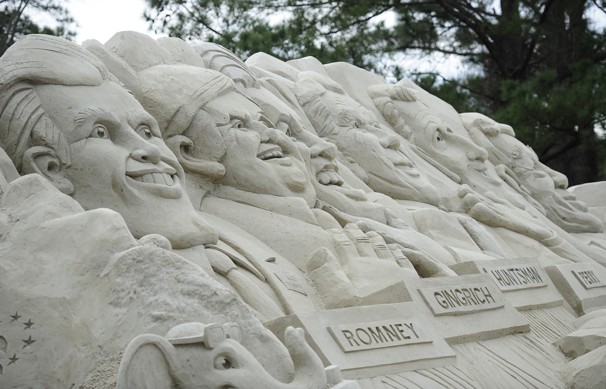
Sand Sculpture in Myrtle Beach, Site of Tonight's Debate

The next Republican presidential debate is hosted by Fox News tonight in South Carolina (9:00 p.m. eastern time). Doug will be posting his comments on Twitter as the debate unfolds, and sometimes responding to others “tweeting” the debate (e.g., Dick Morris).

This debate will feature “only” five candidates, now that Jon Huntsman has withdrawn.

Follow along here.

Poll: Is a Mitt Romney Nomination Inevitable?


Some believe that Mitt Romney’s nomination by the Republican party is inevitable, or, for those who hedge their bets ever so slightly, “all but inevitable.” Romney, who knows better than to believe it, hopes they’re right.

“Inevitability” is a state of mind. Getting people to think a Romney nomination is inevitable is a way to ensure that Romney is nominated. That’s the power of perception.

What do you think today, with another debate to happen in less than three hours and the South Carolina primary five days from now? Take this simple poll, and feel free to leave a comment!

Poll: Which Movie Now Showing Most Interests You?