Fellow at the Biola Center for Christian Thought


I’ve recently returned from Saint Louis University where I was Visiting Faculty of Philosophy for the fall 2014 semester. I was there on a generous grant from the Templeton Foundation doing research on The Philosophy and Theology of Intellectual Humility. I’ve received an additional grant for the current spring 2015 semester as Research Fellow in the Center for Christian Thought at Biola University. The theme is Intellectual Virtue and Civil Discourse. With this grant I’m able to continue my research on the general topic of intellectual humility. There are many good online materials and in-residence opportunities at CCT. Click here for details.

Screen Shot 2015-02-16 at 7.36.11 PM


Two Interviews with the Pilgrim Radio Network


Those following the New Apostolic Reformation may want to tune into my interview with the Pilgrim Radio Network (pilgrimradio.com) in a two-part discussion of the subject of the New Apostolic Reformation. Part 1 airs Monday, February 1 at 2:30 am, 12:30 pm, and 9:30 pm. The second portion airs Tuesday, February 2, on the same schedule.

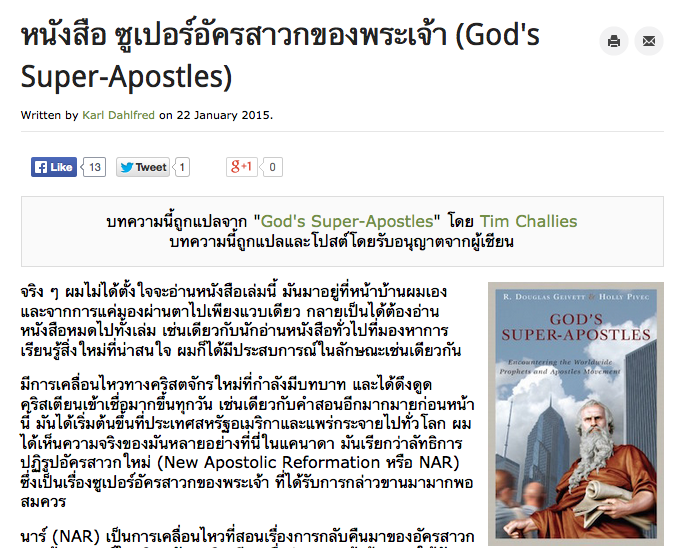
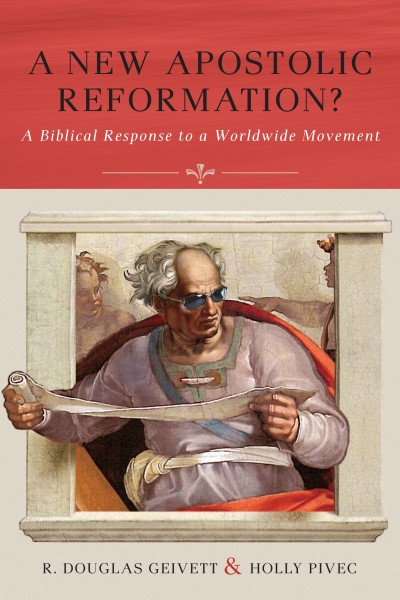
We’ll be talking about two books I’ve co-authored with Holly Pivec: A New Apostolic Reformation? and God’s Super-Apostles.

NAR Book Cover-Final-201 Both books are available

• in paperback

• on KindleNAR Book Cover-101 final (6-6-14)

If you wish to schedule an interview with one of us about the New Apostolic Reformation, or review a copy of one of our books, please contact our agent Emily Varner at AcademicPS.

Chinese Version of Four Views Book


Imagine my surprise when I received in the mail yesterday a book published in Chinese. Often I do get complementary copies of new books. But in Chinese? This does not happen every day. On close inspection it turned out to be a Chinese translation of the book Four Views on Salvation in a Pluralistic World, a Zondervan publication. Years ago I co-authored one of the four views for the original English edition of this book, never expecting that it would one day reach a nation with over 1 billion people! How strange to see my name written in Chinese characters. I didn’t know that was possible.


IMG_0863

Chinese Edition of Four Views on Salvation in a Pluralistic World—Published by CCLM

If you’re more proficient in Chinese than in English, I commend this edition book to you!


Book Cover-Four Views on Salvation


A useful summary and review of the book by Michael J. Vlach can be found here.


Reviews of “God’s Super-Apostles” and “A New Apostolic Reformation?”


For more information about our books on the New Apostolic Reformation, you may want to read these reviews:

Tim Challies

Brian T. Dempsey

George Paul WoodNAR Book Cover-Final-201 NAR Book Cover-101 final (6-6-14)

• “Young, Restless, and Reformed, here and here

• Amazon, here and here.

If you learn of reviews that should be included in this list, please say so in the comments box below.

—————

Both books, God’s Super-Apostles and A New Apostolic Reformation? can be ordered at Amazon here and here, or direct from the publisher here.

Does Islam Have a Monopoly on Violent Religous Intolerance?


The western world is still trying to make sense of the Charlie Hebdo murders in Paris on January 7, 2015. Four days later, in his Forbes column, Doug Bandow offered a unique analysis. He makes an interesting and persuasive argument that there is much more at stake than free speech. What lies at the root of this incident, reflected time and again in one atrocity after another, is religious persecution meted out against dissenters.

Here is one especially thought-worthy paragraph:

The thugs who cut down a dozen [people at] Charlie Hebdo are the international cousins of those who murder alleged blasphemers and apostates in Muslim nations. Laws against blasphemy once were common in the West, and persist in a few nations—some, ironically, represented by government leaders who marched in Paris—and even a couple of American states, but are rarely used. However, blasphemy laws are actively enforced throughout the Muslim world. The irony is that where Islam is strongest, with belief by overwhelming popular majorities and support from authoritarian state authorities, the slightest perceived criticism of the dominant faith can result in prison or death. That suggests lack of confidence in the truth of Islam and fear of free inquiry by free minds.

The last two sentences draw attention to a neglected point. Would a religious group that is secure in its beliefs be as hypersensitive as those who murder alleged blasphemers?

I would add that such horrific actions—which are a daily occurrence somewhere in the world—are rooted in a worldview, a set of controlling beliefs that are either true or false. Our public discussion needs to acknowledge this point. There has been plenty of talk about whether Islam is a “peaceful religion” that has been hijacked by militant apostates (notice, they aren’t generally called “apostates” even by moderate Muslim leaders). But this distracts from three more fundamental questions:

  1. Peaceful or not, is Islam true?
  2. Are there are good reasons to believe that Islam is true?
  3. What are the best reasons to believe that Islam offers the most plausible worldview?

The atrocities we’re witnessing should prompt us to give more attention to this question.

Assemblies of God Ministers Newsletter Reviews God’s Super-Apostles


In the January 2015 issue of the Assemblies of God Ministers Newsletter, George Paul Wood urges his Pentecostal friends and co-workers to read our books God’s Super-ApostlesNAR Book Cover-101 final (6-6-14)  and A New Apostolic Reformation? A Biblical Response to a Worldwide Movement. HisNAR Book Cover-Final-201 review begins on page 6. In addition to summarizing the message of the books and explaining his view of their importance for Pentecostalism worldwide, Wood presents his own summary of the central tenets of the New Apostolic Reformation.

What, then, is the New Apostolic Reformation? Its most distinctive teaching is that the end-times church must be led by apostles and prophets. In addition . . ., NAR promotes strategic-level spiritual warfare, apostolic unity, and the ability of all Christians to work miracles.

Wood notes that the Assemblies of God position paper “Apostles and Prophets” expresses concern about NAR emphases. To be sure, leaders of the New Apostolic Reformation very clearly have moved beyond classic Pentecostalism. Wood aptly refers to NAR leaders as “hypercharismatics.” As a Pentecostal leader himself, he implores fellow Pentecostals to resist  the excesses of the NAR movement, and to recognize how distant this movement is from the core commitments of classic Pentecostalism.

————

*The Assemblies of God Ministers Newsletter is circulated to some 36,000 credentialed ministers of the AG church.

Tim Challies Reviews “God’s Super-Apostles”


Tim Challies, pastor of Grace Fellowship Church in Toronto, Ontario, reviews God’s Super-Apostles, our recent book assessing the New Apostolic Reformation.

His review article begins . . .NAR Book Cover-101 final (6-6-14)

I didn’t actually intend to review this book. It showed up at my door and a brief glance turned into a quick skim turned into a full read turned into a review. As a committed reader always looking for something new and interesting, I just love it when that happens.

Tim, we just love when that happens!

Thank you for helping to expose the excesses of the New Apostolic Reformation. It’s clear from the comments your review has already gleaned that many of your readers have encountered the NAR movement and its extraordinary claims.

Update:

The Tim Challies review has been translated into Thai. Read here.

—————

Both books, God’s Super-Apostles and A New Apostolic Reformation? can be ordered at Amazon here and here, or direct from the publisher here.

HAPPY NEW YEAR EVERYONE!


Geivett Post-Christmas Tree-Jan. 2015

Geivett Post-Christmas Tree


My Interview with Janet Mefferd about the New Apostolic Reformation


Today I’ll be on the Janet Mefferd Show to be interviewed about my new book, co-authored with Holly Pivec, A New Apostolic Reformation? A Biblical Response to a Worldwide Movement. The Show airs live at 3 pm Central. Go to janetmefferd.com for the live broadcast, or listen to the interview at your leisure in the audio archives.

Fx’s “The Bridge,” Bill O’Reilly, and Me—Another Odd Coincidence


This afternoon I heard a radio announcement that the season premiere of Fx’s “The Bridge” airs tonight. I thought I might tune in. So I settled into my easy chair and flipped on the TV. Bill O’Reilly was waxing eloquent and I was reaching for my TimeWarner Cable guide to find the Fx channel. I paused, however, to listen to O-Reilly’s customary interview with Dennis Miller, often the only worthwhile segment on “The Factor.”

Dennis signed off and I recalled my task—to find where I can get Fx on my TV. I scanned the column of station numbers. And just as my eye landed on “Fx,” I heard Bill O’Reilly actually say “Fx.” I’m not making this up. O’Reilly then went on to remind his audience—that would be me (in a manner of speaking)—that “The Bridge” airs tonight.

Bill O’Reilly is a talented man. But his ability to read my mind, and his inclination to say something about it on national TV, is uncanny.

***

Footnote: Speaking of coincidences, the timing of tonight’s premiere of “The Bridge” could not be better. This is a series about border crossings between Mexico and the U.S. Today there’s as much coverage of our urgent border dilemma as there is of the imminent threat of an Israeli ground invasion into Gaza. Border crossings are making news in more ways than one. And that’s a memo.

Secularist Faith and College Football


There’s an interesting story in the Chronicle of Higher Education this week. It reports on the football program at Clemson University, where the coaching staff is openly Christian. They have prayer meetings for students and baptize those who come to faith.

Apparently, this is controversial.

Anne Laurie Gaylor is co-president of the Freedom from Religion Foundation. She asserts that “a culture of evangelizing on a football team has got to stop.” She adds that a state-funded institution is an inappropriate place for repeated religious messages.

This is ironic and hypocritical. It is ironic because the university exists for the purpose of influencing impressionable young men and women. Ms. Gaylor knows this. It’s what she does when she advocates for “freedom from religion,” and trains her powers of influence on young adults to persuade them to adopt a liberal, religiously pluralistic, and secular, perhaps even atheist, perspective. Her agenda is threatened by the presence of equally vocal religious believers on turf where she and other secularists have staked a claim and are used to getting their way.

Advocacy of a religious point of view or another is not equivalent to “pushing religion” on others, any more than Ms. Gaylor’s secularist advocacy amounts, in principle, to pushing her religion on others. I say “in principle” because her tactics are exclusivist. She has no tolerance for ideological competition. Her basic outlook on life is her own take on religious questions. It defines her religion. And her religious outlook is reflected in her advocacy. Her organization exists principally for advocacy for this religion.

A football program differs from a religious advocacy group like the Freedom from Religion Foundation. A football program prepares young men for leadership through discipline and sport. At Clemson, the leaders of this program happen to be Christians who, exercising their own freedom of conscience, are openly Christian and interested in the souls of their players. The Freedom from Religion Foundation is all about pushing a set of ideas on impressionable students. Their ideas are overtly secularist and anti-Christian. Apart from that, they have nothing to contribute. They do not even advocate for vigorous public discussion and comparison of Christian and non-Christian perspectives, including their own. They do not invite scrutiny of their agenda, nor do they submit their own worldview commitments to examination suited to university life. They are preachers and missionaries. They expect to exercise the freedom that they insist should not be allowed to others in the university world.

Ms. Gaylor herself probably was an impressionable young student at one time; she, too, probably was influenced by people she wished to please. It is likely that she fell under the spell of an ideology that she now seeks to promote, because she thinks that what she believes is true and that others should believe as she does. She has beliefs about what counts as religion, what it means to be free from religion, what it takes to be free from religion, and how freedom from religion can be fostered through her organization. And she expects others to believe this, too. It is peculiar that she expects religious believers like those on the coaching staff at Clemson to agree with her. She claims that what they believe is their own business. But they should not “evangelize.” They should, in other words, keep their faith to themselves, while she and her kin promote a secular agenda in the resulting vacuum. How convenient for her.

Secularists seek enforcement of the privatization of Christian belief. They do this publicly and generally without censure. But Christian belief is compromised when it is privatized. So the effect of Ms. Gaylor’s missionary enterprise would be the privatization of a faith that is essentially interpersonal and the social advancement of a cult of irreligion that she would not keep to herself.

For the article in the Chronicle of Higher Education, click http://chronicle.com/article/With-God-on-Our-Side/143231/?cid=wb&utm_source=wb&utm_medium=en.
 

Missing Pages of the Bible


So today I was reading on the subject of Christianity’s Hebrew heritage and I wanted to consult a Scripture reference made in the book. I grabbed the most convenient copy of the Bible where I was in my office, the New Living Translation. I don’t remember the circumstances, but I obtained this Bible in May of 1997. In all the intervening years, I never opened this book. I literally had to blow the dust off it! So I turned to Luke 1:73.

It wasn’t there. Neither were any of the other verses between Mark 7:31 and Luke 9:7. Thirty-three pages are missing. The missing pages recount the most compressed version of the Passion of Jesus and the most extensive account of the birth of Jesus. These things matter.

I’m not worried about the orthodoxy of Tyndale House Publishers, who inscribed the front cover of this edition with the words “Easy to Understand, Relevant for Today.”

It made me mindful of the contemporary relevance of ALL of Scripture. And of the compelling evidence we have that extant manuscripts of the Old and New Testaments are reliable copies of the original autographs.

But it struck me as odd, as such things always do, that on the one occasion when I turn to this edition of the Bible, the passage I seek simply cannot be found. Time, now, to look up Matthew 7:7.

Happy 11.12.13


Today is: 11-12-13. Savor it. It won’t last long. And it won’t happen again!

A Thing of Beauty—for You, Me, and Roger Shattuck


In a book called Candor and Perversion, Roger Shattuck writes, “Forty years ago in a Paris bookstore near the Odéon, I happened upon a large, slim volume of intermingled writing and drawing. That book was the first object I acquired for purely aesthetic reasons.”

Shattuck goes on to lament the altogether passive response others had when, in his enthusiasm, he showed them his prized possession.

Often we find the beautiful in places where others see only a peculiar drabness. If they see anything at all. (Appreciation of the beautiful depends on close observation, an intentional noticing.) So it’s no surprise that Shattuck’s aesthetic tastes were not especially contagious.

When I came across this passage about ten years ago, and then again today in the commonplace surroundings of my living room, what struck me was Shattuck’s ability to recall “the first object [he] acquired for purely aesthetic reasons.” I thought to myself: What was the first object I acquired for purely aesthetic reasons? Is there a “first object”? That is, have I ever acquired anything for purely aesthetic reasons?

And then I wondered: Is it possible to appreciate something for purely aesthetic reasons, untainted by other reasons I might have? It must be, if Shattuck acquired just such a thing. So, If it is possible, how is it possible? And, Is it possible to appreciate an object for aesthetic reasons if it is also appreciated for other reasons?

It’s so easy to ask questions that are not so easy to answer. No wonder we ask but do not stick around for the answer. (Perhaps we inoculate ourselves against guilt about this with the relativist bromide that “there is no answer.” How can one be so confident of this if one hasn’t looked for an answer? Skepticism is such a convenient disguise for intellectual laziness and indifference.)

But I digress.

What I’d like to know is whether you can recall what object you first acquired for purely aesthetic reasons. If so, what was that object?

Silence Your Cell Phones—World War Z Is about to Begin


Cover of "World War Z: An Oral History of...

Cover via Amazon

What is it about zombies that makes them so worth watching? I can’t prove this, but I have a hunch . . . nothing does.

With nothing to do but watch the world come to an end, and no one to do it with, I went to see World War Z. How could I have forgotten what the ‘Z’ stands for? I had just come from a hamburger and an excess of fries at the local 5 Guys when I got to the theater. It looked like I was at least ten minutes late. I told the ticket agent (isn’t that a fancy title?) that I was there to see World War Z, if, but only if, it hadn’t started yet. I wasn’t sure he could sort out the bi-conditional “if and only if,” but this kid must have a keen mind for logic. He told me I had nine minutes; they were still showing previews. I asked if the theater was full. “There are eleven people,” he said. I wondered, Is that good or bad? I guess for a Tuesday night, that’s pretty good.

I paid for my ticket and met my old friend Ken, the guy who takes my ticket when I walk in. I always ask Ken what he thinks of the movie I’m about to see. I’ve learned to trust Ken’s judgment. This time Ken said, “I’m not much into zombie movies, but in this one they look pretty good.” That’s when I realized what I had gotten myself into. That’s when it hit me that World War Z is about zombies . . . and the world, of course. I felt stupid. What else could the ‘Z’ stand for? But I might be forgiven. Check out the movie poster. Doesn’t it bring to mind the Zorro series, this time with a faint hint of apocalyptic doom?

Usually, I don’t wait in line to see a zombie movie. In fact, if you’ll pardon the allusion, I generally avoid them like the plague. But I had paid for a ticket. And Ken had said about this movie that the zombies “look pretty good.” I had to satisfy my curiosity. What do good-looking zombies look like? Is this a movie my wife would approve of?

For those who haven’t seen the movie, here’s a spoiler alert: Ken must have meant something else by zombies that “look pretty good.”

For the record, the zombies I know (remember, I’m a university professor) don’t look or act anything like the ones in this movie. My zombies are rather subdued, almost motionless. If you tripped over them in a dark alley, you still might not know they were there. By comparison, I must say, the zombies in this movie are pretty amped up. And you certainly would never want to meet them in a dark alley. (I wonder what it would be like if these zombies and my zombies were to meet?)

I did learn something from this movie, apart from the intended message narrated at the end. If an encounter with a zombie doesn’t make your teeth chatter, hearing his teeth chatter will make you laugh. That’s how it affected 9 out of 11 people in the theater. (Silly me, there were other times when I could not restrain a mild chuckle, even when no one else appeared to be in such good humor.)

I have an obligation to tell you there are things about this movie that simply aren’t believable.

  • Israel’s Mossad figures out before anyone else in the world how to protect themselves from zombies, but they don’t know the effect that loud, screechy microphones would have on them? Come on, people! The Mossad are better than that.
  • Can you really hear the teeth of a zombie chatter through plexiglass that is so substantial that even the zombie can’t break through it? Give me a break!
  • Are we supposed to believe that an envoy from the United Nations is the best candidate for staving off the complete annihilation of humanity? I’d trust any neighbor in my cup-de-sac over the U.N. boys and girls. (Remember Benghazi and Susan Rice?)

These things just don’t add up. Fortunately, the movie’s realism is salvaged by the general plot: Savage zombies ravage the world, quickly turning the un-undead into the undead, and there’s a bona fide solution to the problem that is discovered by Brad Pitt—and just in time.

That’s the reassuring message of the film.

Or not.

But I can’t spoil the movie for you by revealing what the narrator says at the end.

If that doesn’t get you to go see this movie, then I guess nothing will.