When Vanessa Johnson served as a Wayne County Michigan prosecutor, her work included cases involving sexual assault and crimes against vulnerable victims. Following her prosecutorial career, Ms. Johnson has devoted her energies to advocating for victims of sexual abuse and trauma. Today she released a video in which she evaluates the legal implications of comments issued by leaders at Bethel Church (Redding, California) in response to very public allegations brought by Mike Winger.
Ms. Johnson’s analysis offers an important and unique lens for evaluating the dilemma now confronting Bethel Church as an institution, and the leaders, Bill Johnson, Kris Vallotton, and Dan Farrelly. She argues that, in addition to the risks exposed by the Mike Winger video, there are new risks of legal liability caused by public statements made by these leaders in response to Mike Winger. She says she would not be surprised to learn that victims are lawyering up.
I encourage you to see how she reasons from the evidence contained in these statements. She brings prosecutorial expertise to bear on the situation Bethel leaders have created for themselves. When she expresses an opinion that stands apart from the law and the legal vulnerabilities facing Bethel, she is clear that she is offering an opinion. But here, as well, she makes compelling arguments. She concludes that spiritual failure on the scale exhibited by these men disqualifies them from continuing in leadership. And she advises people within the Bethel orbit who are not implicated in the actions of their leaders to leave for their own spiritual protection.
A major lesson of Vanessa Johnson’s careful analysis is that recent public statements may later become evidence that places the parties in question in a legal bind. These parties have confessed to having relevant knowledge of the facts, and this prior knowledge makes them responsible. The law does not recognize “pastoral care” and “church discipline” as sufficient remedies in situations of sexual abuse. Institutional responsibility is not cancelled by pleas of ignorance of the law or ambiguity of the circumstances. “Seeking discernment,” and other devices of pastoral framing can be interpreted as delay. That is not a good thing.
There are two things about this that I need to emphasize. First, whether Bethel Church is faced with a legal emergency will depend on whether victims become plaintiffs. Second, what transpires in that event will not be influenced by anger expressed in social media by Bethel Church defenders who believe their leaders are innocent of wrongdoing. Calling critics of Bethel culture liars will have no effect on legal proceedings that might emerge.
In addition, if I’m not mistaken, if an institution like a church responds to sexual abuse allegations primarily as either a reputational problem or a pastoral problem, that institution may be risking civil liability. It doesn’t matter whether the leadership thinks its response is compassionate. And, all cheering aside, if a congregation believes the narrative that compassion prevailed in the church’s handling of a matter, civil liability is not mitigated.
Some may suspect that Vanessa Johnson is simply an activist lawyer with an axe to grind or that she has an inordinate sympathy for victims. But that is not the case here. She is thoroughly familiar with prosecutorial practice and her statements about the legal risks seem to comport with California statutes. And it should be noticed that Ms. Johnson speaks with Christian concern that is quite conspicuous in her remarks.
My initial dip into California case law reflects much of what she is saying in her analysis. As I understand it, California courts deem the specific organizational or governmental structure of a particular church as irrelevant to duty of care. So as far as California case law is concerned, it makes no difference that a church is governed by an apostle and a prophet. The presumed authority of an apostle or a prophet would not absolve the institution of legal liability. This is not due to religious prejudice. The theology of the institution is not under attack. It is simply a question of whether leaders had relevant knowledge and whether they acted responsibly on the knowledge that they had.
*
Of course, a legitimate apostle and a legitimate prophet could be expected to have knowledge that issues in responsible action. For the likes of Bill Johnson and Kris Vallotton (the presumed apostle and prophet, respectively, at Bethel Church), discernment is not generally a lengthy process. Rather, it is a spontaneous awakening brought about by encounter with the Spirit. Even Kris Vallotton, in his volte face on Monday, January 19, 2026, spoke of an encounter with the Spirit that caused a reversal in the judgment he had expressed in a Bethel Church service only the day before (a fact he apparently did not share with the congregation until the next Sunday).
So their own conception of the mechanism of revelation needed for a ministry of protective covering for their congregation incriminates them. Quite apart from what case law might imply, these men teach a theology that entails that, in their role as apostle and prophet, and their attendant responsibility to provide a spiritual covering for the church, they would have had the requisite knowledge of the facts and they would have known what action would be most responsible. Their theology condemns them. This point has no legal significance, but it does mean, as we’ve argued repeatedly in various ways over the years, that they are not what they pretend to be. Bill Johnson is not an apostle. Kris Vallotton is not a prophet. Since the entire culture they have created at Bethel Church Redding depends on that illusion, the culture is a shambles.
It is central to the culture of Bethel Church—what Kris Vallotton has been calling “our movement” in his latest speeches to the congregation—to revel in what they call “reckless Christianity.” We have documented the dangerous effects of this folly in our book Reckless Christianity: The Destructive New Teachings and Practices of Bill Johnson, Bethel Church, and the Global Movement of Apostles and Prophets. Many have testified to this and escaped the delusory chains of a false prophetic narrative. Finally, because of sexual scandal linked to prophetic malfeasance, many more are today discovering that Bethel has sewn the wind and is now reaping the whirlwind.
In their official response to recent allegations by Mike Winger, Bethel Church leaders have admitted to being too “merciful” toward Shawn Bolz. But they deny that they were ever involved in a deliberate coverup. So, is Mike Winger on the wrong track? Or does cover-up culture go even deeper than Mike alleges? Holly Pivec and I, authors of Counterfeit Kingdom and Reckless Christianity, address these questions about the Bethel Church movement in a new podcast that dropped today.
For Mike Winger’s 6-hour expose that launched a major controversy and elicited a response from Bill Johnson and Kris Vallotton, click here.
Here are two other important discussions of the Bethel Church response to Mike Winger’s compelling podcast:
• Alisa Childers, “Repentance or Damage Control: Testing Bethel Against the Scripture” (click here)
• John Cooper, “Bethel Controversy Erupts” (click here)
Perhaps you’ve heard of the New Apostolic Reformation. This movement promotes the view that certain divinely anointed individuals exercise significant authority for the church in their capacity as apostles and prophets for today. Shawn Bolz is a NAR prophet with close ties to Bethel Church (Redding, California), including the apostle Bill Johnson and the prophet Kris Vallotton.
For quite some time now, Shawn Bolz has been accused of data mining when prophesying about individuals in attendance at his various public events. In 2017, Stewart James Felker explained in detail how he came to this conclusion about Bolz. Felker gave a step-by-step analysis of a single incident during one of Bolz’s prophecy rallies. In our book Counterfeit Kingdom, Holly Pivec and I discuss a different case in Bolz’s prophetic career dating back to 2019. Thoughtful observers have been aware of this data mining dependency for several years.
Recently, further information has come forward that makes it even more difficult to deny that this is Bolz’s modus operandi as a prophet for this generation. And rumor has it that Bethel Church leaders have cut ties with Bolz now that more details have come to light. Bethel’s reaction is indeed further evidence that the allegations are true. Not because NAR prophets at Bethel are keen to expose error in order to protect the flock, but because of blowback against Bethel’s own prophetic pretenses, blowback that must be managed with aggressive action. Wolves in sheep’s clothing are sometimes sacrificed by fellow wolves when their own neck is on the line.
Data mining involves the extraction of useful information from large sets of data, often using internet technology. By leveraging this technology, Shawn Bolz can access a wealth of information about individuals that provides context and validation for his prophecies. But exposure and strained relations with his prophetic pals at Bethel has led to some scurrying behind the scenes. That is a story in itself. But one outcome is an emendation made to the Bolz Ministries website, dated January 17, 2025. The new “Statement of Prophetic Integrity” outlines guidelines that Bolz and associates plan to use in all future prophesying. Without mentioning data mining explicitly, Shawn Bolz seems to have changed his mind about further dependence on this prophetic technique. But get this: the new guidelines are, in effect, prophecies that Shawn Bolz has made recently about how he and his affiliates will prophesy in the future. We’ll see if this prophecy comes true.
Now you may think that calling Bolz’s new prophesying policy a prophecy itself is just sarcasm on my part. But it really is not. He says he will not be issuing prophecies that reveal certain types of personal information about individuals. But how can he know that unless he knows that God will not call upon him (or anyone on his team) to reveal such things? And wouldn’t advance knowledge of that sort have to be prophetic? Bolz purports to know in advance what God will have him prophesy. Who told him that, if it wasn’t God? So Bolz makes a prophecy about what he will and will not be revealing in future prophecies.
Of course, there is another possibility that must be considered. If Shawn Bolz has been data mining for the content of his prophecies, maybe he is data mining now for the criteria to be used in his new policy regarding all future prophecies. If Bolz has formed the intention never to resort to prophesy certain things, he can simply “data mine” his own brain to ground his prediction and issue new and improved prophesying guidelines for future prophesying! Old habits die hard.
But I think Bolz, who’s in the revelation business, revealed a deep truth about himself without intending to. Apparently, he didn’t think people would notice that Shawn Bolz had decided what God could and could not reveal through him if God wanted to keep using him as a prophet.
Most people, especially if they’ve read the Book of Jonah, know that Bolz has it backwards. God decides who the audience is and God decides what the message is. So the new prophesying policy, now available for inspection, lets the cat out of the bag. Bolz is the source of his new revelations.
And if you’ve watched Bolz perform, you realize this kind of makes sense. His prophetic utterances have the same texture as all those mentalism shows you see where the showman acts like he’s getting a vibe about someone in little pieces, starting with vague generalities and then groping from there toward something more specific.
Have you ever wondered why the Hebrew prophets didn’t do that? It has so much more entertainment value.
For all the amazing similarities between professional mentalists when they perform and Shawn Bolz when he prophesies about individuals in his audience, there are two main differences between them. First, mentalist entertainers aren’t speaking for God. They don’t claim to speak for God. They don’t launch into soul-stirring messages about how God plans to use specific members in their audiences. They just wow the audience with their amazing knowledge of specific details about strangers in the auditorium. Bolz seems to have decided that he can improve on what the typical mentalist does by making it a religious exercise that has the stamp of God’s authority. It’s a bold idea, but easy to execute. All he has to do is claim that God is speaking through him. With Bolz, you can get all the same entertainment value as you might with any experienced mentalist, but drive home after the show believing that God has spoken. With Bolz, you get wow plus worship.
That sounds like a difference that could catapult Bolz into the stratosphere way above most mentalists in demand today. And it might be, if it weren’t for the second difference.
The second difference between Bolz and professional entertainers in the mentalism racket mitigates the value of what Bolz does in comparison with the best mentalists, who don’t even have God helping them. The best mentalists on TV, the most impressive performers on the Vegas strip, really are convincing. A good mentalist will have you wondering, how in the world does he do that? And even though you know the mentalist does not have a hotline to heaven, you find it hard to think that it’s just clever trickery. This is because the pro performer is so smooth and so well-spoken that you couldn’t figure out what the trick is if your life depended on it.
With Bolz, on the other hand, the performance is very amateur in comparison. His use of his smart phone is not cleverly integrated into his performance as a prop that enhances his persuasiveness. Rather, the device he clutches is wielded like an embarrassing crutch, and, in his execution of the art, Bolz looks like a wannabe magician practicing in front of a mirror at home in his den while his mom shakes her head in despair and suggests that maybe he should get a real job.
I reckon that Bolz, determined to make it work, discovered a way to compensate for his ham-handed showmanship. That gets back to the first difference I’ve mentioned, plus an insight into his mostly Christian audience. By playing the religion card, Bolz cleverly incorporates an ingredient that redirects audience focus in a very natural and convincing manner. This is the “sleight of hand” that isn’t available to the professional mentalist. Bolz is banking on audience expectation and character traits specific to Christian audiences. That’s where the magic comes in.
Because of their religious outlook, most of those attending Bolz’s rallies are expecting a word from God. That will sound amazing to a lot of people, but it’s absolutely true, and it’s critical to Bolz’s success. Those who attend his rallies are among those Christians who think that God has anointed certain men and women today to be prophets to this generation. That gives Bolz a huge advantage. In addition, Bolz’s niche audience is willing to give this minister, who seems to love Jesus and to exude genuine godly warmth, whatever benefit of the doubt they must to help carry off the charade. They are decent people who fear the malice of suspicion. So they check any “critical spirit” that may be lurking in their souls as they enter the revival arena. They aren’t put off by the amateur quality of the performance. Why not? Because they are already primed to believe, and they have committed to suppressing any doubt that might inhibit deeper faith in a miracle-working God. Their very presence at the rally indicates that they are heavily invested in Shawn Bolz’s success as a modern prophet. For many, that was a decision they made before they showed up. If it was entertainment they wanted, they would be in Las Vegas instead. (Not that a prophecy rally isn’t sometimes entertaining.)
Shawn Bolz has a host of NAR leaders to thank for his success, including the tribe of Bethel prophets (in Redding and at large around the world). They have helped to construct a narrative, embraced by many Christians—about the nature of faith in connection with expectation, about the power of God at our disposal today, about God’s plans to mobilize an army of victorious believers poised to wage effective spiritual warfare.
We’ve seen this movie before, literally—recall Burt Lancaster in the film Elmer Gantry (1960) and Steve Martin in Leap of Faith (1992). But the fiction of modern-day prophetic revivals still captivates a segment of the Christian world when practiced in the wild.
Other posts in this series—“Shawn Bolz, Prophet of the New Apostolic Reformation”—will explore the advantages of data mining for NAR purposes and suggest that perhaps Shawn Bolz should stick to data mining rather than resort to a less reliable technique of prophesying That has gotten other NAR prophets into trouble.
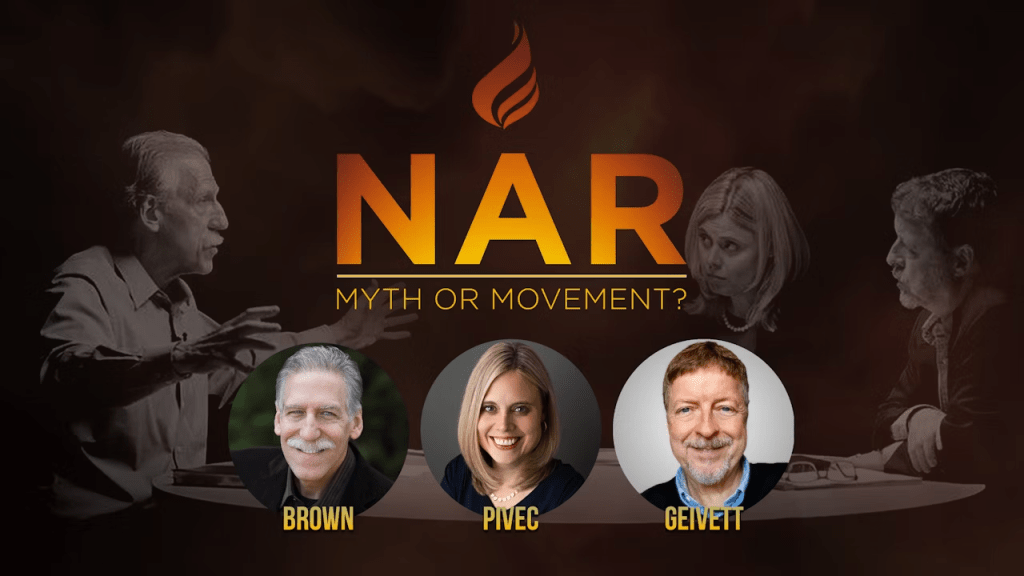
In August 2022, Holly Pivec and I met with Michael L. Brown for a Roundtable discussion that was released July 15, 2024 under the title “NAR: Myth or Movement?” The release of that discussion for public viewing was delayed for nearly two years for reasons that may eventually come to light. In the end, the three of us were invited to record final summary statements that would be attached to the end of the original production by American Gospel producer, Brandon Kimber.
In our joint summary statement concluding the Roundtable, Holly describes five errors or misrepresentations that we identify to illustrate problems with Michael Brown’s factual claims during the Roundtable. In the fifth instance, we comment on Brown’s response to the NAR apostle Ché Ahn.
In his book Modern-Day Apostles, Ahn recalls his conversation with Peter Wagner about the shortage of revivals in America, compared with other nations. “Peter said, ‘The reason why I don’t think it happened is because pastors are not the ones with the highest level of authority in the church. It’s apostles.’” Ahn then writes, “I realized that wherever revival has broken out it was because an apostle led that revival. This was true whether it was John Arnott in Toronto; John Kilpatrick in Brownsville; or me in Pasadena at Mott auditorium, where we had nightly meetings for three years; or Bill Johnson in Redding, California.”
After Holly quoted this passage from Ché Ahn’s book, Brown pushed back and disputed Ché Ahn’s point about the Brownsville Revival. Brown says,
I was part of the Brownsville Revival that was mentioned there. There was not a syllable ever about John Kilpatrick being the apostle over this. He was pastor of a local church. And God birthed the revival within this pastor of a local church. Someone else now is putting an interpretation on it and now you think, Okay,well John Kilpatrick held to that. No, no. That was someone else looking at it, whereas the people involved would say, “No, this happened through prayer and through a pastor and an evangelist working together. That’s how God poured out his Spirit in revival.” . . . . This is someone else’s opinion. . . . That’s Ché’s opinion about what happened at Brownsville. People within Brownsville differ with that. . . . I was there. I was a leader. . . . That’s his interpretation. (“NAR: Myth or Movement?”)
Brown objects to Ahn’s “interpretation,” as he calls it: that John Kilpatrick was an apostle who led the revival in Brownsville. Brown says, “There was not a syllable ever about John Kilpatrick being the apostle over this.” But of course, this misrepresents what Ahn has said. Ahn does not say that John Kilpatrick was identified at the time as the apostle who led the Brownsville Revival. In the passage Holly cited, Ahn only asserts that “wherever revival has broken out it was because an apostle led that revival.” And Ahn believes that was true of John Kilpatrick at Brownsville.
To dispute Ché Ahn’s claim regarding the Brownsville Revival, Brown must establish that no apostle played a role in the leadership of the revival period at Brownsville. Brown cannot simply assert that no one stepped forward as an apostle during the Brownsville Revival or that no one was ever dubbed an apostle of the revival during revival events. For it is at least theoretically possible that an individual functioned as an apostle leading the revival, without ever calling himself or herself an “apostle,” or without being regarded as such by anyone else, at the time. In that event, Ché Ahn would be correct, that an apostle did lead the Brownsville Revival and this apostle was John Kilpatrick. And Brown’s claim—“There was not a syllable ever about John Kilpatrick being the apostle over this”—would be completely irrelevant. Brown’s rejoinder to Ahn misrepresents what Ahn is saying in the passage we quoted.
That is Brown’s first mistake. But Brown’s comment is also factually mistaken.
As anyone can see from the video clip shown in our summary comment about this matter, a prophet, who was invited by John Kilpatrick himself to speak a word from the Lord, explicitly declares that Kilpatrick is more than a mere pastor, that he is in fact an apostle, whose leadership ministry during the Brownsville Revival is evidence of Kilpatrick’s apostolic calling. This prophet further reveals that Kilpatrick will go on to lead future revivals following the same pattern of authority, with events marked by similar phenomena as those manifested during the Brownsville Revival.
So, as a matter of fact, someone uttered a whole string of syllables expressing what Ché Ahn alleges—that John Kilpatrick, a pastor at Brownsville Church, was also an apostle who led the Brownsville Revival, as evidenced by the phenomena that occurred during the revival. And the person who said this did so from the pulpit at Brownsville Church, with John Kilpatrick present, after being introduced by John Kilpatrick as a prophet of God invited to bring a word from the Lord.
If you wonder whether “apostle John” accepted this designation, or thought that it applied to the role he played during his leadership of the Brownsville Revival, you need only consult a sermon that Kilpatrick preached at Calvary Christian Center in Ormond Beach, Florida (uploaded to YouTube Feb 13, 2022). Kilpatrick says,
I remember in the Brownsville Revival I didn’t understand the apostolic, or any of that stuff, until God poured out revival at Brownsville. And when God came and poured out His Spirit there, and the world began to come to our church, and they were drawn to that presence and that glory of God, I began to feel and understand and hear about the apostolic. . . . Somebody said, “You’re an apostle.” I said, “What do you mean by that?” . . . . So I had to begin to look into the apostolic and begin to try to get an understanding of it. [43:53]
In other words, John Kilpatrick, a noted leader of the Brownsville Revival, gradually learned during the course of the revival that he was indeed an apostle. He had exercised apostolic authority without fully realizing it. He studied the apostolic and reflected on the supernatural phenomena exhibited during the Brownsville Revival, and on that basis he concluded that people who had called him an apostle were correct.
So Ché Ahn’s so-called “interpretation” of events is shared by John Kilpatrick, of all people. And it is Michael Brown’s interpretation that is called into question.
We’re not quite sure how to account for this discrepancy between the Kilpatrick-Ahn account and Brown’s understanding. But Brown’s interpretation has all the appearance of being revisionist. It will be interesting to see if he can persuade either of these luminaries of the New Apostolic Reformation (NAR)—John Kilpatrick and Ché Ahn—that they have misdescribed the situation and that there was no apostle giving leadership to the Brownsville Revival at all.
In any case, the prophetic utterance—given in the clip we exhibit in our concluding comment for the Roundtable—establishes that Brown is indeed mistaken when he says, “There was not a syllable ever about John Kilpatrick being the apostle over this.” And he is mistaken when he says that this is merely Ahn’s interpretation that would be disputed by “people within Brownsville.”
This fuller account of how it came to be understood that an apostle was specially designated by God to lead the Brownsville Revival creates additional problems for Michael Brown. He is well-known for his vigorous defense of the Brownsville Revival (which is a head-scratcher in itself), and his claim to be a prominent participating and authoritative eyewitness of what took place at Brownsville. But due to some conflict between himself and leaders at Brownsville, Brown was relieved of his role as president of the Brownsville Revival School of Ministry and left before the Revival petered out. That Brown emerged as a leading spokesperson for the revival in the afterglow of its eventual extinction is a testament to his capacity for reinventing himself. But his interpretation of events and his denial that an apostle played a crucial role is at odds with the narrative propounded by the most significant living leader of the Brownsville Revival, apostle John Kilpatrick.
In addition, Brown, who calls NAR a “myth,” must now find himself defending a phenomenon—the Brownsville Revival —that, by official accounts, critically depended on the leadership of an apostle for its manifestation. Brown was a proud participant in a major NAR event. Fancy that!
***
Michael Brown has repeatedly sought to defend his NAR friends in response to critics of NAR. But so far, that has not gone well for Michael Brown—or for his NAR friends. In so many instances, where he has objected to our identification of individuals as NAR, Brown has invited further scrutiny of their NAR bona fides and exposed them to further trenchant criticism.
He co-authored with Joseph Mattera a statement on “NAR and Christian Nationalism” and recruited signatories whose approval of the statement is incompatible with their NAR commitments, including Joe Mattera himself. During the Roundtable, he challenged our claim that his friend Mark Chironna is NAR and pressed us to produce evidence for it. We’ve done that. (See our article “Response to Joseph Mattera and Michael Brown, Statement on ‘NAR and Christian Nationalism.'”) Brown has parted company with Ché Ahn, in no uncertain terms, when pressed about the differences between their views about apostles. And now his friend and former colleague, John Kilpatrick, is brought under the spotlight for special scrutiny by Brown’s attempted revisionist characterization of the Brownsville Revival, which is actually a paradigm instance of NAR revivalist theology and practice.
In each case, the effort to characterize NAR as a “myth” and to defend his friends against NAR allegations has only subjected Brown’s friends to the revelation of further blinding evidence in support of our claims.
***
There is one further irony to this story. When Holly quoted the passage from Ché Ahn (cited above), the purpose was to make explicit Ahn’s own view about the authority of apostles as a requirement for revival today. She was not especially interested in what Ahn had said about John Kilpatrick and the Brownsville Revival. For her specific purposes, it wasn’t the least bit relevant whether Ché Ahn had given the correct insider’s interpretation on Brownsville. The Ahn quote was one of a series of quotations Holly presented to Brown to elicit his response. Following her recitation of these several passages by different NAR individuals, Brown immediately accused the two of us of adopting a faulty methodology. And one example he offered in support of this claim was our use of the Ahn passage. Note, again, what Brown says to us: “Someone else [Ché Ahn] now is putting an interpretation on it [the Brownsville Revival] and now you think, Okay,well John Kilpatrick held to that.” But that is not what we thought and that certainly is not what we said. So it is Brown’s methodology that goes terribly awry. And thanks to Michael Brown, whose chastising comment inspired us to research John Kilpatrick’s role during the Brownsville Revival, we now do believe that Kilpatrick indeed came to consider himself to be an apostle whose leadership as such facilitated the Revival. That’s an interesting conclusion, to be sure, though it is not germane to our purposes in quoting Ché Ahn during the Roundtable.
Over several decades, the Christian radio host Michael Brown has fashioned a narrative with himself starring as a high-profile representative of charismatics and Pentecostals. And for a long time this was his reputation with quite a number of his followers. But that narrative is unraveling.
His zealous defense of the controversial New Apostolic Reformation (NAR) movement—including his support for his friends who clearly are NAR and his attacks on the critics of NAR—has revealed that he is not the advocate for the charismatic and Pentecostal mainstream that he claims to be. He is out of sync with the mainstream, and a growing number of charismatics and Pentecostals in that stream recognize what Brown denies—that NAR is real and dangerous.
Brown’s Response to Exposure of NAR
His Support for NAR Leaders
Though Brown has long defended extremist expressions of charismatic/Pentecostal practice, and was even a leader of the controversial Brownsville Revival, he has perhaps been better known for his work as a Messianic Jewish apologist and debates with gay activists. And he does often insist that he has called out fringe leaders in the charismatic movement when they have gone too far off-center. So until recently he has perhaps been perceived as a reliable spokesman for the mainstream charismatic movement, thanks to his comparatively unnoticed extremism of the past. But that has been changing with his strenuous defense of NAR leaders.
NAR leaders Brown defends include some of the movement’s most controversial figures:
Bill Johnson: “Apostle” and senior leader of the globally influential Bethel Church in Redding, California—a church known for its failed resurrection attempts, failed predictive prophecies, and other bizarre practices like “grave soaking” and wrapping children in toilet paper like mummies to teach them to raise the dead.
Ché Ahn: “Apostle” of Harvest Rock Church in Pasadena, California, and author of the NAR manifesto Modern-Day Apostles, which details the “extraordinary authority” today’s apostles are believed to possess.
Mark Chironna: NAR apostle who teaches that every church should be governed by apostles and that such apostles function at an unparalleled “level of genius.”
Sid Roth: Host of the wacky It’s Supernatural television program, where guests frequently claim to receive appearances from Jesus, make trips to heaven, and receive messages from God to deliver to the church.
Brian Simmons: Author of the notorious PassionTranslation of the Bible—one of the most deceptive “translations” of the Bible ever produced, subjected to criticism by numerous credible Bible scholars.
Mike Bickle: Founder of the International House of Prayer in Kansas City, Missouri (IHOPKC), who claims to have gone to the courtroom of heaven, where God told him that, if he were found faithful, he would be an end-time apostle with immense authority bringing divine revelation. Bickle also teaches that Christians in the last days will take vengeance on their persecutors by making prayer declarations that will “loose” the judgments of God described in the book of Revelation. And Bickle claims that God spoke to him through Bob Jones, a scandalous sexual abuser prophet, who gave him a message for the global church—a message about Jesus’ “fiery love” for believers, based on a bizarre interpretation of the Song of Solomon in the Bible.
It’s confounding that Brown would defend leaders with such extreme teachings and practices. But when asked about these and other NAR leaders, he says they could never possibly teach the things the critics say they teach. Why? Because they are his friends and he knows they would never do that. This is his resolute stance even when he has been presented with direct evidence of their teachings from their own writings and sermons. And Brown’s years-long defense of Mike Bickle and his organization is especially noteworthy in this moment, when Bickle and his organization are presently embroiled in a sexual abuse scandal involving disturbing allegations concerning multiple women and fostering grave misgivings about leadership’s management of the crisis.
Michael Brown’s routine defense of these and other prominent NAR leaders is an endorsement of individuals who lie far outside the boundaries of mainstream charismatic and Pentecostal teaching and practice.
His Attacks on the Critics of NAR
Brown responds to critics of NAR with unwarranted attacks. Many have noted his recourse to ad hominem name-calling (by denying that the NAR movement exists and asserting that critics are “conspiracy theorists”), shaming and scolding, and pleading a morally superior high ground, often quoting the Bible in his rebukes and admonitions. He adopts language of extreme censure in response to those who have noted his tendency to obfuscate, accusing them of the sin of slander.
Brown treats thoughtful critics like they are imbeciles, while they patiently present the evidence, document their claims, and stand ready to be corrected on reasonable grounds. Meanwhile, in dialogue with critics, he has admitted, on direct questioning, that he has not read their work. Nor, apparently, has he read the works of those he defends! His “knowledge” of their views is grounded in personal conversations, he says, but this is nothing more than hearsay as far as third parties are concerned, and it is trumped by a trove of published books, articles, podcasts, sermons, and the like by the NAR leaders we identify. He has dispensed with the routine work of acquiring detailed knowledge of the NAR phenomenon and loudly excoriated critics who have done their homework, never offering a detailed analysis of their specific arguments.
But people are not blind to Brown’s deflection. Following an informal debate we had with Brown on Alisa Childers’ podcast in 2018, one listener noted the many unscrupulous tactics Brown employed and wrote this:
He comes off as a skilled debater who chooses to rile and rattle his opponent rather than to come to an informed and well-discussed knowledge of the truth. He may not be a NAR apostle, but he is most certainly its foremost apologist. In conclusion, Dr. Brown can obviously deflect solid points against his position so that he is not easily pinned. However, he cannot avoid the fact that individuals who listen to or read his words are appalled by his cunning avoidance of truth and truthful conclusions.
Following a 2022 interview he did about NAR, this exchange appeared in a comment thread on YouTube:
I find it very hard to believe that Dr. Brown isn’t familiar with the craziness in the NAR movement. Che Ahn, Bill Johnson, Rick Joyner—he’s got to be familiar with these men. I mean, he’s appeared with his good friend Sid Roth on It’s Supernatural multiple times. He filibustered this entire interview.
—–
He does interview after interview having never heard of these things. The interviewer tells him, and then the very next interview he’s never heard of or seen it again.
—–
Yes! It becomes hard to see it as anything more than him being deliberately misleading and I really hate to say that. As for Kat Kerr and Sid Roth, you couldn’t slide a piece of paper between them that’s how close they are in their nuttiness.
—–
He knows full well and he’s not fooling those who think as you (and I) do.
Comments like these are frequently found in online discussions of his many appearances on behalf of NAR. (When they are posted to his own social media platforms, such comments swiftly disappear.)
Brown’s Message about NAR Rejected by Charismatics and Pentecostals
There are multiple indicators that Brown is out of step with mainstream charismatics and Pentecostals.
Brown’s Message is Repudiated by Charismatics Who Have Fled NAR
A host of people have left NAR and given testimony after testimony of the very things we and other critics have described—pertaining not only to NAR theology, but also the painful effects it’s had in people’s lives. That’s an empirical reality that Brown will not acknowledge. Some have reported experiencing the equivalent of PTSD. Many express sorrowful repentance for their former association with NAR groups. Recovery groups have formed to assist in the emotional healing of NAR refugees.
These people cannot be dismissed as cessationists (who believe the miraculous gifts, such as prophecy and speaking in tongues, have ceased). Rather, most remain within the continuationist fold, affirming the continuation of the miraculous gifts but seeking a more stable and theologically sound environment. Clearly, they aren’t listening to Brown. You can hardly expect them to track with his message about NAR, that It doesn’t exist, there’s nothing to see here. The growing exodus from NAR groups is a repudiation of that message.
Many of those people have left NAR churches and found new home churches in safe environments that are more moderate. But where is Michael Brown’s pastoral concern for the many who have been injured by prominent NAR groups and abandoned them in favor of mainstream alternatives? Why has he sided with those who have injured them?
While Brown may not know the difference between NAR and mainstream charismatic teaching, these people most certainly do. His denial that there is any substantive difference between his NAR friends and associates on the one hand and the charismatic mainstream on the other hand simply is not believable for people who have lived through the ordeal of NAR’s destructive teachings and practices.
Mainstream charismatics have not taught prayer declarations, they have not taught apostolic decrees, they have not taught prophetic activation exercises, they have not taught that it is always God’s will to heal (with no exceptions), they have not taught dominionism, they have not taught strategic-level spiritual warfare, they have not taught that apostles are officers governing the church today, and they have not taught that these offices have been reinstated in these “last days” to coordinate a miracle-working army and bring God’s kingdom to earth. Nothing Brown says to defend those who teach such things will change that fact.
The critics know better. The victims of NAR theology and practice know better. And those leading the NAR movement—including Brown’s friends who have used the label NAR of themselves in the past—know better. Is Brown the only one who does not know better? He’s positioned himself more as a spokesman for NAR than for the mainstream charismatic movement.
Brown’s Message is Contradicted by Classical Pentecostals
The largest Pentecostal denomination in the world, the Assemblies of God (AG), recognized the emergence of NAR and acted deliberately to curb its influence in their ranks with an official statement on Apostles and Prophets. Those who have read this document know that the “apostles” Bill Johnson and Randy Clark are outside the pale of acceptable teaching about apostles from the AG point of view. This is why, in March 2023, when Johnson and Clark were invited as guest speakers for one of the most influential AG churches in America, many AG pastors were disconcerted and a firestorm ensued.
Brown’s denials of NAR’s existence and his posturing in support of NAR leaders are not appreciated by these pastors. Because of their opposition to NAR, many Pentecostal pastors have expressed appreciation for our critique of NAR and recommended it to others. They have joined the resistance that we speak of in the final chapter of Counterfeit Kingdom.
Brown’s Collapsing Narrative
In short, by denying the existence of NAR and directly supporting individuals like Mike Bickle, Brian Simmons, and Bill Johnson, Brown has compromised his claim to represent the charismatic/Pentecostal mainstream, squandered the opportunity to offer a well-informed and realistic appraisal of NAR, and relinquished all moral authority to speak for most continuationists. He certainly has nothing to offer the throngs who have fled NAR in search of a more authentic experience of God.
The more Brown defends NAR leaders and portrays them as mainstream charismatics, the more he alienates mainstream charismatics who know better—and that number is growing. The same goes for Pentecostals, like those in the Assemblies of God. Brown has effectively crossed swords with them, too.
To learn more about NAR and influential NAR leaders, see our three books on this topic, including especially the most recent: Counterfeit Kingdom: The Dangers of New Revelation, New Prophets, and New Age Practices in the Church. Our forthcoming book, Reckless Christianity: The Destructive New Teachings and Practices of Bill Johnson, Bethel Church, and the Global Movement of Apostles and Prophets, is soon to be released.
My new book with Holly Pivec, Counterfeit Kingdom: The Dangers of New Revelation, New Prophets, and New Age Practices in the Church, is about to be released. It can be preordered now at Amazon.
Looking for a worthwhile news and commentary aggregator, I found Dave Pell’s celebrated NextDraft site. The background buzz was almost intoxicating.
Maria Konnikova, of The New Yorker, declares it to be “a consistently informative and entertaining guide to some of the best stories on the web, with a healthy mix of news you should know, want to know, and prefer to pretend you didn’t read.” Wah?
CNN Executive Editor, Ram Ramgopal, says “NextDraft is a must read.” (Where have I heard that before?)
Andrew Corsello, associated with the authoritative serial GQ, lauds Pell for answering “questions you weren’t even aware you were asking.” I guess that’s a reference to the really important questions.
“NextDraft is invaluable,” says Tim Sullivan, Editorial Director of Harvard Business Review. Don Van Natta Jr. (ESPN) calls it “indispensable.” Hamish McKenzie (whoever that is) offers somewhat more modest praise when he says that NextDraft is “perhaps the world’s best email newsletter.” Modesty increases as visibility on the page decreases, when Kevin Kelly (whoever that is) says that NextDraft is “usually interesting.”
Others opine, but Dave Pell himself tops them all. “I am the algorithm. Each morning I visit about 75 new sites, and from that swirling nightmare of information quicksand, I pluck the top ten most fascinating items of the day, which I deliver with a fast, pithy wit that will make your computer device vibrate with delight.”
This is not the pithiest expression of hubris I’ve heard. But the point is made . . . pointedly. Except that the entries for September 21 don’t live up to the self-hype.
First up, “Famous Last Words.” This witty entry begins with recitations of last words by cultural gods and goddesses—Dylan Thomas, Elvis Presley, James Joyce, Groucho Marx, Christopher Hitchens, and Steve Jobs. (“Oh wow” is right.)
Oops. Did I say “gods and goddesses”? Mea culpa. There are no goddesses in the group, only male deities.
Recently, however, a woman “placed herself towards the top of the pantheon” when she “dictated to her granddaughter” words we’ve heard trumpeted in worshipful awe over the past few days: “My most fervent wish is that I will not be replaced until a new president is installed.” Dave Pell thus sets the stage for his first diatribe of the day, a missive about doubts that the attribution is genuine.
I don’t doubt that Ruth Bader Ginsberg said such a thing. Count me agnostic. And indifferent.
But isn’t it interesting how the alleged deathbed wish has been baptized as an almost religious aphorism? Pell speaks of “RBG’s call.” Does he mean that Ginsberg (who “placed herself” in the pantheon) issued an edict to be obeyed by the American people? Surely not. But Pell does say next that some people launched “an immediate, cynical race to disobey.” To disobey? You heard that right—disobey. These are the people cynical enough to follow (obey?) the United States Constitution, drafted by a pantheon of American political geniuses.
So as RBG joins the august ranks of Groucho Marx and Elvis Presley, Pell enjoins obeisance worthy of her peers within that great pantheon. The suggestion appears almost satirical. But the subtlety of such wit strikes me as beyond the reach of the celebrated aggregator.
One of the paradoxes of human existence is that, while there is nothing new under the sun, nothing stays the same. And so it is in the world of ideas. It is no less so in the realm of religious belief, even when the object of belief is eternal and changeless.
As long as Christian belief has been proclaimed it has had to adjust to the challenges unique to each period of proclamation. And wherever it has been propagated, it has needed to respond to the immediate conditions of its propagation. Changes in circumstance call for new methods of commending Christian belief.
In an article on “Modern Apologetics,” published in 1903, George Trumbull Ladd (1842-1921) explained the need this way:
“Now, that Christian apologists should alter their methods, and even many of their claims, in order the better to defend their religion amidst altered circumstances, is no new thing in the history of apologetics. On the contrary, changes in the points attacked and in the methods of attack call peremptorily for changes in the points where the defense is concentrated and in the methods of defense. The vitality of Christianity has always shown itself in its adaptability to meet the new requirements with a reconstructed apologetics. In the time before the political triumph of the church under Constantine, the history of Christian apologetics shows it to have been constantly engaged in a vigorous and almost life-and-death struggle with a series of determined and powerful hostile forces. But both the form of these forces and the form of repelling them have long since passed away and are never to return. To defend the Christian faith against the modern scientific, philosophical, and sociological objections by recurring to the arguments of the church fathers would be as unskilful and ineffectual as would be the use of the weapons of war belonging to the same centuries in a contest with the modern rifle and modern artillery. Mediaeval apologetics was, from the intellectual point of view, a comparatively tame affair—a dialectical contest over the comparative merits of the different religions, which, however, became realistic and bloody enough when it was waged in the political field against rival heathen, Jews, and Moslems. Even the apologetics which introduced the modern era, and which consisted in a defense of the older orthodoxy against the modifications attempted by the older deism and rationalism, is thoroughly unfitted for present use. Both the attack and the defense of a hundred years ago are now largely antiquated.”
– George Trumbull Ladd, “Modern Apologetics” (1903), 523-24
Ladd was trained at Western Reserve College and Andover Theological Seminary. He was pastor in Congregational churches in Ohio and Wisconsin. He later taught philosophy at Bowdoin College for a few years and philosophy and psychology at Yale University for several more years. He served as a kind of ambassador for the United States in Japan in the last decade of the 19th century. He wrote extensively in psychology, philosophy, and religion.
The complete text of Ladd’s essay may be found at this link. Today, July 1, is the anniversary of this publication.
“Some philosophers have been rather adroit in their expression of this theme. For Gabriel Marcel, the only problem of evil is what is sometimes called the ‘existential’ mode of the problem. If Marcel is correct, this language intrudes a pseudodistinction and the so-called logical problem of evil becomes a pseudoproblem, or a mystery degraded to the level of a problem. To seek ‘the causes or the secret aims’ of experienced evil, the professed goal of any theodicy, is to view evil ‘from outside,’ where evil no longer ‘touches me’ and is therefore ‘no longer evil which is suffered.’ And evil that ceases to be suffered ‘ceases to be evil.’ So the only evil that exists is the evil that we encounter in our prereflective lived experience. Our ivory tower incursions into logical territory miss the heart of the matter.”
It has always seemed to me that Gabriel Marcel (1889-1973) was onto something. Today I would say it is a penetrating insight. The details can be found in his little book The Philosophy of Existentialism. But the themes intimated there are explored and developed throughout his essays and plays.
Today, October 8, is the anniversary of Marcel’s death. His work lives on and his influence continues, notably through the work of the Gabriel Marcel Society. I hope you’ll venture to explore the rich texture of Christian sensibility reflected in the pages of this French thinker of the 20th century.
“The American People” is an abstraction. It is a fiction. Yet pundits and politicians are always saying it. American pundits and politicians. When this began, I do not know. But to refer to fellow-citizens of the United States in this way is to fictionalize real people and to regard them as somehow separate from oneself. It’s silly. It’s shallow. It’s trite.
It’s unthinking.
And it’s often used with promiscuous presumption about what the American People think or feel, want or believe.
It’s also a totally useless generalization when it functions as a stand-in for what pundits and politicians think fellow Americans want (or what they want them to want).
I think the American People would agree. Don’t you?
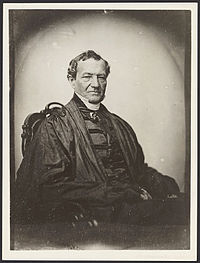
Simon Greenleaf died on this date, October 6, in 1853. He was an American jurist who wrote an influential three-volume Treatise on the Law of Evidence.
Greenleaf believed that lawyers have a responsibility to evaluate the evidences of the Christian religion using the standards of evidence demanded in their professional lives. Accordingly, Greenleaf detailed the results of his own investigation in an 1846 work titled An Examination of the Testimony of the Four Evangelists, by the Rules of Evidence Administered in Courts of Justice. With an Account of the Trial of Jesus.
First, he set forth the following basic principles for governing any responsible investigation:
In examining the evidences of the Christian religion, it is essential to the discovery of truth that we bring to the investigation a mind freed, as far as possible, from existing prejudice and open to conviction. There should be a readiness, on our part, to investigate with candor, to follow the truth wherever it may lead us, and to submit, without reserve or objection, to all the teachings of this religion, if it be found to be of divine origin. (p. 21)
Here, in brief, is the conclusion Greenleaf reached regarding the testimony of the gospel writers concerning the resurrection of Jesus:
The great truths which the apostles declared, were, that Christ had risen from the dead, and that only through repentance from sin, and faith in him, could men hope for salvation. This doctrine they asserted with one voice everywhere, not only under the greatest discouragements, but in the face of the most appalling terrors that can be presented to the mind of man. Their master had recently perished as a malefactor, by the sentence of a public tribunal. His religion sought to overthrow the religions of the whole world. The laws of every country were against the teachings of his disciples. The interests and passion of all the rulers and great men in the world were against them. The fashion of the world was against them. Propagating this new faith, even in the most inoffensive and peaceful manner, they could expect nothing but contempt, opposition, revilings, bitter persecutions, stripes, imprisonments, torments and cruel deaths. Yet this faith they zealously did propagate; and all these miseries they endured undismayed, nay, rejoicing. As one after another was put to a miserable death, the survivors only prosecuted their work with increased vigor and resolution. . . . They had every possible motive to review carefully the grounds of their faith, and the evidences of the great facts and truths which they asserted; and these motives were pressed upon their attention with the most melancholy and terrific frequency. It was therefore impossible that they could have persisted in affirming the truths they have narrated, had not Jesus actually risen from the dead, and had they not known this fact as certain as they knew any other fact. (p. 53; italics added)
Suppose it were possible that Jesus’ disciples could have persisted in their public claims concerning Jesus and his resurrection even if Jesus had not risen. What seems most unlikely is that they would have persisted in this if they did not believe with grave conviction that Jesus had indeed risen. And this fact of their belief surely demands some plausible explanation, given their readiness to endure such persecution.
Greenleaf’s book still makes for stimulating reading. Its arguments deserve the attention of sincere inquirers today.
An Examination of the Testimony of the Four Evangelists is in the public domain. It can be read online here.
Paul Moser and I have teamed together to produce a new book published by Oxford University Press. The Testimony of the Spirit: New Essays is an edited volume of eleven chapters written by distinguished scholars in North America and the United Kingdom. The book includes a detailed bibliography of all the most important work on the subject.
Publisher’s Description:
The theme of the testimony of the Spirit of God is found in various Biblical writings, but it has received inadequate attention in recent theology, Biblical studies, and the philosophy of religion. This book corrects that inadequacy from an interdisciplinary perspective, including theology, Biblical studies, philosophy of religion, ethics, psychology, aesthetics, and apologetics.
The book includes previously unpublished work on the topic of the testimony of the Spirit in connection with: its role in Biblical literature, an ontology of the Spirit, conscience and the voice of God, moral knowledge, religious diversity and spiritual testimony, psychology and neuroscience, community and language, art and beauty, desire and gender, apologetics, and the church and discernment.
The book includes a General Introduction that identifies some key theological and philosophical topics that bear on the topic of the testimony of the Spirit, and it concludes with a bibliography on the testimony of the Spirit. The book pursues its topics in a manner accessible to a wide range of readers from various disciplines, including college students, educated non-academics, and researchers.
The cover art features an oil on canvas titled “Pentecost,” painted by El Greco, ca. 1600 [see here]
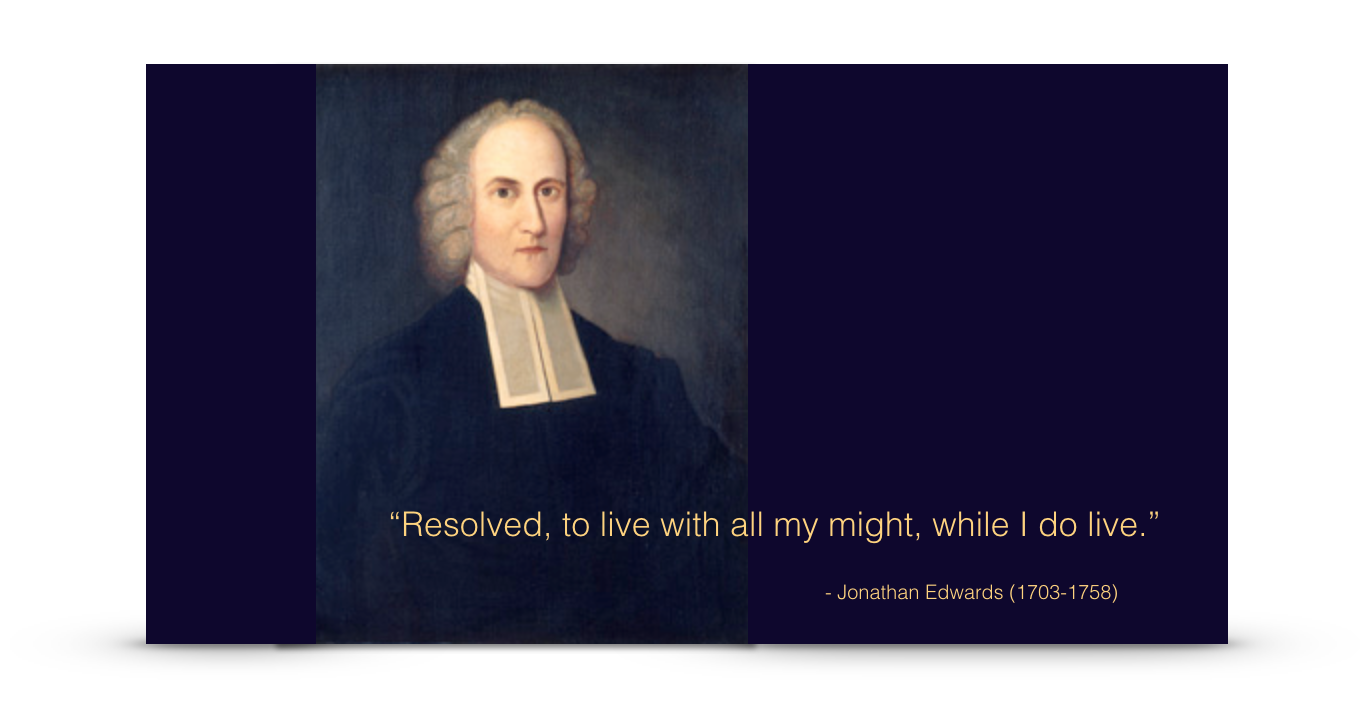
Today is Jonathan Edwards’s birthday. He turns 313.
At age 19, Edwards drafted a list of 70 “Resolutions” by which he hoped to live the rest of his days. They were written over a period of several months, beginning in late 1722. His plan was to review the list each week and evaluate his progress. Resolution number six is a great one for birthday anniversaries.
My co-author, Holly Pivec, was interviewed recently on Pirate Christian Radio about the New Apostolic Reformation and the two books we’ve written. You can hear the broadcast,
Holly Pivec
hosted by Chris Rosebrough, here. For the books, see A New Apostolic Reformationhere and God’s Super-Apostleshere.
Interest has been high, as illustrated by the number of listener comments and likes on their Facebook page here. We’ve also seen a significant uptick in “Best Sellers Rank” on Amazon.
Holly and I have written a Study Guide for God’s Super-Apostles that will be published as a convenient e-book for personal use and group discussion. Stay tuned for details.
***
Holly blogs about the New Apostolic Reformation here.
On his radio show “Stand to Reason,” Greg Koukl recently took a call from a 14-year-old young man from Washington state. David had just listened to an interview I did with Greg a year or so ago. He called in to talk about the New Apostolic Reformation. David wanted counsel about how to approach a friend who has been drawn to the movement through the work of Bethel Church in Redding, CA. They talk for ten minutes at the end of the show, beginning at minute 00:46. If you’re interested in the discussion, click here.
You may know someone who has been lured into the network of contemporary prophets and apostles. Or you may have some other interest in learning more. Have a listen to the interview, then get the book God’s Super-Apostles. It gives you all the basic information you need to understand this movement and make a reasonable assessment of its claims. If you’re looking for something a little more in-depth, the book to get is A New Apostolic Reformation? A Biblical Response to a Worldwide Movement.


 the new requirements with a reconstructed apologetics. In the time before the political triumph of the church under Constantine, the history of Christian apologetics shows it to have been constantly engaged in a vigorous and almost life-and-death struggle with a series of determined and powerful hostile forces. But both the form of these forces and the form of repelling them have long since passed away and are never to return. To defend the Christian faith against the modern scientific, philosophical, and sociological objections by recurring to the arguments of the church fathers would be as unskilful and ineffectual as would be the use of the weapons of war belonging to the same centuries in a contest with the modern rifle and modern artillery. Mediaeval apologetics was, from the intellectual point of view, a comparatively tame affair—a dialectical contest over the comparative merits of the different religions, which, however, became realistic and bloody enough when it was waged in the political field against rival heathen, Jews, and Moslems. Even the apologetics which introduced the modern era, and which consisted in a defense of the older orthodoxy against the modifications attempted by the older deism and rationalism, is thoroughly unfitted for present use. Both the attack and the defense of a hundred years ago are now largely antiquated.”
 we encounter in our prereflective lived experience. Our ivory tower incursions into logical territory miss the heart of the matter.”
 First, he set forth the following basic principles for governing any responsible investigation: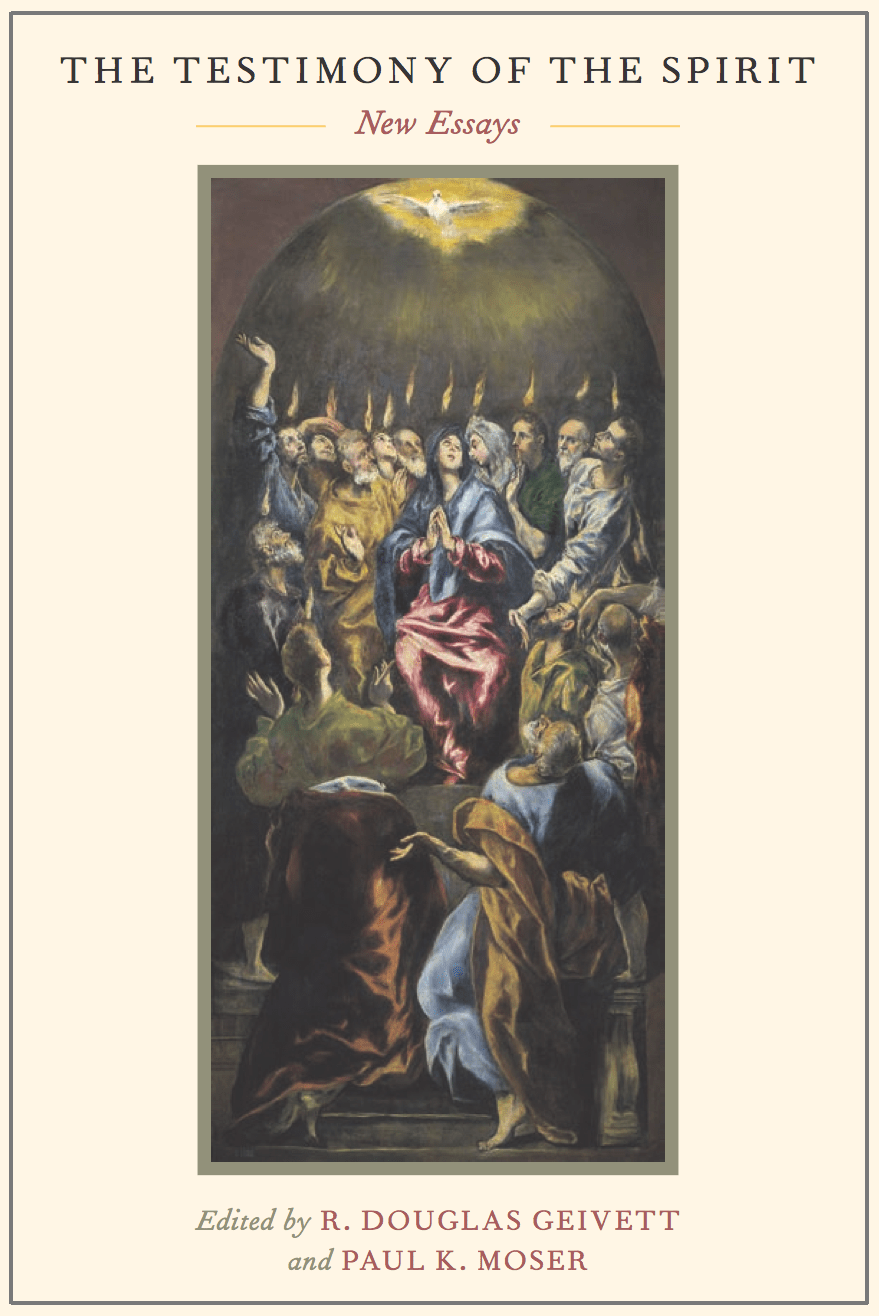



 Doug Geivett's Blog
Recent Comments