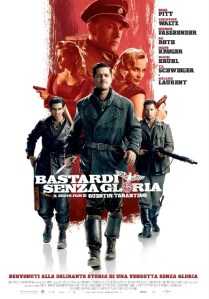
What’s to Like about “Inglourious Basterds”?


I didn’t see Inglourious Basterds in the theater. It sat in my Amazon Video on Demand queue until last night.

I know it was a popular nominee for various Academy Awards recently. But I haven’t read any reviews and I’m not sure I ever saw a trailer. That’s all for the good. I didn’t know what to expect, and that surely made seeing the movie a better experience. Read more of this post

Faith, Film & Philosophy—New Format


Large Print Format

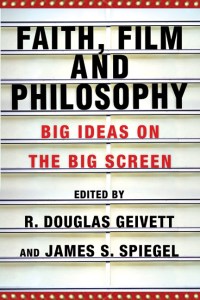
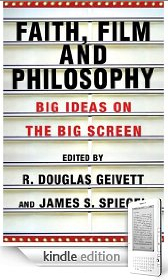
Our publisher has recently announced that our book Faith, Film and Philosophy: Big Ideas on the Big Screen is now available through “Read How You Want”—a company that customizes select books for readers with reading difficulties. This is good news for readers who will benefit from the special formatting provided by this company. Read more of this post

Why We Fight: A Film Discussion Guide


Why We Fight is a documentary film directed by Eugene Jarecki. According to the DVD cover, this film “launches a nonpartisan inquiry into the forces—political, economic, and ideological—that drive America to fight.” Why We Fight was awarded the Grand Jury Prize at the Sundance Film Festival in 2005.

I’ve screened this film in my course on “Faith, Film and Philosophy.” Here are the discussion questions I developed for use in discussing this film: Read more of this post

Julian Jackson on Daniel Cordier on the French Resistance


Anyone interested in the history of the French Resistance should become familiar with the memoirs of Daniel Cordier. To be convinced of that, I recommend Julian Jackson’s recent critical review of Cordier’s book (here). Read more of this post

Joyeux Noël: A Film Discussion Guide


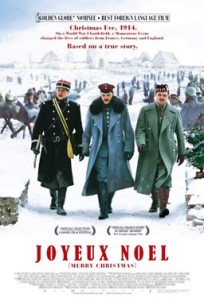
Joyeux Noël (Merry Christmas) (France, 2005); directed by Christian Carion

In an earlier post, I recommended the film Joyeux Noël. The DVD of this wonderful foreign film can be viewed with English subtitles. Here are the discussion questions I’ve used recently in my course on Faith, Film and Philosophy:

  1. Many film critics, even some who give it high marks, say this film is “sentimental.” What do you think they mean by that? What evidence could be cited in support of the claim that the film is sentimental?
  2. Audebert, the French Lieutenant, draws something he’s seen on the wall of his quarters. What does he draw? Why does he draw this? Does this have any significance for the film as a whole? Explain your answer.
  3. Is it reasonable to the think of the alarm clock as a character in the film? Explain the role(s) played by this clock throughout the film. Read more of this post

Eating Movies Like Popcorn


Ray Bradbury, named by Marie Arana “America’s one-man fantasy factory,” wrote,

I was a child of movies. My mother ate them like popcorn.

In 1964, Bradbury called cinema “a science fiction device.” He was talking about all cinema. So, naturally, he wished to see film adaptations of his stories. His best-known successes are Fahrenheit 451 and The Martian Chronicles.

At Barnes & Noble one day, I crossed paths with the book The Writing Life: Writers on How They Think and Work. Opening the book at random to page 76, I went to the bottom of the page and read the last sentence:

If you wait long enough, I learned, and stuff your eyeballs with shapes, sizes and colors, the gumball machine to your skull lends you gifts at the drop of a pen. Read more of this post

Favorite Christmas Movie for 2009


I know, it’s January 2, 2010. But within the past few days I watched a movie that ranks as one of the best—maybe the best—Christmas movie I’ve seen. It’s the foreign film called Joyeux Noël (translated, “Merry Christmas”).

The setting is Christmas Eve, 1914, on the battlefield, with French, Scottish, and German battalions hunkered down in their respective trenches. Conditions are grim. But something very special happens.

Plotting, casting, cinematography, soundtrack are all good. But crucial to the success of this film is that the story it tells is true.

The film is realistic down to the language and accents. The French Lieutenant speaks French, the German Lieutenant speaks German, and (most challenging of the three?) the Scottish Lieutenant speaks English, but the way they do in Scotland. There are no subtitles in the digital version I viewed. But to me, this was a major plus. Read more of this post

What Is the Movie Avatar About?


So what is the movie Avatar really about? Here are some possibilities:

  1. The obstacles to finding spiritual energy in the world around us
  2. The joys of flying a high-tech helicopter
  3. The dangers of the scientific enterprise, or of scientific knowledge
  4. The need for humans to find and explore life on other planets
  5. The vices of capitalism
  6. The honorable service of the United States Marines
  7. The virtues of a simple lifestyle
  8. The religious significance of trees
  9. The degrading effect of secularism in contemporary western civilization
  10. The color blue

Amazon link for Avatar

Sherlock Holmes Is Back


I haven’t seen the Sherlock Holmes movie that was released on Christmas day. Instead, I drew a likeness of the celebrated sleuth—in the pages of a Moleskine, of course.

If you’ve seen the movie, how about leaving a comment with the rank you would give it?

Heads Up Film Fans for Christmas Deals at Amazon


Because of the film commentary often posted here, I know many readers have an interest in film. So here’s something you might like to know. Now until December 22, Amazon is offering deep discounts on movie and TV DVDs and Blu-ray. Click here if you want to go directly to their Christmas discount pages. Boxed sets are especially well-priced.

Speculative Fiction by and for Christians


Twitter led me to a blog called My Friend Amy, where there’s an interesting take on speculative fiction in today’s “Faith ‘n Fiction Saturdays” category. The post addresses several questions:

  1. What is speculative fiction?
  2. What is “Christian speculative fiction”?
  3. What are the standards for high quality Christian speculative fiction?

This short post got me thinking about these and related questions. The result is a longer post sketching some of my thoughts about the general topic.

What Is Speculative about ‘Speculative Fiction’?

My Friend Amy quotes Wikipedia for an answer to this question:

Speculative fiction is a fiction genre speculating about worlds that are unlike the real world in various important ways. In these contexts, it generally overlaps one or more of the following: science fiction, fantasy fiction, horror fiction, supernatural fiction, superhero fiction, utopian and dystopian fiction, apocalyptic and post-apocalyptic fiction, and alternate history. (Click here for the complete Wikipedia entry for “Speculative fiction.)

The term is of relatively recent vintage. It doesn’t appear in any of the three handbooks I consult for such things:

  • Benet’s Reader’s Encyclopedia, 4th edition published in 1996. A new edition was published in 2008, and no doubt includes novel entries (no pun intended).
  • The Reader’s Companion to World Literature, 2nd edition published in 1984. This edition was updated in 2002. Of the three books listed here, this is the best value—very affordable and reliable, with excellent coverage of authors, titles, literary movements, historical periods, terms and phrases.
  • Kathleen Morner and Ralph Rausch, From Absurd to Zeitgeist: The Compact Guide to Literary Terms (1997). I believe this book is out of print, but I see that (at the time of this post) one copy is in stock at Powell’s Books.

I once read an essay on speculative fiction that developed a convincing account of the form. Unfortunately, I don’t remember the author or where I came across the item. But I do remember thinking then that “speculative fiction” is an apt label for fiction that explores counterfactuals—ways things might have been but weren’t, or ways things might yet be but won’t. [FN: For more about counterfactuals at this website, “Run Lola Run—A Discussion Guide.”]

The interesting examples of counterfactuals are worlds very close to this, the actual world. “What if, instead of X happening at time t, something else that could easily have happened, Y, had happened at t? How would things have turned out then?” (One serious philosophical problem with speculation of this sort is that the sequel to any counterfactual at time t—the succession of events following Y, for example—may itself vary in numerous counterfactual ways. There may be many ways things might have turned out if Y had happened rather than X at t. And it’s puzzling to think that there is just one way things would have turned out in such a counterfactual setup. But I digress.)

The better fictional depictions of counterexamples would be at least minimally ‘literary.’ And they would explore themes of enduring human interest.

Could a Christian author write speculative fiction? Of course. The author at My Friend Amy’s blog alludes to several. The most obvious examples are ones that are most obviously ‘Christian.’ They broadcast a Christian message so overtly that it cannot be missed. For example, as noted in the blog post over at My Friend Amy, much Christian fiction depicts battles in the spirit world between angels and demons and the role of intercessory prayer by humans caught in the conflict. This kind of speculative fiction will appeal mostly to Christian readers, and then only to a certain kind of Christian reader. They don’t appeal to My Friend Amy for example. [FN: Some Christians, you may be surprised to hear, would argue that many such specimens of fiction are not properly Christian.]

C. S. Lewis and Others

It is interesting to me that C. S. Lewis is not mentioned. In addition to his cherished Narnia series of fantasy novels, Lewis wrote a very sophisticated series of three novels in what might be called the category of ‘space fiction.’ These are Out of the Silent Planet, Perelandra, and That Hideous Strength. Lewis wrote with subtlty and grace. It’s well-known that he wrote from a Christian worldview. But these novels do not ‘preach.’

Lewis also wrote The Screwtape Letters and The Great Divorce. These must surely count as paradigm cases of ‘speculative fiction.’ Next time you read them, consider this question: “What sort of ‘what-if’ question is Lewis endeavoring to answer in this book?”

I think that’s the question to put to any book if you want to be sure it counts as ‘speculative fiction.’ This opens the way for ostensive definition of the term. That is, it facilitates understanding of the term ‘speculative fiction’ by pointing to clear cases of it. Two examples that come immediately to mind are Shikasta, by Doris Lessing (1979), and The Children of Men, by P. D. James (1992).

It’s interesting to consider these examples in connection with questions raised by My Friend Amy. My view is that speculative fiction is a particularly congenial form for writing from a distinctive worldview, be it Christian or otherwise. It is congenial in part because it permits experimentation with the implications of a worldview without wearing that worldview on its sleeve. Doris Lessing and P. D. James both write with religious sensibilities—Lessing with the perspective of Sufism, James with a Christian worldview. [FN: Lessing was once offered the honorific title of “Dame” by Queen  of England. Lessing declined the honor. James was created Baroness James of Holland Park in 1991.] The guiding perspective in each case, though often discernible, is subtly layered into the narrative. This is akin to what the great authors Flannery O’Connor and Graham Greene accomplished in their more ‘realist fiction.’ [FN: See for example, and the short stories of Flannery O’Connor, and The End of the Affair, by Graham Greene.]

For many readers of this post, the film adaptation of The Children of Men will be better known than the book. While watching the first few scenes, I thought about how this darkly apocalyptic film might render the religious component of the human condition when humanity is faced with extinction. My guess was that it would represent society as completely secular, and that any portrayal of religious people would characterize them as the kind who stand on street corners warning passersby of imminent divine judgment, in a tone that betrays their conviction that ‘none who hear will convert, and it’s just as well anyway, since they deserve to go to hell.’ That pretty much is how religion was ‘treated’ in the film.

That last statement needs qualification. What I should say is that religion, imagined under the conditions described in the film, is presented a certain way. This may be a commentary on how religion is manifest in the world today. But it’s pretty striking that no one I would call a ‘serious believer’ shows up in the movie. I imagine they don’t exist, or, if they do, they are marginally significant to the storyline. But then what would account for their nonexistence? Or what would explain their insignificance to the unfolding story? It is precisely the apocalyptic character of the story that makes their absence conspicuous. And that is interesting.

So a film or a novel may have something to say about religion even when it makes no direct reference to anything explicitly religious.

Vampires

The Amy post also asks whether fiction featuring vampires might be a venue for developing Christian themes. I’ve thought about this myself. That would be an excellent question for Anne Rice, the bestselling author of vampire fiction, and an adult convert to Christianity. Books in her newer series based on the gospel narratives has not been quite as successful as Interview with the Vampire. They are, to be sure, friendly presentations of the life and influence of Jesus. I suspect they have generated a new set of fans.

Susan Howatch

Another contemporary author known for her Christian worldview is Susan Howatch. Also a bestselling author (and British), Howatch composes stories with a realist cast. They take place in our world, you might say. See, for example, her acclaimed series beginning with the novel Glittering Images. One of her best is The High Flyer, which can be recommended to any reader with a taste for literary fiction set in the contemporary context.

* * *

A blog permits the expression of random thoughts during idle moments. I’ve exploited that opportunity here. As often happens, the flood of thoughts swelled to the point of necessary expression because of a bit of reading. This time I happened to be reading another blogger who reads.

Thank you, Amy my friend—whoever you are.

Related Posts by Doug Geivett:
Best Movies Set in Venice


rialto_1Ever been to Venice? Ever get a hankering to be there, like, right now? Sometimes that happens to me. Today it happened to one of my daughters.
Last night I saw the new Star Trek movie. Not to ruin the plot or anything, but you find out (sort of) how the transporter technology was devised by Scotty. Wouldn’t it be great to be able to just beam yourself to a nostalgic place for a day? “Southern California too boring for you? How about Venice? Beam me up, Scotty!”

Unfortunately, there isn’t an iPhone application for that. I checked. (Apple, are you listening?) But there is another option, another way to “take you there,” and that is to select a movie that is set in Venice.

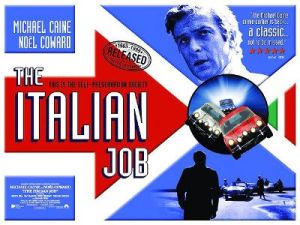
200px-ItalianjobSo tonight we’ll be watching The Italian Job. It’ll bring back pleasant memories of our leisurely time strolling the Piazza San Marco, shopping the Rialto Bridge, and taking in the half-believable vista of the Grand Canal.

Or not.

“The Italian Job is hardly a film to slow your heartbeat.” Agreed. So our recollection of Venice will be accompanied by a high level of manufactured adrenalin. Anything wrong with that?

The 1969 version of The Italian Job, starring Michael Caine and Noël Coward, is different in interesting ways. (This was Noël Cowards last movie.) In fact, it’s different in so many ways that seeing the 2003 film, with Mark Wahlberg and Charliz Theron, does nothing to make the 1969 film predictable. Fortunately, there is one great similarity, and that is the role cast for the Mini Coopers used in the heist. The two movies begin and end very differently.

Other options for movies set in Venice include Casino Royale (for it’s ending), A Death in Venice (not a happy film), Everyone Says I Love You (a Woody Allen musical), Indiana Jones and the Last Crusade (more action and adventure in Venice), Just Married (a romantic comedy), The League of Extraordinary Gentlemen (yep, the one with Sean Connery as Allan Quartermain), A Little Romance, (a comedy in which a 13-year-old American girl enjoys reading Heidegger!), The Merchant of Venice (Venice in 1596), Moonraker (James Bond movie #11, featuring Venice and a gondola/hovercraft contraption), Othello (take your pick: 1952 with Orson Welles, 1965 with Laurence Olivier, or 1995 with Laurence Fishburne and Kenneth Branagh), Pokémon Heroes (the fictional location “Johto” is supposed to be based on Venice), Sharks in Venice (for those who like implausible great white shark movies), Summertime (with Katherine Hepburn and probably the best cinematic exploitation  of Venice), The Thief Lord (co-written by children’s adventure novelist Cornelia Funke), The Venetian Affair (spy thriller starring Robert Vaughn and Elke Sommer, vintage 1967, and hard to find), The Wings of the Dove (“Venice has never been portrayed so beautifully, or romantically,” says Leonard Maltin’s 2007 Movie Guide).

Myself, I’ve seen exactly four of the movies on this list. Wanna’ guess which ones? I’ll send an Amazon gift card for $5 to the first person who gets it right, within 24 hours of this post. I’ll announce the winner—if there is one—at the end of 24 hours. (Setting my mobile phone timer . . . now.)

Good luck!

Oh, and by the way, you also have to explain why you picked the four you did AND tell me your favorite movie with a Venetian setting.

Faith, Film and Philosophy Book Now on Kindle


ffp-kindle-editionToday, Amazon announced the release of it’s Kindle 2. I’m pleased to announce that my book Faith, Film and Philosophy (co-edited with Jim Spiegel) is now available through Amazon in a Kindle version. Kindle users can now wirelessly download a complete copy here for $16.47, a 45% discount from the retail price of the paper edition.

For the paperback edition of Faith, Film and Philosophy: Big Ideas on the Big Screen, click here. At $19.77, that’s still a good savings of 34% off retail.

The book is in its second printing, and rights have been purchased for a Spanish language edition.

Reasons to Like “The Pink Panther 2”


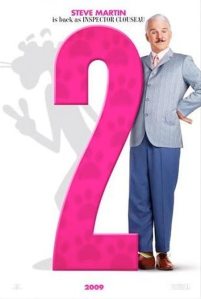
posterpink-panther-2There are reasons to like The Pink Panther 2:

  1. John Cleese plays Chief Inspector Dreyfus.
  2. Steve Martin does onscreen physical comedy better than anyone else around.
  3. The film pokes fun at political correctness, in the form of uptight, and ultimately hypocritical, Lily Tomlin as Mrs. Berenger.
  4. The Andy Garcia character, Vicenzo, actually says, in dumbfounded awe, that Jacques Clouseau really is the greatest detective in the world. This is a positive step away from typecasting for Garcia.
  5. You can’t help laughing at a goodly number of the gags.

On the downside:

  1. This is slapstick comedy, hardly fashionable among today’s movieviewers, known for their refined taste.
  2. John Cleese doesn’t do paranoia as well you as would expect.
  3. Steve Martin is a greater talent than these films can demonstrate.
  4. Casting Yuki Matsuzaki as Kenji, Aishwarya Rai as Sonia, and Alfred Molina as Pepperidge is half of what’s wrong with this movie. John Cleese would have been a better Pepperidge (a virtual reprisal of his role as “Peasant 3” in Monty Python and the Holy Grail). Lily Tomlin would do as a Dreyfus stand-in. I mean that. Let Aishwarya play Mrs. Berenger (if there has to be a Mrs. Berenger). Maybe someone who looks more like Angelina Jolie than Aiswarya should be cast for the Sonia part (pretty crucial to the film, in more ways than one). Who then? How about Angelina Jolie? Jackie Chan, however old he is, makes better sense as Kenji.
  5. You can’t even make yourself laugh at a goodly number of the gags.

What did you think of The Pink Panther 2?

“Batman and Friends”: A Discussion Guide


morrissuperheroes-and-philosophyTom Morris and Matt Morris are the editors of a a book called Superheroes and Philosophy: Truth, Justice, and the Socratic Way (Open Court 2005). Matt’s own chapter (pages 102-117) is titled “Batman and Friends: Aristotle and the Dark Knight’s Inner Circle.” I created this discussion guide, based on Matt’s chapter, for my course on Faith, Film and Philosophy.

Read pages 102-105 and answer questions (1) through (4):

  1. What explains the main title of this essay, “Batman and Friends”?
  2. Morris writes that “Batman is often thought of as the most solitary superhero.” Do you agree with this assessment? How does this set things up for the main theme of Morris’s chapter?
  3. The chapter sketches Aristotle’s three-fold analysis of friendship as developed in the Nichomachean Ethics. What three types of friendship does Aristotle describe? What is your assessment of Aristotle’s analysis? Is it plausible? Is it comprehensive? Do you have friendships of each kind?
  4. Morris uses the Aristotelian analysis of friendship as a template for studying Batman’s closest relationships. Before reading Morris’s discussion of Batman’s relationships, write down your own thoughts about Batman’s relationships. What are his primary relationships? How would you describe each relationship in terms of Aristotle’s three-fold analysis of friendship?

aristotleRead pages 105-115 and answer these questions:

  1. Which of Batman’s relationships does Morris consider in terms of the Aristotelian account of friendship? How does Morris classify each relationship? Do you agree with his classification? If you disagree, explain.
  2. Is there anyone else who is closely related to Batman who is not considered by Morris in this essay? If so, identify the person or people you’re thinking of. What does Aristotle’s analysis of friendship imply about the relationship(s) you have in mind?
  3. What is Morris’s primary thesis in this essay? What is your evaluation of Morris’s thesis?

Now read pages 115-117 and answer the following questions:

  1. In this section of his essay, Morris writes about the “elusiveness” of a certain kind of friendship. How does he explain this elusiveness in Batman’s case? Do you agree that Batman is incapable of this kind of friendship? Explain your answer.
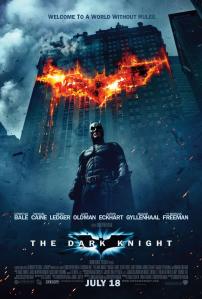
  2. If you’ve seen one or both of the most recent Batman movies, Batman Begins (2005) and The Dark Knight (2008), what features of these films support or conflict with Morris’s analysis of Batman’s friendships?posterbatman-beginsthe_dark_knight_poster
  3. Who has more or less authentic relationships with others, Batman or Bruce Wayne? Explain your answer.
  4. Would it ever be possible for Batman to have the kind of friendship that Aristotle admires most? Explain your answer.
  5. Morris identifies three things that can happen when we “philosophically address art, whether it’s a novel, a comic, a painting, or a film” (see pp. 116-17). What are these three things? What does Morris say is the most important contribution philosophical analysis of art can make? Do you believe that philosophy can play this role? In his use of philosophy to analyze Batman’s character and relationships, does Morris succeed in showing that philosophy can make this kind of contribution?
  6. Morris concludes with an admonition. Think about your own ambitions and sense of calling. If you were to follow Morris’s admonition, what would it mean for you? Be as specific as possible. Does Morris’s counsel seem like good advice to you? Explain your answer.

Copyright © 2009 by R. Douglas Geivett