Debate with Michael Shermer at Northern Arizona University


If you attended tonight’s debate at Northern Arizona University, I want to thank you for coming, and let you know that I welcome your comments or questions.

Please feel free to post them here in the comments box.

Why Should the Devil Have All the Good Music?


I discovered the music of Larry Norman through a friend in 1979. I never made it to a concert, but I’ve listened to his music for 30 years. And I’ve introduced others along the way. (I play his song “The Outlaw” in my course on Christian apologetics.)

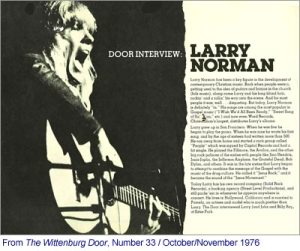
Today I came across an interview he did with a magazine called The Wittenberg Door, published in 1976.

In the interview, Larry talks about the Jesus Movement, “Jesus Rock,” Christian music, signing autographs, being a celebrity, and having heroes. There’s a lot there for Christians to chew on today. I’m not a musician, but my world, what you might call the “Christian knowledge industry,” has its own problems with integrity.

Larry’s perspective applies at all levels of Christian engagement with culture. I encourage thoughtful consideration of what he had to say in 1976.

Note: The title of this post comes from Larry Norman’s song “Why Should the Devil Have All the Good Music?”

The Official Larry Norman Web Site

Dodgy Ruminations about an Afterlife


“God bless non-scientific narratives,” writes Jacques Belinerblau, a professor at Georgetown University. Of course, this is with tongue in cheek, since, though he’s Jewish, Berlinerblau is an atheist.

He speaks sincerely, however, about a hopefulness grounded in certain non-scientific narratives, for he’d like to believe that there’s an afterlife. Actually, he finds it hard to believe that there is not an afterlife of some kind.

So he believes that God does not exist, and sorta-kinda believes that there is an afterlife.

This lede sets the context for Berlinerblau’s review, titled “You’re Dead. Now What?” of four books on the topic:

Berlinblau is a touch dismissive of D’Souza. But Berlinblau, I believe, is right that there really isn’t good strictly scientific evidence for an afterlife.

If Berlinerblau’s review of Frohock is rooted in a reliable summary of the book, I’d say it’s worth a look. But it sounds like Frohock is working from some sort of pantheist or neo-pagan metaphysics (or worldview). I wish Berlinerblau had said more about this.

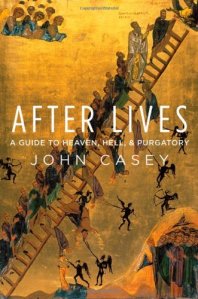
This reviewer makes Casey’s book sounds especially dull. But he has positive things to say about it. And I must say that the pages of this book are cloaked in the most impressive cover of the bunch.

Johnston appears to be one of those philosophers who has to be brilliant simply because it’s frequently impossible to understand what he’s saying. I suspect he’s of the “continental” variety. Berlinerblau’s sample quote from the book is almost a dead give-away.

I probably will read Frohock, eventually. He’s supposed to be ambivalent about whether science could yield evidence for an afterlife. And yet, says Berlinerblau, he’s a materialist. Like Berlinerblau, I find this confusing. If an individual person is completely constituted by material stuff and its physical organization, and this stuff dissolves—or its structure breaks down—following death, then what is the nature of the life beyond death?

The review is published in The Chronicle of Higher Education, of all places. This indicates re-entry of the possibility of an afterlife into academic surmise. Until recently, most scholars would rather die than enter a conversation about such things. Possibly, most scholars still have this preference. (It has not always been so.)

It’s equally fascinating that the traditional Christian doctrine of the afterlife is waved off with an almost pious flick of the wrist. (Check out the review and see if you agree.)

Berlinerblau’s book review enters a general conversation that is cautiously making its way back into serious discourse. But this discourse is dominated by a distinctly secular hope for a pleasant afterlife. Does this sound to anyone else like whistling past the graveyard?

Afternotes:

1. Berlinerblau adorns his essay with a choice literary quote:

The flesh would shrink and go, the blood would dry, but no one believes in his mind of minds or heart of hearts that the pictures do stop.

—Saul Bellow, Ravelstei

2. Christopher Benson reviews the Casey book, together with A Very Brief History of Eternity, by Carlos Eire, for the Christian periodical Books and Culture. Benson titles his review “Without End—Changing conceptions of the afterlife.” Indeed.

***

What do you think?

  1. What is the best evidence for an afterlife?
  2. If you believe in an afterlife, what will it be like?
  3. What is the best argument that there is no afterlife?
  4. Would there have to be a God for there to be an afterlife?
  5. Are you hoping for an afterlife?
  6. Are you expecting an afterlife?
Interview with Brian Auten


I was interviewed recently by Brian Auten. Most of Brian’s questions concern the topic of miracles. Today Brian has posted this audio interview at his website and can be heard here.

Doug’s other posts on the subject of miracles:

“If God, Why Evil?” Presentation Slides


Today I participated in the “Always Be Ready” conference in Downey, CA. The title of my presentation was “If God, Why Evil?”

You’re welcome to view the Keynote slides I used for this presentation. Just click on the following link:

Doug Geivett, “If God Why Evil” (2010.07.31)

Related post here.

Doug to Speak at the “Always Be Ready” Conference July 31


Doug will be speaking at the “Always Be Ready” conference at Calvary Chapel, Downey, CA—July 31, 2010—2:00-2:55 pm. Topic: “If God, Why Evil?”

For registration information and other details:

“Always Be Ready” Conference—Calvary Chapel Downey

This conference is sponsored by the Veritas Evangelical Seminary.

Update (1 August 2010):

Keynote slides for this presentation can be viewed here.

Feminist Sensibilities as an Issue for Christian Apologists


Blaise Pascal (1623-1662) wrote that Christians should “make good men wish that Christianity is true, and then show them that it is.” Both tasks are severely neglected by the Church.

It seems we’re surrounded by people who hope that Christianity is not true. The major media, at least, often express suspicion of Christianity. Sometimes, to be sure, the media go further and deride Christianity. But they seldom deride Christianity with arguments that its central truth claims are false. Rather, they deride its attitudes and practices.

Attitudes differ from beliefs (except in the technical philosophical sense that a belief is a “propositional attitude”). What, for example, do Christians believe about the status of women—in society, at the workplace, at home, in marriage? To be candid, Christians don’t agree in their beliefs about these matters. Read more of this post

On This Date in 431: The Council of Ephesus


Today is an apt day for reflecting on the Christian doctrine of the two natures of Christ. Read more of this post

Twice Shattered—A Memoir by Frank Pastore


In 1970, I was playing Little League baseball for the “Sparks” in Alta Loma, California. In Upland, the next town over (not 10 minutes away from my home), Frank Pastore was the Little League pitcher for his team. We both played “south of Foothill Boulevard,” but I have no idea whether I ever faced Frank with a bat on my shoulder.

More than twenty years later, we were introduced officially. Read more of this post

Radio Interview Today


I’m about to be interviewed about film and Christian engagement with culture on a radio program called “Iron Sharpens Iron,” out of Long Island, NY. Here are details for listening to live streaming. Read more of this post

Do Miracles Happen Today?


In the comments section of a post I made some months ago, I was recently asked if I believe that a severely damaged eye could be restored immediately following a Christian prayer meeting.

Here’s my reply, made more accessible with a separate and exclusive post. Read more of this post

Christmas Challenge


Today is Christmas. I have a Christmas challenge for you. Whoever you are, I urge you to read a succinct summary of the central role Jesus is supposed to play in God’s plan for the salvation of humanity.

Please, don’t click away from this post without reading to the end. Surely you can spare a few minutes for this. It is, after all, Christmas Day.

This challenge doesn’t assume that you’re a Christian, that you believe in Jesus, or that you have any religion whatsoever. But any reasonable evaluation of Christianity presupposes a knowledge of the basic outline of what a true disciple of Jesus believes to be the only hope for this world.

To accept this Christmas challenge, please click on this link to a brief PDF file: God’s Plan of Salvation

I’ll be happy to receive any comments or questions you have after reading this. Unless you wish to have them published on this post, your comments will be kept in the strictest confidence.

Note: I have taken this challenge myself today and found it truly rewarding. It’s attributed to Mark Dever, and appears as an explanatory essay in the study version of the English Standard Bible, published by Crossway Books.

Don’t Fool Yourself


If you think you don’t need to read this book, you’re probably fooling yourself. I Told Me So: Self-Deception and the Christian Life—by my friend and colleague, Gregg Ten Elshof—may get you thinking about all those people you know who deceive themselves. It should be obvious that that’s not the goal of the book. But because what Gregg says in his book is so on target, I’m afraid it won’t be obvious to everyone.

Forward by Dallas Willard. For more details on this new title, click here for the Amazon description.

Best Books in Systematic Theology


Everyone should read some Christian theology. And the first thing to read is a systematic theology, that is, a work that treats all the major doctrines of Christian theology in systematic fashion. (This used to be called “Dogmatic Theology.”)

Recently I’ve been reading E. A. Litton’s 19th-century volume Introduction to Dogmatic Theology. I wouldn’t hesitate to recommend Litton to any serious reader who has time or shelf space for only one volume of systematic theology.

Here are my recommendations for different categories. Read more of this post

The Apologetics of Jesus


What would Jesus do if he was alive on the earth now and facing the skeptics of our day? The same thing he did in the first century. And what was that?

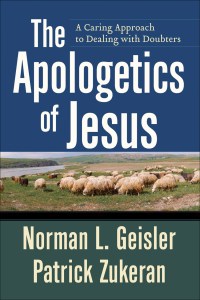
This question is answered with great clarity in the new book by Norman Geisler and Patrick Zukeran—The Apologetics of Jesus: A Caring Approach to Dealing with Doubters.

I want to recommend this book for several reasons: Read more of this post