Bearing Books from New England


A week ago I returned from a New England holiday with my family. We journeyed to Maine and New Hampshire in quest of respite from the cacophony of California. We found it. Harbor views, the Maine woods, marine vessels, lobsters, crisp air, and fall leaves.

And I found bookshops—with mountains of second-hand books—ranging from the maximally disheveled to the customary semi-organized to the immaculate (for example, The Old Professor’s Bookshop in Camden, ME). Read more of this post

Speculative Fiction by and for Christians


Twitter led me to a blog called My Friend Amy, where there’s an interesting take on speculative fiction in today’s “Faith ‘n Fiction Saturdays” category. The post addresses several questions:

  1. What is speculative fiction?
  2. What is “Christian speculative fiction”?
  3. What are the standards for high quality Christian speculative fiction?

This short post got me thinking about these and related questions. The result is a longer post sketching some of my thoughts about the general topic.

What Is Speculative about ‘Speculative Fiction’?

My Friend Amy quotes Wikipedia for an answer to this question:

Speculative fiction is a fiction genre speculating about worlds that are unlike the real world in various important ways. In these contexts, it generally overlaps one or more of the following: science fiction, fantasy fiction, horror fiction, supernatural fiction, superhero fiction, utopian and dystopian fiction, apocalyptic and post-apocalyptic fiction, and alternate history. (Click here for the complete Wikipedia entry for “Speculative fiction.)

The term is of relatively recent vintage. It doesn’t appear in any of the three handbooks I consult for such things:

  • Benet’s Reader’s Encyclopedia, 4th edition published in 1996. A new edition was published in 2008, and no doubt includes novel entries (no pun intended).
  • The Reader’s Companion to World Literature, 2nd edition published in 1984. This edition was updated in 2002. Of the three books listed here, this is the best value—very affordable and reliable, with excellent coverage of authors, titles, literary movements, historical periods, terms and phrases.
  • Kathleen Morner and Ralph Rausch, From Absurd to Zeitgeist: The Compact Guide to Literary Terms (1997). I believe this book is out of print, but I see that (at the time of this post) one copy is in stock at Powell’s Books.

I once read an essay on speculative fiction that developed a convincing account of the form. Unfortunately, I don’t remember the author or where I came across the item. But I do remember thinking then that “speculative fiction” is an apt label for fiction that explores counterfactuals—ways things might have been but weren’t, or ways things might yet be but won’t. [FN: For more about counterfactuals at this website, “Run Lola Run—A Discussion Guide.”]

The interesting examples of counterfactuals are worlds very close to this, the actual world. “What if, instead of X happening at time t, something else that could easily have happened, Y, had happened at t? How would things have turned out then?” (One serious philosophical problem with speculation of this sort is that the sequel to any counterfactual at time t—the succession of events following Y, for example—may itself vary in numerous counterfactual ways. There may be many ways things might have turned out if Y had happened rather than X at t. And it’s puzzling to think that there is just one way things would have turned out in such a counterfactual setup. But I digress.)

The better fictional depictions of counterexamples would be at least minimally ‘literary.’ And they would explore themes of enduring human interest.

Could a Christian author write speculative fiction? Of course. The author at My Friend Amy’s blog alludes to several. The most obvious examples are ones that are most obviously ‘Christian.’ They broadcast a Christian message so overtly that it cannot be missed. For example, as noted in the blog post over at My Friend Amy, much Christian fiction depicts battles in the spirit world between angels and demons and the role of intercessory prayer by humans caught in the conflict. This kind of speculative fiction will appeal mostly to Christian readers, and then only to a certain kind of Christian reader. They don’t appeal to My Friend Amy for example. [FN: Some Christians, you may be surprised to hear, would argue that many such specimens of fiction are not properly Christian.]

C. S. Lewis and Others

It is interesting to me that C. S. Lewis is not mentioned. In addition to his cherished Narnia series of fantasy novels, Lewis wrote a very sophisticated series of three novels in what might be called the category of ‘space fiction.’ These are Out of the Silent Planet, Perelandra, and That Hideous Strength. Lewis wrote with subtlty and grace. It’s well-known that he wrote from a Christian worldview. But these novels do not ‘preach.’

Lewis also wrote The Screwtape Letters and The Great Divorce. These must surely count as paradigm cases of ‘speculative fiction.’ Next time you read them, consider this question: “What sort of ‘what-if’ question is Lewis endeavoring to answer in this book?”

I think that’s the question to put to any book if you want to be sure it counts as ‘speculative fiction.’ This opens the way for ostensive definition of the term. That is, it facilitates understanding of the term ‘speculative fiction’ by pointing to clear cases of it. Two examples that come immediately to mind are Shikasta, by Doris Lessing (1979), and The Children of Men, by P. D. James (1992).

It’s interesting to consider these examples in connection with questions raised by My Friend Amy. My view is that speculative fiction is a particularly congenial form for writing from a distinctive worldview, be it Christian or otherwise. It is congenial in part because it permits experimentation with the implications of a worldview without wearing that worldview on its sleeve. Doris Lessing and P. D. James both write with religious sensibilities—Lessing with the perspective of Sufism, James with a Christian worldview. [FN: Lessing was once offered the honorific title of “Dame” by Queen  of England. Lessing declined the honor. James was created Baroness James of Holland Park in 1991.] The guiding perspective in each case, though often discernible, is subtly layered into the narrative. This is akin to what the great authors Flannery O’Connor and Graham Greene accomplished in their more ‘realist fiction.’ [FN: See for example, and the short stories of Flannery O’Connor, and The End of the Affair, by Graham Greene.]

For many readers of this post, the film adaptation of The Children of Men will be better known than the book. While watching the first few scenes, I thought about how this darkly apocalyptic film might render the religious component of the human condition when humanity is faced with extinction. My guess was that it would represent society as completely secular, and that any portrayal of religious people would characterize them as the kind who stand on street corners warning passersby of imminent divine judgment, in a tone that betrays their conviction that ‘none who hear will convert, and it’s just as well anyway, since they deserve to go to hell.’ That pretty much is how religion was ‘treated’ in the film.

That last statement needs qualification. What I should say is that religion, imagined under the conditions described in the film, is presented a certain way. This may be a commentary on how religion is manifest in the world today. But it’s pretty striking that no one I would call a ‘serious believer’ shows up in the movie. I imagine they don’t exist, or, if they do, they are marginally significant to the storyline. But then what would account for their nonexistence? Or what would explain their insignificance to the unfolding story? It is precisely the apocalyptic character of the story that makes their absence conspicuous. And that is interesting.

So a film or a novel may have something to say about religion even when it makes no direct reference to anything explicitly religious.

Vampires

The Amy post also asks whether fiction featuring vampires might be a venue for developing Christian themes. I’ve thought about this myself. That would be an excellent question for Anne Rice, the bestselling author of vampire fiction, and an adult convert to Christianity. Books in her newer series based on the gospel narratives has not been quite as successful as Interview with the Vampire. They are, to be sure, friendly presentations of the life and influence of Jesus. I suspect they have generated a new set of fans.

Susan Howatch

Another contemporary author known for her Christian worldview is Susan Howatch. Also a bestselling author (and British), Howatch composes stories with a realist cast. They take place in our world, you might say. See, for example, her acclaimed series beginning with the novel Glittering Images. One of her best is The High Flyer, which can be recommended to any reader with a taste for literary fiction set in the contemporary context.

* * *

A blog permits the expression of random thoughts during idle moments. I’ve exploited that opportunity here. As often happens, the flood of thoughts swelled to the point of necessary expression because of a bit of reading. This time I happened to be reading another blogger who reads.

Thank you, Amy my friend—whoever you are.

Related Posts by Doug Geivett:

TR on Reading Fiction for Personal Improvement


Book Cover.TR's Letters to His SonsThe American President that most fascinates and inspires me is Theodore Roosevelt. I’ve read several biographies, the best of which is by Texas A & M historian H. W. Brands. I also enjoy collections of TR’s essays and letters.

In a letter to his son Kermit, written from the White House February 3, 1906, the President reveals something of the way he viewed fiction:

Dear Kermit:

I agree pretty well with your views of David Copperfield. Dora was very cunning and attractive, but I am not sure that the husband would retain enough respect for her to make life quite what it ought to be with her. This is a harsh criticism and I have known plenty of women of the Dora type whom I have felt were a good deal better than the men they married, and I have seen them sometimes make very happy homes. I also feel as you do that if a man had to struggle on and make his way it would be a great deal better to have someone like Sophie. Do you recollect the dinner at which David Copperfield and Traddles were, where they are described as seated at the dinner, one “in the glare of the red velvet lady’ and the other “gloom of Hamlet’s aunt”? I am so glad you like Thackeray. “Pendennis” and “The Newcomes” and “Vanity Fair” I can read over and over again.

If TR felt he could read such titles by Thackery over and over again, it is because he did. Thackery is mentioned in many of his letters. Here the father takes pleasure in a shared enthusiasm with his son. And why is he so pleased with the boy’s reading predilections? Apparently because of the power fiction has to form character, to provoke thought about values and truth, and to encourage wise decisions in life.

Evidence for this dominates the quotation. Notice that TR is, in effect, counseling his son about choices in marriage. He is very subtle in this.

It’s pleasing to see that this accomplished public figure had such a relationship with his children that he would write about such things in his letters from the White House.

From the quoted portion of Roosevelt’s letter to Kermit, there is much of positive value to glean:

  • He takes time for his children in the midst of major official responsibilities.
  • He writes in a slow, reflective pace.
  • He guides by example.
  • He engages his son in discussion of ideas and values on the basis of a shared interest.
  • He shows genuine enthusiasm for great literature outside his range of responsibilities.
  • He exemplifies a manner of reading fiction that is directed by the desire to grow in wisdom.
  • He advises the young without preaching at them in any condescending fashion.
  • He regards his son as a peer in the realm of ideas.
  • He looks for points of contact between the fictional characters he meets with in reading and living individuals he knows personally.

It’s enough to make you want to go back and read David Copperfield, and check out the works he cites by William Thackeray.

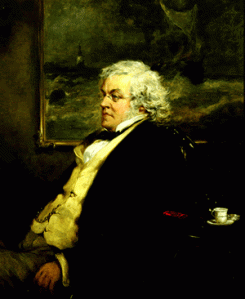
William Makepeace Thackery, Painted by Sir John Gilbert

William Makepeace Thackery, Painted by Sir John Gilbert

Works mentioned in this post:

Kindle users should know that there is a Kindle collection of over 100 of Thackery’s publications (including the three mentioned in this post) that you can get with a single purchase (cost: $4.79 at the time of this post). Click here. I like the Kindle!

Book Cover.TR's Letters to His Sons.2The quotation is from page 80 in The Letters and Lessons of Theodore Roosevelt for His Sons, edited and compiled by Doug Phillips.

Our Role in the Appointment of a Supreme Court Justice


A few days ago, President Obama announced his first nominee for Supreme Court Justice. Among the various tools the President has used to get his message out is his website, where a 4-minute video announcement is posted here. I encourage you to view this video. I also encourage you to think carefully about what the President says at each stage in his announcement.

We live in a democracy. We have the opportunity and the responsibility to pay attention to major developments occurring in the executive, congressional, and judicial branches of our federal government. We should not simply elect a new President and our congressional representatives, and then forget about it. We have a duty to unceasing vigilance. The survival of democracy depends upon it.

The appointment of a new justice to the United States Supreme Court involves all three branches of our government, starting with the executive branch and the President’s nomination of the person he or she believes is best suited to the role. Congress then deliberates and votes up or down on the President’s nomination. If the nominee is approved, he or she steps into the vaunted role of applying the United States Constitution to the most sensitive legal cases of the age. If Congress does not approve the nominee, then the whole process begins again, with the President’s selection of a new nominee.

Now is a good time to consider why so much circumspection is required—required by the Constitution. When drafting the Constitution, the founders of our nation recognized that the degree of authority vested in justices of the Supreme Court is, well, supreme. What they say goes. Each appointment is a life appointment. It ends only when an individual justice decides to retire or that justice dies—whichever comes first. It is not unusual for justices to sit on the highest court for several decades. Except in very rare cases, a justice’s tenure on the Supreme Court is years and years longer than the maximum eight years any person can serve consecutively as President of the United States.

In addition, the decisions made by our Supreme Court justices outlive the justices themselves and stand indefinitely. Reversing the effects of a Supreme Court decision is far more complicated than appointing justices to the Court. It is probably the most unlikely action our federal government can make.

Finally, decisions made by the Supreme Court are compelling for all 50 of the United States.

You may wonder what difference ordinary citizens can make in the process of appointing justices to the Supreme Court. Here are a few key opportunities:

  1. Our responsibility begins with the election of a President.
  2. We then are free to follow the nomination and confirmation process. This is mostly a matter of staying informed. This takes some skill, since media outlets themselves have political agendas.
  3. Being informed is not enough. We must be thoughtful about what we hear. We must consider how a nominee is being pitched to “we, the People.” This requires skills of another kind, the skills associated with critical thinking.
  4. We are represented by elected officials in Congress. Our representatives are sensitive to our expressed will to be heard. Citizens hold some power, then, in influencing the approval process.

The single most significant aspect of our duty as citizens is vigilance and critical thinking.

This post reveals nothing about my response to President Obama’s nomination. I may add posts about that later. Meanwhile, I’m especially interested in the way the nominee is being presented to “the public.” That’s us. Except that we aren’t “the public.” We are the People. And We the People must do our part.

To that end, I’ll be adding posts that encourage critical reflection on aspects of the media coverage. My first post about this can be found here. It begins at the beginning with the President’s announcement.

Geivett’s Book Recommendations:

President Obama’s Argument for Bipartisan Support for the Confirmation of Sonia Sotomayor


A few days ago, President Obama announced his first nominee for Supreme Court Justice. Among the various tools the President has used to get his message out is his website, where a 4-minute video announcement is posted here. I encourage you to view this video. I also encourage you to think carefully about what the President says at each stage in his announcement.

Here’s a specific question to consider:

  • Can you identify President Obama’s argument that Sonia Sotomayor should be a bipartisan slam dunk for confirmation by the Congress?

He makes an argument toward the end of his speech. He doesn’t say, “Let me give you a good argument for this.” But he does make an argument. If we’re paying attention, we’ll recognize the argument. And if we’re critically engaged, we’ll make a sober judgment about the plausibility of his argument.

So the second question I have for you is:

  • Does the President make a good argument that Sonia Sotomayor should be a bipartisan slam dunk for confirmation by the Congress?

These questions are rooted in my goal to encourage greater understanding of media messages—whether from the President, or anyone else.

By greater understanding I mean deeper awareness of what the message is and whether that message is reasonable. The President’s speech, because it is addressed to ordinary citizens and because it can be viewed very conveniently online, presents us with a great opportunity to hone the skills needed to be responsible citizens of a fragile democracy.

Book Recommendations:

If you have any questions about these recommendations, please use the comment box below.

Related Posts by Doug Geivett:

Paranoid Atheists, Take Note


There are varieties of atheists. Some manifest symptoms of paranoia about the vigor of religion in the Western world. They decry everything about religion and are determined to curb its altogether negative social effects. A good example is Christopher Hitchens, whose book is titled god Is Not Great: How Religion Poisons Everything. Their publications, blogs, speeches, radio and TV appearances are rants against religion, litanies of what is dangerously wrong with religion. The paranoid atheists are not discriminating. And they are loud and vociferous.

Then there are atheists who are reconciled to the fact that religion is here to stay, and even believe that positive goods have been produced by religion—social goods that would not exist but for religion. They see religion as neither good nor bad, as such, but as something capable of extraordinary good and unparalleled evil. They are discriminating. They are willing to cheer what is good about some manifestations of religion. And now they are calmly entering the fray with a distinctively different and refreshing tone.

Excellent examples are the authors John Mickelthwaite and Adrian Wooldridge. Their new book, God Is Back: How the Revival of Religion Is Changing the World, is a kind of protest against the excesses of paranoid atheism. They argue that modernity is a boon to religion, and that more of religion in certain of its forms, especially as it is exhibited in America, should be encouraged. Mickelthwaite and Wooldridge cannot be ignored. They are prominent journalists who write for the prestigious British periodical The Economist. Their message of good news about religion is bad news for scoffers like Christopher Hitchens, Richard Dawkins, Sam Harris, and Bill Maher.

God Is Back is a book for your summer reading list. With 400+ pages, it may be the only summer reading you do. But the price is right and the balanced consideration of religion as a social good is timely

Helpful reviews of God Is Back, by John Mickelthwaite and Adrian Wooldridge:

Gearhead Philosophers


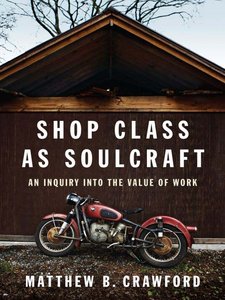
Book Cover.Crawford.Shop ClassWhat would you expect from a book by a trained philosopher who quit his job as a Washington think tank shill (I almost said “tankard”) to work as a motorcycle mechanic?

If you know anything about the academic job market, you might think I have things backwards. It wouldn’t surprise to hear that a professional philosopher ended up—or rather, started out—rebuilding motorcycle engines. But philosophers do strange things. And Matthew Crawford, with a Ph.D. in political philosophy, is a good example.

Crawford is the author of  a new book called Shop Class as Soulcraft: An Inquiry into the Value of Work. I learned about his book from a “Tweet” (i.e., a Twitter post) linking to a review of the book by a  Slate contributor named Michael Agger. The article, titled “Heidegger and the Art of Motorcycle Maintenance,” praises the book and suggests that a copy be given to everyone you know who is graduating from college and about to “commence real life.” (Never mind that a majority of college graduates postpone commencing real life, some of them indefinitely.)

Every year, grads take jobs they’ve dreamed about, then become so absorbed in them that they are absorbed by them, little noticing that their work is not particularly absorbing in the sense that matters most. Crawford’s book is supposed to get office grunts, from secretaries to CEO’s, to consider more carefully the work they’re doing.

Of course, this year a much higher percentage of college graduates will look in vain for jobs that they believe will satisfy. Maybe that’s a good thing. Maybe they’ll have time for some profitable reading. A book like this could help them get their heads together. Soulcraft versus bank draft. It’s an interesting contrast. Leave it to a philosopher to subvert the values of our age.

Two questions. What does any of this have to do with motorcycle maintenance? And what does it have to do with Heidegger?

The first question, presumably, is answered in the book. Crawford the philosopher became Crawford the disillusioned “knowledge worker,” which led him to become Crawford the motorcycle mechanic. And Crawford the motorcycle mechanic, who had apparently dropped out of the knowledge enterprise, learned what was of real value where life intersects work.

The answer to the second question isn’t obvious from reading the Slate article. There’s no attempt in the article to tie Crawford’s ideas and conclusions to the work of any philosopher named Heidegger. One naurally assumes that Agger is thinking of the Heidegger, as in German philosopher Martin Heidegger (1889-1976). But Agger doesn’t connect the dots. Maybe he just latched onto the name of the first philosopher he thought of. Heidegger is not known for his luminosity—nor for motorcycle expertise. So Agger’s choice of a title may be bad in more ways than one. On the other hand, there’s the possibility (admittedly remote) that Crawford draws valuable concrete lessons for life from one of the most austere philosophers of the past 100 years.

So far I’ve only read about the book. But I’m definitely interested. And if Crawford leaves Heidegger out of it, even more so.

***

Notes:

  1. Michael Agger is also playing off the title of Robert Pirsig’s 1973 classic Zen and the Art of Motorcycle Maintenance. Maybe there’s a subtle connection between Heidegger, Zen, and motorcycle maintenance that escapes me just now. If so, my apologies to Michael Agger.
  2. As I write this, Shop Class as Soulcraft is #30 in sales rank at Amazon.
  3. Kudos for Crawford’s book include the following by Harvard professor of government, Harvey Mansfield: “Matt Crawford’s remarkable book on the morality and metaphysics of the repairman looks into the reality of practical activity. It is a superb combination of testimony and reflection, and you can’t put it down.” (Source: Amazon.com)
  4. As long as we’re onto Heidegger here, I should note that there’s an interesting BBC documentary on the man that’s available on YouTube, starting with this 8-minute installment here.

Related Posts:

Divine Guidance and the Decisions You Make


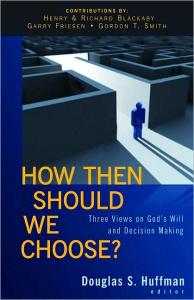
Book Cover.How Then Should We ChooseI spoke in chapel at Biola University on the subject of divine guidance recently. Some have asked for a suggested reading list on this topic. On issues of divine guidance and decision making, I recommend the following three books, suggest reading them in the following order, and urge you to read the Friesen book if you read only one:

Each of these is linked to Amazon for your convenience. Much of the Waltke book is available at this link on Google. For a convenient outline of Friesen’s view, click here. This overview of Friesen’s position will give you a good idea of the approach he takes. But to really understand the position, you’ll have to consult his book. I encourage this because his careful study of the scriptural material on this topic has done the most to shape my view and practice.

A new book compares three approaches, presented and defended by their respective proponents: How Then Should We Choose? Three Views on God’s Will and Decision Making (Kregel, 2009). Garry Friesen is a contributor, along with Henry and Richard Blackaby, and Gordon T. Smith.

Am I a Calvinist? Not Exactly


Recently I received this note from a friend on Facebook:

Dr. Geivett,

What is your view on Calvinism, election, and free will? Do you have any good resources you could recommend?

Since I am occasionally asked this question, I thought it might be helpful to others to post my reply here, together with Amazon links for the reading I recommend:

Hi . . . ,

I’m not a Calvinist. I’m a libertarian regarding human freedom, and I reconcile human freedom and divine sovereignty on the basis of the doctrine of divine middle knowledge. I can recommend several books on this:

(1) Luis de Molina, On Divine Foreknowledge

This is an early primary source for the doctrine of divine middle knowledge. Luis de Molina was the first to develop the doctrine systematically. This is Alfred J. Freddoso’s translation from the Latin text. Freddoso’s lengthy introduction to the volume is an excellent sympathetic introduction to the doctrine. This is the ideal place to begin your study of middle knowledge if you’re prepared to read a fairly sophisticated treatment of the topic.

(2) William Lane Craig, The Only Wise God

William Lane Craig is an evangelical Christian apologist and a leading proponent of the doctrine of divine middle knowledge. This book explains the doctrine, contrasts it with alternative views of the relation between divine sovereignty and human freedom (e.g., Calvinist views), and includes careful examination of the relevant texts of Scripture. If you read only one book on this topic, this is the book to study. The topic is complex, so any exposition of the doctrine and related issues will generally be written above the popular level. This is the most accessible detailed treatment of the topic (at a very reasonable price).

(3) Thomas P. Flint, Divine Providence: The Molinist Account

This is an exceptional treatment of the doctrine of divine middle knowledge by a prominent Catholic philosopher of religion. Exposition and defense of the doctrine is more developed here than in William Lane Craig’s book, so it’s a good place to go next if you plan further study of the topic.

(4) Dennis L. Okholm and Timothy R. Phillips, eds., View Views on Salvation in a Pluralistic World

For an application of the doctrine of divine middle knowledge to the question of the fate of the unevangelized, see the contributions in this book that I co-authored with Gary Phillips. Another source for this material is my chapter in the book Jesus Under Fire (see below).

(5) Michael J. Wilkins and JP Moreland, Jesus Under Fire

My concluding chapter to this volume presents the same material contained in my contribution to the book Four Views on Salvation in a Pluralistic World, on the fate of the unevangelized (see above).

Jack Bauer’s Creators, We Need You—Mid-season Ruminations on 24


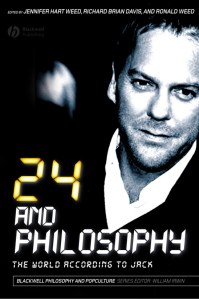
24-philosphyIf you’re a 24 fan and you haven’t yet seen tonight’s episode, you better save this post for later. It might reveal more than you want to know, which is ironic, given what I’m about to say.

This has been a remarkably engaging season, given the challenge its writers have faced to be fresh and unpredictable. Even more so given some other challenges it has set for itself. Some of these have to do with the writing, some have to do with the marketing.

The writing. Is the FBI really as inept as it’s portrayed here? Tactical differences between Jack Bauer and FBI personnel have made sense. Larry fits the stereotype. His objectivity is fogged by his interest in an admittedly attractive agent who’s working a little too closely with Bauer, but he hangs in there pretty well. His capacity for rage hints that he’s not altogether unlike Bauer, whom he so patently loathes. Tonight, though, I think the script may have dropped a couple of points on the credibility score. Larry’s real life counterpart wouldn’t have been so clumsy about tightening the net on FBI infiltrators . . . would he? Wouldn’t that seedy-looking Shawn—or Sean—chap have been a possible? You would think. But not Larry. At least not soon enough. Even for the FBI. I hope.

Next, Rosa’s death. This was predictable. How it would happen wasn’t. That was a good story thread. We’ve known of innocent, uncomplicated civilians acting with valor at personal risk to thwart terrorism. Rosa’s desperate attack on the driver, causing a fatal accident, is believable. Remember 9/11? But is she the completely sympathetic character she needs to be for us, the viewers, to relate vitally to the angst played out so elaborately by agent what’s-her-name (the one who looks like she could be Jaclyn Smith redivivus, . . . or Jaclyn Smith’s daughter)? The pretty and gritty agent’s sentiments are realistic enough. But what do they do to advance the plot? Isn’t it a little smarmy?

Finally, why the silly stock antics by Tony when he appears on the steps next to Jack at the end of tonight’s episode? He steps down, removes his shades, and tells Jack that “it’s not over.” Once he’s satisfied that he’s nearly convinced Jack, he dons the glasses and says, “I need you, Jack.” Very original.

Point being—the writers are much too clever to settle for these derivatives. The sensational TV series still works for me. I’ll be tuning in next week. But something’s crept in here that has nothing to do with exhausting the storyline potential of the show.

The marketing. Here I’m talking about the way the series is played up by the show’s engineers between episodes. Tonight we were told to expect, before the episode began, that this hour would provide some significant closure. This was risky. And it worked, I think. There was closure, which is unusual for the series. But it didn’t ruin the effect. Let’s hope it doesn’t happen often. But it was refreshing to experience it on this segment. Did it have to be pre-announced? I think it may have been constructive, since most of us probably watched with wariness about that prospect, and thus experienced a heightened sense of tension.

So what’s the problem? After watching a fully riveting episode, the producers think we have to be told virtually everything that will happen next week to get us to come back. I don’t care what happens in the next episode—I know they revealed too much at the conclusion of tonight’s show. It’s anticlimactic—unless you have short-term memory loss, in which case you probably aren’t sure what’s going on from one week to the next and aren’t tuning in for that reason.

It’s been rumored, maybe for marketing effect, that the writers work inside the series close to the release of each episode, not knowing all that much about where they’re headed from episode to episode. Their spectacular series 24 is more believable than that. But let’s pretend there’s still time for tinkering. I have a selfish request—ligthen up on the shibboleths and can the forecasting. Your program has attracted an intelligent audience. They’re your core. Don’t let them down.

In case you couldn’t resist reading this post before seeing tonight’s episode, awaiting playback on your Tivo, here’s my advice: stop watching immediately after Tony walks away toward Constitution and First. I think you’ll enjoy the next week’s installment more than I will.

Note: Evidence of my enthusiasm for 24 can be found in my chapter in the book 24 and Philosophy.

Faith, Film and Philosophy Book Now on Kindle


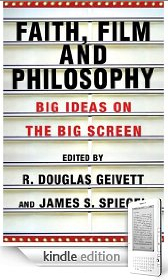
ffp-kindle-editionToday, Amazon announced the release of it’s Kindle 2. I’m pleased to announce that my book Faith, Film and Philosophy (co-edited with Jim Spiegel) is now available through Amazon in a Kindle version. Kindle users can now wirelessly download a complete copy here for $16.47, a 45% discount from the retail price of the paper edition.

For the paperback edition of Faith, Film and Philosophy: Big Ideas on the Big Screen, click here. At $19.77, that’s still a good savings of 34% off retail.

The book is in its second printing, and rights have been purchased for a Spanish language edition.

This is Conjecture, You Understand?


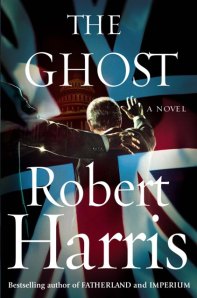
Robert Harris is one of my new favorite authors. His genre? Literary fiction in the thriller/suspense vein. Fatherland is his most celebrated work. But I first read The Ghost.

book-coverthe-ghostThe Ghost is written in the first person by a ghostwriter who is commissioned by his publisher to help a former British prime minister draft his memoirs. The project has to be completed within a few weeks to meet the publisher’s deadline. Our man, the ghostwriter, must scramble to repair an initial and very unsatisfactory draft, because the first ghostwriter has died—under mysterious circumstances, of course.

The Ghost reads well from the start. It’s immediately engrossing, for someone who likes this sort of thing. The plot is intricate and plausible. The finale is realistic but unpredictable. The narrator is the hero, and since it’s narrated in the first person, that means Harris has to be careful how the hero defines himself for his reader. It turns out, the protagonist is pretty human. He writes books that others get credit for. He’s intelligent but self-effacing. He makes dangerous mistakes, but works his way through trouble. His life is transformed by the events he narrates, but we’re not entirely sure what that means as the story comes to an end. One thing we do know—he doesn’t get the girl. This doesn’t matter. What matters is that readers will not forget what they’ve read.

Ditto for Fatherland. But the possibilities turned up here are more disturbing.

I classify this novel as a counterfactual historical novel. What does that mean? First, it’s based on historical events and real people. The setting is 1960s Berlin. The counterfactual conceit is that Hitler is still in power and is about to celebrate his 75th birthday. Harris considers what might have been, had Hitler survived the Allied invasion.

book-coverfatherlandOn the scenario he envisions, the Reich encompasses all of Europe, including England and France. Hitler’s military continues to battle the Russians on the eastern front. He’s negotiated a détente with the United States. President Kennedy—that’s Joseph P. Kennedy, father of John F. Kenney—is paying the Fürher a personal visit to commemorate his birthday. Hitler’s solution to “the Jewish problem” has been almost completely successful, and yet the details about what has happened to the Jewish population of Europe are known only to a handful of high-level members of the Nazi regime.

The story begins with an apparently routine crime scene investigation. Xavier March, of the kriminalpolizei, is dispatched to head the investigation. A corpse has been discovered on the forested edge of the river Havel. The deceased may have drowned accidentally. It may, somehow, have been suicide. The trail of clues suggests homicide.

Homicide it is. But by whom and for what reason? March is determined to find out. Soon he’s embroiled in a plot to cover up dangerous truths. Each turn in the investigation leads to further complication, confusion, and risk to Sturmbannfürher March himself.

Harris’s carefully researched novel reveals the Führer’s ghastly strategy to eliminate the Jewish race. It describes the practical difficulties that had to be overcome in order to make it work. And it envisions a horrific post-war outcome that may well have been realized if Hitler had had his way.

An American journalist collaborates with March. She believes that a public revelation of the facts would lead, sooner or later, to the collapse of a regime built “on a mass grave.” She’s confident that human beings, possessed with the knowledge of what had really happened, would not let it stand. The protagonist, Herr March, is skeptical. But he does know how, as a homicide investigator, to “turn suspicion into evidence.” And he’s compelled to do his part to sort out the nasty business. Whether the damning evidence he finds could change history is another matter.

At one point, March is explaining his theory about what the evidence means. He says, “This is conjecture, you understand?” Robert Harris has given us a suspenseful novel of counterfactual history that is filled with plausible conjecture. The last page ends with a fitting quote from Dante Gabriel Rossetti: “Look in my face; my name is Might-have-been.”

Michael Dirda on “The Knowledge Most Worth Having”


My education in the value of the personal essay probably began in a time and space I don’t recall. But I was compelled to appreciate this specialized form of literature most memorably during my reading of Philip Lopate’s collection The Art of the Personal Essay. The enthusiasm inspired by his anthology resulted in a welcome appetite for more of the same. Lopate’s genius for selecting the best of the breed was proven by the difficulty I experienced during my search for collections of comparable value. The annual publication of books in The Best American Essays series, edited by Robert Atwan, sometimes approximates the Lopate standard. And there are other worthy collections. Thankfully, my quest for the best has put me in touch with individual authors, contemporary essayists of the first rank, whose writing is consistently creative, wise, and ennobling.

My favorite contemporary essayists include Michael Dirda, Joseph Epstein, John Updike, and many others. This post loiters in one section of one essay from Michael dirdabook-by-bookDirda’s book Book by Book: Notes on Reading and Life. The essay is titled “The Pleasures of Learning,” and the section I’ve isolated for consideration here is called “The Knowledge Most Worth Having.” This section consists of seven sentences, followed by a list of sixteen items, and a concluding sentence that reads:
Know these well, and nearly all of world literature will be an open book to you.

Clearly, Dirda’s reference to “the knowledge most worth having” is circumscribed by a specific purpose. He doesn’t mean to catalog all that it is most important to know. More precisely, he asks, “What should a person know of the world’s literature?” This question presupposes that some works are more worthy of our time and meditation than others, and that if we are to have a “structured reading program” we must have a criterion for determining which works are most deserving. Dirda gives us a criterion and then “a roughly chronological short  list of those that the diligent might read in a year or two.” Both the criterion and the list are interesting.

Dirda’s criterion—the test he uses in deciding which authors and which works are most rewarding for the reader who would attain a knowledge of the world’s literature—is simple. Devote yourself to those works “that later authors regularly build on, allude to, work against.”  Dirda does not elaborate on the principle, except to bestow a name on works that meet this condition; they are “the great patterning works.”

For further insight into the principle, we might consider Dirda’s list. He does not claim that it’s exhaustive. Actually, he implies that it is not. It’s a place to begin. Still, it’s a comfort to hear that “there aren’t many of these key books,” and it’s enticing to be told that “they aren’t all obvious classics.” One might spend a year or two in the company of these books, and then move on to others.

Before I reveal the list, I want to ask, again, what is the point of the list? It is to commend works with the potential to crack open the world of great literature. These works have this power because other authors have built on them, alluded to them, and worked against them. They are, in other words, touchstones for so much great literature that our capacity to appreciate and know the greatness of other works is unlocked by our acquaintance with these.

Now to the list. It is no surprise that it begins with

  • The Bible (Old and New Testaments)

Dirda recommends the Authorized, or King James, Version because it’s “the one that has most influenced the diction and imagery of English prose.” As a kid, I attended a Baptist Sunday School that used the King James Bible in Bible lessons, Scripture memory, and “sword drills.” (Incidentally, I never heard anyone seriously proffer a defense of the KJV on the grounds that “if it was good enough for Saint Paul, it’s good enough for me.” My Sunday school teachers were far more sophisticated than that.) In the third grade, taught by my mother, we children were awarded Bibles of our own—the King James Version, of course. Shortly after that, the production of new English translations began in earnest, and today the original KJV of 1611 is little known, even by those who know the Bible. I’m a proponent of the multiple versions doctrine, that individual versions or translations have their distinctive virtues, and that more than one should be consulted in the serious study of the Bible. But Dirda is hardly alone in proclaiming the incomparable linguistic beauty and legendary influence of the KJV, and I do not disagree. (For those interested in the translation debate, I recommend D. A. Carson’s book The King James Version Debate: A Plea for Realism.)

Next on the list:

The items listed by Dirda are not annotated. He doesn’t say why an entry meets the criterion he’s adopted. But some source containing the ancient myths of Greek, Roman, and Norse provenance is a no-brainer, and Bulfinch’s is the industry standard. Oddly, my copy of the generally reliable Benét’s Reader’s Encyclopedia (mine is the 3rd edition) has no entry for this classic collection. But then, neither does my handy paperback copy of The Reader’s Companion to World Literature. No matter. The important thing is that allusions to mythologies abound in acknowledged “great literature.” The reason for this is worthy of contemplation, but beyond the scope of this post.

Fine. If ancient mythologies must be known on the grounds that they are sources for innumerable allusions, then Homer’s influence is no less significant. The Ionian poet as a man is a mystery. Even his actual existence is doubted. The story of the composition, preservation, and function of “Homer” among the ancient Greeks is interesting in its own right, and is told with clarity uncompromised by brevity in . . . Benét’s.

We begin to suspect that the influence of the ancients runs deep in our literature. Plutarch, who lived in the first century of the Common Era, is best known as a biographer. It’s an irony of history and of literature that little is known about Plutarch himself—no biographer for the biographer. Shakespeare made use of Plutarch in two of his great plays. (Plutarch was, by the way, a master of the personal essay, and his compendium, the Moralia, has survived to please readers to this day.)

So far, Dirda’s choices are obvious. Of course Dante. But why the Inferno and not the whole the the Divine Comedy? Dirda doesn’t declare. So let’s speculate. The Inferno is the first part of the Divine Comedy. So maybe you read the first part and can’t put it down. Or you do put it down, but you’ve had enough Dante for the purposes envisioned by Dirda. Imaginative writing about hell does make for scintillating writing. For some, heaven is boring in comparison, and a proffered reason for indifference about the soul’s destiny. Strange logic.

Next in line:

I confess that I was initially surprised by this entry from the early Middle Ages. But I shouldn’t have been. This is our source for Ali Baba, Aladdin and his Magic Lamp, Sinbad the Sailor, and the phrase “Open Sesame” (which appeals to our get-rich-quick aspirations). The story of Sultan Shahriar and his clever wife Shaharazad is endlessly intriguing. But a guide to The Arabian Nights would be useful, if only because of its length.

The Middle Ages brings to mind the next fairly obvious choice:

  • Thomas Malory, Le Morte D’Arthur (tales of King Arthur and his knights)

Seeing the Monty Python movie is no substitute for reading the book. Take my word for it. But it does give a sense of the book that is somewhat surprising. (Take that with a grain of salt.) The written tales were probably composed in prison by a chap who commended the ideals  of chivalry and was notorious for violating those same ideals. Alfred, Lord Tennyson, was very much taken with these tales, and transcribed them into epic poetry in his Idylls of the King. Here is a clear case where one legendary author, the Victorian poet Tennyson, is understood better against background knowledge of a 15th century author of legend.

You knew he had to show up on the list eventually, and if you’ve been following the chronology, you may have suspected his appearance at any moment—William Shakespeare.

Some of these have been quite respectably adapted for film. Hamlet, starring Mel Gibson (1990) finally made sense of “words, words, words” to me. The Orson Welles film Chimes at Midnight (1965), featuring Welles as Falstaff and John Gielgud as Henry IV, was a favorite of Welles and is generally thought to be one of his greatest movies.

There have been a dozen or more adaptations of King Lear. Most celebrated is the 1983 version starring Laurence Olivier and Dianna Rigg. Another cinematic reprise is planned. How would you like to see Naomi Watts, Keira Knightley, and Gwyneth Paltrow as the three daughters of King Lear, played by Anthony Hopkins? It’s in the works. So now is an especially auspicious time to have a read of the original King Lear.

Film or television adaptations of A Midsummer Night’s Dream were released in 1935, 1968, 1996, 1999, 2002, and 2005. Enough said.

An adaptation of The Tempest is said to be in production. It won’t be the first. The Tempest was first “screened” in 1905, in a two-and-a-half minute production. The play enjoyed a science fiction adaptation in 1956 in the film The Forbidden Planet. Other adaptations were screened in 1982, 1991, 1992 (in animation that is faithful to Shakespeare).

These works by Shakespeare are immortal. The enjoyment of a worthy film adaptation is enriched by a reading of Shakepeare himself.

Michael Dirda’s list continues. But here the entries shade into the controversial.

Miguel de Cervantes Saavedra introduced his dubious but endearing hero, the Man of La Mancha, in two volumes (1605 and 1616). Cervantes is credited by many as the first modern novelist. Since he died in 1616, that’s quite a distinction. The only thing controversial about including Don Quixote on Dirda’s short list is that the list is so short. Some would argue that the inclusion of Don Quixote obliges the inclusion of some other great work not on the list. But the fact is, this grand novel supremely fits Dirda’s criterion. If you disagree, you’re tilting at windmills.

A shade more controversial are

and

Defoe wrote something like 250 works. They call that prolific. Businessman, journalist, government representative, spy, possibly even double agent, but best known for his novel Robinson Crusoe, or The Life and Strange Surprising Adventures of Robinson Crusoe, of York, Mariner. Through this depiction of a solitary figure stranded on an island, we learn how noble men might conduct themselves under such conditions. Crusoe is an admirable figure, with lessons to teach us all. Who hasn’t imagined what it would be like, what we would do, what we would become, if we were to live in such forced seclusion?

Swift was a genius. As evidence for this, I take the liberty of quoting:

Gulliver’s Travels is perhaps the sole major work in all English literature that has continuously led a double life: it has been at once one of the most glamorous of children’s adventure stories and one of the most pungent critiques of humanity addressed to the mature imagination. This almost incredible marriage of opposites is possible because in the main the disturbing satire for adults lurks inconspicuously behind the pleasantly exciting façade of the explorer’s tale; the child can rarely see behind the façade, and the adult can never cease seeing behind it or trying to pierce through it. Further, there are times when Swift is entirely concerned with the façade—of the elaboration of the details of the story for its own sake . . . and the presence of such passages assists the young reader—or the unperceptive reader generally—to take the whole story at the simplest level of meaning. . . . Swift’s obvious enjoyment of playing the game—of unusual sizes, mysterious phenomena, and strangely shaped creatures—gives zest to his narrative without in any way impeding him when he chooses to make the game philosophical. (The Reader’s Companion to World Literature, 226)

Dirda’s inclusion of Gulliver’s Travels is vindicted by the suggestion that this satire “draws upon at least five traditions of world literature,” and the claim that “the use of fantasy for serious statement, virtually eliminated by two centuries of emphasis upon realism, is reappearing in our own day” (The Reader’s Companion to World Literature, 229).

Dirda goes on to add items undeniably suited to his premise. But these, I confess, lie at the periphery of my own reading interests:

and

Fairy tales and folk tales. Their influence has been great. My interest is negligible. For the record, the noted study of folklore and human society is James Frazer’s The Golden Bough.

The final three works are perhaps the most controversial choices. Again, one could argue that some other work is more worthy of inclusion on such a list.

I believe a rationale may be built for each of these entries. Notice, Jane Austin is the only woman to be valorized on the basis of Dirda’s criterion. Some readers might object to this. I know some writers would have filled in with other great female authors just to avoid the appearance of impropriety and escape censure by enforcers of political correctness. But this is Dirda’s list.

There should be considerable pride in and no prejudice against the admission of Jane Austin to the august company of writers of seminal importance. (I hope that doesn’t sound like a bad pun or a contradiction in terms.) In 2003, the BBC sponsored a program called The Big Read, in quest of “the nation’s best-loved novel.” Pride and Prejudice was voted #2, after Tolkien’s Lord of the Rings. I suspect many titles voted onto the Top 100 list for The Big Read found their way there with the help of recent cinematic adaptations. But Dirda’s basis for including Jane Austin’s novel isn’t current popularity but lasting influence in the field of literature.

Lewis Carroll has to be acknowledged, even by someone without predilections for his plotting and style. Alice in Wonderland falls into that class of fairy tales and folklore that have little appeal for me.

As for The Adventures of Sherlock Holmes, I’m completely sympathetic with ranking it high on a list of entertaining and well-crafted fiction. I would even consider bringing Holmes along for my island exile. I’m less sure of the application of Michael Dirda’s criterion for educating ourselves in preparation for mastery of the world’s great literature. Doyle’s imagination, plotting, and writing style are both creditable and inimitable. But there are others. Agatha Christie has sold better—much better, in fact. Edgar Allen Poe is the acknowledged inventor of the mystery story, and is the namesake for the Edgar Award in mystery fiction. I suppose that Doyle gets the nod because Sherlock Holmes is the paradigmatic sleuth, the one who comes to mind first when that special expertise is needed. Fair enough.

So there you have it. A criterion and a list. I’ve tried to make sense of Dirda’s choices. Using his criterion, and limited to sixteen items, I think he succeeds.

Related Posts by Doug Geivett:

Reading Owen Wister


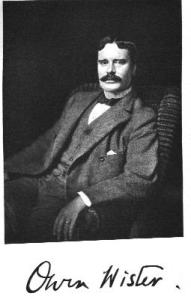
wisterowen1Owen Wister, The Virginian: A Horseman of the Plains (1902) — I started reading this novel January 8, 2009. I was hooked by the first paragraph. I suppose some ‘hawsses’ really are giddy pranksters. Wister’s book is a classic, the first in the western genre, and unexcelled. Humor I can appreciate appears on every page. Bits are stories in their own right, and fun to read aloud. You can hear how the Virginian sounds from the way the author crafts his dialogue. Wister and Theodore Roosevelt were close friends. The complete text of the novel is available online at Project Gutenberg. You could have a look there, then decide whether to get a hard copy. It can be ordered at Amazon here.
Excerpt from Chapter 5—”Enter the Woman”

“We are taking steps,” said Mr. Taylor. “Bear Creek isn’t going to be hasty about a schoolmarm.”

“Sure,” assented the Virginian. “The children wouldn’t want yu’ to hurry.”

But Mr. Taylor was, as I’ve indicated, a serious family man. The problem of educating his children could appear to him in no light except a sober one.

“Bear Creek,” he said, “don’t want the experience they had over at Calef. We must not hire an ignoramus.”

“Sure!” assented the Virginian again.

“Nor we don’t want no gad-a-way flirt,” said Mr. Taylor.

“She must keep her eyes on the blackboa’d,” said the Virginian, gently.

“Well, we can wait till we get a guaranteed article,” said Mr. Taylor.

. . . . The Virginian was now looking over the letter musingly, and with awakened attention.

“‘Your very sincere spinster,'” he read aloud and slowly.

“I guess that means she’s forty,” said Mr. Taylor.

“I reckon she is about twenty,” said the Virginian. And again he fell to musing over the paper that he held.

“Her handwriting ain’t like any I’ve saw,” pursued Mr. Taylor. “But Bear Creek would not object to that, provided she knows ‘rithmetic and George Washington, and them kind of things.”

“I expect she is not an awful sincere spinster,” surmised the Virginian, still looking at the letter, still holding it as if it were some token.”

Living too Fast with Books


This post-holiday season I pored over the offerings of a major bookseller advertizing deep discounts on books. I found much to interest me and placed my order. Shipping was FREE, so I even saved on the cost of fuel driving to the nearest big box book store.

swiftmapping-the-worldThe parcel arrived today. Here’s what came in the box:

Mapping the World, by Michael Swift. This is truly a handsome book. It can’t help make an impression at 17 inches wide and a foot tall—the perfect size to support my MacbookPro on my lap (the thing does get hot). This book, by a writer/publisher that specializes in cartography, lavishly features some 200 beautiful maps. The panoramic layout and size are perfect. This was easily the heaviest book in the box, ensuring that the free shipping really counted for something.

Next out of the box, a book of normal physique by Peter Walsh called It’s All Too Much: An Easy Plan for Living a Richer Life with Less Stuff. What could be more timely than a book to shame me for acquiring so many more books in one day? And in the same box! Whether this is a book I can do without for my soon to be “richer life” I’ll know when I read what Peter has to say.

pipherwriting-to-change-worldOh, here’s Author 101, by Rick Frishman—first of the batch related to writing and reading. This batch includes Michael Dirda, Book by Book: Notes on Reading and Life; Mary Pipher, Writing to Change the World (who isn’t tantalized by that prospect?); Karen E. Peterson, Write. 10 Days to Overcome Writer’s Block. Period. (ordered on the basis of Kurt Vonnegut’s ringing endorsement—Wait. Did he ever have the block?); and, Good Fiction Guide, edited by Jane Rogers and boasting an annotated list of “4000 Great Books to Read” (a classified fiction guide from Oxford University Press).

What have we here? Italian language CDs from Berlitz? Indeed. Also in the “CD category,” Peter Kreeft’s lecture series Questions of Faith: The Philosophy of Religion. I know Peter, professor of philosophy at Boston College, and I expect great audio presentations on atheism, the problem of evil, arguments for God’s existence, religion and science, immortality, heaven, hell, religious experience, and an answer to the question . . . “What would Socrates think?” Hmm.

There’s financial guidance to be had from Ben Stein (the Expelled guy) and Phil DeMuth, in their book Yes, You Can Get a Financial Life! The exclamation point at the end of the title is reassuring. But I wonder, “Is it too late.” Have to see about that. Published in 2007, it does pre-date the fine mess that was made in October by our genius Congress.

Two items for the kitchen, so to speak. Kitchens: Design Is in the Details, by Brad Mee, and the Black & Decker Complete Guide to Kitchens, with everything you need to know to “Design, Plan & Install a Dream Kitchen.” (My idea of a dream kitchen is a kitchen that installs itself. But I couldn’t find a book on that.) Have you seen these Black & Decker guides? They’re the best for the do-it-yourselfer. If you DIY, you may already know that.

Getting back to the simpler life theme, there’s an suitably thin book called The Declutter Workbook: 101 Feng Shui Steps to Transform Your Life, by Mary Lambert. Come on, Mary, we both know that my life isn’t going to be “transformed” by applying feng shui to all our stuff. But for a guy who lives with three women, who have plenty of stuff, it’s a start. And maybe I’ll finally figure out what feng shui is.

I’m not done yet.

You know that book You—The Owner’s Manual? Well now I own one.

In the category of “most exotic cover” is Top 10 of Everything 2009, by Russell Ash. I can’t tell you anything about it because it’s shrink wrapped. But I’m sure it’s good. I bought it, right?

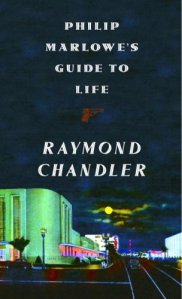
The most diminutive, but maybe the most overall helpful, is Raymond Chandler’s book (or “book-ie”) Philip Marlowe’s Guide to Life. The pages measure 4 x 6 inches, and there’s a profile sketch of a handgun on the front cover. I’m starting with this book tonight.

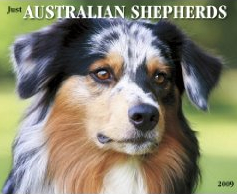
Finally, in the “not-books-after-all” category, there are three wall calendars for 2009, “The Ultimate Motorcycle,” “Just Australian Shepherds” (I think that’s my dog on the front cover), and “On Broadway Theater Posters” (a gift for one of my daughters). I don’t aussie-wall-calendar-cover-2009know yet whether Aussies or Triumphs will adorn the wall in my university office. Either way, I’ll be inspired to get less done.

So there you have it. A forecast of my reading activities for some snatches of 2009.

I got a good deal, but probably spent more money more frivolously than Ben Stein and Phil DeMuth would approve. I hogged up books I don’t have room to shelve, compounding the clutter problem. So Peter Walsh and Mary Lambert will be tisking me. There’s a chance our kitchen remodel won’t be started before this time next year, even with the inspiring ideas book and the step-by-step guide. I do now have a beautiful book of maps—almost a piece of furniture in its own right—for the coffee table we don’t have.

You may not make for inspiring reading, but when you’ve owned a human body long enough, a manual for maintenance and repairs is a valuable reference work. I can work on my Italian, not because I plan to go there again, but because it adds some spice when you can sprinkle your conversation with fancy words like ciao and feel like you mean it. Since I spend little time in my car, the eight CDs of Peter Kreeft should last me for a couple years.

marloweguideI can at least pretend to be changing the world with my writing, and get some help with the effort when I’m stuck, or when I forget that world-changing potential is literally at my fingertips. Jane Rogers will save me the trouble of reading hundreds of books I really ought to read, though she probably can’t do much for the guilt I’m going to feel for cheating. One book I know I’ll read, keep, and re-read is Book by Book. Michael Dirda is, as it says on the book’s cover, “a cultural treasure.”

I have to admit, though, I’ve got to watch this binge book-buying and the dangerous speed reading it leads to. As Philip Marlowe once said, “I got up and went to the built-in wardrobe and looked at my face in the flawed mirror. It was me all right. I had a strained look. I’d been living too fast.”