Fx’s “The Bridge,” Bill O’Reilly, and Me—Another Odd Coincidence


This afternoon I heard a radio announcement that the season premiere of Fx’s “The Bridge” airs tonight. I thought I might tune in. So I settled into my easy chair and flipped on the TV. Bill O’Reilly was waxing eloquent and I was reaching for my TimeWarner Cable guide to find the Fx channel. I paused, however, to listen to O-Reilly’s customary interview with Dennis Miller, often the only worthwhile segment on “The Factor.”

Dennis signed off and I recalled my task—to find where I can get Fx on my TV. I scanned the column of station numbers. And just as my eye landed on “Fx,” I heard Bill O’Reilly actually say “Fx.” I’m not making this up. O’Reilly then went on to remind his audience—that would be me (in a manner of speaking)—that “The Bridge” airs tonight.

Bill O’Reilly is a talented man. But his ability to read my mind, and his inclination to say something about it on national TV, is uncanny.

***

Footnote: Speaking of coincidences, the timing of tonight’s premiere of “The Bridge” could not be better. This is a series about border crossings between Mexico and the U.S. Today there’s as much coverage of our urgent border dilemma as there is of the imminent threat of an Israeli ground invasion into Gaza. Border crossings are making news in more ways than one. And that’s a memo.

The New Apostolic Reformation—Announcing Two New Books


Maybe you’ve heard of it—the New Apostolic Reformation. Or maybe you haven’t. Either way, you probably know someone involved in the movement. It’s even possible that you attend a church that is part of a vast network of churches and ministries promoting the cause of modern-day apostles and prophets. You may be supporting missionaries and Christian organizations that have joined this cause.

Whether you’re sympathetic, concerned, or just curious, I urge you to take a close look and consider how you will respond. This movement is worldwide. Its mission is ambitious. It seeks to control the key sectors of society, including government, education, and the media. And it claims to act with unique authority from God, who has re-instated the New Testament offices of apostle and prophet to usher in the kingdom of God.

Scores of people are drawn to NAR claims that God is now revealing himself through an army of prophets and that they are producing miracles on a scale never seen before in Church history. The signs and wonders performed by the new apostles and prophets, they say, are greater even than the miracles wrought by Jesus.

Scores of people have been injured by this movement. It has divided families. It has left people in financial difficulties they never imagined. It has fostered disappointment with God, who failed to deliver on his alleged promises. It has even left some with a bitter taste about Christianity of any kind.

The major media have been talking about it. But there hasn’t been a serious and detailed investigation of NAR claims until now.

I’ve just completed two books, co-authored with Holly Pivec, about the New Apostolic Reformation, a movement ignited by C. Peter Wagner and now spreading like wildfire beyond the limits of his own influence. We offer a full exposition of the major teachings of movement leaders, and we examine them in detail, testing them against the teaching of the Bible. We conclude that their claims are false and misleading. Some are dangerous.
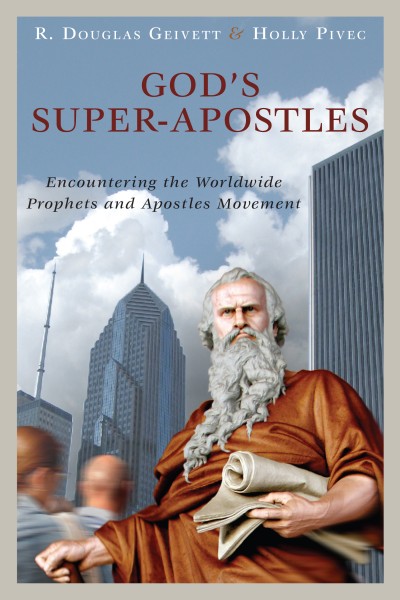
If you’re looking for an overview of the movement and you want a concise biblical evaluation of the movement, then you might begin with our book God’s Super-Apostles—Encountering the Worldwide Prophets and Apostles Movement.
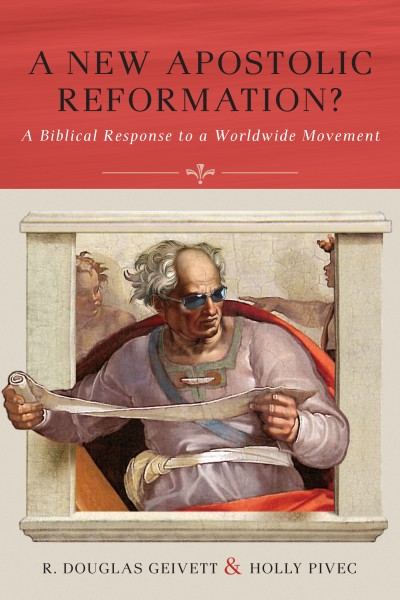


If you want a fuller exposition of NAR teachings and a more complete examination of the movement, then you’ll want to read A New Apostolic Reformation? A Biblical Response to a Worldwide Movement. In this second book we offer detailed documentation for our description of the New Apostolic Reformation. And we carry our examination further, with fuller arguments to support our assessment.

I want to thank Holly for enjoining me to research this movement with her and for collaborating on two books that we believe will be of real service to others, including Christians and non-Christians. Both books are in production now and will be out in October or November. Already people have been placing advance orders with the publisher, Weaver Books.

In the days ahead I’ll be sharing more about the NAR. Meanwhile, you may want to visit Holly’s blog spiritoferror.org.
Writing with Hedges


Good authors hedge their bets. That’s what English professors Booth, Colomb, and Williams claim. But is this always the case? See if you can identify any hedges in this selection from their book The Craft of Research.

“Some researchers think their claims are most credible when they are stated most forcefully. But nothing damages your ethos more than arrogant certainty. As paradoxical as it seems, you make your argument stronger and more credible by modestly acknowledging its limits. You gain readers’ trust when you acknowledge and respond to their views, showing that you have not only understood but considered their position. But you can lose that trust if you then make claims that overreach their support. Limit your claims to what your argument can actually support by qualifying their scope and certainty. . . .

“Consider mentioning important limiting conditions even if you feel readers would not think of them. . . .

“Only rarely can we state in good conscience that we are 100 percent certain that our claims are unqualifiedly true. Careful writers qualify their certainty with words and phrases called hedges. For example, if anyone was entitled to be assertive, it was Crick and Watson, the discoverers of the helical structure of DNA. But when they announced their discovery, they hedged the certainty of their claims (hedges are boldfaced; the introduction is condensed):

‘We wish to suggest a [note: not state the] structure for the salt of deoxyribose nucleic acid (D.N.A.). . . . A structure for nucleic acid has already been proposed by Pauling and Corey. . . . In our opinion, this structure is unsatisfactory for two reasons: (1) We believe that the material which gives the X-ray diagrams is the salt, not the free acid. . . . (2) Some of the van der Waals distances appear to be too small. (J. D. Watson and F. H. C. Crick, “Molecular Structure of Nucleic Acids.”)

“Without hedges, Crick and Watson would be more concise but more aggressive. . . .

“Of course, if you hedge too much, you will seem timid or uncertain. But in most fields, readers distrust flatfooted certainty expressed in words like all, no one, every, always, never, and so on. Some teachers say they object to all hedging, but what most of them really reject are hedges that qualify every trivial claim. And some fields do tend to use fewer hedges than others. It takes a deft touch. Hedge too much and you seem mealy-mouthed; too little and you seem smug. Unfortunately, the line between them is thin. So watch how those in your field manage uncertainty, then do likewise.”

The Craft of Research, 3rd ed.
Authors: Wayne C. Booth, Gregory G. Colomb, and Joseph M. Williams
Publisher: Chicago University Press
Copyright 2008
Pages: 127-129

Questions to Consider:

1. What do the authors mean by a “hedge”?

2. Why must authors hedge when making arguments, even when they are experts in their field?

3. Do the authors do any hedging of their own in this selection?

4. Can you give an example of something you’ve read that came across too smug? How about too timid?

5. It can be tough to tell whether a blog post is trustworthy, knowledgeable, or well-argued. Often, a blogger neglects to hedge responsibly. How would you apply the “hedge test” to the blogs you read?

The Unexamined Life and the Fate of Serious Reading


A serious book about serious reading. By “serious” I mean a book that takes comparatively serious effort. But Bound to Please is also a pleasing book, for those who make the effort. You’ll know what I mean by “serious” and “pleasing” when you read the following selection. Author Michael Dirda comments on a report issued by the National Endowment for the Humanities (NEH)—called “Reading at Risk: A Survey of Literary Reading in America.” The preface to that report is by Dana Gioia, a distinguished poet and critic.

“’Reading at Risk’ is right to lament the decline of what I will forthrightly call bookishness. As the report implies, the Internet seems to have delivered a possibly knockout punch. Our children now can scarcely use a library and instead look to the Web when they need to learn just about anything. We all just click away with the mouse and remote control, speeding through a blur of links, messages, images, data of all sorts. Is this reading? As Gioia reminds us, ‘print culture affords irreplaceable forms of focused attention and contemplation that make complex communications and insights possible. To lose such intellectual capability—and the many sorts of human continuity it allows—would constitute a vast cultural impoverishment.’


“Yes, the Internet has allowed fans of Finnegans Wake and Dorothy Sayers and the English ghost story to gather and share their knowledge. Web sites and chat rooms do encourage people from around the world to form digital communities. But the computer must seem a far more ambiguous gift to anyone who has ever faced screenfuls of spam, or discovered that hours are eaten up just answering email, or found their colleagues drooling over pixellated lovelies, or noticed that their children had stopped going outside because they were unable to tear themselves away from bloody, digitized battles, or simply realized that they themselves felt incomplete when not online every minute of the day—and half the night. In other words, virtually all of us recognize that that flat-screen monitor before our eyes casts an insidious spell, and all too often it seems that the best minds of the next generation—and more than a few of our own—are being lost to its insidious, relentless ensorcellments. Who now among the young aspires to be cultivated and learned, which takes discipline, rather than breezily provocative, wise-crackingly edgy’?


“Americans can still be smart and creative, but the pressure of the times is oriented toward quickness—we want instant messaging, live news breaks, fast food, mobile phoning, and snap judgments. As a result, we are growing into a shallow people, happy enough with the easy gratifications of mere speed and spectacle in all aspects of life. Real books are simply too serious for us. Too slow. Too hard. Too long. Now and again, we may feel that just maybe we’ve shortchanged our better selves, that we might have listened to great music, contemplated profoundly moving works of art, read books that mattered, but instead we turned away from them because it was time to tune into Law and Order reruns, or jack into a WarCraft game on our home computer, or get back to the latest made-for-TV best seller. Sometimes nonetheless, late at night or when faced with one of life’s true crises, we will surprise in ourselves what poet Philip Larkin called the hunger to be more serious.”

MDirda-Book Cover-Bound to Please

Bound to Please: An Extraordinary One-Volume Literary Education—Essays on Great Writers and Their Books
Author: Michael Dirda
Publisher: W. W. Norton
Copyright 2005 by Michael Dirda
Pages xxv-xxvi

Questions to Consider:
1. Dirda compares serious reading with the Internet, to draw attention to the special value of reading real books. What values are compromised when the print-culture gives way to the Web-culture?
2. What is Dirda’s basic thesis? What do you find most convincing about his thesis?
3. How do these few paragraphs make you feel about your own reading practices?
4. What does the word ensorcellment mean? Why would Dirda use an unfamiliar word like this here?