TR on Reading Fiction for Personal Improvement
June 1, 2009 3 Comments
 The American President that most fascinates and inspires me is Theodore Roosevelt. I’ve read several biographies, the best of which is by Texas A & M historian H. W. Brands. I also enjoy collections of TR’s essays and letters.
In a letter to his son Kermit, written from the White House February 3, 1906, the President reveals something of the way he viewed fiction:
Dear Kermit:
I agree pretty well with your views of David Copperfield. Dora was very cunning and attractive, but I am not sure that the husband would retain enough respect for her to make life quite what it ought to be with her. This is a harsh criticism and I have known plenty of women of the Dora type whom I have felt were a good deal better than the men they married, and I have seen them sometimes make very happy homes. I also feel as you do that if a man had to struggle on and make his way it would be a great deal better to have someone like Sophie. Do you recollect the dinner at which David Copperfield and Traddles were, where they are described as seated at the dinner, one “in the glare of the red velvet lady’ and the other “gloom of Hamlet’s aunt”? I am so glad you like Thackeray. “Pendennis” and “The Newcomes” and “Vanity Fair” I can read over and over again.
If TR felt he could read such titles by Thackery over and over again, it is because he did. Thackery is mentioned in many of his letters. Here the father takes pleasure in a shared enthusiasm with his son. And why is he so pleased with the boy’s reading predilections? Apparently because of the power fiction has to form character, to provoke thought about values and truth, and to encourage wise decisions in life.
Evidence for this dominates the quotation. Notice that TR is, in effect, counseling his son about choices in marriage. He is very subtle in this.
It’s pleasing to see that this accomplished public figure had such a relationship with his children that he would write about such things in his letters from the White House.
From the quoted portion of Roosevelt’s letter to Kermit, there is much of positive value to glean:
- He takes time for his children in the midst of major official responsibilities.
- He writes in a slow, reflective pace.
- He guides by example.
- He engages his son in discussion of ideas and values on the basis of a shared interest.
- He shows genuine enthusiasm for great literature outside his range of responsibilities.
- He exemplifies a manner of reading fiction that is directed by the desire to grow in wisdom.
- He advises the young without preaching at them in any condescending fashion.
- He regards his son as a peer in the realm of ideas.
- He looks for points of contact between the fictional characters he meets with in reading and living individuals he knows personally.
It’s enough to make you want to go back and read David Copperfield, and check out the works he cites by William Thackeray.
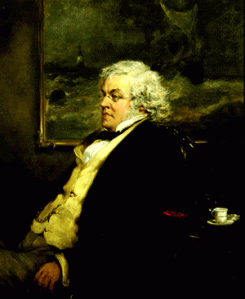
William Makepeace Thackery, Painted by Sir John Gilbert
Works mentioned in this post:
- Charles Dickens, David Copperfield
- William Makepeace Thackeray, The History of Pendennis
- William Makepeace Thackeray, The Newcomes
- William Makepeace Thackeray, Vanity Fair
Kindle users should know that there is a Kindle collection of over 100 of Thackery’s publications (including the three mentioned in this post) that you can get with a single purchase (cost: $4.79 at the time of this post). Click here. I like the Kindle!
 The quotation is from page 80 in The Letters and Lessons of Theodore Roosevelt for His Sons, edited and compiled by Doug Phillips.


 Doug Geivett's Blog
Does “Somewhere in Between” Mean “Ideologically Neutral”?
June 1, 2009 2 Comments
At Politico.com, Michael Calderon has a piece assessing the significance of the drop in viewership at CNN—“CNN fades in prime-time picture.” The brief article is mostly just straight reporting.
These are the “facts”—except for the part about the trick ponies, which I slipped in. And there’s a reason why I use the term “trick pony” to refer to cable TV “news” anchors. To begin, the persona of an anchor is crucial to nabbing and keeping viewers. Everyone acknowledges that. But we should wonder why.
The answer may seem obvious. Take CNN, for example. They claim to be “the most trusted news . . .” Leave aside the question whether the tag captures the truth. Why would they be trusted more than the other networks? Remember, the answer has to have something to do with persona. So why would Anderson Cooper, the leading news anchor for CNN, be, in effect, the most trusted news reporter, period?
The answer we’re supposed to come up with is that CNN is ideologically neutral, and Anderson Cooper is the embodiment of that neutrality. And, we must remember, ideological neutrality is good . . . if it’s news you want.
Calderon begins to reveal this outlook early on, when he contrasts the CNN strategy with the “more opinionated programming” at FOX and MSNBC. Notice that—FOX and MSNBC are “more opinionated” in their programming. Maybe that’s true. But what does it mean, and why believe it?
Well, a network can be more or less opinionated. FOX and MSNBC are “more.” So CNN is “less.” Thus, it follows that CNN may also be airing “opinionated programming,” but just not as much as FOX and MSNBC. But then, what is this more or less of opinionated programming? And are viewers supposed to be able to tell when it’s happening and when it isn’t?
Surely things aren’t that simple.
I think we can agree that Keith Olberman is an opinionated guy, and that he unleashes his opinions pretty regularly on his show at MSNBC. Sean Hannity comes to mind when thinking of FOX. So does Bill O’Reilly, who has created a whole new meaning for the phrase “I’ll let you have the last word.” (If you’re a guest with whom he disagrees, he will, indeed, “let you have it.”)
We agree in thinking that prominent anchors at MSNBC and FOX are “opinionated” because it’s obvious. But here’s the significant point: what’s obvious is what their opinion is. That is, they make it obvious that they are presenting an “opinion” because they tell us when they are giving us their opinion.
Why is this so significant? Because opinions don’t always come flying at us with banners telling us that we’re in the trajectory of an opinion. Often they sneak up on us, clothed with disclaimers that their message is completely “objective.”
Calderon is mistaken in suggesting that CNN is ideologically neutral on the grounds presented by him in his piece. Being neither overtly conservative nor overtly liberal, in the style of FOX and MSNBC, respectively, does not mean that CNN is “in the middle” or “neutral.” It has been convincingly argued that they are not neutral but considerably left of center.
Viewers need skills in detecting the ideological commitments of media outlets, the more so when their commitments are more subtly packaged and publicly advertised as “neutral.”
Share this with others:
Filed under Critical Thinking, Cultural Issues, Media Tagged with CNN, FOX, ideology, Media, Media Bias, Michael Calderon, MSNBC, Social Commentary, television, television ratings