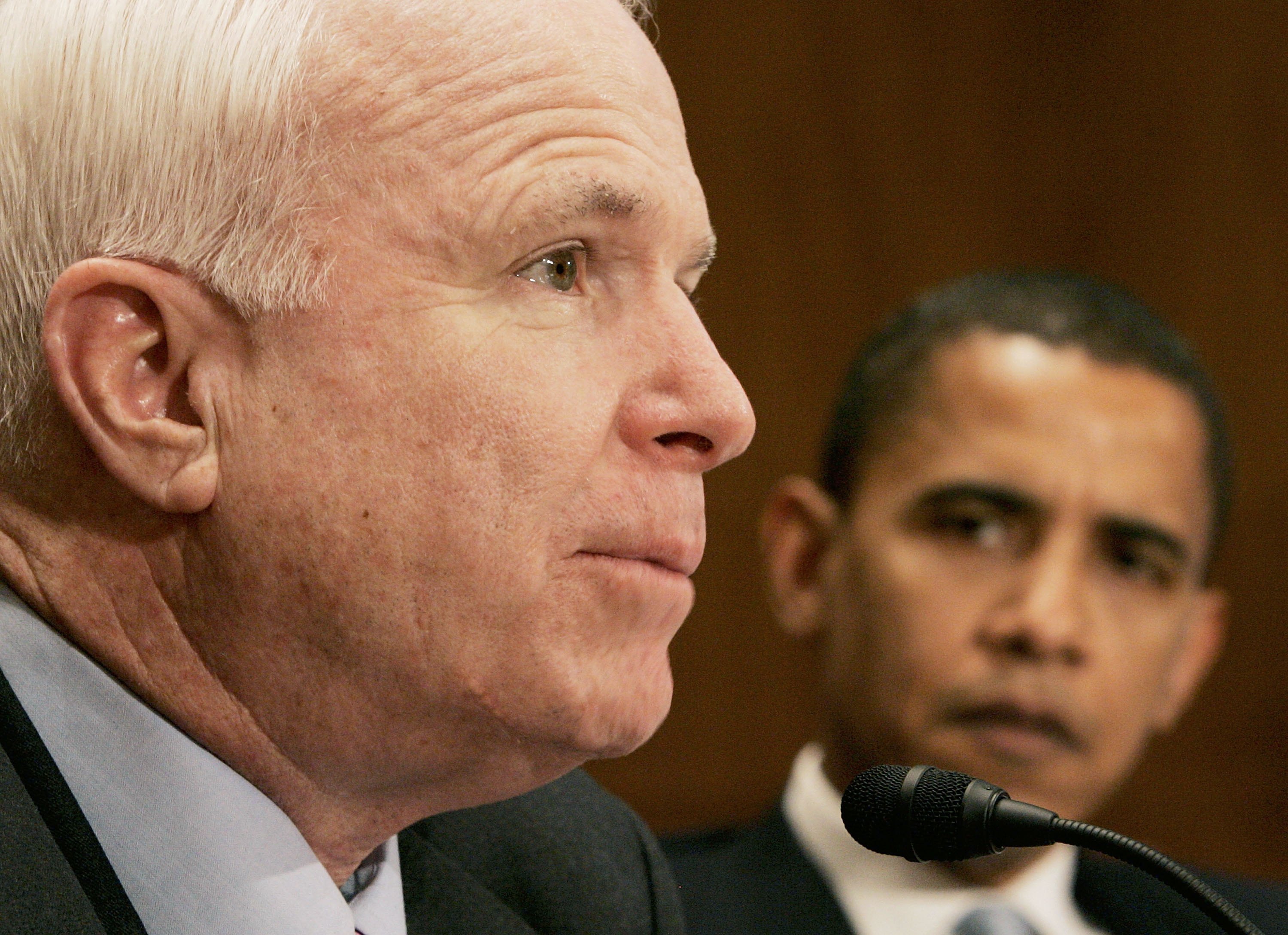
“At Least He Looks Presidential”


Any number of people would look equally presidential in the situation we witnessed tonight. Some of them are good friends of mine. They are self-possessed, have an authoritative bearing, are practiced public speakers across a full range of contexts (including debates), and could have learned everything that was said tonight in less than a week just watching a selection of Obama’s and McCain’s campaign speeches. But none of these friends of mine has any business running for president. Thankfully, they are not.

But Barack Obama and John McCain are running for president. And they both look like they could be president. It’s befuddling and disappointing that this is the single most significant factor the pundits have utilized in calculating the net result of tonight’s debate. Obama only had to look presidential to win—even if McCain also looked presidential—as long as McCain did not deliver a knock-out punch. This because Obama’s lead in critical states has lengthened. And that’s more-or-less how things turned out, if we’re to believe post-debate chatter.

What do pudits mean by a “knock-out punch”? What many of them mean is the slick delivery of a purely rhetorical zinger. An example, courtesy of Brit Hume (Fox News), is Ronald Reagan’s admittedly clever and endearing jibe about not taking advantage of Walter Mondale’s youth and inexperience.

Give me a break. Has the media gone bonkers? The most charitable spin I can put on this is to suppose that the punditocracy is merely speculating (perhaps quite plausibly) about how viewers (especially undecideds) will perceive the outcome. But that isn’t exactly what the pudits are saying. It sounds like it’s what they themselves believe. And they should know better. More than that, they would serve us better if they attempted to educate us in the proper criteria for evaluating a candidate for the presidency. Otherwise, we don’t really need them.

Maybe they think that’s what they are doing—educating us in a tradition of collective wisdom. If so, they and I disagree about what that is and what criteria matter most.

I’m of the anachronistic opinion that we need to distinguish between necessary conditions and sufficient conditions for being qualified to serve as president of the United States. Looking presidential (talk about a subjective variable) may be a necessary condition—may be. But in my judgment it is by no means a sufficient condition. A candidate must have other qualities. And among the preeminent qualities are proven experience and policies that make sense on close inspection.

That probably sounds like an endorsement of a particular candidate. But I’d like to know who disagrees with me about the criteria. “Proven experience” may be a lock for John McCain. “Policies that make sense on close inspection” will be matters of principled disagreement among those who take pains to understand proposed policies thoroughly, know what to look for in sensible policies for times like these, and have the disposition to embrace those policies.

Do you reckon you’re one of those people? I’m not sure I am. Remember that “zen-like” question the candidates had to answer at the end of the debate? “What is it that you don’t know now that you’ll have to learn after you become president?” Maybe those of us who plan to vote in November should be asking ourselves a parallel question: “What is it that we don’t know now (about the candidates) that we’ll wish we knew after one of them becomes president?” Something tells me that tonight’s debate did little to dispel our dangerous ignorance.

Our democracy is threatened by a glib populism. I suppose that’s always been true to some extent. But greater access to modern media by more people, and the dumbing down of America, is cause for concern. This can’t be what the Founding Fathers had in mind, though I’m sure they feared the possibility of its emergence.

Let’s at least think as hard as we can before we “pull the lever” (to use a quaint expression).
The Religious Lives—and Questions—of Children


I know from experience that children think deep thoughts and come up with the most difficult questions. Throughout their childhood, my daughters plied me with questions about the nature of the universe, the existence of God, whether we have souls—that sort of thing. I have always been amazed by two things as a parent and a university professor. First, grad students in philosophy ask questions they probably had when they were three to five years old. They had’t forgotten the answers; they had forgotten the questions. Second, the quirky solutions young kids reach in answer to deep intellectual challenges are seldom more quirky than the ideas of philosophers and theologians about the same things. Come to think of it, their answers often bear a remarkable resemblance!

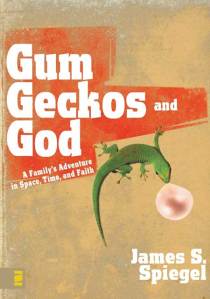
I’m not the first to marvel at this. My friend Jim Spiegel also teaches philosophy. He has twice as many children as I do, and they’re about half the ages of my kids. And his kids don’t let him relax from doing philosophy when he comes home from work. Fortunately for us, he’s written a spanking new book about his experiences in this arena.

It’s called Gum, Geckos and God: A Family’s Adventure in Space, Time, and Faith. My copy just arrived and already I’ve read the first forty pages. Jim is a talented writer and an insightful parent. He can tell a good story, and this book is loaded with them. He’s funny, too, and self-effacing. If you have children or grandchildren, or know someone who does, and you haven’t given up asking questions about faith, I think you might enjoy and grow wiser reading this book.

Ka-ching! Stock Market vs. Credit Market


Near as I can tell, the “bailout,” “rescue,” or whatever, is about shoring up the “credit market.” Banks have to make loans, and they have to have money to make loans. Some pundits are saying that the stock market plunge we’ve been seeing, including the dramatic dive happening today, is not a measure of the prospects for this $700 billion rescue gamble. That’s because they’re splitting off what’s happening on Wall Street with the real problem that is all about credit.

I’m not convinced that the two are unrelated. I’m more inclined to think that the near-panic we’re seeing as people pull their money out of stocks means that people will be very slow to take out new loans, even with the bailout/rescue.

Who wants to borrow money in today’s climate? Time will tell.

Ambivalence about the Congressional Vote for the Not-a-Bailout


Credit is unquestionably tight right now. Individual stock portfolios are in the pits—seemingly bottomless pits. The faux buoyancy of our politicians has evaporated (except Sarah Palin’s buoyancy, which seems anything but faux and far from slipping). Nobody knows whether the $700 billion “bailout” will accomplish much, or even whether it is a bailout or something else.

And I do mean nobody. Nobody has effectively explained how this infusion of government cash is supposed to help the situation. On the other hand, nobody has effectively explained how individual taxpayers could actually be hurt by the action that was taken.

But almost everybody has an opinion about the decisions made in Congress—being either emphatically for it or unequivocally against it. How can this be? What do so many people know and understand that completely evades me?

I’m ambivalent. But that statement has to be qualified, for two reasons. First, I’m not ambivalent about the “pork” or “earmarks” that were weaseled into the legislation. I hope we find out specific ingredients that have no real place in this bill-cum-law, and that we learn by name all those who “porked out.” I hope we find out before the election so we can vote on our representatives with real knowledge of their principles and behavior.

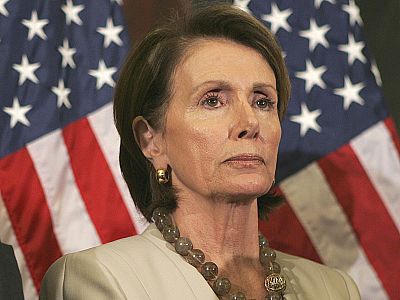
House Speaker Pelosi promises a “bright light of accountability” for greedy Wall Street denizens. But is she willing to shine the same bright light on the doings of Congress to get this bill passed? I’m skeptical. And I wonder if Pelosi herself could be in jeopardy in the November election.

Second, I believe the Fed, the Treasury, the President, and both houses of Congress acted precipitously and pumped hysteria into the atmosphere and needlessly panicked the rest of us. This resulted in self-fulfilling prophecy on fast forward. The market imploded. And we’ll all feel the reverberations of that. Maybe the government needed to step in, maybe not. But this was heavy-handed.

Finally, while I’m ambivalent the general action taken, I’m not indifferent. And if I knew more than I’ll ever know about what just went down, I probably wouldn’t be ambivalent at all.

* * *

Source for “Helicopter Ben” sketch above: UrbanDigs.com

The TimesOnline Make a Good Point about Biden-Palin Debate


Gerard Baker, writing for the London Times Online, has a nice little piece on the Biden-Palin debate. He concludes:

Last week, Senator McCain probably lost his first debate against Senator Obama by not winning it.

On Thursday night Mrs Palin won her debate by not losing it.

That sounds about right to me, on both counts.

I would add that Palin scored points that were missed opportunities for McCain last week. Many were baffled when McCain’s debate with Obama ended and McCain had not drawn attention to his demonstrable record of seeking to reform Fannie Mae and Freddie Mac, while Obama had dubious ties to the principals at those entities. Now I wonder if McCain didn’t keep his powder dry so that Palin could use it to good effect in her salvo Thursday night.

Wall Street Journal Wisdom on Biden-Palin Debate


Jerry Seib, Executive Washington Editor at the WSJ, weighs in already with his “post-debate analysis” and comes to the following conclusion:

It was, in the end, what viewers might have expected from the man who is chairman of the Senate Foreign Relations Committee — much as what they got from Gov. Palin was what they were led to expect from her widely heralded speech to the Republican national convention just a few weeks ago. It was a fascinating byplay — but not necessarily one that changed many minds.

“Not necessarily one that changed many minds”? Apparently, Mr. Seib isn’t one to go out on a limb.

Does anyone else think we should expect more from a Wall Street Journal analyst?