Best Political Cartoon of the Weekend—7 September 2008
September 8, 2008 Leave a comment
Are you good at believing the things you believe? Does it show in the way you live?
September 7, 2008 7 Comments
Reading takes effort. But with the right habits and tools, it is richly rewarding. Here’s a list of tips for improve your reading skills and achieving more of your reading goals.
***
 NOTE: Some of the ideas described in this post can also be found in How to Read a Book, by Mortimer Adler and Charles Van Doren. As the subtitle says, this is The Classic Guide to Intelligent Reading.
September 7, 2008 2 Comments
Many people have said that this year’s presidential election is a referendum on President Bush, and this is a problem for John McCain—because with McCain we would just get a four-year extension of the tired-out Bush policies.
Others have suggested that the election is a referendum on senator Obama because of his inexperience.
Could it be that this year’s presidential election is a referendum on . . . Nancy Pelosi?
John McCain has tapped governor Sarah Palin as his VP running-mate. Many are asking, “But is she ready?” Ready for what? Ready to be the President of the United States if—God-forbid—something should happen to John McCain. After all, the Vice President is only one heartbeat away from the presidency.
So what’s that got to do with Nancy Pelosi?
 Nancy Pelosi is a congressional representative from the state of California, and one of the most liberal members of Congress. She also happens to be the Speaker of the House of Rrepresentatives. The United States Constitution provides for the Speaker of the House to assume the reigns of power if—God forbid—something should happen to both the President and the Vice President. We actually saw Gerald Ford become President in the 1970s through this mechanism—and neither the President nor the Vice President had died!
So Nancy Pelosi is only two heartbeats away from the Presidency . . . right now. That won’t change when we elect a new President and Vice President in November. Maybe we should be looking at her record and experience.
September 7, 2008 Leave a comment
I’m still reading John Wyndham’s classic sci-fi novel The Day of the Triffids. This one’s on my Kindle. I’ve now discovered what amounts to a virtually exhaustive catalog of book covers for all of Wyndham’s novels:
The John Wyndham Post That Made My Brain Hurt
Here are two of the best book covers for The Day of the Triffids:


September 7, 2008 10 Comments
6 September 2008
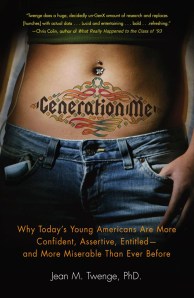 Jean M. Twenge, Generation Me: Why Today’s Young Americans Are More Confident, Assertive, Entitled—and More Miserable Than Ever Before (social commentary)
7 September 2008
14 September 2008
 Michael Dirda, Bound to Please—An Extraordinary One-Volume Literary Education: Essays on Great Writers and Their Books (essays)
1 October 2008
September 6, 2008 Leave a comment
What is the future of religion in America? That depends on the twenty-somethings and the thirty-somethings of today.
 Robert Wuthnow, a sociologist at Princeton University, has sifted through a complex tangle of data about the religious outlook of Americans between the ages of 21 and 45. In his book After the Baby Boomers: How Twenty- and Thirty-Somethings Are Shaping the Future of American Religion, Wuthnow shares his findings about this generation’s perspective on organized religion, worship, the plurality of faiths, the intersection of faith and politics, and the nature of spirituality.
This book presents the case that the 20s and 30s are experiencing a unique form of social isolation. It’s tied, in part, to their tendency to postpone marriage. This influences their relationship to faith and traditional faith communities. But more important, I think, is the disaffection this generation feels in relation to the structured faith of their fathers and mothers.
This generation is no different than any other in its need to experience social integration and cohesion. But the opportunities for authentic participation in community have shifted. Old frameworks are disappearing and new structures are taking their place. Youth programs at traditional churches are still “youth programs”—that is, they enjoin young adults to participate on terms that might have been effective a generation ago but seem to be slipping today. More and more social networking is happening through computers and tools like MySpace, FaceBook, and LinkedIn.
Genuine interpersonal contact relates the souls of persons to each other. But our techno-world literally short circuits the spiritual dimension of soul-to-soul relationship. The result is a kind of spiritual exhaustion that comes, not from over-use, but from atrophy.
The religious life is a communal life. As the nature of community is reconfigured, religious belief and practice is bound to be ordered along a dramatically different trajectory.
September 6, 2008 1 Comment
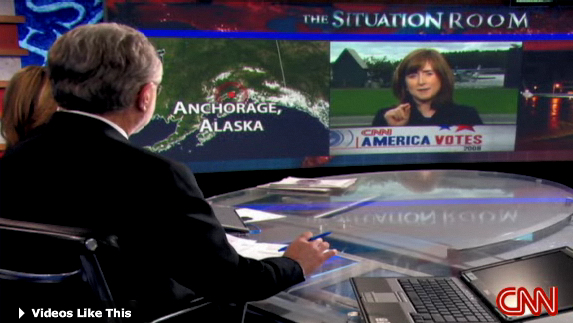
CNN correspondent Christine Romans checked up on some of the bravado expressed by an exuberant Sarah Palin during her speech at the Republican National Convention. You’ll recall that Governor Palin said she had put her predecessor’s luxury airplane on eBay.
CNN thought they should look into that. So they arranged an interview between Wolf Blitzer and Meg Stapleton, former aide to Governor Palin. Stapleton spoke from Anchorage, Alaska. The official CNN version of this interview is recounted with utmost brevity by Romans in her online article “Alaska state jet didn’t fly on eBay”:
“Upon taking office, she [i.e., Governor Palin] wanted to unload what former aide Meg Stapleton called ‘a symbol of corruption.’
“Stapleton told CNN that Murkowski paid too much for the jet, and that it was costing taxpayers money just sitting in the hangar.”
CNN Political Ticker: All politics, all the time – Blogs from CNN.com.
The real story is that, while it’s true that the Governor had the plane listed on auction at eBay, it wasn’t actually sold on eBay, but through a broker, after eBay bids came in too low.
The subtext here is that Palin might have fibbed just a little, or exaggerated the facts . . . or something.
But the real story reported by Christine Romans of CNN is not the whole story. She doesn’t even indicate that Meg Stapleton’s remarks were made during a live and compelling interview she gave with Wolf Blitzer on television today.
You really should see it. I can only imagine what the sophisticates at CNN were expecting from a former aide to Sarah Palin, ensconced in the chilly and woodsy frontier of Alaska. But Ms. Stapleton was impressive. She answered all of Blitzer’s questions about a full range of possible problems candidly and professionally. Every insinuation of possible wrong-doing by Palin was corrected with an articulate and plausible response. And Ms. Stapleton demonstrated unqualified admiration for Sarah Palin that only complemented the favorable impression that Palin herself has made since she was first introduced by John McCain as his running-mate.
Stapleton also demonstrated that Sarah Palin had very capable people working for her in Alaska, and that the big-shot media in the Lower 48 are mistaken if they think their experience and style will intimidate Sarah Palin and the likes of her remarkable associates.
***
For a transcript of Wolf Blitzer’s broadcast from the CNN “Situation Room,” check here. For the complete video of the interview, go here.
September 5, 2008 2 Comments
What the Heck is RSS? And why should I care?
Good questions. First, here’s why you should care. Read more of this post
September 5, 2008 3 Comments
What in the world has happened to journalism in America? US Magazine’s new issue features a picture of Sarah Palin and this essay title in large, bold letters: “Babies, Lies & Scandal.” Read more of this post
September 4, 2008 1 Comment
 “Of course, Sarah Palin’s speech was written by someone else.”
How many times did we hear that from the media last night? I lost count. Keith Olbermann will say anything to make sure people know he’s on the far end of the liberal left. So when he said it, it really didn’t count. But others chimed in. Read more of this post



 Doug Geivett's Blog
Recent Comments