Iron Man—What I Expected, and Why


So last night I finally saw the movie Iron Man. That’s what we like to say, isn’t it, when weeks have gone by before we’ve seen a hit movie of the summer season? The statement often means, “Of course I was going to see it, and probably would have seen it on opening weekend, but somehow other things crowded out my fundamental priorities, and, gee, I’m sorry, people, but I did eventually do what I would have done sooner, if only . . .”

Yea, right. Here’s the truth. When the movie was fresh out in theaters, I called a friend thinking maybe he’d like to see it with me. We see a lot of films together, and pretty much on the spur of the moment—mostly films that are guaranteed to be of little interest to our respective wives. For example, D and J don’t go in much for violence, even of the comic book variety, maybe especially the comic book variety. So I pitched it to him. “How ’bout we go see Iron Man tonight?”

He wasn’t interested. “Maybe there’s a better movie we could see instead?” he suggested and asked at the same time. Not to be thwarted so easily, I started listing off names of major actors in Iron Man, including Gwyneth Paltrow. I kid you not, I was only jesting. I had no idea that Paltrow was in the film; that’s how much I knew about it. And I wasn’t expecting it to be as good as any Gwyneth Paltrow movie she actually was in. Maybe I’d get my buddy to go to the movie, and apologize later for the mistake about Paltrow. No luck.

Sometime later I checked back with him to see if he’d changed his mind. He had. That is, he had already seen the movie with his two sons! So last night I called another friend. He surprised me on several counts. No, he hadn’t seen the movie. Yes, he’d like to see the movie. And yes, he’d be willing to drop everything for the showing scheduled within the next hour.

I wasn’t expecting much, but I did want to see the movie. So what was I expecting? Lots of action. Terrific graphics. Brilliant stunts. These elements do not, by themselves, make for a great movie, even at the level of mere entertainment. A mere entertainment film is a film that isn’t a film, but a “movie.” It has little “intellectual” value and does not remotely qualify as an object d’art. It just kills an evening when you don’t feel like doing much else. And, if you’re lucky, when it’s over you don’t feel like it was a total waste of time.

That was the trend of my expectations. I deliberately aimed low because I was not in the mood for being disappointed.

Iron Man would be predictable (this coming from someone who never once read an Iron Man comic). It would be filmed for kids and rated so adults would come and kids (the younger ones) wouldn’t be allowed to. It would depict the making of a super-hero. That hero would be conflicted about his former way of life and his new mandate to protect “the people.” He would blow away the competition, and bask in the glow of adulation, but with that moderation that we require in our super-heroes (though apparently not in many of our not-so-super heroes). Glib lines would be delivered glibly. . . . Oh, and the original comic book character and his circumstances would be brought up to date, or “contextualized,” maybe in light of post-9/11 trauma about terrorism.

I think the main reason why this is all I expected is that I had assumed all the really good super-heroes and their antics had already been mined bone dry for film potential. If the Iron Man series deserved filmic interpretation, it would surely have been done already and in a memorable way. For that matter, I would have known about Iron Man, the comic book hero, long before the film came out—which I didn’t. (How I could have known the other Avengers and been oblivious to Iron Man is beyond understanding.)

Now, if I had known that Gwyneth Paltrow actually was in the movie, my expectations might have been higher.

In that event, I might have been more disappointed than I was. In fact, I wasn’t disappointed at all. This is a movie I would see again—on DVD. And not because of Paltrow, but because of Robert Downey, Jr. Boy, I never thought I’d say that! But it seems the actor has found a role that’s a good fit on him, as if he kind of lives like the playboy narcissist in the “real world.” Huh.

Jeff Bridges was a surprise, and not only because of his shaved head and bushy gray beard. He was very good as a bad guy. The rest of the actors seemed like they were . . . well, out of a comic book or something. And in this respect, Paltrow was supreme. She acted more corny than her name, Pepper Potts. (Parents, don’t alliterate your children’s names using the letter “p,” especially with words that serve also as the commonest of nouns). Paltrow’s Pepper Potts made the movie seem more like a real comic book come to life. This is a good thing, brilliant, in fact. (Pepper Potts is the subject of special attention in a review at the Hathor Legacy blog. This blog focuses on “the search for good female characters” in film and other pop culture venues. That’s a pretty specialized nighe, I should think.)

Iron Man worked because it was realistic without being too realistic. It was both realistic and true to form. When it was most true to form, it was more fantastic than realistic. But you could swallow the fantastic bits because of the otherwise more-or-less realistic story line. (When realism is wedded almost seamlessly to the comic book form, something has to give, and that something is going to be realism.) It isn’t realistic that Tony Stark survives the ambush at the beginning of the film. It isn’t realistic that his friend, Rhodey, survives the attack, if he was riding in a vehicle behind Stark’s (as we’re made to believe). Stark is so far above average as an improvisational engineer and entrepeneur that the exaggeration is literally comical. And so on and so forth. What is most fantastic, however, is how Stark survives his experiments with palm-operated thrusters in his basement workshop!

That kind of exaggeration is the stuff of old-fashioned comics, though. And the movie Iron Man is the rendering of a comic book character and his story. It can’t be easy mimicking the comic book to such good effect, especially for the jaded audience of the present decade. And that’s why this movie is a film.

I say the film effectively mimicks the comic book. How do I know this if I haven’t read the comic book version? I just do.

Jason Bourne vs. James Bond


If you’re a Jason Bourne movie fan, please let me know here. Do you prefer Bourne over Bond? If so, why? If not, why not? How many of the films have you seen in each series (estimate, at least)? Which would you rather see, another James Bond movie, or another Jason Bourne movie?

I’m just doing an informal poll here.

* * *

Update for 16 November 2008: James Bond has multiple problems. As a film icon, his biggest problem is a dilemma: “Do I play Bond with the key historic links that make this a Bond movie, or do I shake off the clichéd persona of a day gone by?”

Bond is an anachronism. He can’t exist in today’s world. Adapt the storyline to match current events all you like; if Bond is going to be “Bond, James Bond,” he’s going to look like a dinosaur in bow tie and cufflinks. But if he calls himself James Bond without really being James Bond, then he looks like a caricature, like someone who began admiring the real James Bond when he was twelve years old and always wanted to be him.

I think this answers Joel Ryan’s question, over at E!Online: “Why Can’t James Bond Catch Jason Bourne?”

Personal note to Daniel Craig: Please don’t take this personally. But a quantum of solace is about all you have in the day of Jason Bourne. I’m sure you’ll find someone to enjoy the moment with you.

Update for 11 August 2010:

In a 2007 post called “The Best and Worst of James Bond Films,” Webomatica ranks the Bond movies and the Bond actors. Daniel Craig is omitted. Here’s my ranking:

  1. Sean Connery
  2. Roger Moore
  3. Daniel Craig
  4. Pierce Brosnan
  5. Timothy Dalton

What about you?

Does Barack Obama Speak Spanish?


Barack Obama wants everyone to learn Spanish. He announced in Georgia yesterday that he agrees that immigrants to the United States should learn English. That’s a relief. Maybe he’s taken a stand that will hold firm for the duration of his campaign. But this was merely a prelude to his main point. Obama also thinks that every child in America needs to learn Spanish.

What tortured logic leads him to this conclusion? Reconstructed in the form of an argument, here’s the way he reasoned:

  1. If I, Barack Obama, am embarrassed by the fact that most Americans speak only one language, then all Americans should learn Spanish.
  2. I, Barack Obama, am embarrassed by the fact that most Americans speak only one language.
  3. Therefore, all Americans should learn Spanish.

Obama is embarrassed; so I should be teaching my children to speak Spanish. Interesting. I’m starting to feel embarrassed by the logic exhibited by the presidential nominee of a major American party.

Of course, Obama thinks we all should be embarrassed about our monolingualism. Why? Because, as he put it, “when Europeans come over here, they all speak English, they speak French, they speak German, but when we go over there, all we can say is ‘merci beaucoup.'” This got him some laughs from some people in the audience, maybe because they share in his embarrassment.

I’m not sure we should feel embarrassed. At any rate, maybe we should be proud of America’s influence in the world, an influence that has been so positive that people all over the world desire to learn English.

I, frankly, would be just as pleased to be as fluent in German or French as I am in Spanish (having lived in Mexico for six years). I’ve studied German, French, Swedish, and Russian, with mixed results. (I’ve visited China twice, but there’s little hope of my learning Mandarin.) So put me down in support of foreign language learning.

Still, I can’t join Obama in saying that American parents “need to make sure” that their children can speak Spanish. Here’s one reason. If a friend made this proposal in the course of casual conversation, I would think it a little exaggerated. But I’d take seriously the spirit of his admonition, because it would most naturally mean, in that context, that the responsibility to educate children to learn Spanish belongs to their parents. Obama, however, is a politician running for high office. So when he declares, during a campaign speech, that parents “need to make sure” that their children speak Spanish, he means something stronger. He means that if parents don’t ensure that their children speak Spanish, then the federal government may have to step in to make it happen.

This is rich. Tell parents what they should be doing as parents, as if it’s entirely up to them whether to go with his advice. But that’s not what Obama really has in mind. He was speaking as a politician. His words even had a totalitarian tone. If he’s serious, what he said is an indication of how he would reform education in America.

Of course, Obama may not be any more sincere than most politicians. I don’t know when he got this idea that American children should all be learning Spanish. Maybe it occurred to him over the weekend while he was meeting with strategists about how to attract the hispanic vote. There’s an easy way to find out. Just ask Obama’s children a few questions in Spanish.

An even better test would be to check up on Obama’s own proficiency in Spanish. I’d like to hear him give one speech in Spanish, without the use of a teleprompter or a manuscript. I suspect that would be more entertaining than any speech he’s given in English.

***

Here’s an irony for you. Obama mentions the Europeans who come over here and speak English in addition to German and French. I’ve traveled extensively in Europe. The English spoken in western Europe is not uniformly top-notch, although the scope of English-speaking proficiency is impressive. Now, Obama wants us to learn Spanish. Why? Because so many people south of the border have emigrated to the United States, and they don’t speak English. So maybe it’s not los Norteamericanos that Obama should be comparing with Europeans. He may think that Americans are dolts because they’re not bilingual. But at least they speak English!

The irony deepens. Most Europeans come over to visit, practice their English with us, and then return home, happy as clams. In contrast, hoards of Spanish-only speakers stream across our borders, not to visit, but to live and work here illegally. And we’re expected to learn Spanish for their sake!

Most legal immigrants from Mexico, Central America and South America have adopted the U.S. as their new home with a deep desire to assimilate. They have sought to learn English and taken pains to ensure that their children learn English. And opportunities for them to learn English have been made conveniently available. So it isn’t for their sake that every other American needs to learn Spanish.

Do-It-Yourself Reference Source


Blogger Thursday Bram at Stepcase Lifehack has devised a convenient list of “80 How-To Sites Worth Bookmarking,” for the general interest do-it-yourselfer and certain DIY specialists. The list is classified into eight categories, so finding the sites you’ll want to bookmark is a breeze.

All but two of the categories suit me. Can you guess what they are?

Also, if you use other DIY links on a frequent basis, would you mind sharing them in the reply box to this post?

Using the Combox As Your Soapbox


Most bloggers welcome comments at their posts. Some even plead for comments. Many bloggers, as I do, have a “Comments Policy” and moderate comments before letting them through. But this should not discourage you from commenting on a blog post.

This post has two objectives: (1) to encourage blog readers to practice using the “combox” and (2) to offer some tips for making the most of the opportunity to comment.

Reasons to Comment

  1. Commenting helps the blogger gauge the value of his or her posts. If a blank box appears at the end of a post, that’s a virtual invitation from the author to chime in with your response. If no one ever comments, the blogger may conclude that the traffic at his or her site is mostly accidental and that readers are mostly indifferent to what the blogger has written. Zero response does not entail zero interest. But it doesn’t indicate interest, either.
  2. Commenting allows your voice to be heard in the public square, even if you’re not a blogger yourself. The common good depends on participation in dialog with others. Sipping sodas with your best pal and talking politics is a different kind of exercise than packaging your thoughts for broader consumption.
  3. Commenting encourages others to comment. I’ve known plenty of students who don’t want to be the first to ask a question or make a comment in class. Sometimes the period for class discussion begins with several moments of awkward silence. But once a student breaks the ice, others have no trouble jumping in.
  4. Commenting helps you discover and clarify your own ideas. When I begin to write, I usually have some sense of what I want to say. But this general goal congeals into something more specific during the act of writing. Putting my thoughts in writing helps clear the cobwebs in my thinking. So I benefit from my writing, even if my readers don’t. The same goes for blog commenting.
  5. Commenting gives others an opportunity to benefit from what you have to say. Your comments don’t have to be brilliant to be valued by others. Often, the simplest observations are the most useful. There’s actually a good reason to think that the best comments come from readers who are most reluctant to comment. If they push past their reluctance, they may be more likely to make a thoughtful or encouraging or provocative or practical contribution.
  6. Commenting ensures that you reflect on what you read, and so your reading investment pays greater dividends.
  7. Commenting promotes discussion. Sooner or later you’ll find others commenting on your comments. The original author of the post may recede into the background while others carry on a conversation with each other about the topic of the post. This kind of give-and-take yields several benefits. It tests the clarity of your writing as you hear what others think in response to your comments. If properly moderated, it exemplifies respectful discourse among people who disagree and reinforces this important conversational skill. It can be edifying as you see how others benefit from your ideas. It can even lead to new online relationships. A blog post can function like the old-fashioned water cooler at the office, as a place where people, who otherwise might never meet up, interact with each other, learn of common interests, and make new friends.

So there are plenty of reasons to step into the fray now and then as you graze the blogosphere for morsels of insight, entertainment, education, and tips for improving your life in some way or other. No doubt there are many other reasons to comment on blog posts. If you think of any, why not share them in the combox below?

Tips for Commenting

So how do you do it? How do you join the party and realize the benefits described above?

Let’s face it—this isn’t rocket science. It doesn’t have to be complicated. It’s better if it isn’t. But here are a few suggestions that might make commenting more enjoyable for you and those who stumble across (rather than over) your words.

  1. Think about why you went to this post in the first place. Was it accidental? The result of a targeted search? Recommended by someone you know? What pathway led you there? And what did you expect to find in the post? As you read the post you’ll be measuring it against the expectations you bring to it. These are things to write about.
  2. Notice any new thoughts you have as you read the post. Your comment at the end of the post becomes a record of these thoughts that might be lost forever if you don’t put them in writing when you have them. (There are ways to aggregate your comments at various posts across multiple websites.)
  3. Track your feelings while reading the post. In a post about “Leaving the Perfect Comment,” Teli Adlam suggests that you ask how you felt after reading the entry. By paying attention to feelings you have, you gain insight into yourself. Reading the post may have surfaced an internal response that you didn’t expect to have. This gives you something to write about.
  4. Evaluate the argument of a post. Many bloggers offer arguments for claims they make. The combox presents an opportunity for you to assess the argument. You might challenge some premise or evidence used to support the claim. You might offer additional evidence in support of the claim. You can do this whether or not you agree with the conclusion. And you can do it without being belligerent, so don’t hold back. When I “blog an argument” for something, I know the claim and the argument are being released into the broadest possible arena. Why would I risk this? Partly to test the strength of my beliefs or ideas. Partly to see whether my reasons are persuasive to others (something I won’t know unless there are responses in the combox).
  5. Interact with comments others have made. Keep the conversation going. See where it leads. You may want to subscribe to receive email alerts when new comments are made to a post of special interest. Learn about aggregating all your comments across WordPress blogs here.
  6. Be positive. Think of ways to affirm the blogger and others who comment. You can do this without agreeing with their claims or approving of their suggestions.
  7. Proofread your comments before you hit the submit button. Put your best foot forward. Correct any untoward typos or grammatical goofs. Note: If comments are moderated by the blogmaster for the site you’re on, your comment will be screened by the moderator before it appears at the end of the post. Some editors will make minor edits, either to correct typos, repair sentence structure, cull unwelcome language, or what have you. If you know that your comment will be screened, you can ask the screener, right there in your comment, for assistance with your submission.

I’ve given seven reasons to use the combox when you read blog posts, and seven suggestions for leaving your mark. Think of the combox as your soapbox, a socially accepted way to be heard on things that matter to you and others.

***

Here’s a bonus tip: Express yourself with passion. You may not relish the media spotlight. But you probably care about things that pop up on this blog, or you wouldn’t be here. David Avran’s advice makes sense even when it comes to leaving comments at a blog post. Messages that stir meet three invigorating criteria: relevance, credibility, and passion. Go for it!

***

Patsi, over at the Blog Squad, describes proper blog etiquette for leaving comments.

Ferriss, Frauenfelder and Trapani: Three Books for the Productivity Minded


Three books crossed my desk about the same time, Tim Ferriss’s The 4-Hour Workweek, Mark Frauenfelder’s Rule the Web, and Gina Trapani’s Upgrade Your Life. They have certain aims and features in common, so I’ll describe them in one long Reading Jag post.

***

Ferriss counsels his readers to expand their horizons and pursue their dreams, even at considerable risk. He asks a straightforward question: Why put off what you’ve been working for all your life? There are people who work 60+ hours per week, and don’t do much else. Chances are they aren’t happy campers, even if they think they are. Some have been logging dozens of weekly hours for decades. They surely do need to stop the carousel and ask themselves why they got on in the first place. They should also stick around an honest answer.
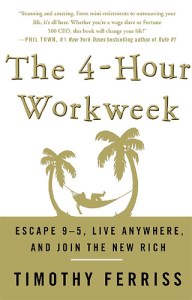
As it happens, Timothy Ferriss is a pretty young guy. To all appearances, he is constitutionally incapable of working a forty-hour week. There’s just too much fun to be had, and much of it requires happy-go-lucky world-travel. Since having fun is his primary aim in life, and work fits uneasily in that scenario, he’s devised a strategy for limiting his work commitments to four hours a week. And he’s managed to make a fortune doing so. This book explains how. It’s also an advertisement for his consulting services for those who wish to follow the plan and achieve the same dream.

Ferriss offers a lot of practical advice about how to manage time, conduct business more efficiently, and join ranks with “the new rich.” And plenty of it is good advice. But layered throughout his enthusiastic campaign to streamline is a work ethic that deserves closer examination than many readers will give. He makes certain assumptions and claims about the point of human existence and the value of work that will be absorbed without awareness by the narcissistic rabble that makes up so much of the American population today.

Living a morally exemplary life has more to do with being than doing. For any significant action or form of life it is appropriate to ask, What sort of person would make that choice? In this case, what sort of person would wish to tidy things up on the scale and in the manner commended by Ferriss? What would it mean for society if everyone behaved in the way that is celebrated here? What kinds of relationships and commitments would be possible living this way? And what would replace the machinery of work as an incentive to personal discipline?

I don’t mean to break the spokes on Ferriss’s wheel. The irony is that “leisure is the basis of culture,” as Joseph Pieper argued. If the community of the new rich use their greater leisure for at least a modicum of contemplation and pursuit of the highest ideals, it will be a good thing for them and others. I like the way Ferriss writes and I share his sense of adventure. I welcome many of his specific suggestions for improving productivity and making room for other important activities beyond work. I recommend the book, but with caution. And I have to say, his website is way cool.

***

The other two books are more about the pragmatics of productivity, and both focus heavily on the use of technology in ordering our lives. Gina Trapani has a name for the person who assimilates efficiency habits in the use of technology—computer technology, mostly. The name is “lifehacker.” The subtitle for Upgrade Your Life is The Lifehacker Guide to Working Smarter, Faster, Better. I don’t know what there is about “better” that isn’t covered by “smarter” and “faster,” or why “better” doesn’t cover the bases all by itself. Titles like these abound, and they’re much more effective from a marketing standpoint when they aren’t subjected to much analysis. But hey, who’s analyzing?
The book, in the edition I have, includes no less than 115 “hacks,” laid out in eleven chapters and 450 pages, if you count the index. It’s definitely “user-friendly,” as any book with its objectives would have to be. Here’s a chapter-by-chapter rundown.

Chapter 1 suggests ten hacks for controlling email. Hack 1, like all the hacks in the book, is stated as a directive and uses a verb in the active voice—”Empty Your Inbox (and Keep It Empty).” If you aren’t already convinced of the value of this advice, Trapani makes a compelling case. And the suggestions for making this work are useful. Hacks 2, 3, and 4 didn’t do much for me. Number 5 is interesting: “Use Disposable Email Addresses.” This can certainly come in handy when you don’t want to risk a barrage of junk mail after divulging your email address online as a condition for some promised benefit. Trapani tells you how to circumvent that dread possibility.

Hack 6 is useful, number 7 not so much (speaking personally, of course). I especially liked learning about hacks 8 and 9, for consolidating email addresses and scripting repetitive email responses, respectively.

The main problem I have with Hack 8 is that I can’t use gmail in tandem with my business email account in the way that’s required. That’s a limitation of FirstClass mail, one of many that have caused me a degree of frustration. I can forward mail from FirstClass to gmail, of course. But if I reply from gmail, recipients get my messages marked with my gmail address rather than my FirstClass address. That’s generally not desirable.

It’s remarkable how often I receive unsolicited questions about some presumed area of expertise, and how often the same questions recur. A solution, helpful to both parties, is to script replies to the commonest inquiries. Scripting repetitive messages and replies doesn’t take much specialized knowledge. But a book of this kind, that is virtually (no pun intended) encyclopedic, has to include a few pages on the wherefore and the how-to.

Hack 10 is OK, but not brilliant in my work environment. (Trapani understands that some hacks will work better for some people than for others.)

Hacks 11 to 21, collected in Chapter 2, are about organizing your data—all that stuff that comes your way and has to be archived in some fashion, ready for future reference. There are hacks for

  • structuring your documents folder (the main thing is to come up with some way to keep unrelated stuff off your desktop and in places where it can be found fairly easily),
  • using searches and various tools to retrieve files,
  • keeping track of the bulging tribe of passwords needed for web logins and such,
  • tagging bookmarks (using del.icio.us, for example; see Brett O’Connor’s book del.icio.us Mashups),
  • organizing digital photos (Trapani likes Picasa; but Leo Laporte, The Tech Guy,on AM radio, recommends an online service called carbonite.com),
  • designing a personal planner, and
  • maintaining paper files.

Chapter 3 is kind of a breakdown in greater detail of the final hack in chapter 2. That hack, number 21, is about designing your own planner. Chapter 3 is titled “Trick Yourself Into Getting Done.” This is a series of eight hacks (22-29) for managing your projects, calendar, and time. The advice is sound. While not entirely original, it’s convenient to have it packaged here with other lifehacking suggestions.

Chapter 4 continues in the same vein, but with greater focus on specific types of activities and responsibilities, using the computer for it all. Here are six hacks for doing more things with your photo library (using Flickr), taking notes, and organizing tasks. Hack 31 explains how to build your own personal wikipedia. It sounds cool. But the cool factor is erased for me because it only works on the Windows platform. I know, I can run Windows on my Mac. But I don’t want to run Windows, which is one reason why I have a Mac.

The last hack of the chapter, number 35, very sensibly suggests using plain-text files for tracking projects and tasks. This suggestion is every bit as useful to GTDers—the cult followers of David Allen’s somewhat baroque strategy for Getting Things Done. I actually like David Allen’s general approach, have recommended his book to my students, and have gifted the book to my research assistants. I imagine GTD appeals most to those of us with obsessive-compulsive personality disorders (sorry, David). But a disorder is a disorder, and you’ve got to work with it. The thing is, a GTD addict may be completely nonplussed about managing life with something as prosaic as plain text, when there are so many exotic software programs specifically designed to play well with GTD guidelines.

(I know something about this, having spent time in that sandbox myself. And I’ve finally settled on a software program that does it all and without an inordinate number of bells and whistles. It’s called Things. I reckon it has all the virtues trumpeted by Gina Trapani on behalf of plain text, but with greater visual appeal and a minimum of setup. Granted, Things doesn’t work with Windows, at least not yet. Which is yet another reason to go with the Mac platform!)

Hacks 36-44 are set forth in Chapter 5. The chapter title, “Firewall Your Attention,” is not especially self-explanatory. But the point is to have strategies for staying focused on what matters, to avoid web and email distractions, and to set up a work environment conducive to productivity.

Chapter 6 is all about streamlining. There are thirteen hacks here, outlining tricks for speeding up web searches and web page displays, using keyboard shortcuts, text-messaging, and managing money using your cell phone (!). I can’t see myself ever using my camera phone to scan text to PDF (hack 57). But I do use Google Calendar and the instructions about this in hack 56 are very helpful.

One of the main advantages of technological excess should be greater potential for automation, especially for repetitive tasks. That’s the focus of the ten hacks in Chapter 7. Trapani explains, step by step, ways to automate file backups, disc cleanups, application launches, Google searches, and media downloads. Backups are a necessity, and the simpler the procedure the better. (Did I mention carbonite.com?) I guess auto-launches have their place, but I haven’t felt much need for them myself. As for automating searches and downloads, this could be a potential nightmare. You can set your computer to download more stuff than you can possibly wade through during your more leisurely moments. And even if you are willing to burrow into so many archives, you’ll still have to remember to do it periodically and muster the inner strength to resist the temptation to loiter needlessly among all the stimulating stuff that’s been collected while you were sleeping. (That inflated sentence actually illustrates the problem I’m getting at.)

Chapter 8 is all about how to go portable with your tech-saturated life. Twelve unique hacks will have you on your way in no time. First you need a web-based office suite. (Not for me, thank you.) Then you want some device or devices for portable storage, like MojoPac or flash drives. (This makes sense.) You may want to use text messaging to run web apps. Since you always have your cell phone with you, all you need to know is how. Hack 73 explains how to create a virtual private network (VPN). I didn’t know what this was until I came to that portion of the book, but I was pretty sure I didn’t want one. Generally, I prefer a network that is so private no one else but me can get in. I have a home network that links me to the women in my life, and, so far, that’s been enough for me.

Speaking of home computer operation, there are nifty hacks for running a home web server (hack 74), implementing remote controls (hack 75), and assigning a web addresses to your home computer (huh?) (hack 76). Hack 77 is a potpourri of simple ways to get the most out of your computer battery, keyboard, screen, and so forth. Gmail can be used as an internet hard drive (hack 80), your cell phone can multi-task as a modem (hack 79), and your iPod can replace your hard drive (hack 78)—well, not replace it, exactly.

Greater web mastery is only sixteen hacks away—Chapter 9. Google like a pro. Use RSS. Multiply search engines. Exploit the URL bar (I knew there was a name for that thing). Get Firefox working for you. Find out what “reusable media are,” then use them and re-use them. Plot data in interesting ways on various maps. Get used to tabbed browsing. Here’s a good one: “Access unavailable web sites via Goggle” (hack 91). You would think that if a website is unavailable, you wouldn’t be able to access it. What does “unavailable” mean, after all? But you have yet to learn the miraculous powers of Google. And the method is all condensed on one page.

Maintain your elaborately constructed browser habitat from one computer to another (hack 92). It takes two pages to learn this one. Lift the hood on a website you’re not sure you can trust (hack 93). Don’t let Google ruin your reputation; expunge their invasion of your privacy (hack 94). Use Google Notebook for web research (hack 95). (This seems to me to be rather like the Firefox extension called Zotero. But I haven’t done a close comparison.) Cover your tracks after browsing the web (hack 96).

Has your computer ever let you down? Get the upper hand using resources on your computer. Chapter 10 takes you through the steps with twelve specialty hacks. These deal with viruses and infections, data-space hogs, firewalls, and lost files. I couldn’t help noticing that many of these hacks are designed for PCs only. Hmm, wonder what that means?

Chapter 11 concludes the book with eight hacks needed to get multiple computers to synchonize and play nice with each other, sharing data and peripherals (like the same printer, for example)

I wouldn’t have had the patience to write a book like Trapani’s. I’d have to mess with Windows in order to offer the best advice to Windows users, and I’d have to write out in excruciating detail various hacks that are mostly a matter of common sense. And I’m beginning to wonder if Upgrade Your Life is the proper title for a book in this genre. Gina Trapani’s motto says it better, “Don’t live to geek; geek to live!”

The book includes an index. Another nice feature is the set of references that comes at the end of each chapter. Most of these references are web addresses for further material on topics covered in the relevant chapter. Trapani has done her homework. And she keeps up with this dynamic field of tech-savviness at her engaging website (to which I have subscribed using RSS).

***

I suggested earlier that Trapani and Frauenfelder have similar goals. Given the encyclopedic nature of Trapani’s book, what can we expect from Frauenfelder that we don’t find in Trapani? Answer: more focus—as indicated by the full title of his book, Rule the Web: How to Do Anything and Everything on the Internet—Better, Faster, Easier. You see, Frauenfelder limits himself to tricks of the internet trade.
But he doesn’t shortchange the reader, since his book comes to 402 pages, including the index. The sheer heft of this reference work (available in inexpensive paperback) convinces us that pretty much anything and everything you can do on the internet is covered in its pages. Testing the claim that you’ll be able to do it all “better, faster, easier” is another matter. I’m in no position to challenge. But I wouldn’t want to; the tactics I find most useful enhance my performance adequately.

Coincidentally, Rule the Web also has eleven chapters. (Or is there some numerological significance in the realm of techno-cultural enhancements?)

  1. Creating and Sharing
  2. Searching and Browsing
  3. Shopping and Selling
  4. Health, Exercise, and Sports
  5. Media and Entertainment
  6. Travel and Sightseeing
  7. Work, Organization, and Productivity
  8. Communication
  9. Toolbox
  10. Protecting and Maintaining
  11. Tips from My Favorite Bloggers

Rule the Web follows a familiar structure. But instead of labeling each hack-like suggestion as a kind of directive, Frauenfelder opts for the interrogative. He formulates a question you might have and then he answers.

Things start off pretty simply:

  • How do I set up my own web site?
  • Is it “website,” one word, or “web site,” two words? (Oops, sorry. That’s not one of the questions.)
  • What’s a domain name?
  • How many people visit my web site?

Notice the conversational tone. Very user-friendly.

  • What are blogs and why should I read them?
  • What is RSS and how do I use it? (This overlaps with Trapani.)
  • How can I blog using my mobile phone? (Finally we come to a question I’ve been aching to ask. Just kidding.)

There is some seriously good advice here for sprucing up your blog to make it more popular. The whole section on podcasting is a good introduction to the subject. Chapter 1 includes advice about using Wikipedia effectively, stowing photos, and sharing files.

Chapter 2 begins with a nice tutorial on the use of Google’s search tools. Page 108 lists some helpful keyboard shortcuts for the Firefox browser. The rest of the chapter offers pretty elementary instruction on browser technique.

Chapter 3 is a hodgepodge of suggestions for buying and selling goods using the internet. The pages about navigating eBay could save users some agony . . . and maybe even a little money. Comparison shopping is treated here, and there’s advice for buying certain kinds of products on the web (like planes, trains, and automobiles—well, automobiles, anyway). I’ve used the web to find user manuals for all sorts of aged products around our house. I thought it was a sign of Frauenfelder’s sensitivity to the things the web can do for people that he included a paragraph about this.

Chapter 4 sounds like it would be one of the longer chapters. It comes to only eight pages. But this is by no means a measure of the wealth of health and exercise information available online. My questions in this category are almost completely different than the ones raised and answered in this book.

Chapter 5 offers a much more extensive survey of internet resources in the media and entertainment category—63 pages, in fact. This is probably a reflection of the proportional use that is made of the web by our generation. (Of course, no other generation has ever used the web.)

Chapter 6 explains the relatively simple procedures for planning vacations, booking airline seats, reserving hotel rooms, and finding restaurants online. These are common uses of the internet, and the treatment could stand a little more in the way of detail for those who already have some elementary sense about web browsing.

Chapter 7 has two categories: personal productivity, and money and financial management. Again, the treatment is sparing, but internet novices are at least alerted to a sample of the range of things they can do online.

Mark Frauenfelder

Chapter 8 is slightly bulkier than chapter 5. And well it should be, since it deals with so many communication options and issues: wi-fi, cell phones, integrating cell phone use with the internet, Skype, email, and protection from spam. Since I travel a lot, I was interested in the brief section about finding free wi-fi service in public places. This led me to buy the Canary Wireless Hotspotter. I don’t use it often, but it does come in handy. I can test a neighborhood for wi-fi signals and see whether they’re free or not, without booting up my laptop. Thank you, Mark, for that tip!

Chapter 9 recommends ways to keep your computer humming efficiently. It also has a section on music downloads and applications that you might expect to find in chapter 5. One page tells you how to eliminate scratches from the display window on your iPod. Several questions deal with iTunes issues, but not the one that’s had me befuddled for several months, namely, Why can’t I download the tunes I’ve paid for at the iTunes Music Store! The best entry in this chapter explains how to use iTunes as an alarm clock. I’ve genuinely appreciated and enthusiastically followed the simple guidelines. Again, thanks, Mark! Next I’ll be trying his technique for capturing a still image from a DVD movie that’s playing on my laptop.

Chapter 10 is about maintenance issues, like keeping your cookies down while navigating all those twists and turns in your browsing (not exactly the way Frauenfelder puts it). Encryption, spyware, phishing, pharming, evil twins, and spam are given space here.

Chapter 11 is potpourri time. Twenty-two different bloggers contribute their ideas for superior web techniques. A couple of these appealed to me: Jeff Diehl’s tip on transcribing podcasts and Hana Levin’s practice using random Google searches to come up with blogging links. I’ll experiment with Cyrus Farivar’s ideas for using Greasemonkey scripts. Other than that, the tips section is pretty short on tips and long on plugging favorite websites.

The index makes it a little easier to find your way around this book. The Table of Contents, with its single-level subheaders, is crucial for quick navigation. Otherwise, thumbing through the pages and browsing is your best bet for finding something that will meet your needs or aspirations. I like the book’s concept. The price tag is covered by even the few things that were most useful to me. But the bulk of it is less than what I needed. And that really counts when it comes to space on my bookshelf. I estimate that there are maybe two or three dozen pages that really helped me out. And that’s how it is with books of this kind. They aim at such a broad audience that, for each particular reader who has some facility with the internet, there will probably only be a few entries that are truly educational. So the ideal audience for this book is the shrinking population of web users for whom the internet remains a total mystery.

Mark Frauenfelder blogs at boingboing.

***

The internet is truly an amazing phenomenon. My brother-in-law and his family are vacationing in the East right now. His wife phoned my wife to ask for a restaurant recommendation in the vicinity of Times Square (like we go there all the time). Fact is, Dianne did recall a restaurant we all enjoyed when we were there as a family in 2001. She just couldn’t remember the name. Our daughters knew exactly what she was referring to, but couldn’t bring up the name, either. Me? I didn’t even remember being there! But after listening to their nostalgic recollections for a few minutes, I knew exactly what to do. I went to the family computer and Googled the following string of terms: “space theme burgers restaurant new york city.” And there it was—Mars 2112, Restaurant and Bar. It will take more effort than that to call the in-laws back with the information.

Mars 2112, Restaurant and Bar

Summer Nights


Summer nights are for . . .

  • taking turns in the batting cage under the bright white lights
  • sitting on the tailgate of the pickup truck, eating ice cream with someone you love
  • listening to the diminutive voices at the end of the street chattering, “Hey, batter-batter!”
  • swimming a few refreshing laps in the backyard pool
  • pausing to hear the distant booming of the fireworks going off at Disneyland
  • strolling down Birch Street (if you live in north Orange County, California)
  • seeing a movie at a drive-in (if you can find one)
  • gathering with close friends round the patio table and talking with hushed voices
  • reading what you want, for as long and as late as you want

  • observing the physical similarities between pedestrians and their dogs at a busy intersection
  • going to the beach, just to see the sunset
  • splurging on dessert on the patio of a fancy restaurant
  • counting each distinct sound the mocking bird makes as you lie in your bed trying to sleep

What are the best experiences you’ve had during the summer nights of your life? Care to share them in the reply box?

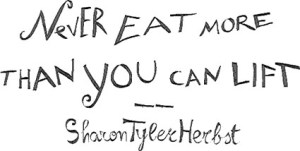
The New Food Lover’s Companion, by Sharon Tyler Herbst


I don’t cook, but I do eat. And while I may not be a gourmand in the strict sense, I appreciate fine food.

Ten years ago, on a bit of a lark, I picked up the second edition of The New Food Lover’s Companion, by Sharon Tyler Herbst. Anyone under the illusion that this is a book about eating in good company had better check the contents before making the investment. This is a reference work that works for me. The second edition boasts “comprehensive definitions of over 4000 food, wine and culinary terms.” Entries are arranged alphabetically and many include cross-references. Most important, there are guides to pronunciation for terms that are less familiar. Don’t know how to pronounce “coquilles St. Jacques”? Turn to page 147.

My copy is bound in 715 pages that open easily to the term I’m looking for. I refer to the book on those rare occasions when I’m trying to understand some exotic recipe. More often, I turn to it when I’m simply curious about what I’m eating or have eaten. Sometimes I skim for something that sounds delectable or adventurous. Just about every time I consult it for a specific term, I find myself checking out other entries. If were writing a novel, it might come in handy as a source for foods to mention or describe. A mystery novel, for example, might reveal that the victim of a crime had been poisoned from eating an unripe May apple. (Before her culinary debut with a book called Breads, Sharon Tyler Herbst wrote mystery fiction.)

This isn’t a book to read cover-to-cover. But that doesn’t disqualify it from inclusion in my Reading Jag posts. Here are some samples of its uses.

What are “floating islands,” also known as oeufs a la neige (not to be confused with ile flottante)? That burning question is answered on page 221.

Huckleberries proliferate in the Great Northwest. But how do you tell a huckleberry from a blueberry? Easy. Count the seeds! The huckleberry has ten small, hard seeds in the center of the berry. There are many more seeds in a blueberry, though they are hardly noticeable. See page 287.

Eating utensils and cooking tools are described. There’s a paragraph on the ice-cream scoop, for example.

There’s information here about cooking techniques, like induction cooking or making a soufflé.

What are those cookies you enjoyed so much at your friend’s big fat Greek wedding? Could they have been kourabiedes?

How are you when it comes to beer terms? Do you know the difference between a stout and a pilsner? What about ale versus lager? Can’t keep track of the different wines or sort out the various cheeses? You’ll find two pages for the entry on “wine,” including a lengthy list of terms defined elsewhere in the book. The general entry on wine also includes basic information about wine storage and serving temperatures. The entry that follows next is about “wine bottles,” addressing the various sizes: split, half bottle, magnum, double magnum, Jeroboam, Rehoboam, Methuselah, Imperial, Balthazar, and Nebuchadnezzar. (I’m not making this up.) The “cheese” entry spans two pages, and nearly a half page of terms for cross-reference.

At a loss when picking out an artichoke at the grocer? Consult The Food Lover’s Companion, page 21.

I didn’t know that “apples come 2 to 4 per pound, depending on size.” Did you? Which apples are best used for cooking? For “out-of-hand” eating? What’s the difference between a Golden Delicious and a Red Delicious, besides color? (For one thing, the Reds have five knobs on the bottom.) I’ve eaten Granny Smiths, Gravensteins, and Mcintosh apples. But there are others I wouldn’t know by name: Criterion, Jonathan, lady, Macoun, May, Newton Pippin, Rhode Island Greening, and Stayman apples. The May apple sounds most intriguing, and the Jonathan sounds especially tasty.

Fish presents special problems for the novice. At a favorite seafood restaurant in Laguna last week, my brother-in-law asked me about the taste of swordfish, one of my favorites when it isn’t baked dry. What could I tell him? Herbst is concise and on the money—swordfish is mild-flavored, with moderately fat, firm, dense and meatlike flesh. Of course, that’s more or less what I said.

The end pages of the book include a copy and explanation of the “Food Guide Pyramid,” produced and distributed by the USDA, guidelines for “Understanding Food Labels,” a “Profile of Fatty Acids in Commonly Used Oil,” “Approximate Smoke Points of the Most Commonly Used Cooking Oils,” an “Additives Directory,” an “Ingredient Buying Guide” showing equivalents in various metrics, a list of “Emergency Substitutions” for the cook who discovers he or she needs an ingredient that isn’t available, a list of “Common Measurements and Equivalents,” “Approximate Metric Equivalents,” charts for converting to and from metric, temperature equivalents and terminology, conversion times for microwave ovens based on wattage, adjustment guide for high-altitude baking, a chart displaying “Approximate Boiling Temperature of Water at Various Altitudes,” a list of “Comparative Baking Pan Sizes,” a chart showing “Candymaking Temperatures and Cold-Water Tests,” a 14-page “Herb and Spice Chart,” detailed diagrams for specific cuts of lamb, pork, veal, and beef. There’s a list of “Consumer Information Sources” about specific foods and wines and a bibliography that comes to thirteen pages. Whew!

Quotations: On Food


A Meal Without Wine Is Breakfast

—Title of a book by Sharon Tyler Herbst

Sources for Quotations about Food and Beverages

What Is It about Licorice?


I like it. The women in my life (my wife and two daughters) don’t. I’m OK with that, but I don’t get it. For me, “licorice” means licorice, pure and simple. “Black licorice” is redundant. If I offer someone licorice, I’ll say, “Would you like some licorice.” But if someone offers me licorice, it’s possible they mean “the red kind.” So I ask, what kind of “licorice”? It’s almost always “the red kind,” and I usually say, “No. Thank you anyway.” And if I am most sincerely polite, I don’t add, “By the way, that’s not really licorice.”

Experience tells me that Red Vines are the most popular of “the red kind.” That’s what the women in my life keep on hand. I’m on my own to keep a stash of the real thing.

So what’s the real thing? Well, to begin with, it’s black. And—surprise, surprise—one key ingredient is . . . licorice, or licorice extract. The substance is extracted from the root of a plant whose botanical name is Glycyrrhiza glabra. The root is believed to have medicinal uses, but it is most often enjoyed in the confection known as licorice candy.

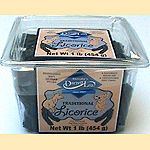
My friend Lucas says he likes the Goodyear brand, for the ingenuity they’ve demonstrated in making tire rejects into something quasi-edible. Thanks to another friend, Kristel, my current favorite is Australia’s Darrell Lea Traditional Licorice, available at Trader Joe’s. Contrary to popular lore, licorice candy is not necessarily tough to chew. The Darrell Lea brand can be masticated with ease, because the bite-size chunks are soft. It contains no trans fats and is cholesterol-free.

The distinctive taste of real licorice derives from the use of molasses, wheat syrup, and, of course, licorice. But texture is just as important to the quality of the experience. It should be chewy, without sticking to the teeth. Bite-size pieces are the right-size pieces, filling the mouth with flavor that lasts long after the candy has been chewed up and swallowed.

Eating licorice in moderation is one of life’s simple pleasures. And Darrell Lea Traditional Licorice makes my list of Favorite Things.

To participate in an informal poll, let me know if you enjoy licorice (not “the red kind,” but the real thing), and if so, what brand you prefer.

A book about “Licorice”:

Licorice: Webster’s Timeline History 1872-2007

Description: Webster’s bibliographic and event-based timelines are comprehensive in scope, covering virtually all topics, geographic locations and people. They do so from a linguistic point of view, and in the case of this book, the focus is on “Licorice,” including when used in literature (e.g. all authors that might have Licorice in their name). As such, this book represents the largest compilation of timeline events associated with Licorice when it is used in proper noun form. Webster’s timelines cover bibliographic citations, patented inventions, as well as non-conventional and alternative meanings which capture ambiguities in usage. These furthermore cover all parts of speech (possessive, institutional usage, geographic usage) and contexts, including pop culture, the arts, social sciences (linguistics, history, geography, economics, sociology, political science), business, computer science, literature, law, medicine, psychology, mathematics, chemistry, physics, biology and other physical sciences. This “data dump” results in a comprehensive set of entries for a bibliographic and/or event-based timeline on the proper name Licorice, since editorial decisions to include or exclude events is purely a linguistic process. The resulting entries are used under license or with permission, used under “fair use” conditions, used in agreement with the original authors, or are in the public domain.

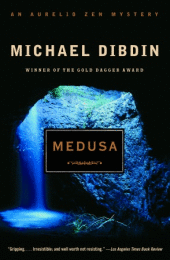
Medusa, by Michael Dibdin


A few months ago, my editor at Oxford University Press and I were talking about favorite authors of mystery fiction. I recommended John Dunning, whose novel The Sign of the Book I wrote about a few days ago. I mentioned to her that I especially like to read novels that are set in places I’ve visited or will be visiting. Knowing that I’d been to Sweden on a lecture tour, she recommended Swedish author Henning Mankell (b. 1948). She also suggested Michael Dibdin (1947-2007), creator of the Aurelio Zen series set in Italy.

I paid a visit to my local Barnes and Noble and selected one book by each author, Mankel’s Before the Frost and Dibdin’s Medusa. Before the Frost is a Kurt and Linda Wallander novel, set in Sweden. I dove into it right away and liked it well enough. My records indicate that I started it November 19, 2007 and ended December 11. Maybe I’ll write about it later.

For the Fourth of July weekend just ended, I read Medusa—mostly during odd moments when the women in my life (my wife and two daughters) were shopping or doing other things when my absence goes unnoticed. Medusa isn’t the first in the Aurelio Zen series, but that didn’t matter. The jacket cover, together with some travel experience, convinced me it was the place to start.

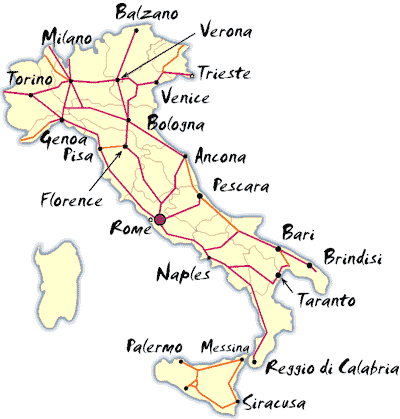
Two summers ago I traveled by train from Florence to Venice, then from Venice through Verona and north to the Brenner pass in the Italian alps. I spent one night in Bolzano, Italy on my way to Salzburg. The hotel, situated opposite the rail station, was a family-run outfit with a storied history. I learned from the manager’s daughter that her grandfather had moved there from Austria before World War 2. A smaller version of the hotel had been his livelihood. During the war, the main floor of the building was commandeered by Italian military forces while the family was permitted to live upstairs. The building was restored to hotel status and expanded during the years following the war.

At the end of the war, the international boundary in the extreme north of modern-day Italy was disputed. This dispute was settled at the Yalta Conference, the result of bargaining by Stalin, Churchill and Roosevelt. The region differs dramatically, both geographically and socially, from the rest of Italy. It’s called the Südalpen, German for “the southern alps.” Italian is learned, but Austrian German is preferred and more commonly spoken by the people living in the area. I didn’t know most of this until my visit, and I was glad that I had casually decided to layover in Bolzano (Bozen, in German). (For a pleasing description of the peculiar culture of Bolzano, see the Washington Post article “Bolzano: German or Italian? Yes,” by Robert V. Comuto.)

The back cover of Medusa states that the story takes place in the Italian Alps. That, together with the author’s reputation with my friend, led me to buy the book. Aurelio Zen investigates a cold-case crime and, as it happens, follows the same route by train that I had taken in 2006. The conditions were nearly perfect for a satisfying read. They would have been only slightly better if I had discovered the book about the time I was entering Austria from the south on my earlier journey.

The story begins with the discovery of a comparatively well-preserved corpse by mountain climbers high in the Alps bordering Switzerland. Three different government agencies take an interest in the mystery surrounding its discovery and the cause of death. Aurelio Zen is a police investigator with the Ministry of the Interior. His assignment is to solve the original crime while also discovering the nature of the interest taken by the Ministry of Defense. Zen goes to Bolzano to observe the body and interview the coroner who had conducted the autopsy. But the body had already been taken into custody, as it were, by military officials. The reader knows there’s a cover-up even before Zen begins to suspect it.

The plot is narrated with suitable complexity. Each section of the novel is narrated in the third person, with an omniscient perspective used for some main character in that section. Different things are going on in different places, all at the same time. So there is movement from one scenario to another to keep the reader up to speed throughout the complex progression of the whole novel. Dibdin manages the tangle adroitly.

Medusa succeeds on the level of sophisticated mystery fiction. It also reveals disparate attitudes about Italian life, or what is frequently referred to as the mysteri d’Italia. Some stereotypes are reinforced. For example, government stability in Italy is oxymoronic, and beneath the Italian facade of joyful contentment is a latent malaise that troubles the general population. There is corruption and intrigue, and hence distrust, at every turn. This is, from Zen’s point of view, “‘Italia Lite’: the new culture of empty slogans, insincere smiles and hollow promises overlaying the authentic adversarial asperity of public life” (50).

Italian words and phrases are sprinkled throughout, sharpening the reader’s sense of being in Italy. Telecomando (for remote control), belissimo, carabiniere (something like classic keystone cops, I gather, but with a military bearing), capo (a respectful form of addressing one’s superior without being too formal?); servizio, disfatta storica, magistratura, Dottore (which is what it sounds like, but used with potentially mischievous connotations), and Pronto! (a typical form of answering the phone, which apparently can be said in a tone suggesting a declaration of war—see page 73).

Some American readers may stumble over Dibdin’s use of British diction. For example, there are no flashlights in the story, but there are plenty of “torches.” “Petrol pumps” (51) are not shoes worn by women working oil derricks. I’ve never heard an American use the word “tetchy” (66). One potentially useful word is now at my disposal, though: “pollard” as a noun and “pollard” as a verb (see page 68).

There are occasional references to historical events, some of them grand, like the Versailles conference, others relatively obscure, for instance, “the bomb of 2 August 1980” (65).

Those with culinary aspirations learn that, to be worth eating, minestrone must be accompanied by fresh vegetables and high-quality olive oil and Parmesan; otherwise, a person of cultivated taste should order lentil soup with chunks of smoked bacon (45). (I would have opted for the lentil soup, in any case.)

Descriptions of place and strings of dialog are often artfully crafted. I enjoyed coming across such constructions as:

  • “. . . the only sound was the whine of the unpredictable squally breeze with fistfuls of sleet in its folds” (42);
  • “The wormholes pervading the body politic remained, but the worms had never been identified, still less charged or convicted” (65);
  • “. . . he recalled his childish fascination with this physical oxymoron: water flowing over water” (76);
  • “Whatever the outcome, it could not be worse than living in a state of perpetual uncertainty and inchoate terror” (78; maybe hell is quite literally like that?).

And how could I not appreciate Zen’s exasperation when he declares to his chief,

  • “We can’t disprove it, because they haven’t given us anything to disprove” (85)?

I’ve yet to hear a more apt description that noxious deviation that nevertheless has to be called “architecture”:

  • “the abusivo building boom of the sixties and seventies.”

Here is a clever paragraph contrasting scientific theory and religious belief:

  • “He [Gabriele Passarini] remembered having read somewhere that the difference between a theory and a belief rested not on proof but on the possibility of disproof. No matter how many observations appeared to corroborate the theory of relativity, for example, it could never conclusively be proved to be true. Its scientific respectability rested on the fact that it could instantly be proven false should contradictory evidence come to light. The same did not apply to the idea that God had created the world in six days and then faked the fossil record to suggest otherwise, which is why this amounted to nothing more than a belief. As did his fears about his own safety, he now realized.” (69-70)

and what must have been an irresistible sentence about the medieval church:

  • “The church would have banned [Halloween], . . . or at least fulminated against it.” (72)

There are other ruminations of interest. Gabriele speculates that the world used to be “hard but benign,” but now it was “soft and malevolent” (71). Zen waxes philosophical about children today, in comparison with children of a bygone era (82).

I believe I have rarely come across the word “fireworks” while reading a novel. It wouldn’t be strange if I did, unless it happened, quite unexpectedly, on the 4th of July—as it did the other day when I came to page 75. This is just one of those little inconsequential coincidences of life that seem to happen in my experience with uncanny frequency.

In addition to a larger vocabulary of Italian words, and the addition of one English word, I’ve acquired from Aurelio Zen a new trick for assisting a long-winded speaker to get to the point. Just say, politely, of course, “Yes, yes. And the upshot?” That alone is worth the price of the book.

I also learned that Giovanni Agnelli was “the creator of Fiat”—perhaps you see why the four words in italics struck me as oxymoronic when I came across them on page 92. (Finding out who started the Italian motor company is not worth the price of the book, since I don’t expect to be on any of those game shows that test your mastery of trivia.)

This novel was published in 2003, so it can’t have been intentional that the passage at the top of page 93 almost exactly parallels the campaign strategy of a chief contender for the upcoming election of a new President. But then, what politician really is “a new kind of politician”?

I recommend the book, and I’m game to try another Dibdin. Next time maybe Dark Specter, not one of Dibdin’s Aurelio Zen installments. The publisher’s description says that “a dogged Seattle detective and a horribly bereaved survivor are about to come face-to-face with their perpetrator—a man named Los, a self-styled prophet who has the power to make his followers travel thousands of miles to kill for him.” Seattle is one of my favorite cities, and the Great Northwest is my favorite region among the places I’ve visited or lived.

By now you’re thinking, “Yes, yes. And what’s the upshot?” Just this—if you ever find yourself traveling by train between Venice and Florence and between Venice, Verano, and Bolzano, I suggest taking this novel, Medusa, along with you. You’ll enjoy it, and your trip will be more meaningful than if you studied the pages of a travel guide.

Best Quote Challenge—On Happiness (July 6, 2008)


Lytton Strachey (1880-1932) broke new ground as a biographer committed to describing the psychology of each subject he wrote about. His most familiar work is a set of chapter-length biographies called Eminent Victorians (1918). Strachey’s close study of the human condition led him to conclude that “happiness is the perpetual possession of being well deceived.” It’s doubtful that anyone who believed such a thing could be happy.

Born to privilege and suffering great reversals later in life, François de la Rochefoucauld (1613-1680) was not quite as pessimistic. He wrote, “We are never so happy nor so unhappy as we imagine.” If he’s right, one has to wonder how he knew.

The Best Quote Challenge for this week—July 6 to July 12—is “On Happiness.”

Here are the rules:

  1. Submit your quotation no later than July 12, 2008.
  2. Submit no more than one quotation for this challenge.
  3. Identify the source for the quotation you submit.
  4. Feel free to quote yourself; that is, you’re welcome to submit a quote of your own invention.
  5. Use the “Leave a Comment” link below this post to enter your submission.
  6. All submissions will be screened and must be consistent with the general guidelines for posting comments at this blog. (See the “Comments Policy” page.)

On Sunday, July 13, a new Best Quote Challenge will be set at this blog. During the week of July 13-19, votes will be taken for the “Best Quote on Freedom” submitted this week. So be sure to come back to this post then to cast your vote using the “Leave a Comment” link below.

Movies for the Fourth of July


Patrick Henry vs. Bruce Willis


Who said, “Give me liberty, or give me death”? No, it wasn’t Bruce Willis, though the actor did star in Live Free or Die Hard. Same thing, right? Tomorrow is Independence Day. The “Best Quote Challenge” for this week is still in effect through Sunday. Topic? “On Freedom.” Help me out here. Go to my June 29th post titled “Best Quote Challenge—On Freedom” and share your favorite quotation.

Movie trailer for Live Free or Die Hard.

The Sign of the Book, by John Dunning


Years ago I read John Dunning’s detective novel Booked to Die and realized I’d found a new author to stalk during my reading jags. The novel was the first installment in Dunning’s series featuring Cliff Janeway, ex-cop and second-hand bookseller, living, reading, and sleuthing in Denver. I watched for the sequel, The Bookman’s Wake, but somehow missed it (if memory serves). Almost ten years went by before there was a third installment. By then I had stopped monitoring Dunning’s authorial movements.

About seven months ago I stumbled across The Sign of the Book, #4 in the series. I reckoned I could get away with reading it without playing catch-up on #2 and #3. I was right. But I didn’t put this theory to the test until recently. Saturday was my first beach day of the summer. I brought the Dunning novel with me to Corona del Mar and enjoyed my re-introduction to the author and his detective.

To the degree that I can recall, Dunning is true to form in #4. I still like his style and will eventually get to his other series books. Dunning adopts the first person point of view, probably the trickiest POV out there. When reading fiction written in the first person, I have the tendency to ask periodically why the fictional narrator is telling me his or her story. First person point of view doesn’t work for me if there aren’t any clues about the speaker’s motive. The first-person novel is, after all, one long monologue—in this case, 513 pages worth.

Dunning makes it work. Only rarely did I take exception to the way he handled the speaker’s perspective on the mental states of other characters in the story. This novel impresses me as an exemplary specimen of first-person narration. It’s fitting that in the final sentence of the novel, Cliff Janeway remarks, “The mysteries of the human mind are far beyond my comprehension.” (I’m confident that quoting the last sentence is not a spoiler.)

The writing is intelligent, but The Sign of the Book is not literary fiction in the hifalutin sense. Each character speaks in a distinctive fashion that is consistent throughout. The best bit of dialog occurs in a courtroom scene. I was a little confused about the floor plan of an important building at one point in the story. But this was not as much of a handicap for Janeway as it was for me.

This isn’t comic fiction, but Dunning manages to amuse with his choice of words and the dialog at which he excels. Suspense comes in two forms. First there’s the plot and the mystery about who dunnit. But frequently along the way there are stretches of suspenseful action . . . or inaction . . . as well. And that’s critical to the success of a detective novel (in contrast, for example, to the sort of mystery fiction so masterfully crafted by P. D. James).

One more thing. Janeway taught me a new way to survive the monotony of waiting for countless hours with nothing to do. This could come in handy if I’m ever on a stakeout without my Kindle.

***

John Dunning is a distinguished author. Booked to Die won him the Nero Wolfe Award, and The Bookman’s Wake appeared on the New York Times list of Notable Books. Other detective novels of his have been nominated for the Edgar Award. In addition to awards, Dunning has readers. Drew Goodman, book sales manager at the University of Utah campus store, has gone so far as to include two of Dunning’s Janeway novels on his “Sacred Shelf of 10,” as of October 25, 2007.

Classic Mystery Reads:

The Films:

For the preview and Unbox rental for The Maltese Falcon, go here.