Why Book Covers Matter


As a reader, I care about what books in my library look like. As an author, I care about what my books look like. Cover art has its own aesthetic. It should appeal. It should say something about what is between the covers, but without saying too much. And, if you’re a marketing director at a publishing firm, it should have what they call “pop”—it should get a prospective buyer (notice, I didn’t say reader) to turn the book over, to read the blurbs, to inspect the pages. With that sort of investment, there’s a better chance the book will sell (whether or not it’s read).

There’s more to the aesthetic of a book than its cover design. What does it feel like in the hand? How are the pages trimmed? Are they ragged, or clean? What about the paper itself? What is its quality? The font, the margins, the kerning. These all matter.

The cover is special. It’s the most noticed feature of the aesthetic of any book. And yet, for me at least, it isn’t always noticed. Countless times I have perused a book without noticing, much less examining, its cover. Not everyone is flawed in this way. I’m sure that what I don’t attend to directly still leaves an impression via its subliminal power. But when I do notice, this noticing is often the source of two different feelings, which may or may not concur. I’m either bewildered by the art or pleased by it, or both.

What I mean by bewildered is quite simple. I don’t get it. I can’t make heads or tails of it. I don’t understand it. And this is what is arresting about it. The design of the cover confuses me or strikes me as impertinent. I assume that the cover is designed. That is, there’s an explanation why this cover is attached to this book. But the explanation escapes me. This intrigues me, especially if the art is at the same time pleasing.

When I say I’m pleased by the cover art of a book, I mean that it gives me pleasure. This is more difficult to explain. And the pleasure induced by a particular cover may be diminished or it may be intensified by the effort to explain its special appeal. Explaining the appeal of a book cover must begin with a description of the experience induced. And this is remarkably variable.

At any rate, this experience of pleasure may be a selling point for me. I may wish to own a copy of the book as much for its cover design as for any other reason. I may feel this way even if I realize that the book holds this “limited” attraction for me. I may even buy the book. This could explain, at least in some cases, why I have purchased a book at a brick and mortar establishment, even if I could have saved a few dollars by ordering it online. It isn’t necessarily an indication of impatience. It may have to do with an attachment to this particular copy of the book I hold in my hands. It is this one that has provided the pleasure. I will zigzag through the columns of books, each shelved book beckoning hopelessly for my attention. I will stand in line, beholding the book with persistent wonder. I will step up to the cashier and hand over my credit card with satisfaction.

The physicality of this unified experience cannot be matched by a paypal order. I will leave the store “holding the bag,” feeling responsible for my purchase. I may pull the book out and place it on the passenger seat of my car, giving it occasional sidelong glances as I return home, and thus extending the experience of pleasure. The prolongation of the experience adds texture to the experience.

At home, I will leave the book out for awhile, so that the initial pleasure returns for brief instants as I tend to other business. I will wait to “process” the book, to assign its place in my collection. For now, its place is distinctive. It is not just one more book among many. It has a distinctive power over my attention.

To be sure, and thankfully, there won’t be many books like this. Man does not live, aesthetically or otherwise, by books alone. But the quality of life may be improved by the cover of a book.

***

A Book about Book Covers

Links about Book Covers
First Lines: Thinking of the Future When It’s Become the Present


“Not until my ears popped and the plane was coming down over the winking lights of Bogatá—or really it looked like any other city at night—did I raise my eyes from the page I’d been puzzling at and begin to think of the girl, or woman, the friend or acquaintance, Natasha, whom I was flying so far to visit. That’s how it was with me then: I couldn’t think of the future until I arrived there.”

—Dwight B. Wilmerding, lead character in the novel Indecision, by Benjamin Kunkel

“I couldn’t think of the future until I arrived there.” In this case, the character is literally arriving by plane at

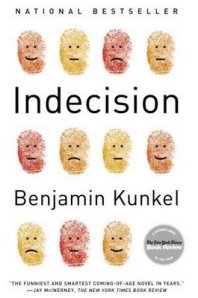
Book Cover for Indecision, by Benjamin Kunkel

Book Cover for Indecision, by Benjamin Kunkel

Bogatá, and he’s thinking—really thinking—for the first time about the point of his trip. Whatever he was reading before this moment had occupied his attention and had nothing to do with what was going to happen next.

Wilmerding was there to visit Natasha, and he’d come a long way by plane. Natasha doesn’t have a settled identity for this protagonist. She is, variously, “the girl, or woman, the friend or acquaintance” he’s come to see. These are his thoughts. But if this is so, why has he travelled so far to see her?

That’s what we want to find out, isn’t it?

As for Bogatá, on approach into the airport, it didn’t look different than any other city at night. Has he seen Shanghai, I wonder? But I take his point—in a way, cities do look alike, even the ones we’re seeing for the first time. We approach a new place intent on noticing what’s foreign about it. We’re romantics when it comes to travel. But if we think about it, we really must be more modest. We have projected a difference that doesn’t exist.

Wilmerding hints that his penchant for waiting ’til the future arrives before thinking about it is now past. That’s interesting. What accounts for this idiosyncrasy? And are we any different? Shall we find out?

That’s our question as we stand in the Barnes and Noble fiction isle trying to decide whether to buy and read Kunkel’s novel. We are in the grip of Indecision.

First Lines: What Does Sunday Sound Like?


Sometimes you read the first line of a novel and you just have to take the next step. If you’re lucky, the next sentence is equally galvanizing, and before you know it, you’re deep into another read.

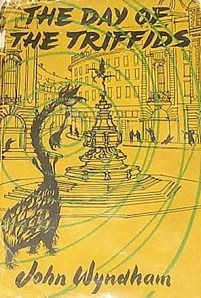
The experience is rare. But it happened for me again the other day. The sentence that did it comes from John Wyndham’s book The Day of the Triffids: “When a day that you happen to know is Wednesday starts off by sounding like Sunday, there is something seriously wrong somewhere.”

First Edition Cover of John Wyndham's Novel, The Day of the Triffids (1951)

First Edition Cover of John Wyndham's Novel, The Day of the Triffids (1951)

The Day of the Triffids is favorably reviewed by its numerous readers. For example, it averages four-and-a-half stars at Amazon for sixty-nine customer reviews. But it’s still not known very well outside the sci-fi community. Paul Thompson, of Devon, England, has dedicated a website to this book. It’s called “The Reader’s Guide to John Wyndham’s The Day of the Triffids.”

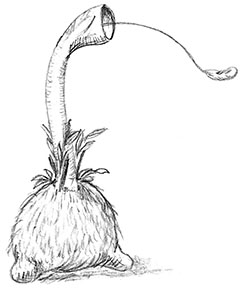
Here is an artist’s rendition of a triffid:

Sketch of a Triffid

Sketch of a Triffid

Best discussions of The Day of the Triffids:

If you’re familiar with Wyndham’s novel, please post your thoughts.

My Motorcycle vs. Batman’s


Whose cycle has the greatest cool factor?

Be honest.

Doug's Rebel

Doug's Rebel

Batman's Pod

Batman's Pod

Related Posts:

No Joke—Morality Matters


My daughter and I planned to see The Dark Knight together. One of my movie buddies, who saw it earlier this week, said I should spend the time some other way because the film was average, at best. Naturally, I had to see for myself. And when my daughter asks me out on a date, how can I refuse?

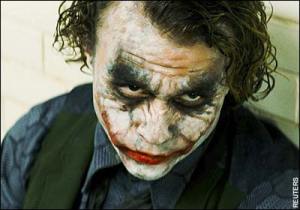
I kept hearing that the movie is “very dark.” This isn’t a very enlightening summation (no pun intended). In fact, now that I’ve seen the movie, I wouldn’t say that at all.

First, Gotham City is remarkably lit up. It doesn’t have that pervasive seedy look that we naturally associate with the City. It looks like a normal American metropolis—present-day New York, in fact. Doesn’t the director know that Batman movies of the past have uniformly rendered Gotham City gothically? Of course he does. So maybe there’s a message there: a bright and bustling city on the brink of moral chaos . . . . Hmm.

Is city-wide chaos really imminent? The citizens think so; the Joker hopes so. And by the end of the movie there is quite a mess to clean up. The demolition of the General Hospital, the disarray of the police force, panic in the streets, mangled vehicles piled everywhere, the involuted character of the District Attorney, are all powerful symbols of disintegration. Teetering on the brink, however, a deeper truth about Gotham’s citizens is brought to light.

Isn’t that what the Joker believed, that in those final moments, with life in the balance, a person’s true character is revealed?

The Joker’s mind is supposed to be completely inscrutable because there quite literally is no method in his madness. This is how he wants to be known, and this is how he is regarded. He has an appallingly distorted view of the world. We can agree that his childhood experiences contribute significantly to his twisted perspective. He seems genuinely unable to resist his urge to injure others. He is, we imagine, driven by some unintelligible motive. But for all that, the Joker is a calculating individual, with a conception of humanity and our shared moral impulses.

The Joker’s worldview is dark. It is repugnant. But it is not representative. He reasons that the good conduct of individuals in an ordered society is an illusion. There is no goodness, deep down. All people are fundamentally self-interested. The Joker is so sure of this that he fully expects one group of passengers on one ferry to blow up the ferry loaded with other passengers. It doesn’t matter which group prevails, the group of ordinary citizens or the group of convicts. In their heart of hearts, they do not differ. And though they deliberate about saving their own skin at the expense of the others, each group ultimately resists the temptation. Even the convicts, represented by a truly imposing man of criminal bearing, do the right thing. And the Joker is baffled. Batman notices this and rubs it in. It is the most effective means of wounding the Joker: demonstrating that his worldview is simply false.

The Dark Knight is not a dark film. It conveys the hopeful message that morality matters, and that it is within reach. It also reflects the possibility of self-inflicted character deformation. The Joker is not altogether mistaken when he says, “I’m not a monster—I’m just ahead of the curve.” His sinister behavior is the result of habit, fueled by an obsession with his own injuries. He plays the hand he’s been dealt in life with clownish charades of “chance” behavior. His life is tragic, but he is a responsible agent in a morally significant arena.

Unfortunately, the film makes no attempt to explain why morality matters. Being good appears to be a purely secular value. As such, it dangles in suspended animation, rather like the Joker himself, whose fate remains a mystery at the close of The Dark Knight.

My Bucket List


Roger Ebert was offended by the movie The Bucket List. He thought it made a mockery of the seriousness of terminal cancer. Maybe he took the film a little too seriously.

My gripe with the movie is different: while it pays tribute to friendship and its redemptive value, it fails to come to grips with the the real value of an adventurous life. The Jack Nicholson character, true to form, is all about exotic thrills, the rush of adrenalin, and tempting fate. The Morgan Freeman character has more depth, but as a comparison with Nicholson, that’s not saying much. Both men are self-absorbed; neither can place “the list” into the context of purposeful living.

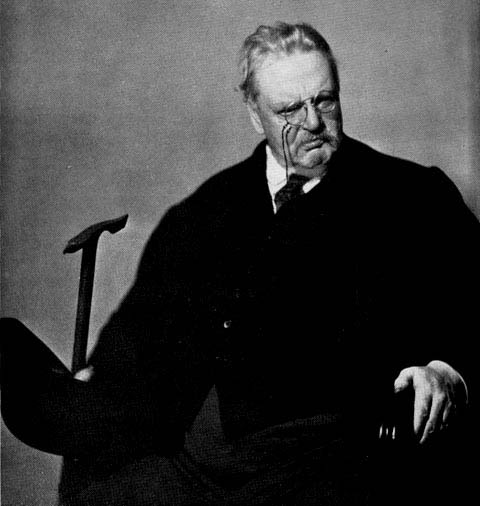
G. K. Chesterton

Today I read these words by G. K. Chesterton: “An adventure is only an inconvenience rightly considered. An inconvenience is only an adventure wrongly considered.” Chesterton could see the adventure in the ordinariness of life. Anything can be regarded with the lens of expected surprise. But the inconveniences of life, even the most mundane, afford real opportunities for adventure—a kind of living beyond the ordinary without demanding a change in circumstances. It all depends on perspective.

Today I had an adventure. Not a big, spectacular one that I can check off my own personal bucket list. I had been shopping for something on Craig’s List and had an appointment at a seller’s house. When I rang the doorbell, dogs began barking. Nothing unusual about that. But suddenly, one dog, yelping wildly, sprang through the screen door and lunged at me. As I reared back, the dog grabbed my shirt-tail in his teeth.
I wasn’t injured, but my favorite summer shirt is in tatters.

The adventure potential of this experience really was a matter of perspective. I didn’t like the sudden conversion of my shirt from something that was a pleasure to wear to a rag more worthy of washing the car. But I did feel oddly energized by this close encounter with physical danger. And I can imagine wearing the shirt in future as a badge of courage, so to speak. For a moment I was reminded that real surprises happen. I’m not generally fearful of dogs. And I didn’t have time for fear in this case. The dog—like my own dog, an Australian shepherd—was on me in an instant. But as the dog fled, I felt the exhilaration of a survivor.

In the modern world, we often have to manufacture experiences of that kind. Some go in for extreme sports, others for extreme travel. I like sea kayaking and motorcycling, each activity with its distinctive set of challenges and array of risks. But they aren’t things I have to do, in the utilitarian sense of “have to.” If I have to do them it’s because modern life is a little too humdrum.

Isn’t that why we have “bucket lists,” adventure ticks that we hope to get out of our system before we pass on?

Claudia Root and Jerry Root

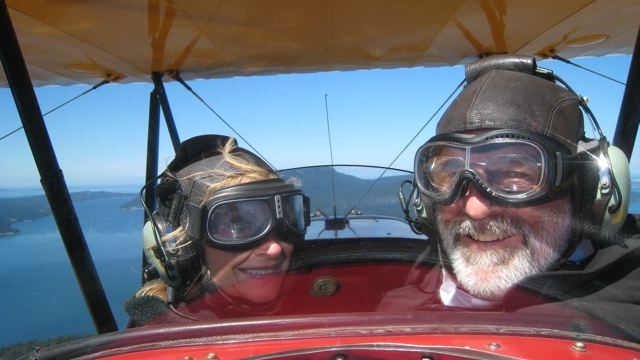
Today I had an email message from a good friend who lives in another state. Completely incidental to the message of his email was an attached photo of him and his wife in a bi-plane over the Puget Sound. They’re sporting goggles and leather headgear—and broad smiles, of course—in a tight picture that says, “We’re having a blast, and we’re doing it together!”

I love the Puget Sound, and I love flying. I’ve dreamed of making a pontoon trip there some day. But it never occurred to me to view the San Juan Islands from altitude in a vintage bi-plane. I’ve now added that to my personal bucket list.

But I have another goal, as well—to remember Chesterton’s spin on the ordinary and the inconvenient. With a perspective like that, everyday is a bucket-list kind of day, every day an opportunity to check something off the list that I didn’t know was on it!

Presidential History: Rutherford B. Hayes


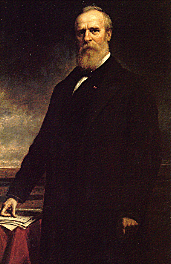
Presidential biography is a long-standing interest of mine. I’ve read more about Theodore Roosevelt than any other historical figure. He would be my favorite in many respects. But I also especially enjoy learning about lesser-known Presidents, like Chester Arthur and Rutherford B. Hayes. Since my Reading Jags often include forays into the arena of Presidential history, I’ll include periodic posts about these jags. This post is dedicated to the nineteenth President of the United States, Rutherford B. Hayes (1822-1893).

Jag for July 23, 2008

Jenny Drapkin posted her blog at http://www.mentalfloss.com today. She acknowledges that Hayes was widely known as a man of integrity. But she attributes considerable responsibility surrounding his controversial election to the man himself. This is probably unfair. Hayes went to bed on the night of the election expecting his opponent to win. His opponent expected the same result. Drapkin recounts a few of the details that determined the somewhat shocking outcome. To say the least, close elections raise special problems.

The Hayes vs. Tilden horse-race was made more complicated by the continued festering of North/South relations. It was still a period of reconstruction, and there were no easy solutions. Who can say what a Tilden presidency would have been like? As it was, the Hayes presidency lasted for only a single term. (The Wikipedia entry on Hayes indicates that Hayes had promised to serve for one term only and had advocated for one-term presidencies of six years. It might be enjoyable to hear a conversation between Rutherford B. Hayes and Franklin Roosevelt on that point—and why not include George Washington, for good measure?)

The White House Biography points out that Hayes, who was from Ohio, sought to establish stronger support for the Republican party in the South. But those with Republican sensibilities considered it too risky to exhibit public sympathy for this effort. (Some will be surprised to learn that Mark Twain campaigned for Hayes, the Republican who wrote in his diary, “the best religion the world has ever had is the religion of Christ.”)

Drapkin’s article comes at an interesting time, in the pre-convention days of the contest between senators John McCain (Republican) and Barack Obama (Democrat). She alludes to “the current political process,” and mentions the “chad debacle of years past,” but she doesn’t explicitly reference the current contestants. Her brief article is a reminder that intrigue has marred presidential politics for a good long while. She suggests that what our generation has witnessed is comparatively benign.

It is useful to sober up on the smelling salts of history when we are in the midst of an election period with so much at stake and such partisan division.

This Is Only a Test


Wanna’ hear hip hop that’s hip to God? And to spiritual discernment, when someone claims a manifestation of the supernatural? Check out the tune called “Test It,” by the group Cross Movement. For the MP3, go here. For the lyrics, go here.

You don’t have to fall for every miracle claim to believe in miracles. You’re not a naturalist—or a deist—if you want to test it. So test it.

If God expects you to believe that a miracle has happened, he will supply the evidence. So test it.

If someone, human or nonhuman, wants to usurp God’s authority, then there will be the illusion of miracles. So test it.

Check out the New Testament and ask this question: “What’s the worst thing that happened to someone who had trouble believing a miracle had happened when it was a genuine miracle?” You’re not a reprobate if you need evidence. So test it.

Something to ponder: “If you believe that Jesus literally rose bodily from the dead, do you need another miracle?”

***

I blogged on July 7, 2008 about an MSNBC article about the Todd Bentley “revival” phenomenon in Lakeland, Florida. I was interviewed for the article, and there were many readers who commented and sent me mail. They were scandalized by my skepticism. Many have watched Bentley on YouTube and happily boarded the bandwagon of non-discriminating miracle mongers. It is possible to be duped. So test it. And test every claim of supernatural revelation and the miraculous. It’s only a test.

Quotations: On Philosophy


“Philosophy doesn’t begin in some abstract realm; the questions that philosophers concern themselves with begin in human experience.” —Charles Johnson, in his interview with Diane Osen for The Book That Changed My Life

Quotations: On Film


“Even the objects in a fictional world are shot through with meaning and philosophical significance.” —Charles Johnson, in his interview with Diane Osen for The Book That Changed My Life

Quotations: On Literature


“Even the objects in a fictional world are shot through with meaning and philosophical significance.” —Charles Johnson, in his interview with Diane Osen for The Book That Changed My Life

“I think that a good work of fiction is comparable to a good work of philosophy. That means it must engage the life of the spirit as well as the life of the intellect. I don’t want the characters to just talk the ideas; I want them grounded in the drama they find themselves in, in the world of action. Philosophy doesn’t begin in some abstract realm; the questions that philosophers concern themselves with begin in human experience.” —Charles Johnson, in his interview with Diane Osen for The Book That Changed My Life

Quotes: On Art


“. . . there is a tremendous social responsibility that comes with any public act we do, and that includes creative acts, as well.” —Charles Johnson, in his interview with Diane Osen for The Book That Changed My Life

“. . . Mozart sits down at the pianoforte/And composes music which had been ready/Before he himself was born in Salzburg.” —From Czeslaw Milosz’s poem, “Creating the World,” in New and Collected Poems, 1931-2001

“Form is an integral part of any art because art affirms order . . . .” —Ted Kooser, The Poetry Home Repair Manual

Doug’s Publications


Books

Book Chapters

Articles in Reference Works

<script type=”text/javascript” src=”http://www.assoc-amazon.com/s/impression-counter?tag=faifilandphi-20&o=1″></script&gt;
<noscript><img src=”http://www.assoc-amazon.com/s/noscript?tag=faifilandphi-20&#8243; alt=”” /></noscript>

Electronic Research Tools


eTurabian

This site simplifies the process of organizing citations for bibliographies and footnotes. eTurabian is a citation generator for printed resources and online and electronic resources based on Kate Turabian’s Manual for Writers. To generate the citation format for a particular source, go to eTurabian and select the link for the kind of source to be cited: book, journal article, magazine article, newspaper article, published music score, thesis or dissertation, website, or blog. The link will bring up a page with fields for entering the required bibliographical details. Fill in each field as appropirate and click on the “Submit” button. (There are two style options to choose from before clicking on “Submit”: Bibliography and Footnotes, and Reference List and Parentheticals.) eTurabian generates the correct format for your source, consistent with the standard Turabian style. For some types of sources (e.g., blogs), the click of another link on that page brings up other style options.

eTurabian has basic and advanced functions. Full performance requires an account. Throughout the eTurabian application there are links to information if a researcher has a question about a feature of the application or an aspect of proper citation. eTurabian also has a service called “Book Citation Express.” This service assists in formatting sources when data from an online library information for that source is cut and pasted into the deignated field in Book Citation Express

Is the New Yorker Obama Cover a Parody of Itself?


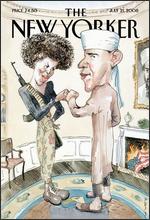
The New Yorker is a high-brow, literary magazine prominently displayed at bookstores everywhere. Its cover art is often eye-catching, a boon to sales, perhaps. But this time the editors at the magazine may have miscalculated. The July 21, 2008 cover features cartoonish renditions of Barack Obama and his wife, Michelle. Barack is portrayed as a stereotypical Muslim and Michelle is decked out in terrorist fatigues and assault weaponry. They seem to be standing in one of America’s iconic centers of political power and they’re doing a fist bump in expression of their solidarity. The American flag is in blazes. Even the afro is portentous.

What’s the message? Well, it’s a parody. That much is clear. A parody, as we all know, is the deliberate exaggeration of something for comic effect. But what does this image parody? The answer to that question lies at the center of a media storm, a controversy that has editors at The New Yorker engaged in feverish damage control.

There are two possibilities. The cover is a parody of Barack Obama’s background and ideology, or it is a parody of popular distortions of Obama’s background and ideology. If it’s the former, it’s an unprecedented expression of affinity for some fringe version of political conservatism and therefore . . . not likely. The New Yorker does not, in general, grandstand for conservative causes. Anyone familiar with the magazine would therefore assume that the cover is a deliberate a parody of popular distortions, mocking the suspicions of Obama’s more radical opponents. But the highbrow subtlety of this issue’s cover art may have backfired by reinforcing those suspicions.

This is what worries the Obama campaign, individual supporters of Obama, and the so-called mainstream media types who regard the cover as a kind of betrayal of liberal values. The cover shocks. That is often the intended effect of parody. The problem for the New Yorker is that this image of the Obamas does not have the right kind of shock value. Superficially, it appears to be an expression of suspicions about Obama, portrayed with exaggeration and comic effect, but with the hint of a genuine warning. Understood in that way, the shock value would be its evocation of fears about who Obama really is, what he really stands for, and where he might lead this nation if he becomes President. But the image isn’t meant to be an expression of suspicion; rather, it’s supposed to be a depiction of unwarranted suspicion. Understood in that way, however, the image itself has almost no shock “value.” What is shocking is that The New Yorker would run the risk of reinforcing a stereotype of Obama that is objectionable to the mainstream media, of which The New Yorker is perceived to be a member in good standing.

To be sure, many media commentators have been shocked by The New Yorker’s choice of artwork. In that respect, the Obama cover has become a parody of itself. And there’s nothing The New Yorker can do about it.